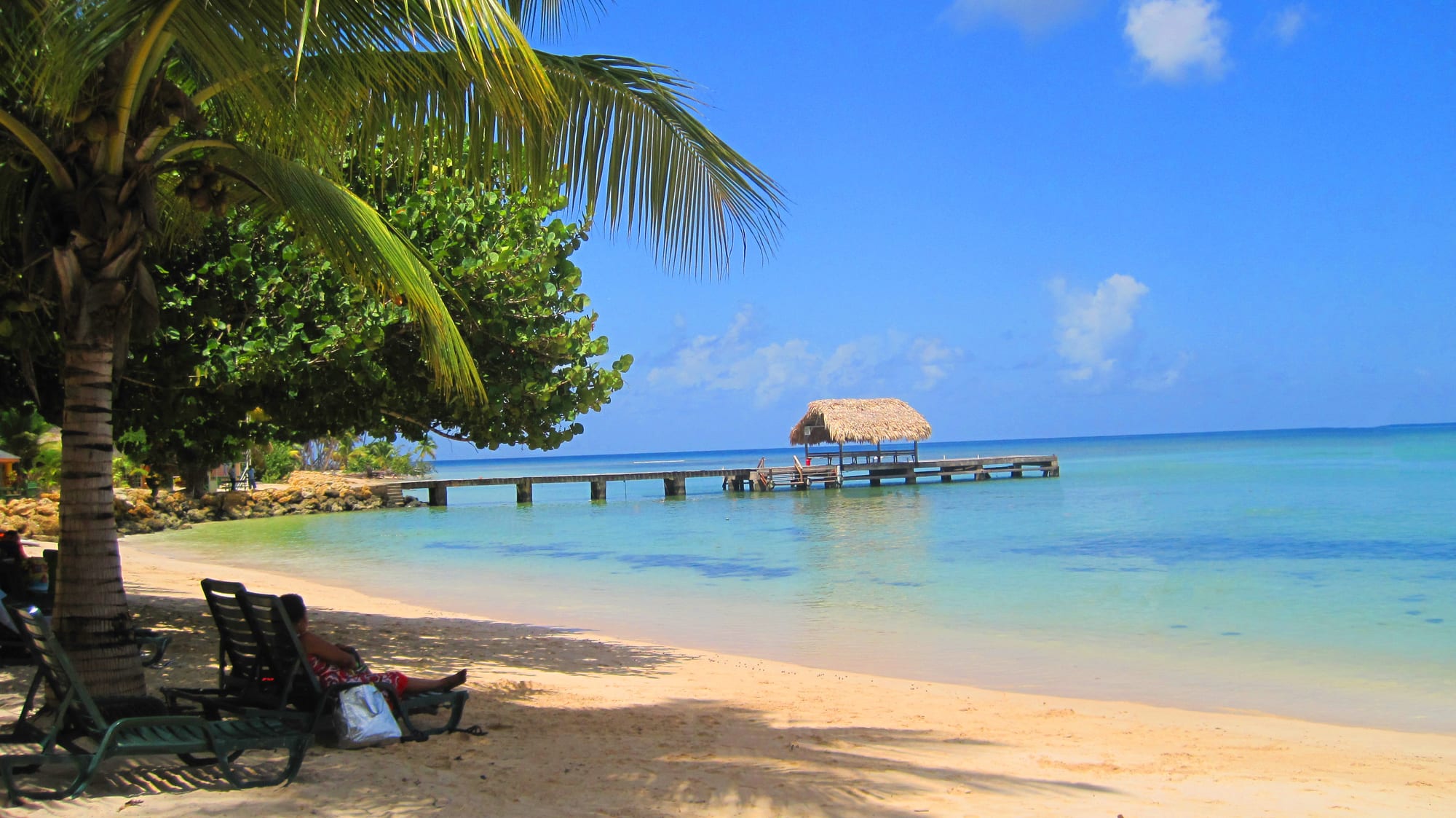
A bright white-sand beach backed by leaning coconut palms beside a calm, clear turquoise sea under a blue sky

Trinidad and Tobago

Pigeon Point on Tobago's southwest coast, near the Buccoo Reef and the Nylon Pool, the island's best-known beach. (Kp93 / Wikimedia Commons · CC BY-SA 3.0)

A twin-island republic just off the coast of Venezuela — Trinidad an industrial, oil-and-gas economy and the birthplace of calypso, soca, and the steelpan; Tobago a quieter tourism island of reefs and rainforest.

Explore Trinidad and Tobago

History

Trinidad was home to Arawak and Carib peoples when Columbus reached it in 1498. Spain held it for three centuries but barely developed it; a late push to attract Catholic planters brought French settlers and enslaved Africans in the 1780s, so that when Britain captured the island in 1797 it was French-speaking and plantation-based. Tobago, meanwhile, changed hands among the Dutch, French, and British more than 30 times before Britain secured it, and the two islands were joined administratively in 1889.

After the abolition of slavery (1834–38), planters brought indentured labourers from British India between 1845 and 1917 — around 150,000 people — to work the sugar estates. Their descendants, the Indo-Trinidadians, now make up a share of the population roughly equal to the Afro-Trinidadians, and this dual heritage shapes the country's culture and politics.

Oil, discovered commercially in 1908, transformed Trinidad into an industrial economy. The islands became independent in 1962, led by the historian Eric Williams, and a republic in 1976. A Black Power uprising and army mutiny shook the country in 1970, and in 1990 a radical Muslim group, the Jamaat al Muslimeen, staged an attempted coup, holding the prime minister and parliament hostage for six days. Politics has largely alternated between parties associated with the two main ethnic communities, against a backdrop of energy booms, busts, and persistent violent crime.

  • Trinidad and Tobago: Oil, Carnival, and Callaloo Two islands off the coast of Venezuela — a Spanish colony repopulated by French planters, a British sugar island worked by enslaved Africans and then indentured Indians, and a petroleum economy whose mixed society invented the steelpan and modern Carnival

Culture & Customs

Trinidad and Tobago is genuinely plural, and its public holidays reflect it: Christmas and Easter, the Hindu festival of Divali, the Muslim commemoration of Hosay, Emancipation Day, and Indian Arrival Day are all national. Christianity, Hinduism, and Islam are the major faiths, alongside Orisha and Spiritual Baptist traditions with African roots.

Carnival is the cultural heartbeat — a pre-Lenten explosion of costumed "mas" bands, calypso and soca competitions, steelpan orchestras battling in the Panorama contest, and the pre-dawn mud-and-paint revelry of J'ouvert. The steelpan, developed in Trinidad in the 1930s–40s from oil drums, is the country's gift to world music, and calypso and its descendant soca are its soundtrack.

"Liming" — hanging out with friends, food, and music, with no particular agenda — is a valued social art. Cricket and, increasingly, football and athletics are followed keenly. Food, banter (picong), and a strong sense of humour are points of national pride.

Daily Life

About 1.4 million people live in Trinidad and Tobago, the great majority on Trinidad, along the western corridor from Port of Spain through Chaguanas to San Fernando. Tobago, with around 60,000 people, is largely rural and tourism- and public-sector-based, and has its own House of Assembly with limited autonomy.

The economy is unusual for the Caribbean in being industrial rather than tourism-led: oil, natural gas, LNG, ammonia, and methanol, centred on the Point Lisas estate and the southwest. This has given relatively high incomes but also exposure to energy-price swings, and gas output has been declining. Recurrent concerns are crime, an influx of Venezuelan migrants across the narrow strait, and diversifying away from hydrocarbons.

Daily life is car-dependent, family- and religion-centred, and punctuated by the long build-up to Carnival, which dominates cultural life for months.

Food

Trinidadian street food is famous. Doubles — two soft fried flatbreads (bara) around curried chickpeas (channa) with tamarind, mango, and pepper sauce — is the national snack, eaten for breakfast on the go. Roti, especially "buss up shut" (paratha) or a dhalpuri wrap filled with curried chicken, goat, duck, or vegetables, is the everyday meal.

Creole cooking brings callaloo (dasheen leaf and okra with coconut), stewed chicken browned with sugar, pelau (rice cooked with pigeon peas and meat), macaroni pie, and crab and dumpling in Tobago. Chinese-Trinidadian and Syrian-Lebanese food are woven in too. "Bake and shark" — fried shark in fried bread with condiments — is the classic beach food at Maracas Bay.

Rum is the national spirit, with Angostura, maker of the world's aromatic bitters, based in Trinidad. Mauby, sorrel (at Christmas), sea moss, and coconut water are the local non-alcoholic drinks, along with Carib and Stag beer.

Attractions & Natural Wonders

Trinidad's northern range, a green wall behind Port of Spain, has rainforest hiking, waterfalls, the Asa Wright Nature Centre for birdwatching, and the beaches of Maracas, Las Cuevas, and the wilder north coast. The Caroni Swamp comes alive at dusk when thousands of scarlet ibis — the national bird — fly in to roost. In the southwest, the Pitch Lake at La Brea is the largest natural asphalt lake in the world, a strange, walkable expanse of tar.

Port of Spain itself has the Queen's Park Savannah, the "Magnificent Seven" colonial mansions, the Botanic Gardens, and, in season, the panyards where steel orchestras rehearse. The east coast has the long Manzanilla and Mayaro beaches and, from March to August, leatherback turtles nesting at Matura and Grande Riviere.

Tobago is the beach-and-reef island: Pigeon Point and its jetty, the Buccoo Reef and the shallow Nylon Pool, the fishing village and Sunday "Sunday School" street party at Buccoo, Englishman's Bay and Castara on the leeward coast, and the Main Ridge Forest Reserve, protected since 1776 and often called the oldest legally protected rainforest in the Western Hemisphere. Little Tobago island is a seabird sanctuary.

Planning basics

Budget

Trinidad and Tobago is a working country more than a resort one, and prices reflect local life rather than tourism. Port of Spain has business hotels and guesthouses; Tobago has small hotels, villas, and guesthouses. Costs spike enormously around Carnival, when accommodation is scarce and expensive months ahead.

Daily Budget Midrange
USD 120–250 (hotel, restaurants, car hire, Tobago reef and rainforest tours)
Daily Budget Shoestring
USD 45–80 (guesthouse, roti and doubles, route taxis and maxi taxis)

Book a year ahead and expect premium prices for Carnival; a rental car is the practical way to explore both islands.

Visa Requirements

Citizens of the UK, EU, US, Canada, and many Commonwealth and other countries enter visa-free for stays of up to 90 days. Others need a visa in advance. A passport valid for six months and an onward ticket are expected.

Typical Stay
Up to 90 days visa-free for most Western passports

Confirm your nationality's visa-free status before booking; carry an onward or return ticket.

Safety

Trinidad has a serious violent-crime problem, with one of the region's higher homicide rates, concentrated in specific parts of Port of Spain (including Laventille, Beetham, and Sea Lots) and linked to gangs and guns; tourists are rarely the target but robberies and carjackings occur. Tobago is much calmer but not crime-free. Petty theft, road conditions, and rip currents on some beaches are the everyday risks.

Health
Dengue and other mosquito-borne illnesses occur; tap water is generally treated in urban areas; the sun is strong

Avoid the named Port of Spain neighbourhoods, don't walk at night or display valuables, keep car doors locked, use arranged or app-based taxis, and check for rip currents before swimming.

Climate

Tropical, hot and humid year-round at around 30°C. The dry season runs January to May, the wet season June to December with heavy afternoon downpours and a "Petit Carême" dry spell around September–October. The islands lie mostly south of the main hurricane belt but are not immune.

Dry Season
January–May
Wet Season
June–December

Transportation

Piarco International Airport near Port of Spain is the main gateway, with A. N. R. Robinson airport on Tobago served by regional flights and a fast inter-island ferry from Port of Spain. On the islands, transport is by route taxi (shared cars on fixed routes), maxi taxi (minibus), and rental car; there is no useful passenger rail.

Rent a car for Tobago and for touring Trinidad outside Port of Spain; use the ferry or the short flight between the islands.

Best Time to Visit

January to May, the dry season, is the most comfortable time and includes Carnival, the country's defining event, held the Monday and Tuesday before Ash Wednesday (February or March). Leatherback turtles nest on Trinidad's north and east coasts from March to August.

Events
Carnival (Feb/Mar) with Panorama, J'ouvert, and the mas bands; Divali; Hosay; Tobago Heritage Festival (July–August); Emancipation Day (1 August); Indian Arrival Day (30 May)

Currency

The currency is the Trinidad and Tobago dollar. Cards are widely accepted in Port of Spain and larger Tobago hotels; cash is needed for street food, route taxis, and small shops. US dollars are useful and sometimes accepted.

Symbol
TT$
Currency Code
TTD — Trinidad and Tobago dollar

Language

English is the official language. Most people speak Trinidadian or Tobagonian English Creole in daily life. Trinidadian Hindustani, French Creole (Patois), and Spanish have historical and residual use, and Spanish is promoted given proximity to Venezuela.

Everyday Speech
Trinidadian / Tobagonian Creole
Official Language
English