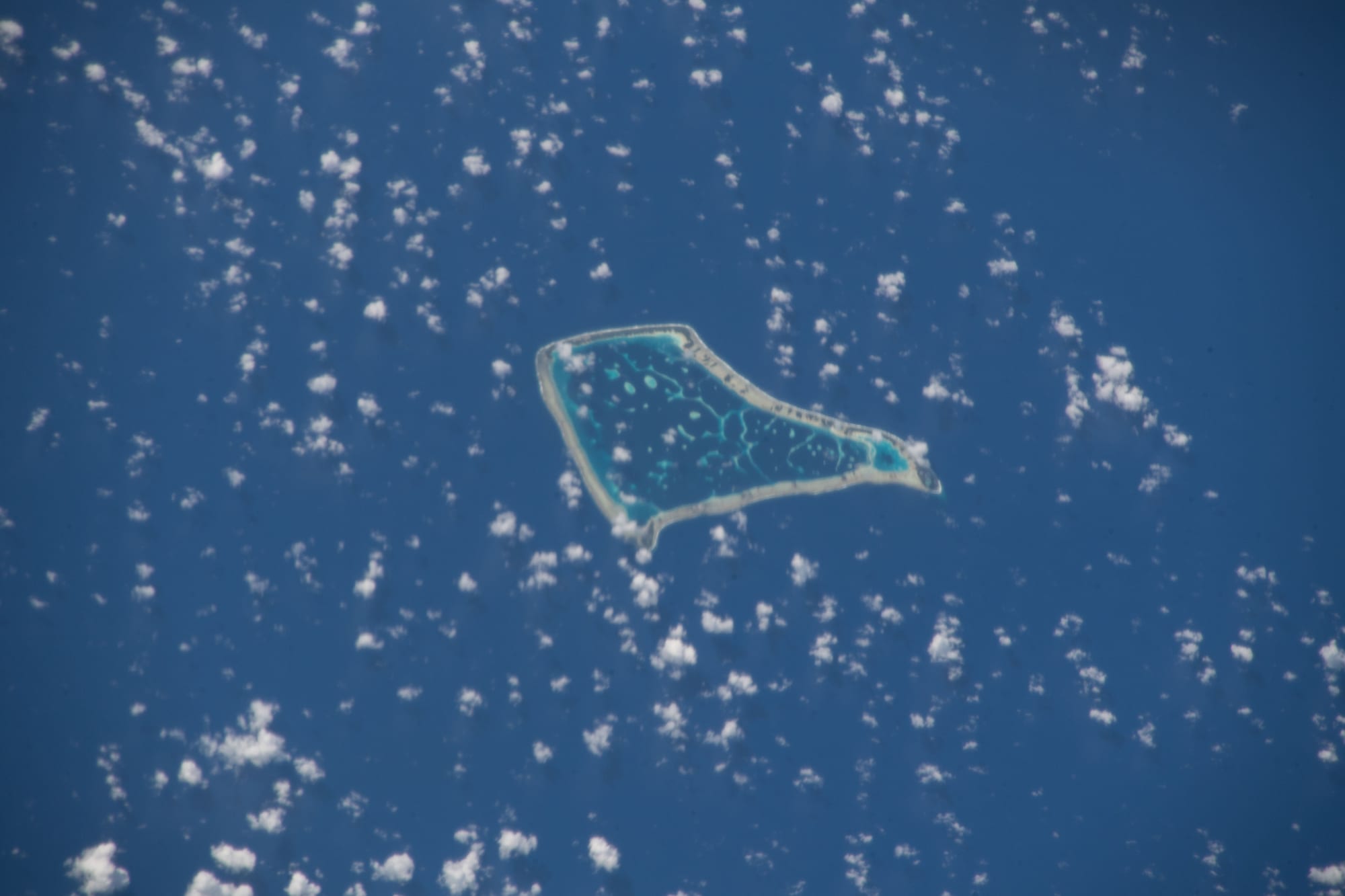
An aerial view of a coral atoll — a thin broken ring of green islets around a pale turquoise lagoon in the open ocean

Tokelau

Fakaofo atoll from the air — a narrow ring of low reef islets around a lagoon, the pattern shared by all three of Tokelau's atolls. (NASA / Wikimedia Commons · Public domain)

Three tiny coral atolls in the South Pacific, a non-self-governing territory of New Zealand — about 1,500 people with no airport, no capital, and no land more than a few metres above the sea, governed by the councils of elders of each village and reached only by a day-and-a-half boat trip from Samoa.

Explore Tokelau

History

Polynesians settled Tokelau perhaps a thousand years ago, with links to Samoa, Tuvalu, and the Cook Islands, and each atoll — Atafu, Nukunonu, and Fakaofo — developed its own village governed by a council of elders, the Taupulega. Commodore Byron sighted Atafu in 1765. Missionaries — Samoan London Missionary Society preachers on Atafu and Fakaofo, French Catholics on Nukunonu — converted the atolls in the 1860s. In 1863 Peruvian slave raiders devastated the population, carrying off most of the able-bodied men, and disease followed.

Tokelau was declared a British protectorate in 1889 and annexed in 1916, administered with the Gilbert and Ellice Islands before being transferred to New Zealand administration in 1926 and formally to New Zealand in the late 1940s. Tokelauans are New Zealand citizens. Referendums on self-government in free association with New Zealand in 2006 and 2007 both fell just short of the two-thirds majority required, so Tokelau remains a non-self-governing territory and stays on the United Nations decolonisation list. Since 2012 the atolls have been powered almost entirely by solar. Sea-level rise is an existential threat.

  • Tokelau: Three Atolls and a Choice Three tiny coral atolls in the South Pacific with no airstrip and no capital — a Polynesian society devastated by 19th-century slavers, administered by New Zealand, and twice offered self-government, which it has twice narrowly declined

Culture & Customs

Tokelau is strongly communal and Christian. The inati system shares the catch and the produce out equally among all families. The Taupulega, the council of elders, governs each village, and the "Ulu-o-Tokelau", the head of government, rotates each year between the three atoll leaders. The Tokelauan language and the fatele — a fast, percussive sitting dance and song, performed as a competition between villages — are central to identity.

Extended families live together, Sunday is for church, and communal work days organise much of village life. A large Tokelauan community in New Zealand, many times the island population, keeps close ties and sends support home.

Daily Life

About 1,500 people live across the three atolls, one village to each. The economy is almost entirely New Zealand budget support and the public service, plus subsistence fishing and coconut, some income from foreign fishing licences and from the ".tk" internet domain and postage stamps. There are no hotels; visitors stay with families by arrangement. Each atoll has a school, a health clinic, a store, and a small administration.

The ring of islets around each lagoon is low, narrow, and crowded, and king tides regularly wash across the land — the reason climate change is not an abstract issue here.

Food

Fish is the mainstay — tuna and reef fish, shared through the inati — along with coconut in every form, and swamp taro (pulaka) and breadfruit where they grow. Pork and chicken are feast food. Imported rice, flour, and tinned goods from the supply ship fill out the diet. Local dishes include faikai, cooked in coconut cream, and takihi, pawpaw and pulaka baked in coconut cream.

Attractions & Natural Wonders

There is essentially no tourism — Tokelau receives only a handful of visitors a year, most with family or official connections. The experience is the atoll itself: the lagoon and its reef for snorkelling and fishing, the fatele evenings, the historic churches including the coral-stone church on Nukunonu, the islet of Fenua Fala off Fakaofo, and the sheer remoteness of the place. Any visit must be arranged in advance through the Tokelau administration in Apia, including transport, a host family, and permission from the Taupulega.

  • Tokelau: Four Attractions and Natural Wonders Three tiny coral atolls scattered across the Pacific, reached only by a day-long boat journey from Samoa, where village life still runs almost entirely on communal, consensus-based decision-making

Planning basics

Budget

There is no commercial accommodation. Visitors pay a daily rate to a host family and for the boat passage, and everything must be arranged in advance through the Tokelau administration in Apia, Samoa. The cost and difficulty are almost entirely the transport.

Daily Budget Note
A modest host-family rate plus the chartered-vessel fare from Samoa; little else to spend on

Start with the Office for the Council for the Ongoing Government of Tokelau in Apia months ahead; independent arrival is not possible.

Visa Requirements

Tokelau has its own entry permit, obtained in advance from the Tokelau administration in Apia. You need a confirmed host, a confirmed berth on the vessel both ways, sufficient funds, and insurance. Even New Zealand citizens need Tokelau's permission to visit. There is no visa on arrival and no independent tourism.

Typical Stay
Tied to the fortnightly boat schedule — commonly one or two weeks

Nothing about a Tokelau visit can be improvised; the permit, the host, and both boat legs must be locked in before you leave Samoa.

Safety

Socially, Tokelau is extremely safe, with no crime to speak of. The risks are the sea crossing and the reef landings, the heat, and the isolation: each atoll has only a basic clinic, and a serious case means waiting for the ship or a medical evacuation to Samoa. Respect for the councils of elders, Sunday observance, and modest dress are expected.

Health
No malaria; the concern is that the nearest hospital is a day-and-a-half away by sea

Follow your host family's guidance, keep Sunday quiet, take care on the reef and in boats, and carry insurance covering evacuation to Samoa.

Climate

Tropical, hot and humid year-round at around 28–30°C, with little seasonal change. It is somewhat wetter from April to October and drier from November to March. Cyclones are infrequent this close to the equator but not unknown, and storm surges and king tides are a growing hazard on land only a few metres above the sea.

Wetter
April–October
Year Round
Hot and humid, 28–30°C

Transportation

There is no airport. Access is by the chartered vessel from Apia, Samoa — about 24 to 36 hours each way to the nearest atoll, longer to reach all three — sailing roughly fortnightly. Between atolls, the same ship or small boats are used, and landing is by dinghy through the reef passage, depending on the swell. On land, each village is walkable end to end.

Book a passenger berth on the Tokelau vessel through the Apia office; expect the schedule to shift with weather and mechanical issues.

Best Time to Visit

The boat schedule from Samoa — roughly every two weeks, subject to weather and maintenance — governs everything. November to March is marginally drier.

Events
Tokelau Day; the fatele song-and-dance competitions between villages; church and family gatherings

Currency

The New Zealand dollar. It is a cash economy — bring New Zealand dollars from Samoa, as there are no banks or ATMs on the atolls.

Symbol
$
Currency Code
NZD — New Zealand dollar

Language

Tokelauan, a Polynesian language close to Tuvaluan and Samoan, is the everyday language. English is taught and used in administration, and Samoan is widely understood.

Also Used
English (administration); Samoan widely understood
Everyday Language
Tokelauan