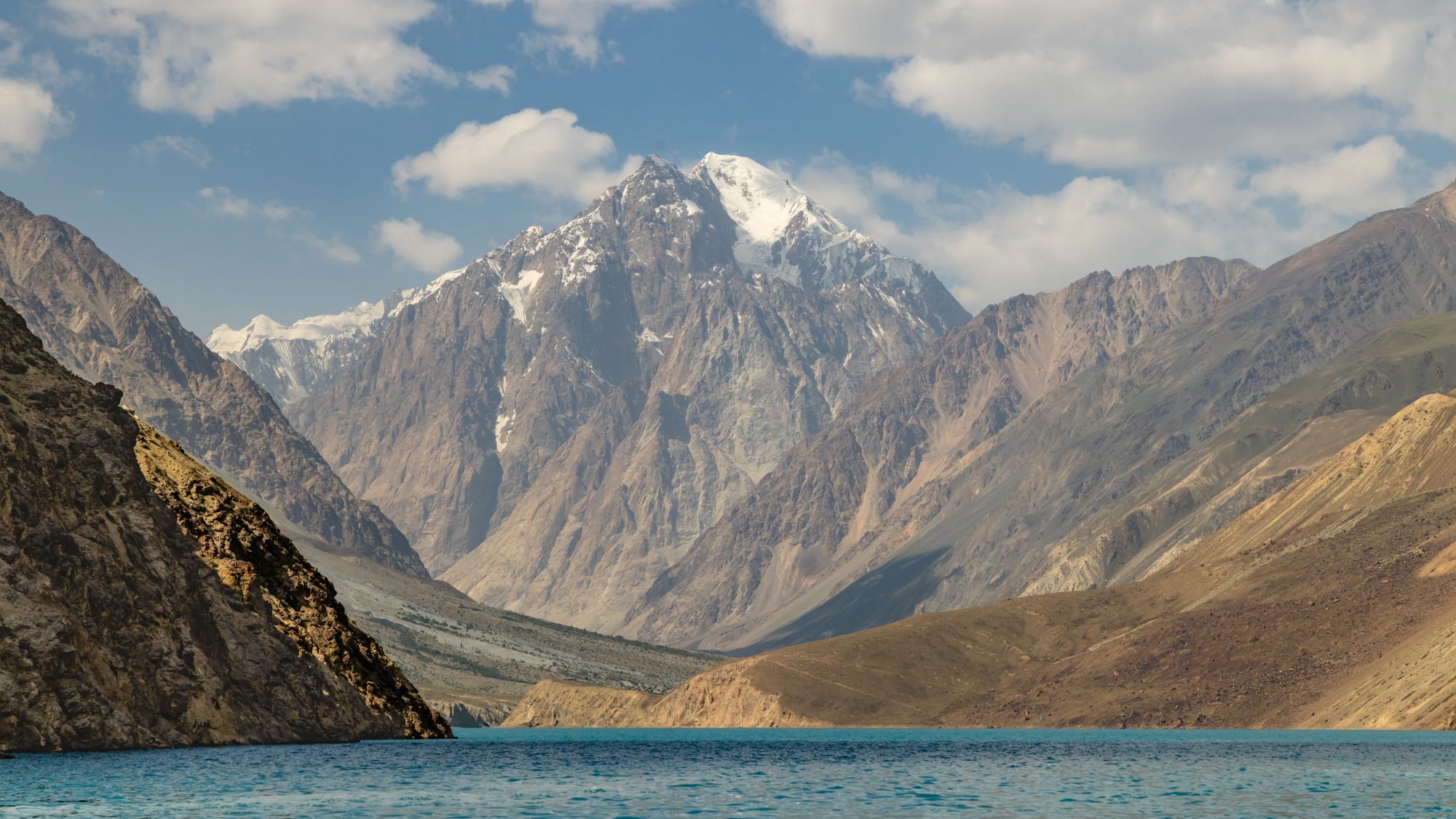
A sharp snow-capped peak rising above bare brown and ochre mountain slopes that drop into a bright turquoise lake, under a blue sky with white clouds

Tajikistan

Lake Sarez, a protected area in the mountains of Tajikistan, with a snow-capped peak rising above its turquoise water. (Marat Nadjibaev / Wikimedia Commons · CC BY-SA 4.0)

A small, overwhelmingly mountainous country in Central Asia — Persian-speaking, the poorest of the former Soviet republics, scarred by a 1990s civil war, and now a magnet for adventurous travellers drawn to the Pamir Highway and the "Roof of the World".

Explore Tajikistan

History

The Tajiks are the Persian-speaking people of Central Asia, heirs to the Samanid Empire of the ninth and tenth centuries, centred on Bukhara and Samarkand — cities now in Uzbekistan — during a golden age of Persian literature and science. Over later centuries the region was ruled by Turkic and Mongol dynasties and, by the nineteenth century, the Emirate of Bukhara, before the Russian Empire pushed in.

The Soviets created the Tajik Soviet Socialist Republic in 1929, drawing borders that left the great Tajik cultural centres outside it and gave the new republic a mountainous, landlocked territory with a weak economy. Moscow built cotton irrigation, aluminium smelting, and hydropower, and settled the lowlands.

Independence in 1991 was followed almost immediately by a civil war (1992–97) between the government and an opposition of Islamists and democrats, with strong regional dimensions; it killed tens of thousands and displaced far more. Emomali Rahmon emerged as leader in 1994 and has ruled ever since, tightening control, sidelining the Islamic party, and grooming his son to succeed him. The economy leans heavily on remittances from the roughly one to two million Tajiks working in Russia, and on the giant Rogun Dam project on the Vakhsh River.

  • Tajikistan: The Mountain Republic The only Persian-speaking country of former Soviet Central Asia — a Samanid heartland reduced to a remote Soviet borderland, plunged into a five-year civil war at independence, and ruled ever since by one man

Culture & Customs

Tajik culture is Persianate: the language, the poetry of Rudaki, Hafez, and Ferdowsi, the celebration of Nowruz, and cuisine and courtesy shared with Iran and Afghanistan. Most Tajiks are Sunni Muslim, but the people of the Pamirs are Ismaili, followers of the Aga Khan, whose foundations have funded much of the region's development.

Hospitality is central and elaborate — a guest is seated at the place of honour on the korpacha cushions around a low table, plied with tea, bread, and fruit, and pressed to eat. Bread (non) is treated with respect and never placed upside down or thrown away. Elders are deferred to, and life-cycle events — weddings, circumcisions, funerals — are large communal affairs, so large that the government has legislated to limit their scale and cost.

Regional identity remains strong, a legacy of the civil war, and the state promotes a national narrative rooted in the Samanids and an "Aryan" heritage.

Daily Life

About 10 million people live in Tajikistan, the youngest population in Central Asia and still mostly rural. Agriculture — cotton, wheat, fruit, and livestock — employs much of the workforce, but the defining economic fact is labour migration: remittances have at times equalled close to half of GDP, and many villages are largely populated by women, children, and the elderly for much of the year.

Dushanbe, the capital, has been rebuilt with wide avenues, monuments, and one of the world's tallest flagpoles; Khujand in the north is the second city and more tied to the Fergana Valley. Electricity is rationed in winter in much of the country outside the capital. Poverty is widespread, and public services are thin.

In the Pamirs, life is high, cold, and remote, sustained by small irrigated plots, livestock, remittances, and Aga Khan-supported schools and clinics.

Food

Tajik cooking is close to the wider Central Asian and Persian table. The national dish is osh (or palov), rice cooked with carrots, onion, and mutton in a heavy cauldron, served from a communal platter. Qurutob — torn flaky bread soaked in a sauce of qurut (dried salted yoghurt) and topped with fried onions and herbs — is a distinctively Tajik dish.

Soups are important: shurbo, a clear mutton-and-vegetable broth, and laghmon, hand-pulled noodles in a spiced meat-and-vegetable soup. Skewered grilled meat (shashlik), manti (steamed dumplings), sambusa (samosas baked in a tandoor), and flatbread round out most meals.

Green tea is the constant social drink, poured and re-poured. Fruit is exceptional — apricots, mulberries, melons, pomegranates, and grapes — much of it dried for winter, and walnuts are a Pamir staple.

Attractions & Natural Wonders

The Pamir Highway (the M41) is the country's headline: one of the highest roads in the world, running from Dushanbe through the Gunt valley to Khorog and across the high, empty eastern plateau past Lake Karakul to the Kyrgyz border, with the Wakhan Corridor branching off along the Panj River within sight of Afghanistan's peaks and, beyond them, the Hindu Kush.

The Fann Mountains, between Dushanbe and Samarkand, offer accessible trekking among turquoise lakes — Iskanderkul, the Seven Lakes (Haft Kul) of the Marguzor valley, and Alaudin — with homestays in the villages. The Pamirs proper hold Tajikistan's highest summits, including Ismoil Somoni Peak at 7,495 metres, and the vast Fedchenko Glacier.

In the cities, Dushanbe has the National Museum with the reclining Buddha of Ajina Tepa and the Ismaili Centre; Khujand has a restored fortress and a huge bazaar; and the Hisor fortress and the Sarazm archaeological site near Penjikent — a 5,000-year-old proto-urban settlement and a UNESCO site — reach far back into the region's past.

  • Tajikistan: Six Attractions and Natural Wonders One of the highest and most remote roads on earth, a narrow corridor of villages squeezed between three towering mountain ranges, and a lake said in local legend to have been created by Alexander the Great

Planning basics

Budget

Tajikistan is inexpensive once you arrive, though the Pamirs push costs up: shared 4x4 transport along the highway, homestays, and fuel are the main expenses, and there is little in the way of hotels outside Dushanbe and Khujand. Homestays in the Pamirs run on a simple fixed nightly rate with meals.

Daily Budget Midrange
USD 60–130 (hotel in the cities, a chartered 4x4 with driver for the Pamir Highway, guided treks)
Daily Budget Shoestring
USD 25–45 (homestays and guesthouses, bazaar food, shared transport)

For the Pamir Highway, share a hired 4x4 with other travellers and carry enough cash — there are no ATMs for days at a time.

Visa Requirements

Most nationalities need a visa, available as a straightforward e-visa online. Travel to the Gorno-Badakhshan Autonomous Region (GBAO), which covers the entire Pamir area, requires an additional GBAO permit, usually added to the e-visa application for a small fee.

Typical Validity
e-visa up to 60 days; add the GBAO permit for the Pamirs

Apply for the e-visa and the GBAO permit together, well before travel, and print both.

Safety

Tajikistan is generally calm for travellers, but there are real concerns: the border regions with Afghanistan and with Kyrgyzstan have seen clashes (serious fighting between Tajik and Kyrgyz forces in 2021 and 2022), the Pamirs have had periods of unrest and heavy security, and roads are hazardous. Petty crime is low. Altitude sickness is a risk on the Pamir plateau.

Health
Altitude sickness above 3,000 m; limited medical care outside Dushanbe; water should be treated

Check the current situation in GBAO and along the Kyrgyz border before travel, acclimatise slowly to altitude, and carry comprehensive insurance with evacuation cover.

Climate

Continental and dominated by altitude. Lowland Dushanbe and Khujand have hot summers and mild winters; the mountains are cool in summer and bitterly cold in winter, when the Pamir Highway passes can close with snow. The eastern Pamir plateau is high, dry, and cold year-round.

Lowlands
Hot summers, mild winters
Mountains
Short cool summer; long severe winter, passes may close

Transportation

Dushanbe has the main international airport, with Khujand also served. There is no useful passenger rail. Travel is by shared taxi and minibus (marshrutka) between towns and, for the Pamirs, by hired or shared 4x4 along rough roads. Journeys are long and slow, and landslides and washouts are common.

Budget far more time than the distances suggest, and treat the Pamir Highway as a multi-day expedition, not a drive.

Best Time to Visit

July to September is the window for the Pamir Highway, high-altitude trekking, and mountain passes free of snow. June and October are marginal. The lower cities are pleasant in spring (April–May) and autumn.

Events
Nowruz (spring equinox, the biggest holiday); the Roof of the World festival in Khorog (July); Independence Day (9 September)

Currency

The currency is the somoni. It is a cash economy outside Dushanbe; ATMs exist in the cities and a few larger towns but are unreliable, and rural areas including the Pamirs are entirely cash-only. Bring US dollars to change.

Symbol
SM
Currency Code
TJS — somoni

Language

Tajik, a variety of Persian written in Cyrillic script, is the state language. Russian is widely used in government, business, and the cities. In the Pamirs, several distinct Eastern Iranian languages are spoken, and Uzbek is common in the north and around Bukhara-influenced areas.

Lingua Franca
Russian
State Language
Tajik (Persian in Cyrillic script)