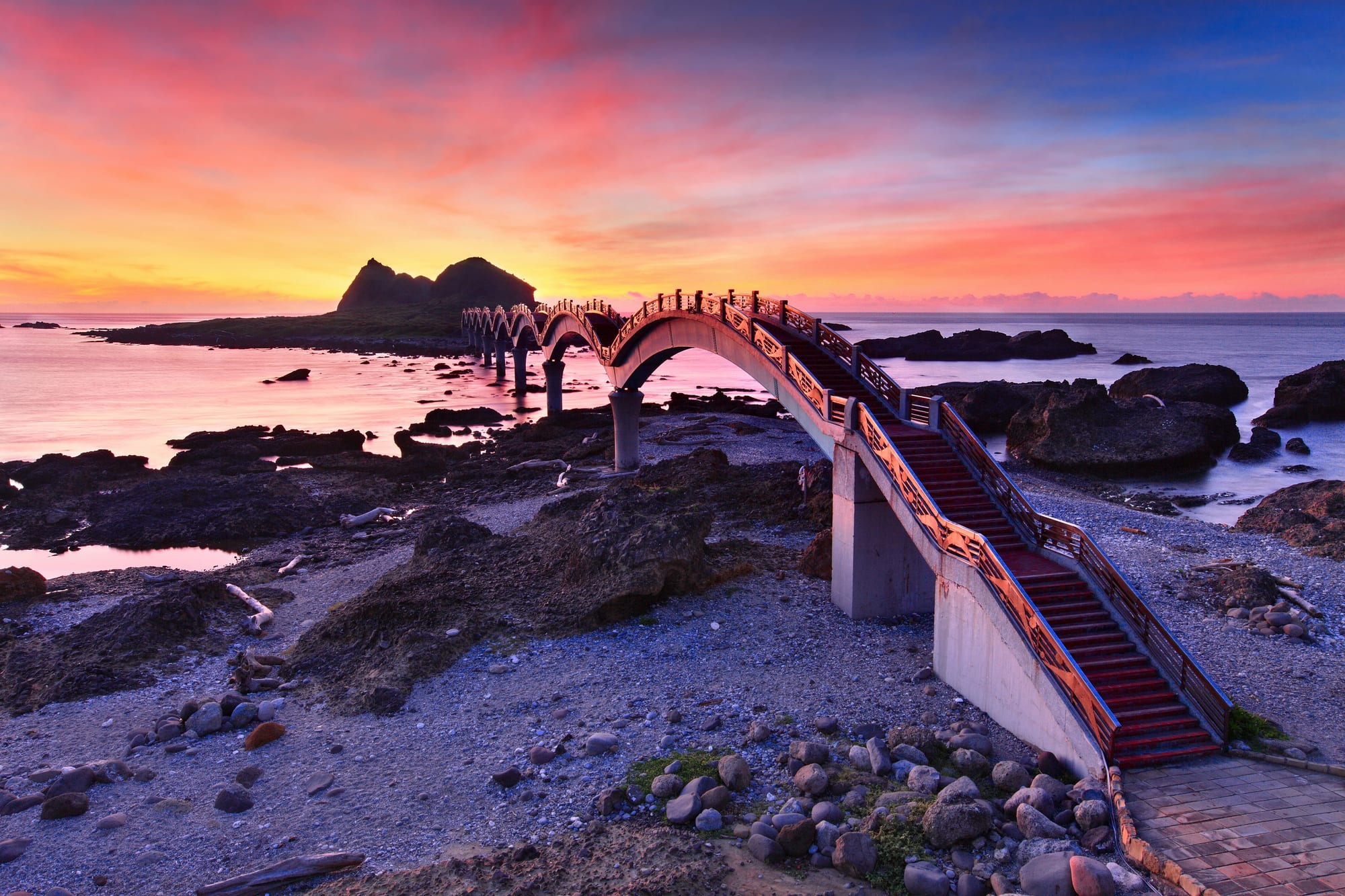
A long footbridge of humped arches crossing a rocky shore to a small craggy island, under a dawn sky streaked with pink, orange and deep blue

Taiwan

Sunrise at Sanxiantai on the Taitung coast, where a many-arched footbridge crosses the rocky shore to a small offshore island. (East Coast National Scenic Area Administration / Wikimedia Commons · CC BY 4.0)

A mountainous island off the coast of China, governed since 1949 by the Republic of China — a vibrant democracy and high-tech economy of 23 million people, claimed by Beijing as a province and recognised as a state by only a handful of governments.

Explore Taiwan

History

Taiwan's original inhabitants are Austronesian peoples, and the island is thought to be the homeland from which Austronesian languages spread across the Pacific and Indian Oceans. Large-scale Han Chinese settlement began in the seventeenth century, when the Dutch ran a trading colony in the south and were then expelled by the Ming loyalist Koxinga; the Qing dynasty annexed the island in 1683 and governed its western plains while Indigenous peoples held the mountains.

In 1895 Qing China ceded Taiwan to Japan, which ruled it for fifty years, building railways, schools, and industry while suppressing dissent. Japan's defeat in 1945 handed Taiwan to the Republic of China. Resentment of the incoming Nationalist (Kuomintang) administration exploded in the 228 Incident of 1947, violently crushed, and in 1949 the Nationalist government and around two million supporters retreated to Taiwan after losing the Chinese Civil War to the Communists, who founded the People's Republic on the mainland.

Chiang Kai-shek's government ruled Taiwan under martial law until 1987 — the long "White Terror" — while the "Taiwan Miracle" turned the island into an export economy. Democratisation followed rapidly: the first direct presidential election was in 1996, and power has since alternated between the KMT and the Democratic Progressive Party. Beijing continues to claim Taiwan and has never renounced the use of force; most countries, following a "One China" policy, maintain unofficial ties with Taipei rather than formal recognition.

  • Taiwan: The Island and the Republic An Austronesian island colonised by the Dutch, the Chinese and the Japanese in turn — the refuge of the defeated Republic of China in 1949, transformed from a one-party state into a vigorous democracy, and now the most dangerous flashpoint between the United States and China

Culture & Customs

Taiwanese culture is rooted in southern Chinese (Hokkien and Hakka) traditions, layered with fifty years of Japanese influence, the mainland heritage brought in 1949, and a growing emphasis on a distinct Taiwanese and Indigenous identity. Folk religion is everywhere — thousands of temples to Mazu (goddess of the sea), Guan Gong, and local deities, with processions, spirit mediums, and burning of paper offerings — alongside Buddhism, Daoism, and Christian minorities.

The society is generally seen as friendly, orderly, and helpful to visitors, with a strong civic culture (reflected in effective disaster response and, famously, recycling and rubbish-truck routines). Family obligation, respect for elders, and education remain important, and Ghost Month in late summer brings widespread observances.

Sixteen officially recognised Indigenous peoples, about two per cent of the population, maintain their own languages, festivals, weaving, and music, particularly in the eastern and mountain regions.

Daily Life

About 23 million people live on Taiwan, most on the flat, developed western plain, with Taipei, Taichung, Tainan, and Kaohsiung the main cities and the mountainous east far less populated. It is a wealthy, highly educated society with universal health insurance, dense public transport, and near-total connectivity.

The economy is dominated by technology manufacturing, above all semiconductors — TSMC alone makes a large share of the world's most advanced chips, giving Taiwan outsized global importance. Long working hours, a very low birth rate, and high housing costs in Taipei are pressing concerns, as is the constant background of cross-strait tension and Chinese military pressure.

Everyday life mixes the high-tech and the traditional: temple visits and convenience stores on the same block, scooters swarming past night markets, and mountains and beaches within easy reach of the cities.

Food

Taiwan is one of Asia's great eating destinations, and the night market is its stage: beef noodle soup (a candidate for national dish), gua bao (pork-belly buns), oyster omelette, stinky tofu, braised pork rice (lu rou fan), pepper buns, scallion pancakes, and shaved-ice mountains topped with fruit and syrup. Bubble tea (boba) was invented in Taichung in the 1980s.

Regional and heritage strands run deep: Hakka stir-fries and preserved vegetables, Indigenous mountain foods, Japanese-influenced bento and seafood, and the mainland regional cuisines that arrived in 1949, with Din Tai Fung's soup dumplings now a global export. Breakfast shops serve soy milk, shao bing, fried dough sticks, and rice rolls.

Tea is central — high-mountain oolong, Tieguanyin, and the ritual of gongfu brewing — and Taiwan also makes respected craft beer, whisky (Kavalan), and rice wine used in cooking.

Attractions & Natural Wonders

Taipei combines the 508-metre Taipei 101 tower, the vast collection of Chinese imperial art at the National Palace Museum, the night markets of Shilin and Raohe, the hot-spring valley of Beitou, and the tea terraces and gondola of Maokong. Just outside are the volcanic Yangmingshan National Park and the coastal rock formations of Yehliu, the old gold-mining town of Jiufen, and the sky lanterns of Pingxi.

The east is the scenic heart: Taroko Gorge, a marble canyon with cliff-hugging trails (partly closed after the 2024 earthquake), the rift valley and Pacific cliffs down to Taitung, and whale- and dolphin-watching off Hualien. The mountainous spine holds Yushan, at 3,952 metres the highest peak in Northeast Asia, plus Alishan with its sunrise railway and cloud seas, and Sun Moon Lake in the centre.

The south has the old capital Tainan, dense with temples and history, the port city of Kaohsiung with its redeveloped harbour and the Fo Guang Shan monastery, and Kenting National Park's beaches at the island's tip. Offshore, Penghu, Green Island, Orchid Island, and the frontline Kinmen and Matsu islands each have a distinct character.

  • Taiwan: Ten Attractions and Natural Wonders A skyscraper engineered to sway safely through typhoons and earthquakes, a marble-walled gorge carved by one of the island's wildest rivers, and a mountain town still lit by red lanterns after dark

Planning basics

Budget

Taiwan is good value. Night-market meals, an excellent metro and rail system, and clean budget hotels and hostels keep costs low; the high-speed train and Taipei hotels are where they rise. Many temples, trails, and museums are free or very cheap.

Daily Budget Midrange
USD 90–170 (mid-range hotel, restaurant meals, high-speed rail, paid sights)
Daily Budget Shoestring
USD 35–60 (hostel, night-market and convenience-store food, metro and local trains)

Get an EasyCard for transport and convenience stores, and eat at night markets and biandang (lunchbox) shops.

Visa Requirements

Citizens of the UK, EU, US, Canada, Australia, New Zealand, Japan, and many others enter visa-free for 90 days; some nationalities get 14 or 30, and others need a visa or the online eVisa. A passport valid for the length of stay is enough for most visa-free visitors.

Typical Stay
90 days visa-free for most Western passports

Check your nationality's exact visa-free period; extensions are possible for some through the immigration agency.

Safety

Taiwan is one of Asia's safest places, with very low violent crime and a strong culture of helping lost visitors. The genuine hazards are natural: earthquakes (a major one struck near Hualien in April 2024), typhoons and the flooding and landslides they bring, and mountain weather. Traffic, especially scooters, calls for care as a pedestrian.

Health
Tap water is safe once boiled; summer heat and humidity are intense; excellent, affordable hospitals

Know your building's earthquake drill, monitor typhoon warnings in summer (which can close transport and trails), and take care crossing roads.

Climate

Subtropical in the north, tropical in the south, with high mountains that can see snow. Summers (June–September) are hot, humid, and the season for typhoons and heavy rain; winters are mild in the south but cool, grey, and drizzly in Taipei. The east coast and mountains get the most rain.

Summer
Hot, humid, typhoon season Jun–Sep
Winter
Mild south; cool, damp north

Transportation

Taoyuan is the main international airport, with Taipei Songshan and Kaohsiung also served. The High Speed Rail runs down the west coast, linking Taipei to Kaohsiung in about 90 minutes; conventional trains loop the whole island, including the scenic east coast. Taipei, Kaohsiung, Taichung, and Taoyuan have metros; buses and the YouBike share scheme fill in.

Use the HSR for west-coast distances and the regular TRA train for the east coast; a scooter or car helps only for remote mountain and coastal routes.

Best Time to Visit

October to December and March to April are the most comfortable — warm, drier, and outside the typhoon season. Spring brings cherry and tung blossom; autumn is clear in the mountains. Avoid the Lunar New Year week, when transport and sights are packed and many businesses close.

Events
Lunar New Year (Jan/Feb); Lantern Festival and the Pingxi sky lanterns; Dragon Boat Festival (June); Ghost Month (August); Mid-Autumn Festival; Double Ten national day (10 October)

Currency

The currency is the New Taiwan dollar. Cards are accepted in cities and chains, but cash is still expected at night markets, small eateries, and rural shops. Convenience-store ATMs are everywhere and reliable.

Symbol
NT$
Currency Code
TWD — New Taiwan dollar

Language

Mandarin Chinese is the official language and the medium of education, using traditional characters. Taiwanese Hokkien (Taiwanese) is widely spoken, especially in the south and among older people, along with Hakka and the Austronesian languages of the Indigenous peoples. English is taught but everyday fluency is limited outside tourism.

Widely Spoken
Taiwanese Hokkien, Hakka, Indigenous languages
Official Language
Mandarin Chinese (traditional characters)