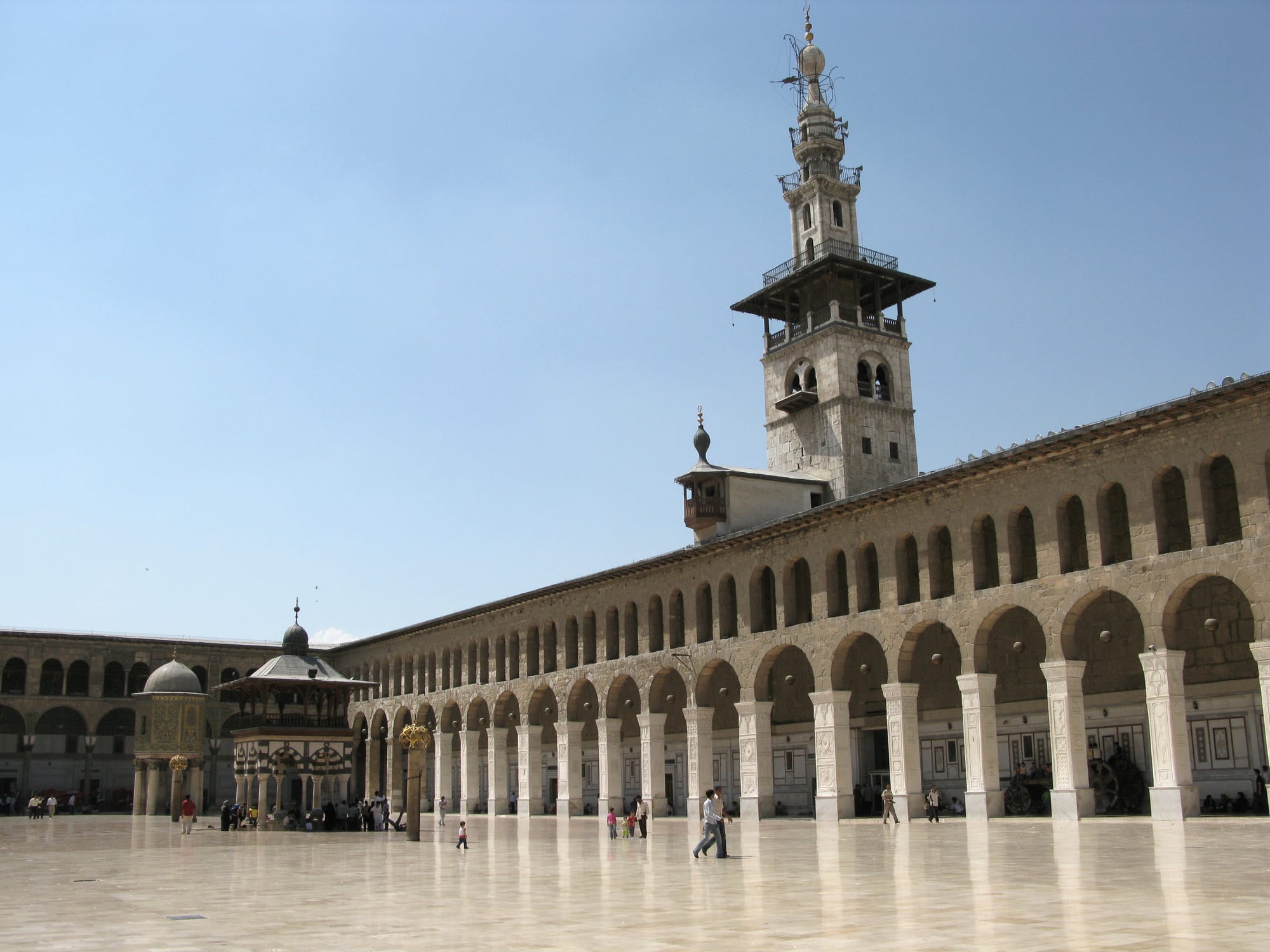
A vast paved courtyard flanked by an arcaded prayer hall with gold mosaic panels, a domed treasury on columns to one side

Syria

The courtyard of the Umayyad Mosque in the old city of Damascus, built in the early 8th century on a site sacred in turn to Aramaeans, Romans, and Christians. (Vyacheslav Argenberg / Wikimedia Commons · CC BY 4.0)

An ancient country at the crossroads of the Levant — home to some of the world's oldest cities and finest ruins — devastated by a civil war that began in 2011, and now in a fragile transition after the fall of the Assad family's 54-year rule in December 2024. This page is written to explain the country, not to encourage travel to it — most governments still advise against all or most travel.

Explore Syria

History

Syria is one of the oldest inhabited regions on Earth. Damascus and Aleppo vie for the title of longest continuously occupied city; Ebla, Mari, and Ugarit were Bronze Age powers, and Ugarit produced one of the first alphabets. The land passed through Aramean, Assyrian, Persian, Greek, and Roman hands — Palmyra grew rich as a caravan city and briefly rebelled under Queen Zenobia — and became an early centre of Christianity.

The Muslim conquest of the 630s made Damascus the capital of the Umayyad Caliphate, the first great Islamic empire, whose Great Mosque still stands. Later came the Abbasids, the Crusader states on the coast, Saladin, the Mamluks, and from 1516 four centuries of Ottoman rule. After the First World War, France governed Syria under a League of Nations mandate, drawing borders and favouring minorities in ways that shaped later politics.

Syria became fully independent in 1946 and then unstable, with repeated coups and a brief union with Egypt. The Baʿath Party seized power in 1963, and Hafez al-Assad, from the Alawite minority, took control in 1970, building a security state that his son Bashar inherited in 2000. Peaceful protests in 2011, part of the Arab Spring, were met with force and spiralled into a civil war drawing in ISIS, Kurdish forces, Turkey, Iran, Russia, the United States, and Gulf states. Hundreds of thousands were killed, half the population displaced, and cities like Aleppo and Homs shattered. In December 2024 a rebel offensive took Damascus, Bashar al-Assad fled to Russia, and a transitional government began the uncertain task of rebuilding.

  • Syria: The Crossroads of the Levant One of the oldest continuously inhabited lands on Earth — heart of empires and caliphates, carved into a French mandate, ruled for half a century by one family, and shattered by a civil war that ended only with the regime's sudden fall in 2024

Culture & Customs

Syria is religiously and ethnically diverse: a Sunni Arab majority alongside Alawites, Christians of many churches, Druze, Ismailis, and Twelver Shia, and ethnic Kurds, Armenians, Assyrians, Turkmen, and Circassians. Cities like Damascus and Aleppo historically wove these communities together in shared quarters, markets, and trades — a coexistence badly strained by the war.

Hospitality is a defining value: guests are pressed with coffee, tea, and food, and refusing outright can cause offence. Family and clan networks are central, respect for elders is expected, and modest dress is the norm, more strictly in conservative and rural areas. Religious festivals — the two Eids, Ramadan evenings, Easter — punctuate the year for their respective communities.

Syria has a deep tradition in poetry, music (the muwashshah and the Aleppo qudud), calligraphy, brocade weaving, inlaid woodwork, and soap-making, and Syrians take pride in a cultural heritage far older than the modern state.

Daily Life

Before the war, around 21 million people lived in Syria; years of conflict have displaced more than half of them, with millions abroad as refugees — chiefly in Turkey, Lebanon, and Jordan — and millions more uprooted inside the country. Some have begun returning since 2024, to homes and neighbourhoods often in ruins.

The economy has collapsed. The currency is a fraction of its former value, sanctions cut Syria off from the banking system, and there are chronic shortages of fuel, electricity, bread, and medicine. Much of the population relies on remittances and humanitarian aid, and reconstruction needs are measured in hundreds of billions of dollars.

Daily life in the more stable areas has meant coping — queuing for subsidised bread and fuel, rationed power, disrupted schooling, and navigating checkpoints — against a backdrop of cautious hope, and considerable uncertainty, about the transition.

Food

Syrian cuisine is a high point of the eastern Mediterranean table. Aleppo in particular is famed for its food — muhammara (walnut and red-pepper dip), kibbeh in dozens of forms, cherry kebab (kebab karaz), and liberal use of Aleppo pepper. Meze spreads of hummus, baba ghanoush, fattoush, tabbouleh, muhammara, stuffed vine leaves, and pickles open a proper meal.

Mains include grilled meats, shawarma, freekeh (roasted green wheat) with chicken, yalanji, maqluba-style layered rice dishes, and slow-cooked stews (yakhne). Flatbread is eaten with everything, and fatteh — bread, chickpeas, yoghurt, and ghee — is a classic breakfast.

Sweets are a Damascus speciality: baklava, barazek sesame biscuits, halawet el-jibn, and booza, the stretchy pounded ice cream. Bitter cardamom coffee, sweet tea, and — before restrictions — arak, the aniseed spirit, accompany gatherings.

  • Syria: Food and the National Dish Bulgur and minced meat shaped and fried, cooked in dozens of regional forms across a country with one of the region's oldest culinary traditions

Attractions & Natural Wonders

Syria's cultural sites are extraordinary and, in several cases, war-damaged. The UNESCO-listed ancient cities of Damascus and Aleppo — the Umayyad Mosque, the covered souqs, the citadels — remain the heart of any visit, though Aleppo's souq and Great Mosque minaret suffered heavily. Krak des Chevaliers, the best-preserved Crusader castle anywhere, came through relatively intact.

Palmyra, the desert caravan city, was deliberately dynamited by ISIS in 2015–16, which destroyed the Temple of Bel, the monumental arch, and tower tombs; much of the colonnade and theatre still stand, and stabilisation work has begun. The "Dead Cities" — hundreds of abandoned Byzantine settlements in the northwest — and the great pilgrimage church of Saint Simeon Stylites are also UNESCO-listed.

Beyond the ruins are the Mediterranean coast around Latakia and Tartus, the Orontes valley and the norias (water wheels) of Hama, the crusader coastal castles, the monastery towns of the Qalamoun, and the basalt landscapes of the Hauran in the south. When and whether they can be safely visited depends entirely on the course of the transition.

  • Syria: Five Attractions and Natural Wonders One of the oldest continuously used mosques in the world, a desert oasis city once at the centre of a trading empire stretching to Rome, and a crusader castle widely regarded as one of the finest surviving fortifications on earth — described here for reference amid a fragile and still-unfolding political transition

Planning basics

Budget

Syria had a very cheap, small travel scene before 2011. Since then, war, sanctions, currency collapse, and shortages of fuel and power have made practical travel difficult and unpredictable. Any figures below are indicative of relatively stable areas only and change quickly.

Daily Budget Note
Where accessible, basic guesthouse travel can be low-cost in local terms, but fuel, transport, and safe logistics are the real expense

Do not plan leisure travel while security is uncertain and services are unreliable; follow your government's advice, which for most nationalities is against all or all-but-essential travel.

Visa Requirements

All visitors need a visa. Under the former government, independent tourist visas were hard to obtain and usually arranged through an approved local agency with a fixed itinerary and guide. Procedures under the transitional authorities are in flux, and some land borders and the visa system are being reorganised.

Typical Validity
Around 15 days on arrival where granted, extendable; rules are changing

Check the current situation with a Syrian mission and a reputable specialist operator immediately before any travel; do not rely on older information.

Safety

Most governments advise against all, or all but essential, travel. Risks include unexploded ordnance and mines, residual and renewed fighting in some regions, kidnapping, crime driven by economic collapse, sectarian violence, Israeli air strikes, and a weak and uneven security environment during the transition. Consular help is minimal or absent.

Health
Health system severely damaged; medicine shortages; no reliable emergency care or evacuation; polio and other outbreaks have occurred

Follow your government's travel advice; if you enter, use an experienced local fixer, avoid all crowds, checkpoints, and military sites, and never touch debris or wreckage.

Climate

Mediterranean on the coast — mild wet winters, hot dry summers — and increasingly arid inland, with hot days and cool nights in the desert and cold, sometimes snowy winters in Damascus and the mountains. Summers are very hot in the interior.

Coast
Mild wet winters, hot summers
Interior
Hot dry summers, cold winters; desert in the east

Transportation

Damascus airport has resumed some international flights and Aleppo airport has partly reopened, but routes are limited and subject to change. Overland entry is mainly from Lebanon and, at times, Jordan and Turkey. Internal travel means shared taxis and buses on damaged roads, with checkpoints, fuel shortages, and areas outside central control.

Assume any itinerary can be disrupted by checkpoints, fuel shortages, and security incidents; move only in daylight and with local guidance.

Best Time to Visit

Historically spring (March–May) and autumn (September–November) were the comfortable seasons for the cities and the ruins. Security conditions, not the season, determine whether travel is possible.

Events
Eid al-Fitr and Eid al-Adha; Easter (large Christian communities); Ramadan nights in the old cities

Currency

The Syrian pound has lost almost all of its pre-war value and continues to fluctuate. It is a cash economy; international cards and ATMs do not work because of sanctions. US dollars in cash are essential and should be changed through trusted channels.

Symbol
£S
Currency Code
SYP — Syrian pound

Language

Arabic is the official language, in a Levantine dialect. Kurdish is widely spoken in the northeast, and Armenian, Aramaic (still spoken in a few villages such as Maaloula), Circassian, and Turkmen by smaller communities. Some English and French is understood in the cities.

Others
Kurdish, Armenian, Aramaic, Circassian, Turkmen
Official Language
Arabic