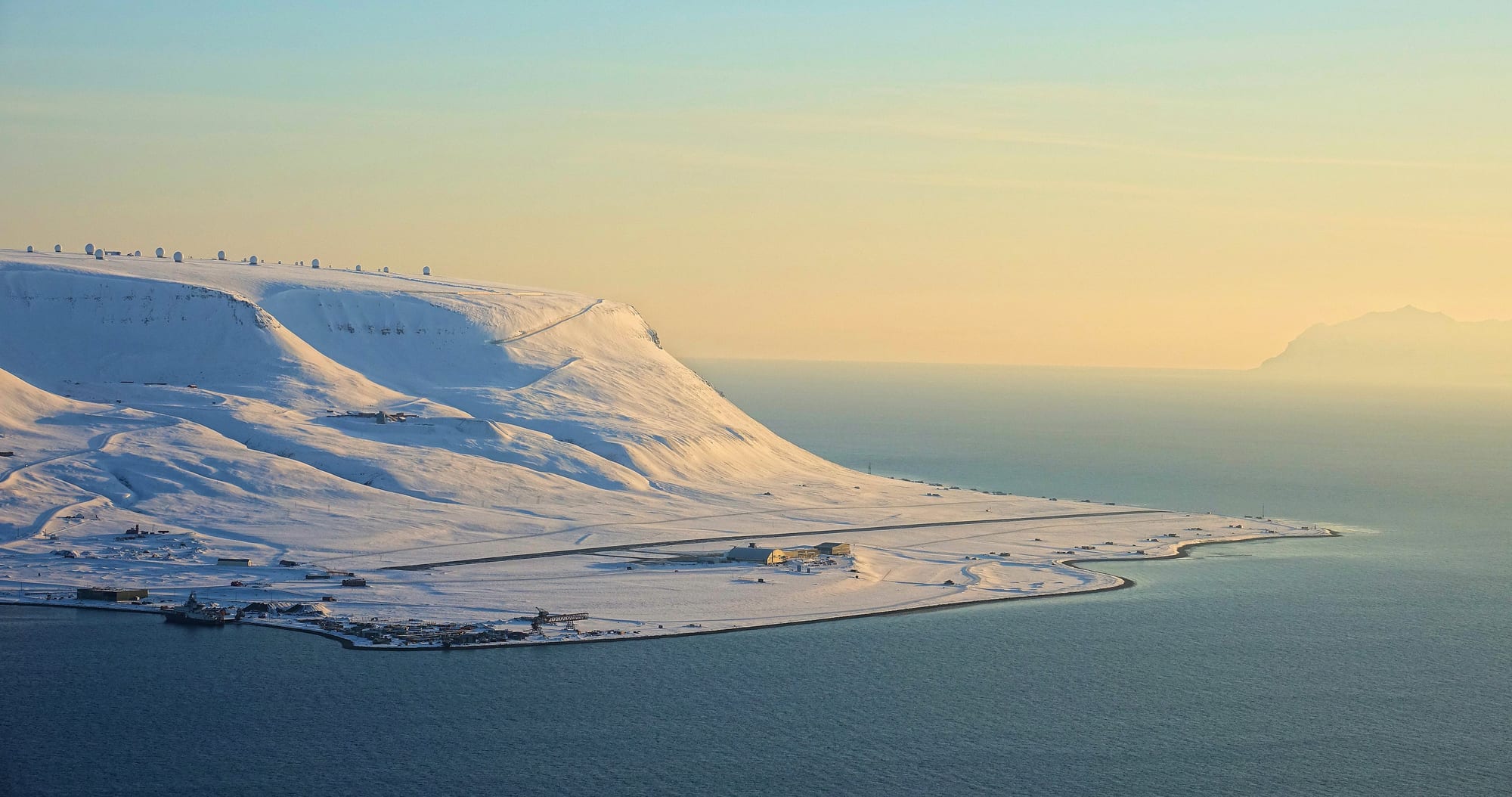
A snow-covered coastal plain running to steep Arctic mountains under a low, pale winter light, sea ice offshore

Svalbard

The snow-covered Hotellneset peninsula near Longyearbyen in winter, on Spitsbergen, the largest island of Svalbard. (Bjoern Christian Tørrissen / Wikimedia Commons · CC BY-SA 4.0)

A High Arctic archipelago about midway between mainland Norway and the North Pole — Norwegian sovereign territory governed under a unique 1920 treaty that lets citizens of dozens of countries live and work there without a visa, with polar bears outnumbering the roughly 2,500 people.

Explore Svalbard

History

Svalbard has no indigenous population. The Dutchman Willem Barentsz recorded the islands in 1596, and for the next two centuries they were a base for Dutch, English, Danish, and Norwegian whaling and walrus hunting, followed by Russian and Norwegian trappers wintering over. From the late nineteenth century the archipelago became a launching point for polar expeditions, several of which ended in disaster.

Coal, discovered in workable quantities around 1900, brought the first permanent settlements. The American businessman John Munro Longyear founded the town that bears his name; Norwegian, Russian, Swedish, British, and Dutch companies staked claims across an archipelago that belonged, formally, to no one.

The 1920 Svalbard Treaty, in force from 1925, resolved this: Norway was granted full sovereignty, but on unusual terms. Citizens and companies of all signatory countries — now more than 45, including Russia — have equal rights to live, work, and carry out economic activity there; the archipelago must not be used for "warlike purposes"; Norway may tax only what is needed to run Svalbard; and it must safeguard the environment. This is why a Russian state company still operates the mining town of Barentsburg, and why some 65 per cent of Svalbard is now protected in national parks and reserves. Norwegian coal mining wound down to its last pit, Mine 7, which closed in 2025, and Longyearbyen has reinvented itself around tourism, research, and the world's northernmost university centre.

  • Svalbard: The Treaty Archipelago A cluster of Arctic islands with no indigenous population — a whaling ground, a lawless coal frontier, and since 1920 Norwegian territory under a unique treaty that lets citizens of dozens of countries live and work there visa-free

Culture & Customs

Longyearbyen is a small, transient, international community — most residents stay a few years — with a frontier practicality about it: people remove their shoes indoors (a habit from the coal-dust days), keep a rifle for trips out of town, and rely on one another in a place where the nearest help can be hours away.

There is a strong "northernmost" novelty to daily life — the world's northernmost church, brewery, chocolatier, and ATM — alongside a serious scientific culture, with climate, glacier, and space research shaping the calendar and the conversation. The old company-town legacy lingers in the museum, the preserved mine cableways, and the pit-head buildings.

Because of the permafrost and the limited hospital, there is a long-standing practice of encouraging people to leave the islands for serious illness and to give birth; the Longyearbyen graveyard has taken no new burials for decades. The polar night and the midnight sun structure moods and routines as much as any festival.

Daily Life

About 2,500 people live in Svalbard, roughly 2,100 of them in Longyearbyen, with around 400 in the Russian settlement of Barentsburg and a few dozen scientists at the international research base of Ny-Ålesund, the northernmost year-round settlement on Earth.

The economy has shifted decisively from coal to tourism — expedition cruises, snowmobile and dog-sled tours, glacier and ice-cave trips, and aurora and wildlife trips — plus research, higher education, and a satellite ground station that exploits the polar orbit. Barentsburg keeps mining coal. Everything else is imported, and the cost of living is high despite the tax-free status.

Daily life is organised around the season's light, the weather window, the supply ship and flights, and the constant awareness that the wilderness — and its bears — begins at the edge of town.

Food

For its size, Longyearbyen has a strong food scene, built on Arctic ingredients: reindeer (the stubby Svalbard subspecies), Arctic char, ptarmigan, seal, minke whale, king crab, and cloudberries, served in restaurants such as Huset and Gruvelageret, some in the old mining buildings. Everything else — vegetables, dairy, grains — is flown or shipped in.

The tax-free regime makes wine and spirits relatively cheap, though residents buy alcohol on a ration card; visitors are not similarly limited but supply can be patchy. The supermarket is surprisingly well stocked for self-caterers.

"Northernmost" branding attaches to much of it — the brewery, the chocolatier — and a long dark winter gives coffee, cake, and the communal meal an outsized place in the social calendar.

  • Svalbard: Food and the National Dish Imported staples and Arctic game, from a permafrost archipelago with one restaurant holding one of the world's most improbable wine cellars

Attractions & Natural Wonders

The scenery is the attraction: glaciers calving into fjords, sharp brown mountains, huge seabird cliffs, and, in season, walrus haul-outs, Arctic foxes, Svalbard reindeer, and — for the lucky and well-guided — polar bears. Boat trips from Longyearbyen reach the Nordenskiöld Glacier in Billefjorden and the bird colonies and old trapper huts along the coast.

In winter, guided snowmobile and dog-sled expeditions cross the frozen valleys to ice caves carved by meltwater beneath the glaciers, and the northern lights appear even at midday during the polar night. In summer, hikes climb the ridges above town and multi-day trips venture deeper into the protected interior.

Near the airport, the concrete wedge of the Global Seed Vault — the "doomsday vault" holding backup samples of the world's crop seeds in the permafrost — can be seen from outside but not entered. And a boat or snowmobile trip up Billefjorden reaches Pyramiden, an abandoned Soviet coal town, complete with a bust of Lenin, the northernmost grand piano, and empty apartment blocks, now run as an eerie open-air museum.

  • Svalbard: Five Attractions and Natural Wonders A remote Arctic settlement where polar bears outnumber people, a doomsday vault carved into a mountainside to preserve the world's crop diversity, and glaciers that calve directly into the fjords below

Planning basics

Budget

Svalbard is very expensive — everything except duty-free alcohol and tobacco is shipped or flown in, and guided trips (the only way to leave the settlements safely) are the main cost. Longyearbyen has a hostel and guesthouses alongside hotels, and self-catering from the well-stocked supermarket helps.

Daily Budget Midrange
NOK 3,000–6,000 / USD 280–560 (hotel, restaurant meals, a full-day guided snowmobile, boat, or glacier trip)
Daily Budget Shoestring
NOK 1,200–2,000 / USD 110–190 (guesthouse or hostel, self-catering, town walking, one short tour)

Book guided excursions well ahead for the season you want, self-cater where you can, and note that the tax-free regime makes alcohol and outdoor gear relatively cheap.

Visa Requirements

Svalbard is part of Norway but sits outside the Schengen Area and the EEA. Under the 1920 Svalbard Treaty, citizens of any signatory country may enter and stay without a visa or permit — but there is no onward free movement: flights connect only through mainland Norway, so you pass through Schengen (Oslo or Tromsø) to get there, and non-visa-exempt nationals need a double-entry Schengen visa for that transit.

Typical Stay
No time limit under the treaty, but you must be able to support yourself; transit is via mainland Norway (Schengen)

If you need a Schengen visa, get a double-entry one so you can re-enter mainland Norway on the way back from Svalbard.

Safety

Longyearbyen is safe from crime, but the environment is not forgiving. Polar bears range across the whole archipelago, and it is illegal to leave the settlements without a firearm and means of deterrence; going out unguided is strongly discouraged. Avalanches (a 2015 slide hit houses in Longyearbyen), crevasses, thin sea ice, extreme cold, and rapid weather changes are all serious hazards, and rescue can be far away.

Health
The Longyearbyen hospital handles emergencies and stabilisation only; anything serious, and childbirth, means evacuation to the mainland; frostbite and hypothermia are the everyday risks

Only leave the settlements with a licensed guide, follow all polar-bear and avalanche advice, dress for extreme cold, and carry travel insurance that explicitly covers Arctic and guided-activity evacuation.

Climate

High Arctic, but milder than its latitude thanks to a branch of the Gulf Stream. Summers are cool, roughly 3–7°C, with the midnight sun from about 20 April to 22 August; winters are cold and dark, often −15 to −25°C, with the polar night from about 26 October to 15 February. Svalbard is warming several times faster than the global average.

Summer
Cool, midnight sun ~Apr 20–Aug 22
Winter
Cold and dark; polar night ~Oct 26–Feb 15

Transportation

Svalbard Airport at Longyearbyen has flights from Oslo and Tromsø. There are no roads between settlements: getting around means snowmobiles in winter, boats in summer, and organised excursions, all typically guided. Longyearbyen itself is walkable, with taxis and a bus to the airport.

Everything outside Longyearbyen is done by guided snowmobile, dog-sled, or boat trip; book these before you arrive, especially in the spring peak.

Best Time to Visit

March to May is the classic season — returning light, deep snow, and snowmobile and dog-sled touring, plus ice caves. June to August has the midnight sun, open water for wildlife cruises, and hiking. The dark months offer the northern lights (including in daytime) and a stark "polar night" experience.

Events
Polar Jazz (February); the Sunfest (Solfestuka) in early March, celebrating the sun's return; the Spitsbergen Marathon (June); Taste Svalbard, a food festival (autumn)

Currency

The currency is the Norwegian krone. Svalbard is almost entirely cashless — cards and contactless are used for everything, including tours and the church collection. There is one ATM in Longyearbyen.

Symbol
kr
Currency Code
NOK — Norwegian krone

Language

Norwegian is the main language in Longyearbyen and the other Norwegian settlements, and Russian in Barentsburg. English is spoken by virtually everyone in the tourism and research sectors, and a large share of residents are international.

English
Spoken almost universally in tourism and research
Main Languages
Norwegian (and Russian in Barentsburg)