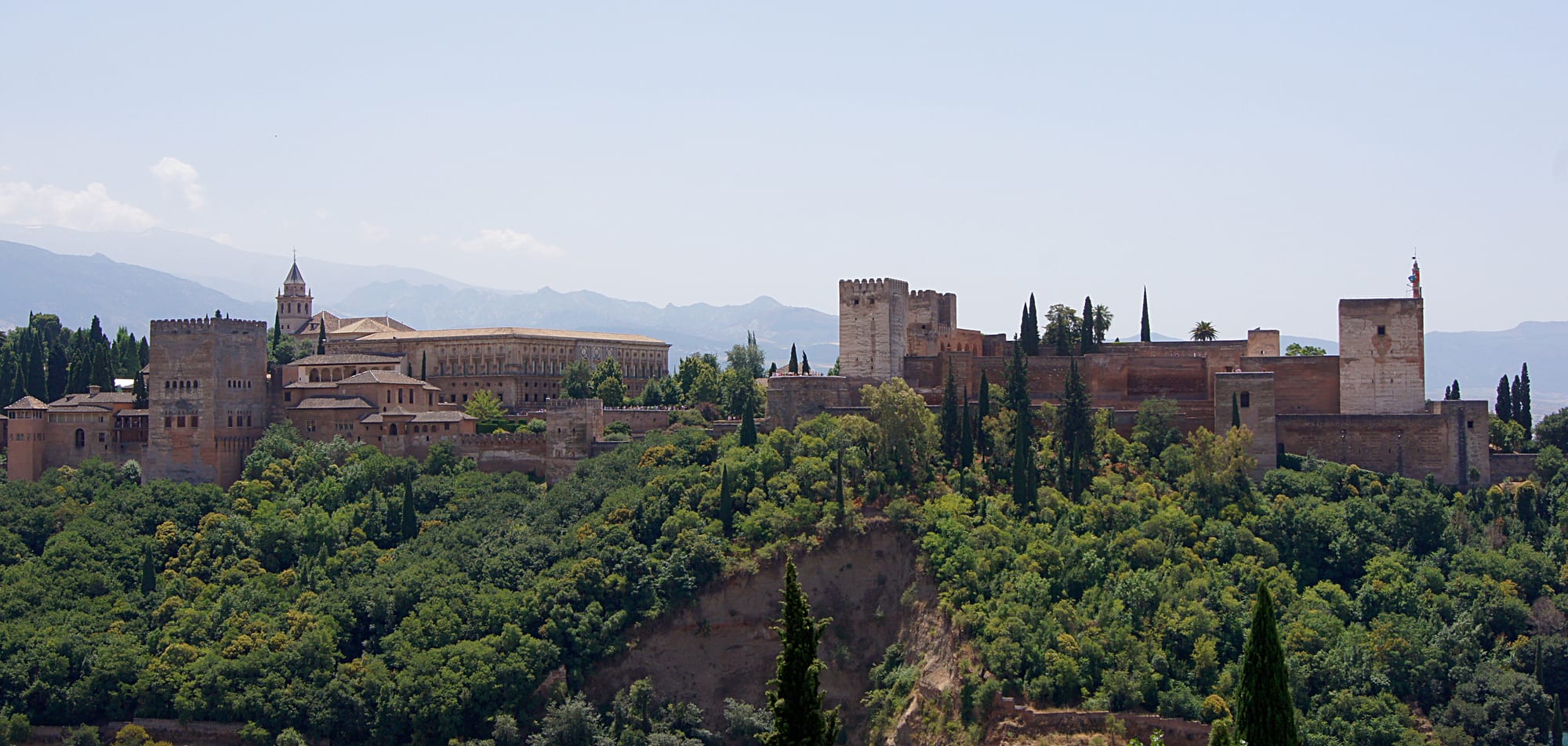
A long hilltop palace-fortress of reddish walls and towers above a city, with snow-streaked mountains rising behind

Spain

The Alhambra above Granada, backed by the Sierra Nevada — the last great palace of Muslim Spain, completed in the fourteenth century. (Jebulon / Wikimedia Commons · Public domain)

A large country filling most of the Iberian Peninsula — shaped by Roman, Muslim, and Christian rule, once the centre of a global empire, and now a decentralised democracy of strong regional identities, from Catalonia and the Basque Country to Andalusia.

Explore Spain

History

Iberia was a patchwork of peoples — Iberians, Celts, Phoenician and Greek colonies — before Rome conquered it as Hispania, leaving cities, roads, law, and the Latin from which Spanish descends. Visigothic rule followed the Western Empire's collapse, and in 711 a Muslim army from North Africa overran almost the whole peninsula. Al-Andalus, centred on Córdoba, became one of medieval Europe's most advanced societies, and the northern Christian kingdoms spent centuries pushing south in the campaigns later called the Reconquista.

In 1492 the last Muslim state, the Emirate of Granada, fell; Ferdinand of Aragon and Isabella of Castile, the "Catholic Monarchs", had united the crowns by marriage; Jews were expelled; and Columbus, sailing under Castile, reached the Americas. The sixteenth-century empire of Charles V and Philip II brought vast silver wealth and Habsburg entanglement in Europe's wars, followed by long decline. The Bourbons took the throne after the War of the Spanish Succession (1701–14).

The nineteenth century brought the loss of most of the American colonies, Napoleonic invasion, and repeated civil conflict. The Second Republic of 1931 gave way to the Spanish Civil War (1936–39), won by General Francisco Franco, whose dictatorship lasted until his death in 1975. King Juan Carlos I oversaw a rapid transition to democracy; Spain joined NATO and the European Community in the 1980s, decentralised into 17 autonomous communities, and has since wrestled with economic booms and busts and the unresolved question of Catalan independence, which peaked with an unauthorised referendum in 2017.

  • Spain: The Many Kingdoms A peninsula of Romans, Visigoths and eight centuries of Islam — unified by two marriages, enriched and exhausted by a global empire, torn apart by civil war, held down by a long dictatorship, and rebuilt as a democracy that is still arguing over how many nations it contains

Culture & Customs

Spain is a country of regions, and identity is often felt first as Catalan, Basque, Galician, Andalusian, or Castilian. Regional languages, festivals, and cuisines are living, not folkloric, and politics is coloured throughout by the balance between the centre and the autonomous communities.

Daily rhythms run late: lunch after 2pm, dinner after 9pm, and an evening paseo or stroll. The sobremesa, lingering at the table in conversation after a meal, is a valued institution. Roman Catholicism shaped the calendar — Holy Week processions, patron-saint ferias, and pilgrimages like the Camino de Santiago — though regular practice has fallen sharply.

Football is a national passion, with Real Madrid and Barcelona a rivalry that is also regional and political. Flamenco, born in Andalusia among Roma and other communities, is the best-known art form, alongside a painting tradition running from Velázquez and Goya to Picasso, Dalí, and Miró.

Daily Life

About 48 million people live in Spain, heavily concentrated in Madrid, the Mediterranean arc, and the islands, while much of the rural interior — "empty Spain" — has lost population for decades. Home ownership is high, families are close, and adult children often live with parents longer than in northern Europe, partly for economic reasons.

The economy leans on services and tourism — Spain is among the most visited countries on Earth — along with cars, agriculture, and renewable energy. Unemployment has long run higher than the EU average, especially for the young, and housing costs in Madrid, Barcelona, and tourist hotspots have become a pressing grievance, prompting protests against short-term holiday lets.

Life is social and street-oriented: plazas, terraces, markets, and long weekends, with August a near-universal holiday month.

Food

Spanish food is regional to its core. The south gave the world gazpacho and salmorejo, fried fish, and sherry; Valencia is the home of paella, properly made with rabbit, chicken, and beans; the Basque Country and Navarre are a culinary powerhouse of pintxos, seafood, and Michelin stars; Galicia means octopus (pulpo a feira) and shellfish; and the interior is country of roast lamb and suckling pig, chickpea stews, and jamón ibérico from acorn-fed pigs.

Tapas culture — small plates with a drink, sometimes free with it in cities like Granada and León — is the sociable way to eat. Tortilla de patatas, croquetas, patatas bravas, boquerones, and pan con tomate are everywhere.

Spain is one of the world's great wine countries — Rioja and Ribera del Duero for reds, Rías Baixas for Albariño, Jerez for sherry, and Catalonia for Cava — and the world's largest producer of olive oil.

Attractions & Natural Wonders

Barcelona offers Gaudí's Sagrada Família and Park Güell, the Gothic Quarter, and the beach; Madrid the Prado, Reina Sofía, and Thyssen art museums and the Retiro. Andalusia holds the Moorish trio — the Alhambra in Granada, the Mezquita of Córdoba, and Seville's Alcázar and Giralda — plus the white villages of the Sierra and the horse-and-flamenco culture of Jerez.

Elsewhere: the Roman aqueduct and fairy-tale Alcázar of Segovia, the walled city of Ávila, Toledo's layered Christian-Muslim-Jewish heritage, Salamanca's sandstone university, Bilbao's Guggenheim, and Santiago de Compostela at the end of the pilgrim road. San Sebastián's shell-shaped bay is one of Europe's finest urban beaches.

The landscapes range widely: the Pyrenees and the Picos de Europa for hiking, the volcanic badlands of Lanzarote and the peak of Teide on Tenerife, the wetlands of Doñana, the deserts of Almería, and thousands of kilometres of Mediterranean and Atlantic coast.

  • Spain: Ten Attractions and Natural Wonders A cathedral still under construction after more than 140 years, a Moorish palace complex regarded as one of the finest surviving examples of Islamic architecture in Europe, and a mysterious rock island said to have inspired the myth of Atlantis

Planning basics

Budget

Spain is mid-priced for Western Europe and often cheaper than France, Italy, or the UK for food and wine. Madrid, Barcelona, and the Balearics in summer are the dearest; inland cities and the north outside August are good value. The menú del día — a fixed-price multi-course lunch — is the traveller's friend.

Daily Budget Midrange
EUR 130–250 (mid-range hotel, restaurant dinners, high-speed rail, paid sights)
Daily Budget Shoestring
EUR 55–90 (hostel or pension, menú del día and tapas, trains and metros)

Eat your main meal at lunch on the menú del día, and book AVE high-speed trains early for the cheapest fares.

Visa Requirements

Spain is in the EU and the Schengen Area. EU and EEA citizens have full free movement. UK, US, Canadian, Australian, and many other visitors enter visa-free for 90 days in any 180; the EU's ETIAS pre-authorisation is expected to apply to them once launched.

Typical Stay
90 days in any 180 (Schengen) for most Western passports

The 90-day limit is shared across the whole Schengen Area, not per country.

Safety

Spain is a safe country with low violent crime. The significant risk is pickpocketing and bag-snatching, which is persistent in tourist areas of Barcelona, Madrid, and Seville, on the metro, and at crowded sights. Summer heat and, increasingly, wildfires are seasonal hazards.

Health
Tap water is safe in cities; the summer sun and heat are intense

Wear bags across the body and keep phones off café tables in Barcelona and Madrid; plan around the midday heat in summer.

Climate

Varied. The Mediterranean coast and the south have hot, dry summers and mild winters; the central meseta around Madrid swings from freezing winters to fierce summer heat; the green north (Galicia, Asturias, the Basque Country) is cool and rainy year-round. Summer heatwaves are increasingly severe.

Interior
Cold winters, very hot summers; wet, mild north
South And Coast
Hot dry summers, mild winters

Transportation

Madrid and Barcelona are major air hubs, with many regional airports. The AVE high-speed rail network links Madrid to Barcelona, Seville, Valencia, Málaga, and more at up to 300 km/h, and long-distance buses (ALSA) fill the gaps cheaply. Cities have good metros. A car is useful only for rural regions like Andalusia's white villages or the Picos de Europa.

Use the AVE and city metros for the main circuit; hire a car only for the countryside.

Best Time to Visit

May–June and September–October are ideal almost everywhere — warm, and before or after the crowds and the worst heat. July and August are hot and busy, and many businesses in the cities close for August. Winter suits city breaks, Andalusia, and skiing in the Pyrenees and Sierra Nevada.

Events
Semana Santa (Holy Week, especially Seville); Las Fallas in Valencia (March); Feria de Abril, Seville; San Fermín running of the bulls, Pamplona (July); La Tomatina, Buñol (August)

Currency

Spain uses the euro. Cards and contactless are accepted almost everywhere, including small bars; carry a little cash for markets, rural tabernas, and tips.

Symbol
Currency Code
EUR — euro

Language

Spanish (Castilian) is the national language. Catalan (and its Valencian variety), Galician, and Basque are co-official in their regions and widely used in daily life, media, and schooling there. English is spoken in tourist areas but less so in the interior.

Co Official
Catalan/Valencian, Galician, Basque in their regions
National Language
Spanish (Castilian)