History · Spain
Spain: The Many Kingdoms
A peninsula of Romans, Visigoths and eight centuries of Islam — unified by two marriages, enriched and exhausted by a global empire, torn apart by civil war, held down by a long dictatorship, and rebuilt as a democracy that is still arguing over how many nations it contains
By Worldlore Editorial · 19 September 2026
A country of countries
Spain occupies most of the Iberian Peninsula, with about 48 million people and a strong sense, in several of its regions, of being distinct nations — Catalans, Basques, Galicians — with their own languages and histories. That plurality is the thread running through Spanish history: the peninsula has been unified by conquest, by dynastic marriage and by dictatorship, and each time the question of how much autonomy its parts should have has returned. Spain built one of the first global empires, and spent centuries and fortunes on it, before a 20th century of civil war and dictatorship and a rapid, successful transition to democracy after 1975.
A short history
- 218 BCE–5th c. CE
Roman Hispania
The peninsula is thoroughly Romanised.
- 711
The Muslim conquest
Arab and Berber armies overrun the Visigothic kingdom.
- 8th–15th c.
Al-Andalus and the Reconquista
Christian kingdoms slowly expand south.
- 1469
Isabella and Ferdinand
The marriage that joins Castile and Aragon.
- 1492
A pivotal year
Granada falls; Jews are expelled; Columbus sails.
- 16th–17th c.
The empire and its decline
Silver from the Americas; costly European wars.
- 1808–1814
The Peninsular War
Napoleon invades; a guerrilla war and the 1812 constitution.
- 1936–1939
The Civil War
The Republic against Franco's Nationalists; Franco wins.
- 1939–1975
The Franco dictatorship
Nearly four decades of authoritarian rule.
- 1978
Democracy
A new constitution creates a monarchy and autonomous communities.
Rome, the Visigoths, and Al-Andalus
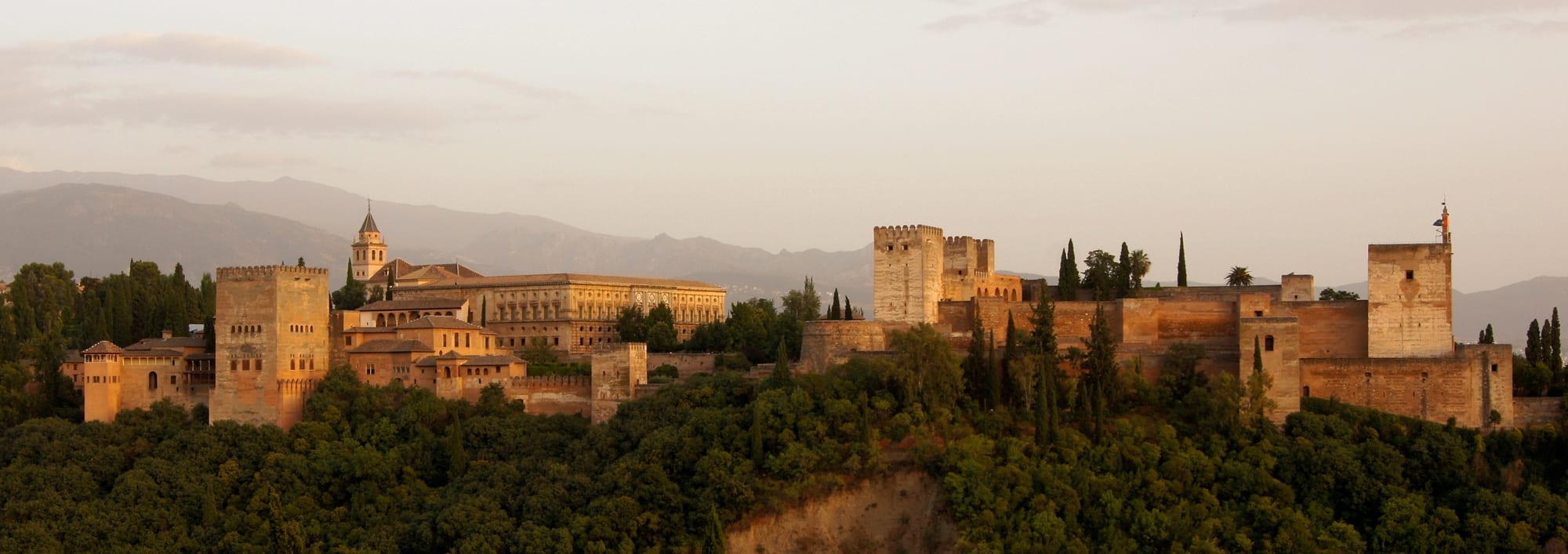
Rome ruled Hispania for some 600 years, leaving the language, the law and the roads; the Germanic Visigoths took over as the empire fell and established a Christian kingdom centred on Toledo. In 711 an Arab-and-Berber army from North Africa destroyed that kingdom within a few years, and for the next eight centuries part or most of the peninsula was Al-Andalus — Muslim-ruled, with Córdoba in the 10th century among the largest and most learned cities in the world, and a mixed society of Muslims, Christians and Jews. Small Christian kingdoms in the north — Asturias, León, Castile, Navarre, Aragon, and the Catalan counties — expanded southward over centuries in the process later called the Reconquista, taking Toledo in 1085, Córdoba and Seville in the 13th century, and finally Granada in 1492.
Union, and empire
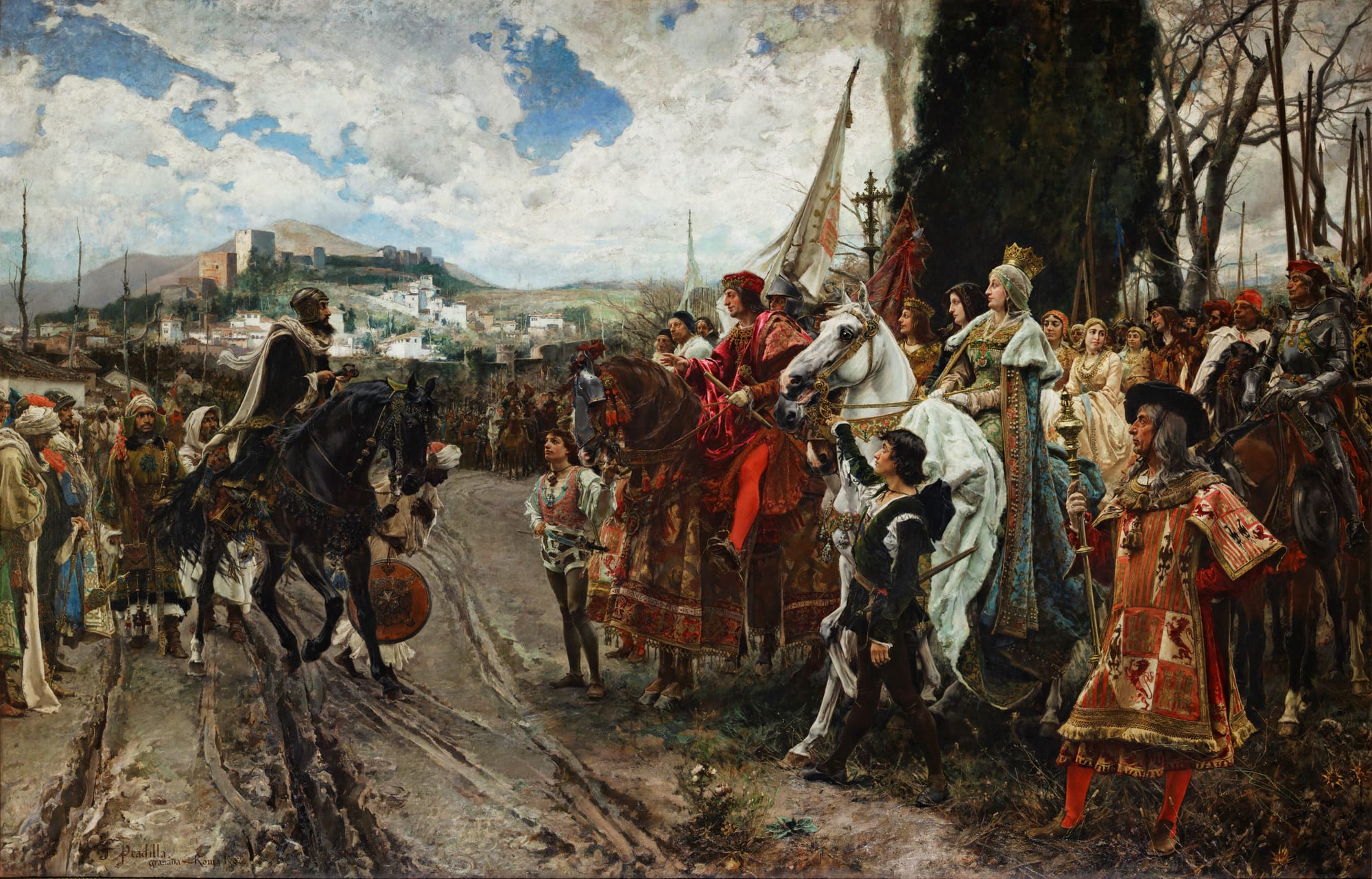
The 1469 marriage of Isabella I of Castile and Ferdinand II of Aragon joined the two largest Christian kingdoms in a personal union — though they kept separate institutions for centuries. Their reign brought the fall of Granada, the expulsion of practising Jews and later Muslims, the establishment of the Inquisition, and the sponsorship of Columbus's 1492 voyage. Through inheritance, their grandson Charles I became also Holy Roman Emperor Charles V, ruling an empire on which, it was said, the sun never set: the Low Countries, much of Italy, and the vast American territories conquered from the Aztecs and Incas. Silver from Potosí and Mexico financed Spain's dominance — and its near-constant wars against France, the Ottomans, Protestant Europe and the Dutch revolt — but also fuelled inflation and debt, and by the late 17th century Spain was a declining power.
Decline, invasion, and instability
The Spanish Habsburg line died out in 1700, triggering the War of the Spanish Succession, which put a French Bourbon dynasty on the throne and cost Spain Gibraltar and its European possessions. In 1808 Napoleon invaded and installed his brother as king; Spanish resistance — a brutal guerrilla war, aided by Britain — and a liberal parliament at Cádiz produced the 1812 constitution, an early European charter of rights. The 19th century was then a cycle of civil wars between liberals and conservatives (the Carlist Wars), military coups, and the loss of the American mainland colonies by the 1820s and of Cuba, Puerto Rico and the Philippines to the United States in 1898.
The Republic and the Civil War
A republic proclaimed in 1931 attempted land reform, regional autonomy for Catalonia and the Basque Country, and the separation of church and state, deeply polarising the country. In July 1936 part of the army under General Francisco Franco rose against the elected Popular Front government. The Spanish Civil War lasted almost three years, drew in Nazi Germany and Fascist Italy on Franco's side and the Soviet Union and international volunteers on the Republic's, and killed around 500,000 people, including large-scale political executions by both sides and, afterwards, by the victors. It became a rehearsal for the Second World War — Guernica, bombed by German aircraft in 1937, gave Picasso his subject.
Franco, and the transition
Franco ruled until his death in 1975: a Catholic, centralist, anti-communist dictatorship that executed and imprisoned opponents, banned the Catalan and Basque languages in public life, and kept Spain poor and isolated until US Cold War aid and 1960s tourism and industrialisation brought growth. Franco designated Juan Carlos, grandson of the last king, as his successor. Rather than continue the dictatorship, the king backed a rapid transition to democracy: political parties were legalised, and a 1978 constitution created a parliamentary monarchy and a system of 17 "autonomous communities" with substantial self-government. The transition survived an attempted military coup in 1981, when the king's televised intervention was decisive.
Spain now
Democratic Spain joined the European Community in 1986, adopted the euro, and modernised rapidly, though it was hit hard by the 2008 financial crisis and a property crash. The Basque separatist group ETA, which killed over 800 people in a campaign from the 1960s, declared a permanent ceasefire in 2011 and disbanded. The sharpest unresolved issue is Catalonia: an unauthorised independence referendum in October 2017, met by police action and the brief imposition of direct rule, produced a constitutional crisis and criminal trials, and the question of the region's status remains open.
What Spain carries
Spain has been assembled repeatedly — by Rome, by the Reconquista and royal marriage, by Franco's forced centralism — and each version has had to reckon with the peninsula's internal diversity. The empire made Spain a world power and then a declining one; the Civil War and the dictatorship are still within living memory and only partly reckoned with. The 1978 settlement gave the regions the most autonomy they have ever had, and the argument over whether that is enough, too much, or the wrong framework altogether is the defining debate of Spanish politics.