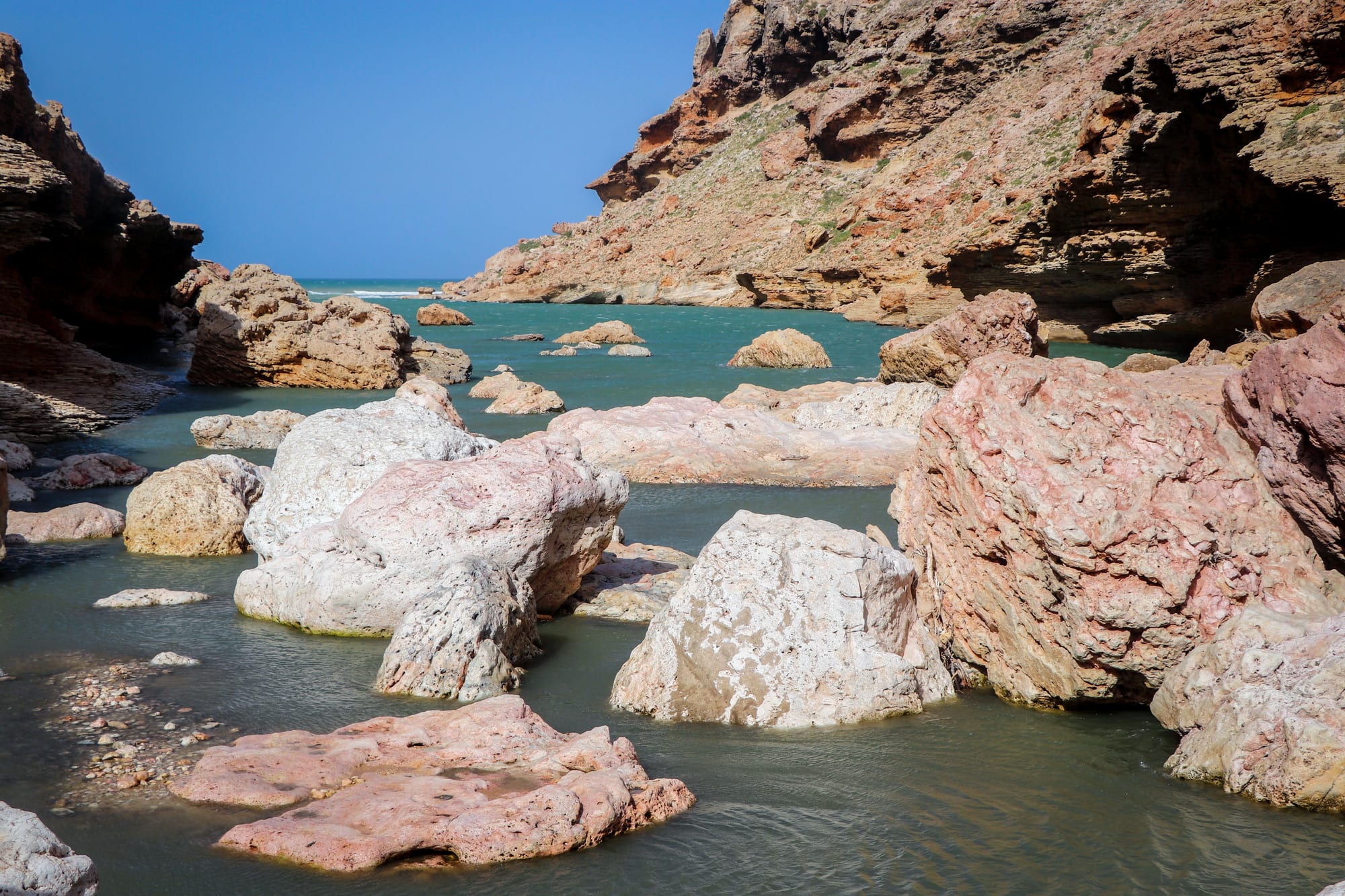
Huge pale pink and white boulders standing in calm green water between rugged red-brown cliffs, with a strip of open sea and a deep blue sky beyond

Somalia

Pink and white boulders in a sheltered inlet that opens to the sea at Garmaal, in Eyl District. (Omar Gadood / Wikimedia Commons · CC BY 4.0)

A Horn of Africa nation with the continent's longest mainland coastline — plunged into civil war and statelessness after 1991, and now a fragile federal government backed by an African Union force fighting the al-Shabaab insurgency, while self-governing Somaliland runs the northwest. This page is written to explain the country, not to encourage travel to it — most governments advise against all travel.

Explore Somalia

History

The coast was known to the ancient Egyptians as part of the Land of Punt, a source of frankincense, myrrh, and gold, and it later anchored a chain of Islamic trading sultanates — Mogadishu, Ajuran, the Adal state around Zeila — linked to the Indian Ocean world. In the late nineteenth century the Somali lands were divided among Britain (the northwest), Italy (the south and east), France (Djibouti), and Ethiopia (the Ogaden). Sayyid Mohammed Abdullah Hassan led a two-decade armed resistance to colonial rule until 1920.

British Somaliland and Italian Somalia became independent and united as the Somali Republic in 1960. In 1969 Siad Barre seized power in a coup and ruled for 22 years, aligning first with the Soviet Union and then the West, and fighting a disastrous war with Ethiopia over the Ogaden in 1977–78. Clan-based opposition movements brought the state down in 1991.

What followed was decades of collapse: rival warlords, a US–UN intervention in 1992–95 that ended after the 1993 "Black Hawk Down" battle in Mogadishu, the rise and fall of the Islamic Courts Union in 2006, an Ethiopian invasion, and the emergence of al-Shabaab. An African Union force has propped up a series of transitional and federal governments since 2007, clawing back territory but unable to end the insurgency, and famine in 2011 killed a quarter of a million people. The northwest declared itself the independent Republic of Somaliland in 1991; it is not internationally recognised but has held elections and remained comparatively stable.

  • Somalia: The Nation Without a State A country unusually united by language, religion and lineage — colonised in five pieces, briefly whole at independence, ruled by a dictator, and then, after 1991, the textbook case of state collapse

Culture & Customs

Somalia is one of Africa's most homogeneous countries in ethnicity, language, and religion: overwhelmingly ethnic Somali, Sunni Muslim, and Somali-speaking. Yet it is deeply divided by clan (qabiil), the genealogical system that structures identity, marriage, dispute settlement, and politics, and whose rivalries drove the civil war.

Somalis are sometimes called a nation of poets. Oral poetry — recited, memorised, and fiercely judged — is the prestige art form, historically used for news, argument, courtship, and feud. Camel husbandry is central to the pastoral heritage, with camels a measure of wealth and a frequent subject of verse.

Society is conservative and religiously observant, with modest dress, gender separation in many settings, and Ramadan widely kept. Hospitality to guests is a strong obligation. The chewing of khat (qat), a mild stimulant leaf imported daily from Ethiopia and Kenya, is a widespread afternoon habit for men.

Daily Life

Around 18 million people are Somali citizens, with a large pastoral population still moving herds of camels, goats, and cattle in search of pasture, and others farming between the Shabelle and Jubba rivers or fishing the coast. Recurrent drought and conflict have displaced millions, and camps of the internally displaced ring the cities.

Where the state is weak, private enterprise and the diaspora fill gaps: money transfer (hawala) firms, telecoms, and mobile money function well, remittances from relatives abroad sustain many households, and Mogadishu has seen a construction and solar-power boom funded partly by returnees. Public services — schooling, health, policing — are patchy and often provided by clan, religious, or aid organisations.

Life in Somaliland is calmer, with functioning markets, universities, and local government, though poverty and unemployment are high and the lack of recognition limits investment and travel.

Food

Somali food reflects centuries of Indian Ocean trade and the Italian presence in the south. The staple bread is canjeero (also called laxoox), a soft fermented flatbread eaten at breakfast with sesame oil and sugar or with stew. The classic main course is bariis iskukaris, spiced rice with goat, camel, or chicken, seasoned with a mix related to garam masala and often served with banana on the side.

Meat is central — grilled or stewed goat and camel, suqaar (diced sautéed meat), and offal dishes — alongside hilib ari and pasta (baasto), a direct Italian legacy usually served with a rich meat sauce. Sambuusa (samosas) are the Ramadan snack. Camel milk is prized, both fresh and soured.

Meals end with sweet xalwo, a dense confection of sugar, ghee, and spices, and shaah, black tea boiled with cardamom, cinnamon, and cloves. No alcohol is sold or consumed.

Attractions & Natural Wonders

Realistic access is limited to Somaliland, where the standout is Laas Geel, a complex of rock shelters near Hargeisa whose painted cattle and human figures, around 5,000 years old, are among the best preserved in Africa. Berbera has long beaches, Ottoman and colonial-era buildings, and warm Gulf of Aden diving, and the Daallo escarpment and the forested Cal Madow mountains rise steeply behind the coast.

Elsewhere the country holds sights that are currently out of reach to ordinary visitors: the ruined port of Zeila, the old stone town of Mogadishu with the thirteenth-century Arba'a Rukun mosque and the Italian-era cathedral shell, the Lido and Jazeera beaches of the capital, and the long, empty Indian Ocean coast running south past Kismayo.

The Somali coastline — the longest of any mainland African country — and the arid interior support wildlife including the endangered Speke's gazelle, the Somali wild ass, and large seabird colonies on offshore islands, though decades of conflict have left little in the way of protected areas or infrastructure to see them.

  • Somalia: Five Attractions and Natural Wonders Some of the oldest and best-preserved rock art in Africa, a long Indian Ocean coastline lined with white sand, and a self-declared republic that has charted a markedly calmer course than the rest of the country — described here for reference amid one of the world's most serious ongoing security situations

Planning basics

Budget

There is almost no tourism industry. In the self-governing northwest, Hargeisa and Berbera have basic and mid-range hotels, and an armed escort is a required cost for travel outside the main towns. South-central Somalia, including Mogadishu, is not realistically visitable independently; visits there are made with private security at high expense.

Daily Budget Note
In Somaliland, roughly USD 80–200/day once the mandatory escort and a driver are included

Treat any visit as a security operation with local fixers, not a holiday, and price the armed escort and vehicle into every day.

Visa Requirements

Somalia and Somaliland issue separate visas and control separate entry points. A Somalia e-visa and visa on arrival at Mogadishu have operated on and off and change frequently. Somaliland issues its own visa through its overseas representative offices or on arrival at Hargeisa airport; a Somaliland visa is not valid for the rest of Somalia and vice versa.

Typical Validity
About 30 days, single entry, for either authority

Decide which territory you are entering, get that authority's visa, and confirm the current process days before travelling.

Safety

Most governments advise against all travel to Somalia. Al-Shabaab carries out bombings and assaults, concentrated in Mogadishu but reaching other towns; kidnapping of foreigners is a serious risk across the south; inter-clan violence and crime are common; and piracy off the coast, though much reduced, has not ended. Somaliland is considerably safer but still carries strong travel warnings and the escort requirement. Emergency medical care is minimal.

Health
Malaria in the south; frequent cholera and measles outbreaks; drought-linked malnutrition; carry full evacuation insurance

Follow your government's travel advice; if you go to Somaliland, use a reputable local operator, take the required escort, keep a low profile, and avoid government buildings, checkpoints, and crowds.

Climate

Hot and dry to semi-desert. Two rainy seasons — the Gu from April to June and the shorter Deyr from October to December — are light and unreliable, and severe multi-year droughts recur, most recently in 2011 and 2021–22. The coast is very humid; the far north can exceed 45°C in summer.

Rains
Gu (Apr–Jun) and Deyr (Oct–Dec), both often failing
Dry Seasons
Jilaal (Dec–Mar) and Hagaa (Jul–Sep)

Transportation

Mogadishu and Hargeisa have international airports with regional flights (Nairobi, Addis Ababa, Djibouti, Istanbul, the Gulf). Domestic flights link the main cities. Road travel in south-central Somalia is dangerous, with al-Shabaab checkpoints and roadside bombs; in Somaliland the main roads are passable but an armed police escort (SPU) is mandatory for foreigners outside Hargeisa.

Fly between cities rather than driving, and never move on south-central roads without vetted local security.

Best Time to Visit

For the northwest, the cooler, drier months from November to February are the most comfortable. The summer Hagaa brings strong coastal winds and extreme heat inland. Travel decisions are driven by security conditions far more than by season.

Events
Independence of Somaliland (18 May, northwest only); Somalia Independence Day (1 July); Eid al-Fitr and Eid al-Adha; Ashura

Currency

The Somali shilling has almost no value for larger transactions; US dollars in cash and mobile money dominate the economy, and mobile-money use is among the highest in the world. The northwest uses the separate Somaliland shilling, changed in bulk on the street.

Symbol
Sh
Currency Code
SOS — Somali shilling (USD cash and mobile money in practice)

Language

Somali is the official language and is spoken by nearly the whole population, an unusual degree of linguistic unity in Africa. Arabic is also official and used in religion and some media. English is used in Somaliland administration and education; Italian survives among older people in the south as a colonial legacy.

Other
English (northwest); Italian (older generation, south)
Official Languages
Somali and Arabic