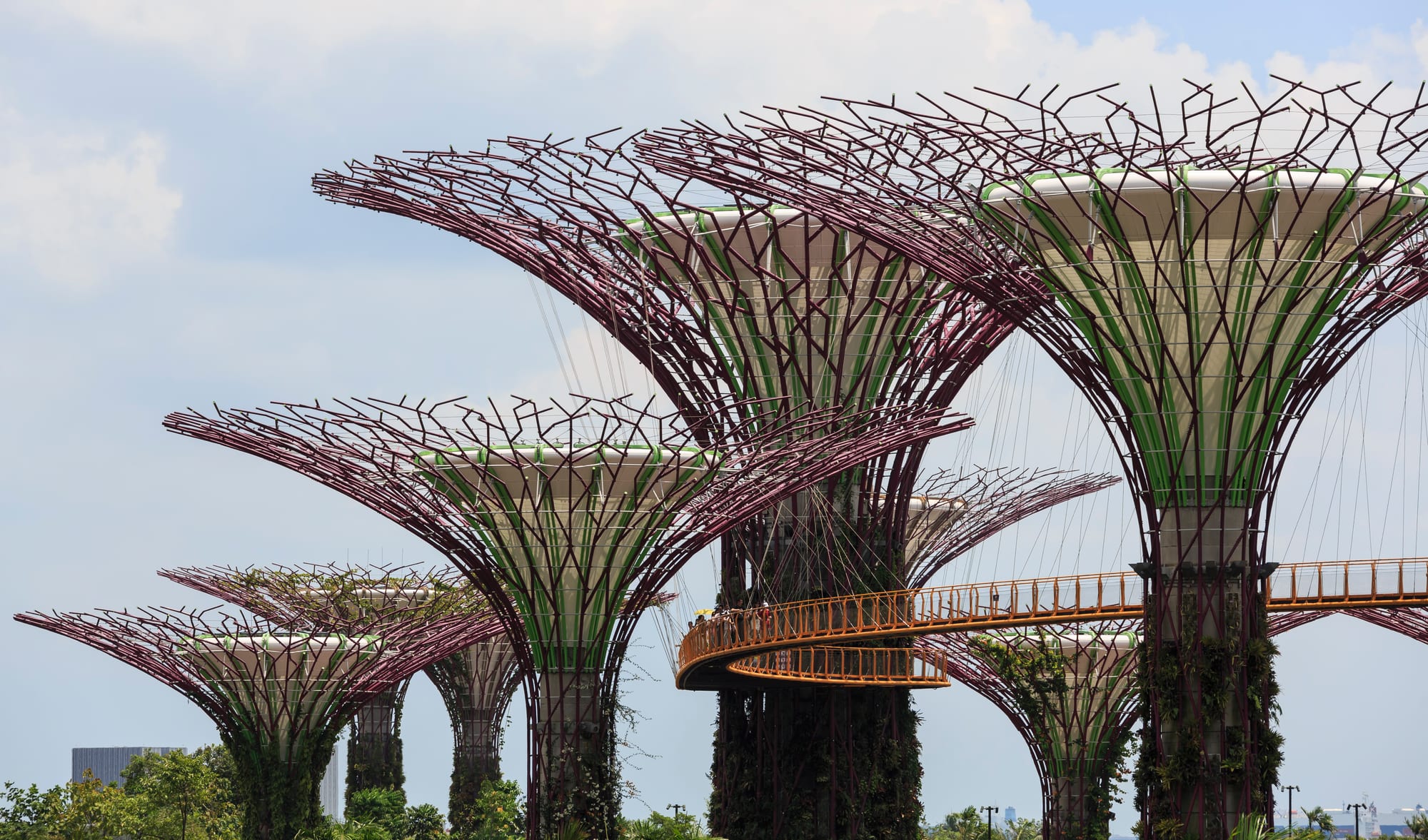
Tall tree-shaped steel structures covered in climbing plants, lit against a dusk sky, linked by an elevated walkway

Singapore

The Supertree Grove at Gardens by the Bay, a reclaimed-land park beside the Marina Bay financial district. (CEphoto, Uwe Aranas / Wikimedia Commons · CC BY-SA 3.0)

An island city-state at the tip of the Malay Peninsula — a British free port founded in 1819 that became, in one generation after a bruising 1965 independence, one of the world's richest and most tightly governed countries.

Explore Singapore

History

The island had a trading settlement, Temasek, in the fourteenth century, but its modern history begins in 1819, when Stamford Raffles of the British East India Company signed a treaty to establish a free port. It grew explosively as an entrepôt on the sea route between India and China, drawing migrants from southern China, the Malay archipelago, and South India, and became part of the British Straits Settlements. By 1900 it was one of the busiest ports in the world.

The fall of Singapore to Japan in February 1942 — the surrender of a large British force — was a shock to imperial prestige, and the occupation that followed included the Sook Ching massacre of Chinese residents. Self-government came in 1959 with Lee Kuan Yew and the People's Action Party in power. Singapore joined the Federation of Malaysia in 1963, but friction over race and economic policy led to its expulsion in August 1965 — an independence its leaders had not sought and initially feared it could not survive.

It survived by turning itself into a manufacturing, shipping, and financial hub, with heavy state direction, near-total home ownership through public housing, a sovereign wealth fund, and strict social control. The PAP has governed without interruption ever since. Lee Kuan Yew stepped down as prime minister in 1990 and died in 2015; his son Lee Hsien Loong led the country from 2004 until handing over to Lawrence Wong in 2024.

  • Singapore: The Improbable City-State A malarial island turned into the British Empire's great Asian entrepôt, overrun by Japan in six weeks, thrown out of Malaysia against its will in 1965, and rebuilt by one party into one of the richest countries on Earth

Culture & Customs

Singapore is officially multiracial, and the framework of everyday life reflects it: four official languages, ethnic quotas in public housing blocks to prevent enclaves, and public holidays for Chinese, Malay, Indian, and Christian festivals. The population is about three-quarters Chinese, with substantial Malay and Indian minorities and a large foreign workforce. Religious and racial harmony is treated as a matter of national security, and speech that threatens it is policed.

The culture prizes education, hard work, and material success — the local term kiasu, "afraid to lose", is used self-mockingly for the competitive streak. Male citizens do about two years of National Service. Hawker food culture, the open-air food courts where the country eats, was placed on UNESCO's intangible heritage list in 2020.

Manners are generally reserved and orderly. Queuing is universal, public cleanliness is enforced, and there is a strong deference to rules and authority that visitors notice quickly.

Daily Life

Around 5.9 million people live on the island, of whom roughly 3.6 million are citizens; the rest are permanent residents and foreign workers, from professionals to construction and domestic labourers. About eight in ten residents live in flats built by the Housing and Development Board, most of them owner-occupied on long leases.

The cost of living is among the highest in the world. Car ownership requires a Certificate of Entitlement that can cost more than the vehicle, so most people rely on the MRT. Working hours are long, competition for school places and jobs is intense, and the birth rate is very low, leaving the population ageing and dependent on immigration.

Daily life is safe, efficient, and highly digital — cashless payment, food delivery, and government services by app are routine — and the city is green, with parks, tree-lined roads, and planted verticals softening the density.

Food

Singapore's cuisine is the food of its migrant communities, eaten side by side. Hainanese chicken rice — poached chicken with rice cooked in the stock — is the unofficial national dish; chilli crab, black pepper crab, and cereal prawns are the seafood classics. Malay and Indian-Muslim kitchens contribute nasi lemak, mee rebus, roti prata, and biryani, while laksa, char kway teow, bak kut teh, Hokkien mee, and satay come from the Chinese and Peranakan traditions.

The place to eat is a hawker centre, where dozens of specialist stalls share communal tables; several have earned Michelin recognition. Kopitiam coffee shops serve strong local kopi with condensed milk alongside soft-boiled eggs and kaya toast.

Peranakan (Nyonya) cooking, the blend of Chinese ingredients and Malay spicing developed by the Straits Chinese, is a distinct local cuisine — ayam buah keluak, babi pongteh, and rich laksa lemak. Durian, in season, is sold everywhere despite being banned from public transport.

Attractions & Natural Wonders

Marina Bay is the modern showpiece: the three-towered Marina Bay Sands with its rooftop, the domed conservatories and Supertree Grove of Gardens by the Bay, the Merlion statue, and the ArtScience Museum, all around a reservoir in the heart of the city. The Singapore Botanic Gardens, a UNESCO World Heritage Site, holds the National Orchid Garden.

The historic quarters remain distinct and walkable — Chinatown, Little India, and the Malay-Muslim Kampong Glam around the Sultan Mosque — while Orchard Road is the shopping spine. The Singapore Zoo, its Night Safari, and the Bird Paradise are well regarded, and Sentosa island packs in beaches, Universal Studios, and aquariums.

For green space there is the Southern Ridges walkway, the rainforest of the Central Catchment and Bukit Timah, and the car-free island of Pulau Ubin, a glimpse of the kampong Singapore that has otherwise vanished. Changi Airport's Jewel, with its indoor waterfall, is a destination in itself.

  • Singapore: Six Attractions and Natural Wonders A grove of towering artificial "supertrees" doubling as solar collectors, a hotel with a ship-shaped pool deck floating 57 storeys above the ground, and a half-lion half-fish statue that has become a national mascot

Planning basics

Budget

Singapore is one of Asia's most expensive cities for accommodation, alcohol, and anything involving a car, but street food at hawker centres is cheap and excellent, and public transport costs little. Backpackers use hostels in Chinatown and Little India; most visitors stay in mid-range or business hotels.

Daily Budget Midrange
USD 180–400 (3–4 star hotel, restaurant meals, drinks, paid attractions)
Daily Budget Shoestring
USD 60–110 (hostel dorm, hawker meals, MRT, free sights)

Eat at hawker centres and food courts, drink at happy hour or not at all, and buy an EZ-Link or use a contactless card for the MRT rather than taxis.

Visa Requirements

Most nationalities, including the UK, EU, US, Canada, and Australia, enter without a visa for 30 to 90 days. Everyone must submit the free electronic SG Arrival Card online in the three days before arrival.

Typical Stay
30–90 days visa-free for most Western passports

File the SG Arrival Card online before you land; carry an onward or return ticket.

Safety

Singapore has very low crime and is safe to walk at any hour. The real caution is the law: drug trafficking carries a mandatory death penalty and offences that seem minor elsewhere — jaywalking, littering, vaping, eating on the MRT, importing chewing gum for sale — bring heavy fines. Penalties for drug use include prosecution for consumption before arrival.

Health
Tap water is safe; dengue occurs year-round — use repellent

Do not carry or use any illegal drug, do not bring vapes into the country, and take dengue precautions.

Climate

Equatorial: hot, humid, and wet all year, with daytime temperatures around 31–33°C and little seasonal change. The wetter northeast monsoon runs November to January with heavy afternoon downpours; February to April is marginally drier. Thunderstorms are frequent year-round.

Monsoon
Northeast monsoon Nov–Jan (wettest); inter-monsoon storms common
Drier Period
February–April

Transportation

Changi Airport is one of the world's major hubs and is linked to the city by MRT. The MRT and bus network is clean, cheap, extensive, and signed in English, and covers almost everywhere a visitor needs. Taxis and ride-hailing (Grab) are reasonable. Renting a car is unnecessary and very expensive.

Tap in and out of the MRT and buses with a contactless bank card or an EZ-Link card; there is no need to hire a car.

Best Time to Visit

There is no bad time, but February to April is the least rainy stretch. Book well ahead around the Formula 1 night race in September and Chinese New Year. The haze from regional forest fires can occasionally affect air quality between roughly July and October.

Events
Chinese New Year (Jan/Feb); Thaipusam; National Day (9 August); Formula 1 Singapore Grand Prix (September); Deepavali; Christmas light-up on Orchard Road

Currency

The currency is the Singapore dollar. Cards and mobile payments are accepted almost everywhere, though small hawker stalls may want cash or PayNow. ATMs are plentiful.

Symbol
S$
Currency Code
SGD — Singapore dollar

Language

There are four official languages — English, Mandarin Chinese, Malay, and Tamil. English is the language of government, business, schooling, and signage, and is spoken by nearly everyone, often in the colloquial form known as Singlish. Malay is the national language, used in the anthem.

Working Language
English
National Language
Malay