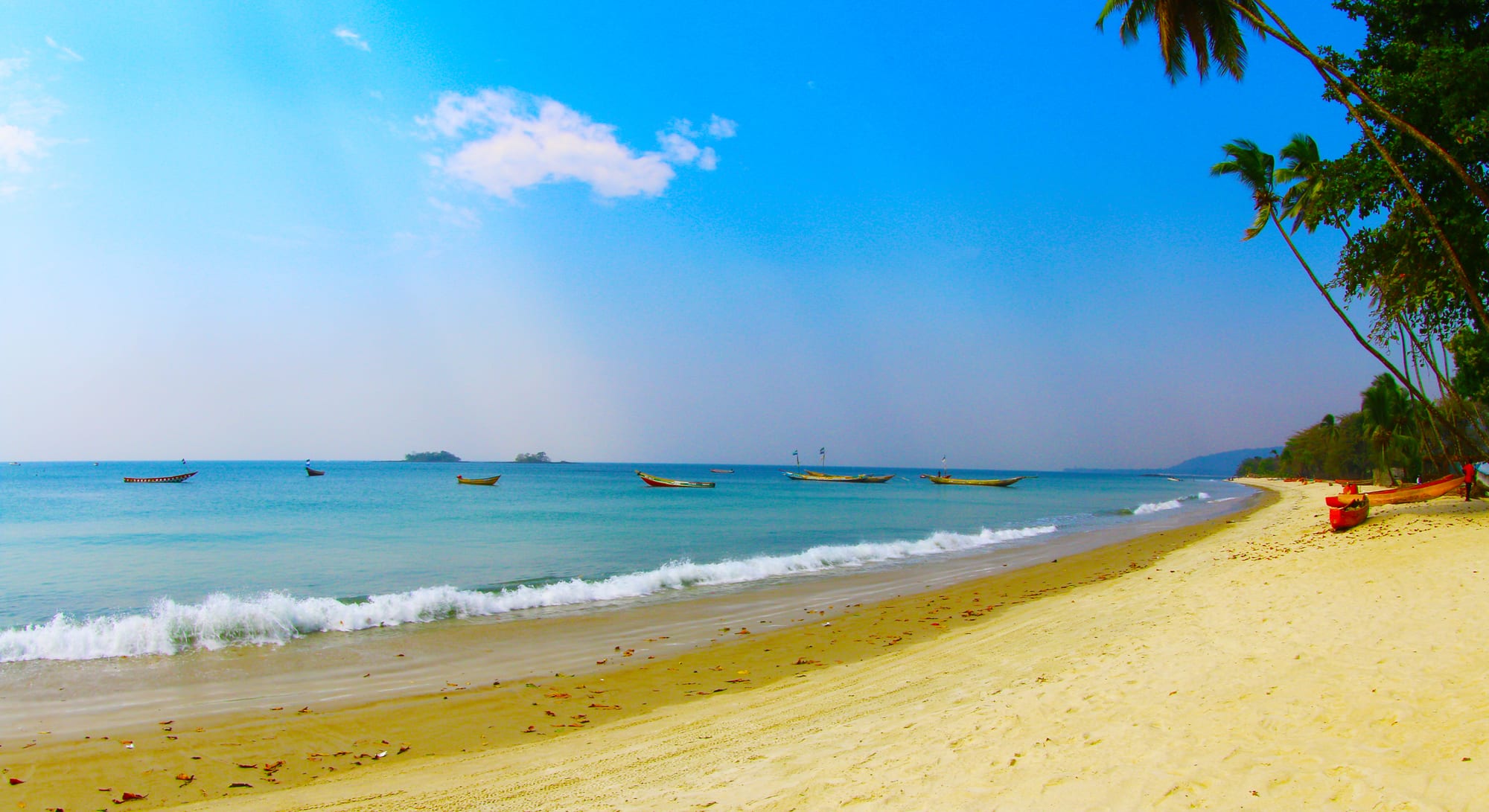
A long curve of golden sand under a bright blue sky, with surf rolling in, wooden fishing boats anchored offshore, red canoes pulled up on the beach and coconut palms leaning over the sand

Sierra Leone

Fishing and transport boats anchored off Tokeh Beach, with painted canoes drawn up on the sand beneath the palms. (Hodroj Houssein / Wikimedia Commons · CC BY-SA 4.0)

A small country on the West African coast, its mountainous capital founded as a settlement for freed slaves — scarred by a brutal 1990s civil war and the 2014–16 Ebola epidemic, and now a peaceful if fragile democracy with fine beaches and rainforest.

Explore Sierra Leone

History

The "Lion Mountains" coast that Portuguese sailors named in the fifteenth century became a source for the transatlantic slave trade, with an English slave castle on Bunce Island shipping captives, many to the rice country of South Carolina. In 1787 British abolitionists founded a settlement at Freetown for freed and destitute Black people from London, joined by Black Loyalists from Nova Scotia and Jamaican Maroons, and after 1808 the Royal Navy landed tens of thousands of Africans freed from intercepted slave ships. From these groups emerged the Krio — English-speaking, Christian, and Western-educated — and Freetown, with Fourah Bay College, became a centre of learning known as "the Athens of West Africa". The coastal colony was British from 1808 and the interior a protectorate from 1896.

Independence came in 1961, followed by a slide from democracy into one-party rule and deep corruption under Siaka Stevens from the late 1960s, and economic collapse under his successor. The civil war of 1991–2002 followed, in which the Revolutionary United Front, backed by Liberia's Charles Taylor and financed by "blood diamonds", waged a campaign of extreme brutality — mass amputations, tens of thousands of child soldiers — that killed some 50,000 to 70,000 people and displaced half the country, before Nigerian-led and then decisive British military intervention and a large UN peacekeeping mission ended it.

A post-war recovery followed, and a special court convicted Charles Taylor. Two further blows came: the 2014–2016 Ebola epidemic, which killed around 4,000 Sierra Leoneans, and a 2017 Freetown mudslide that killed some 1,100. Governments have alternated peacefully between the two main parties, though a 2023 election was disputed and a barracks was attacked that November.

  • Sierra Leone: The Province of Freedom A colony founded as a home for freed slaves, and a slaving coast before that — the base of Britain's anti-slavery squadron, a diamond economy, and a 1990s civil war defined by amputations and child soldiers

Culture & Customs

Sierra Leone is a Muslim-majority country with a large Christian minority and a striking degree of religious mixing — shared festivals, interfaith families, and mosques and churches side by side. Krio culture, carried by a small community, has an outsized reach through the language and through Freetown institutions, keeping traditions from the awujoh ancestral feast to the Christmas and Easter "masquerade" societies and the gumbe drum.

Across the ethnic groups, the men's Poro and women's Sande (or Bondo) initiatory societies remain important in much of the country, teaching adulthood, custom, and craft; the Sande society's carved wooden helmet mask, danced by a senior woman, is one of the few African masks worn by women.

Music runs from palm-wine guitar and maringa to Afrobeats, football is the mass passion, and hospitality, the extended family, and respect for elders are bedrock values.

Daily Life

Sierra Leone is young — a very large share of the population is under 25 — and mostly rural, farming rice, cassava, and oil palm, though Freetown, a crowded, hilly, traffic-choked city on a peninsula, holds well over a million people.

The country is among the poorest in the world, with weak electricity and infrastructure, high youth unemployment, and an economy that swings with the price of diamonds, rutile, and iron ore and with the rains. Recovery from the war and from Ebola has been real but fragile, and new shocks keep coming — inflation and food-price spikes since 2022, and a public-health emergency over "kush", a cheap and highly damaging synthetic drug spreading among young people in the cities.

Remittances from a large diaspora in Britain and the United States are an important support, and Freetown has drawn attention for an ambitious tree-planting and flood-resilience programme.

Food

Sierra Leonean cooking centres on rice — eaten at least once a day, and so important that "rice" and "food" are near-synonymous — topped with a rich, oily leaf sauce, or plasas. Cassava leaf, pounded and stewed with palm oil, groundnut, and fish or meat, is the national favourite, with potato leaf, jute leaf (krain krain), and okra sauces close behind.

Groundnut stew, pepper soup, fried fish, jollof rice, and cassava dishes fill out the table, and street food includes akara bean fritters, fried plantain, and grilled meat and fish. Rice bread, ginger beer, palm wine (poyo), Star beer, and strong sweet tea are the drinks, and the east grows good cocoa and coffee.

Attractions & Natural Wonders

The Freetown Peninsula is the main draw: a string of white-sand, palm-backed beaches — River No. 2, Tokeh, the surf beach at Bureh, and the Banana Islands offshore — with green mountains rising behind, all within an hour or two of the city. Freetown itself has the National Museum, the Krio "board houses", the King's Yard Gate, and, in the rainforest just above town, the Tacugama Chimpanzee Sanctuary.

In the Sierra Leone River, Bunce Island preserves the ruins of the slave castle, a site of deep significance for the African-American Gullah community. For wildlife, Tiwai Island in the south is a small rainforest reserve with one of the highest primate densities in the world, including rare pygmy hippos, and Outamba-Kilimi in the north has elephants and hippos.

The Turtle Islands and the Sherbro coast are remote and rarely visited, and the Loma Mountains in the northeast rise to Bintumani, the highest peak in West Africa west of Cameroon.

  • Sierra Leone: Five Attractions and Natural Wonders A 500-year-old cotton tree standing at the symbolic heart of a capital founded by freed and formerly enslaved people, a ruined slave-trading fort now a place of pilgrimage, and beaches ranked among the finest in West Africa

Planning basics

Budget

Sierra Leone is inexpensive for food and local transport, but the practical costs are getting across the estuary from the airport, hiring a car or 4x4 for the interior, and the few organised trips to Tiwai Island or the wildlife reserves. Freetown has budget guesthouses and a handful of mid-range hotels.

Daily Budget Midrange
USD 90–200 (mid-range hotel, restaurants, a hire car with driver, guided trips)
Daily Budget Shoestring
USD 30–55 (guesthouse, local eateries, poda-poda minibuses)

Budget for a sea-coach or speedboat transfer from Lungi airport to Freetown, and carry cash — cards work at only a few hotels.

Visa Requirements

Most nationalities need a visa. An e-visa is available online, and a visa on arrival is issued at Lungi airport to travellers from many countries with supporting documents. Yellow-fever vaccination is required for entry.

Typical Validity
30–90 days, single or multiple entry

Arrange the e-visa or visa-on-arrival approval before travel, and carry your yellow-fever certificate.

Safety

Sierra Leone has been largely peaceful and stable since the war ended in 2002, and most travel advisories are now at increased caution rather than "do not travel". Petty theft and bag-snatching occur in Freetown markets, the business district, and on beaches, with occasional armed robbery after dark. Periodic protests can turn deadly, and a 2023 attack on a Freetown barracks prompted a curfew — avoid demonstrations and monitor the news.

Health
Malaria is a serious year-round risk; Lassa fever is endemic in the east; the health system is weak, so evacuation insurance is essential

Don't display phones or valuables, use private taxis at night, take malaria precautions, drink bottled or treated water, and carry comprehensive insurance with medical evacuation cover.

Climate

Tropical and one of the wettest countries in West Africa. A long, heavy rainy season runs roughly May to November, peaking from July to September, when Freetown gets torrential daily rain and roads wash out. The dry season, December to April, includes the dusty harmattan haze from December to February and very hot conditions in March and April.

Dry Season
December–April
Rainy Season
May–November, heaviest July–September

Transportation

Lungi International Airport sits across the estuary from Freetown, reached by a fast sea-coach or speedboat in about 30–45 minutes, or a long road route around. There is no passenger railway. The main Freetown–Bo–Kenema and Freetown–Makeni highways are paved and reasonable; rural roads are poor. Local transport is by shared taxis, poda-poda minibuses, and okada motorbike taxis.

Use a chartered (private) taxi at night rather than shared taxis or okadas, and avoid night road travel between towns.

Best Time to Visit

November to April, the dry season, is the time for beaches, wildlife, and the interior roads — December to February is coolest and least humid, though hazier with harmattan, and March–April is very hot. Avoid the July–September peak of the rains.

Events
Independence Day (27 April); the Freetown Krio 'masquerade' processions at Christmas and Easter; Eid and Christian festivals observed together

Currency

The currency is the leone (SLE), redenominated in 2022 (1,000 old leones became one new leone). It is a cash economy; ATMs are limited to Freetown and a few towns and are not always reliable. Bring US dollars to change.

Symbol
Le
Currency Code
SLE — leone

Language

English is the official language, used in government, the courts, education, and the press. Krio, an English-based creole, is the lingua franca — a second language for the large majority across ethnic lines and the everyday language of Freetown. The main indigenous languages are Temne in the north and Mende in the south. Visitors manage everywhere in English.

Lingua Franca
Krio
Official Language
English