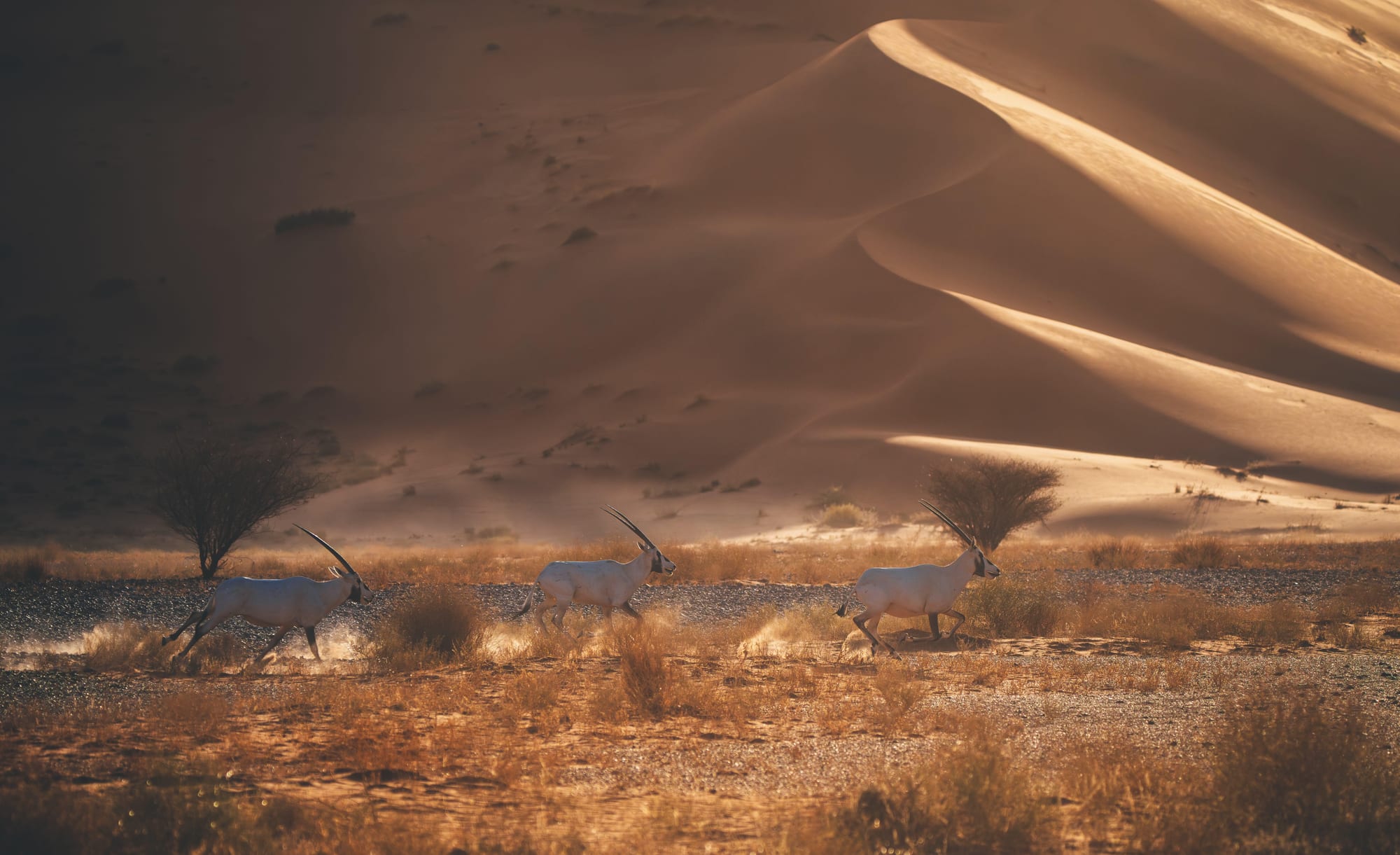
Three white Arabian oryx with long straight horns run across a gravel plain dotted with dry grass and small trees, beneath towering golden sand dunes lit by low sun

Saudi Arabia

Arabian oryx running beneath the dunes of the Uruq Bani Ma'arid Reserve in the Rub' al Khali desert, Saudi Arabia's first natural UNESCO World Heritage Site. (Saudi Press Agency (SPA) / Wikimedia Commons · CC BY-SA 4.0)

The kingdom that occupies most of the Arabian Peninsula — birthplace of Islam and custodian of Mecca and Medina, the world's swing oil producer, an absolute monarchy under the House of Saud, and, since 2016, in the middle of a top-down social and economic overhaul.

Explore Saudi Arabia

History

Arabia was a land of Bedouin tribes, oasis towns, and the Red Sea trade and pilgrimage routes when, in 1744, the emir of Diriyah, Muhammad ibn Saud, allied with the revivalist preacher Muhammad ibn Abd al-Wahhab. Their movement expanded across the peninsula before Ottoman-Egyptian forces destroyed it in 1818; a second Saudi state rose and fell in the nineteenth century. The current kingdom was built by Abdulaziz Ibn Saud, who retook Riyadh in 1902 and unified the Hejaz, with its holy cities of Mecca and Medina, the central Najd, and other regions into the Kingdom of Saudi Arabia in 1932.

The 1938 discovery of oil in the Eastern Province brought immense wealth and a close partnership with the United States. A cautious, oil-funded modernisation was shadowed by religious conservatism, sharpened after extremists seized the Grand Mosque in 1979, and the kingdom played a central role in the 1973 oil embargo and hosted US forces in the 1990–91 Gulf War. Fifteen of the nineteen 11 September hijackers, and Osama bin Laden, were Saudi.

Since 2015 the country has been ruled by King Salman and, in practice, his son Crown Prince Mohammed bin Salman, whose "Vision 2030" drive aims to diversify the economy away from oil and to open and liberalise society — women allowed to drive, the religious police curbed, cinemas and concerts permitted, a first-ever tourist visa, and vast "giga-projects". This has come alongside intensified political repression, including the 2018 murder of the journalist Jamal Khashoggi in the Saudi consulate in Istanbul, and continued mass executions.

  • Saudi Arabia: The Kingdom and the Two Mosques A state built three times by one family in alliance with one religious movement — unifier of the Arabian Peninsula, guardian of Islam's holiest cities, the world's swing producer of oil, and now attempting a state-directed reinvention

Culture & Customs

Saudi culture is Arab, tribal, and Islamic at its core, and the kingdom's identity is bound up with being the birthplace of Islam and the custodian of Mecca and Medina. Family, lineage, and the majlis — the reception room where hospitality means Arabic coffee with cardamom, dates, and endless refills — remain central.

National dress is near-universal: the white thobe and the ghutra or red-checked shemagh for men, and for women the abaya, now a choice for foreigners but still the norm. Older traditions endure — the ardah sword dance, camel racing and camel beauty pageants, falconry, and Nabati poetry — while a young, connected population has embraced, in just a few years, cinemas, concerts, mixed cafés, gaming, and a booming domestic events scene.

The tension between rapid social opening and a firmly closed political system defines the moment.

Daily Life

Saudi Arabia is young, wealthy, and overwhelmingly urban, its population concentrated in Riyadh, Jeddah, Mecca, Medina, and the Eastern Province cities. Around two in five residents are foreign workers — South Asian, Egyptian, Filipino, Yemeni, and others — who do much of the manual and service labour under a sponsorship system that has been partially reformed.

Citizens have long enjoyed generous state support — free health care and education, cheap fuel, and public-sector jobs — funded by oil, and a "Saudisation" policy now pushes nationals into private-sector roles. Vision 2030 has visibly changed daily life: women driving and working in shops and restaurants, entertainment districts, and a construction boom around the giga-projects.

Life still runs on the prayer times, though shops no longer all close for them, and on the extreme heat, which pushes activity to the evening for much of the year.

Food

Saudi cooking varies by region but centres on rice, lamb and chicken, dates, and flatbread. The national dish is kabsa — spiced rice cooked with meat, tomato, and dried lime — with regional cousins such as mandi, cooked in a pit oven, and saleeg, a creamy rice porridge of the Hejaz. Jareesh (cracked wheat with meat), margoog and matazeez dough-and-vegetable stews, and grilled meats are everyday fare.

Breakfast might be ful stewed beans, shakshuka, or mashed banana and bread. Dates are eaten at every opportunity and offered to guests with coffee. Sweets include kunafa, basbousa, and luqaimat dumplings in date syrup, and the Ramadan sunset table is elaborate.

Fresh juices, laban, and a non-alcoholic apple-and-soda "Saudi champagne" stand in for alcohol, which is banned, and coffee — Arabic, Turkish, and imported café styles — is everywhere.

Attractions & Natural Wonders

AlUla, in the northwest, is the flagship of Saudi tourism: Hegra, the kingdom's first UNESCO World Heritage Site, with over a hundred monumental Nabataean tombs carved into desert sandstone, along with the old mud-brick town, ancient inscription sites, the mirrored Maraya concert hall, and dramatic canyon and oasis scenery.

Riyadh has the restored mud-brick district of Diriyah, another World Heritage Site and the dynasty's birthplace, the National Museum, the Masmak fortress, and the Edge of the World cliff escarpment out in the desert. Jeddah's historic Al-Balad quarter, also a World Heritage Site, keeps coral-stone merchant houses with carved wooden screens, and the city is the gateway for the Hajj and Red Sea diving.

The southwest is a green surprise: the misty highland city of Abha, the terraced villages and stone tower-houses of Asir, and Farasan Island. The Empty Quarter, the largest continuous sand sea on Earth, is crossed on 4x4 expeditions. Mecca and Medina, the two holiest cities in Islam, draw millions of pilgrims a year, but their central areas are closed to non-Muslims.

  • Saudi Arabia: Six Attractions and Natural Wonders A lost Nabataean city of tombs carved into sandstone cliffs, the destination of the largest annual religious gathering on earth, and a wind-sculpted rock formation shaped unmistakably like an elephant

Planning basics

Budget

Saudi Arabia is expensive, more like the wealthier Gulf than a budget destination. Riyadh and Jeddah hotels, AlUla accommodation, and desert tours cost most; SAPTCO coaches, ride-hailing, cheap fuel for a hire car, and shawarma-and-kabsa eateries keep a day cheaper.

Daily Budget Midrange
SAR 600–1,400 / USD 160–370 (four-star hotel, restaurants, a hire car, AlUla and desert excursions)
Daily Budget Shoestring
SAR 200–350 / USD 55–95 (budget hotel, local eateries, coaches and ride-hailing)

Book AlUla accommodation and Hegra tickets well ahead — capacity is limited — and drive between cities, as distances are vast and fuel is cheap.

Visa Requirements

Since 2019, citizens of around 60 countries — including the EU, the UK, the US, Canada, Australia, and New Zealand — can get a tourist e-visa online or on arrival, valid for a year with multiple 90-day stays. Umrah and Hajj pilgrims use separate visa routes. A visa does not permit non-Muslims to enter the central areas of Mecca.

Typical Stay
One-year multiple-entry e-visa, 90 days per visit

Safety

Crime is very low and the tourist areas are safe and hospitable, but the country is governed by a strict interpretation of Islamic law with severe penalties. Alcohol is banned; drug offences can bring the death penalty; homosexuality is illegal; and anything read as blasphemy, proselytising, or criticism of the state, the royal family, or Islam — including online, even by visitors — can lead to arrest.

Regional
The UK government advises against all travel within 10 km of the border with Yemen, and against all but essential travel between 10 km and 80 km from it, because of the conflict in Yemen

Dress modestly, avoid photography of people without permission and of any government or military site, keep opinions on politics and religion to yourself, and note that non-Muslims may not enter central Mecca.

Climate

Mostly hot desert, and among the hottest countries on Earth. Summers (May–September) are brutal — 40–50°C in the interior, extremely humid on the coasts — with sandstorms. Winters (December–February) are mild and pleasant in most of the country, cold at night inland, and genuinely cold, sometimes with snow, in the southwest highlands around Abha.

Winter
15–25°C by day; cold nights inland
Interior Summer
40–50°C, May–September

Transportation

Riyadh, Jeddah, and Dammam have the main airports. The Haramain high-speed railway links Jeddah, Mecca, and Medina, a north–south line runs from Riyadh toward Jordan, and Riyadh opened a driverless metro in 2024. Distances are huge and the highways excellent, so most visitors hire a car; ride-hailing is everywhere in the cities.

A 4x4 and a guide are needed for the Empty Quarter and off-road desert; women now drive, and self-drive on the highways is straightforward.

Best Time to Visit

November to March is comfortable across the country and the season for AlUla, the desert, and Riyadh's events. The southwest highlands are pleasant much of the year. Hajj and the Ramadan Umrah season fill Mecca and Medina and strain flights and hotels nationwide. Summer is to be avoided for anything outdoors.

Events
Riyadh Season (winter); the AlUla winter festivals; National Day (23 September); Hajj (dates set by the Islamic calendar)

Currency

The currency is the Saudi riyal (SAR), pegged to the US dollar at 3.75. Cards and contactless payment, including Apple Pay, are used almost everywhere; carry a little cash for markets and small shops.

Symbol
ر.س / SR
Currency Code
SAR — Saudi riyal

Language

Arabic is the official language, in a Najdi dialect in the centre and east and a Hejazi one in the west. English is widely spoken in business, healthcare, aviation, hotels, and tourism, and signage in the cities and at sites is bilingual, so visitors generally manage well without Arabic. Urdu, Hindi, Tagalog, and other languages are common among the large migrant workforce.

English
Widely spoken in cities, business, and tourism
Official Language
Arabic