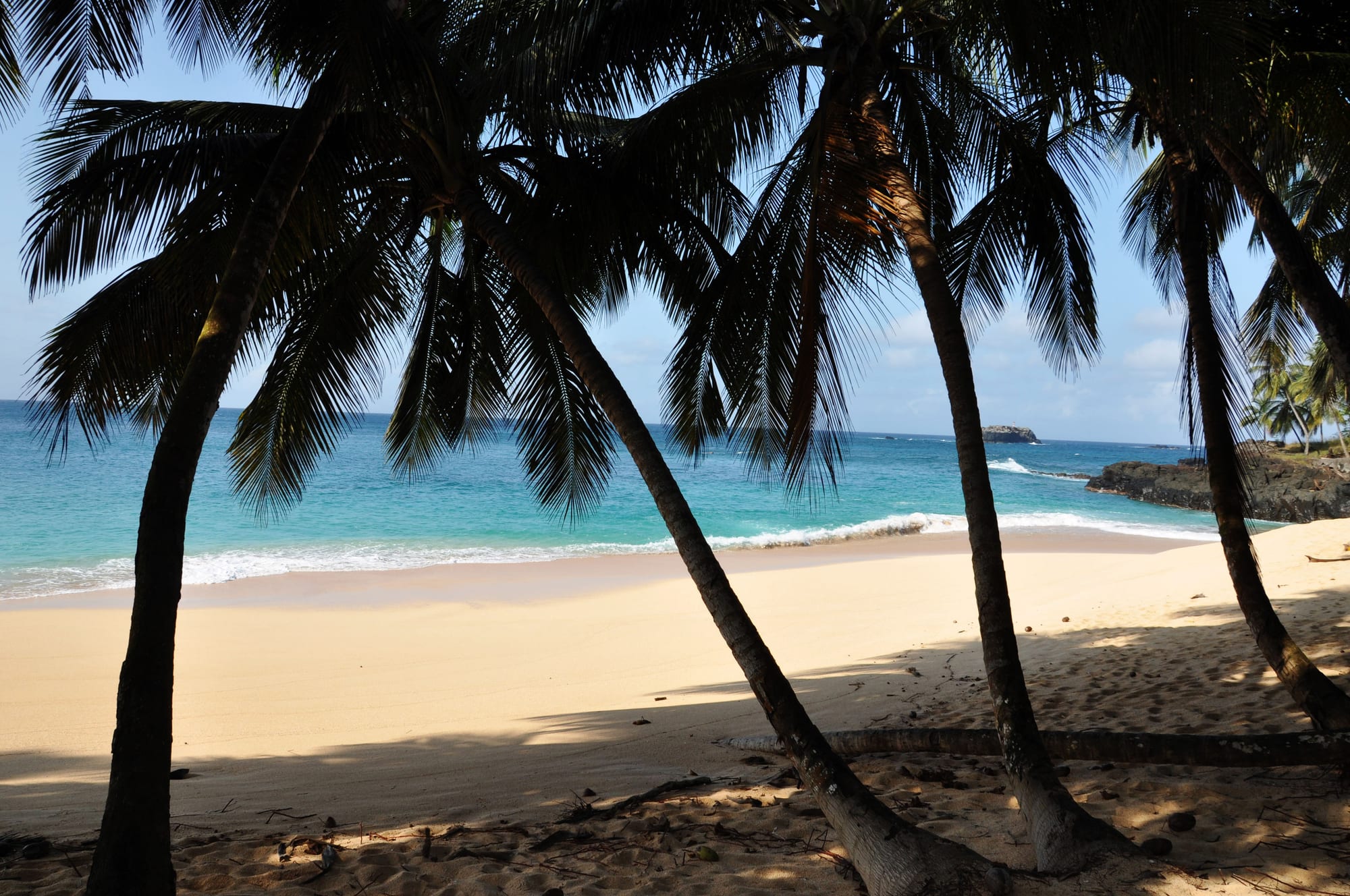
Leaning coconut palms framing an empty beach of golden sand, with turquoise sea, a line of white surf and a small rocky islet offshore under a clear blue sky

São Tomé and Príncipe

Coconut palms shade the golden sand of Praia Boi on the island of Príncipe. (Lboncompain / Wikimedia Commons · CC BY-SA 4.0)

Two small volcanic islands straddling the equator in the Gulf of Guinea — the site of the world's first plantation-slavery economy, once the world's largest cocoa producer, now a lush, quiet, Portuguese-speaking ecotourism destination.

Explore São Tomé and Príncipe

History

The islands were uninhabited when the Portuguese arrived around 1470, and from the 1490s they became the site of the world's first plantation economy based on African slave labour, growing sugar with enslaved people shipped from the nearby mainland. São Tomé was briefly the world's largest sugar producer and a major entrepôt of the transatlantic slave trade.

As sugar declined, the islands turned to coffee and then cacao, and by the early 1900s São Tomé and Príncipe was the world's largest cocoa producer, grown on huge estates — roças — worked by "contract labourers" recruited, often coercively, from Angola, Mozambique, and Cape Verde; conditions there prompted a British chocolate-industry boycott in 1909. The 1953 Batepá massacre, in which colonial forces and settlers killed hundreds of islanders amid labour unrest, became a founding grievance of the independence movement.

Independence from Portugal came on 12 July 1975. Most Portuguese planters left, the roças were nationalised and ran down, and the country was a one-party Marxist state until 1990, when it became one of the first in Africa to adopt multiparty democracy. Elections and peaceful transfers of power have followed, with a few quickly reversed coup attempts, and Príncipe has had autonomous regional government since 1995.

  • São Tomé and Príncipe: The Sugar and Cocoa Islands Two uninhabited volcanic islands in the Gulf of Guinea that Portugal turned into the world's first plantation colony — a laboratory for the model that would be exported across the Atlantic, and later the world's largest cocoa producer, run on labour that was slavery in all but name

Culture & Customs

São Toméan culture is Luso-African and Creole, overwhelmingly Catholic, and relaxed in pace — the local phrase leve-leve, "easy-easy", is a byword for the national temperament. The old roças, with their manor houses, hospitals, chapels, and rows of workers' quarters, are living communities and a distinctive part of the landscape and identity.

Music and dance carry the African inheritance: the ússua and socopé ballroom forms, the drumming and processional danço-congo, and the tchiloli, a centuries-old outdoor folk play retelling a medieval European tale of Charlemagne, performed over hours at saints' festivals. Extended family, the church calendar, and community obligation shape daily life.

Daily Life

Most people live on São Tomé, in and around the capital and along the northeast coast, with Príncipe home to only a few thousand. This is one of the poorest countries in the world, small and dependent on aid and remittances, with frequent power cuts and weak infrastructure.

Cocoa is still the main export, increasingly as organic, fine-flavour beans sold to premium chocolate makers, alongside coffee, copra, palm oil, and pepper. Long-held hopes of offshore oil have not paid off. Tourism is small but growing, centred on the forests, the roças, birdlife, beaches, and whale-watching, and Príncipe — a UNESCO Biosphere Reserve — has staked its future on low-volume, sustainable travel.

Food

São Toméan cooking is tropical and fish-forward. Calulu, a stew of smoked or fresh fish with palm oil, okra, and a mass of forest greens and herbs, served with angú (a firm cornmeal or breadfruit paste), is the national dish. Grilled and fried fish, breadfruit, and cooked bananas are everyday staples, and the molho no prato — fish poached at the table in a pepper and lime sauce — is a speciality.

The islands' own cocoa and coffee are excellent, and there is a small artisanal chocolate industry. Palm wine and a sugarcane spirit, cacharamba, are the local drinks, along with fresh juices from the abundant tropical fruit.

Attractions & Natural Wonders

Pico Cão Grande, a slender volcanic spire rising sheer from the rainforest of Obô Natural Park, is the emblem of São Tomé, admired from viewpoints and forest trails. The park covers much of the mountainous interior of both islands, dense with endemic birds, orchids, and giant begonias, explored with a guide from villages such as Bom Sucesso.

The old roças — Água Izé, Agostinho Neto, Monte Café, and the grand hilltop Roça Sundy on Príncipe, from which Arthur Eddington's 1919 eclipse expedition helped confirm Einstein's theory — can be visited and some are now hotels. The beaches range from the black volcanic sand near the capital to the palm-lined white sand of Príncipe's Praia Banana and the southern islet of Rolas, where a marker sits on the equator.

São Tomé town itself has a small, faded colonial core — a cathedral, a fort, and pastel administrative buildings — and the surrounding waters are good for snorkelling, diving, and, in season, watching humpback whales.

Planning basics

Budget

São Tomé and Príncipe is not a budget destination: flights are limited and pricey, and Príncipe's tourism is dominated by a few upmarket lodges. On São Tomé, guesthouses (residenciais), local eateries, and shared transport keep costs down.

Daily Budget Midrange
EUR 120–300 (mid-range hotel or roça lodge, restaurants, a hire car or driver, birding and boat trips)
Daily Budget Shoestring
EUR 40–75 on São Tomé (guesthouse, local restaurants, shared taxis)

Príncipe is a significant added cost — a flight and lodge stay — so many visitors focus on São Tomé's forests, roças, and beaches.

Visa Requirements

Citizens of the EU, the US, and several other countries can enter visa-free for up to 15 days; others use an e-visa or a visa on arrival with pre-authorisation. Yellow-fever vaccination is required for entry.

Typical Validity
15 days visa-free for some nationalities; e-visa or visa on arrival for longer stays

Check the current visa position with a São Toméan mission or the e-visa portal, as rules have changed.

Safety

São Tomé and Príncipe is one of the safest countries in Africa for visitors, with very low crime and a calm, friendly society. Petty theft from beaches, cars, and rooms is the main issue. The real considerations are practical: very limited medical care, with serious cases needing evacuation abroad; year-round malaria on both islands; and rough seas and strong currents on some beaches, especially in the rains.

Health
Yellow-fever vaccination is required; take malaria prophylaxis and precautions; drink bottled or treated water

Carry comprehensive insurance with medical evacuation cover, use a guide for forest treks in Obô park, and admire Pico Cão Grande from the trails — the climb itself is for expert rock climbers only.

Climate

Tropical, hot, humid, and equatorial, with fairly steady temperatures. The main dry season, the gravana, runs roughly June to September — cooler, drier, and the best time to travel — with a shorter dry spell in January. The rest of the year is wet, heaviest from October to May, and the southwest of São Tomé is extremely rainy. There are no cyclones.

Dry Season
June–September (gravana)
Temperature
24–30°C at sea level; cooler in the highlands

Transportation

São Tomé International Airport has flights from Lisbon, Accra, Libreville, and Luanda. A short flight, and an infrequent boat, connect São Tomé with Príncipe. On São Tomé there are shared taxis and minibuses, private taxis (agree the fare), and hire cars — a 4x4 helps for the rough south and interior. Príncipe is tiny, with transfers arranged by lodges.

Avoid driving the unlit interior and southern roads at night, and budget extra time — journeys are slow.

Best Time to Visit

June to September, the gravana dry season, is best for beaches, hiking, and the interior roads, with a shorter dry window in January. Humpback whales pass from about July to October. The rainy months are lush and good for birding and waterfalls but travel is muddier.

Events
Independence Day (12 July); São Lourenço and other saints' festivals with tchiloli and danço-congo performances

Currency

The currency is the dobra (STN), pegged to the euro since 2010. Euros are widely accepted alongside dobras. Cards work at a few São Tomé hotels only; this is largely a cash economy, and ATMs are limited to the capital.

Symbol
Db
Currency Code
STN — dobra

Language

Portuguese is the official language and is spoken by nearly everyone, making this the only African country where Portuguese is close to universal. Portuguese-based creoles — Forro, Angolar, and Príncipe's endangered Lung'Ie — are also spoken, along with Cape Verdean Creole among descendants of contract labourers. English is limited to the tourism sector.

Also Spoken
Forro, Angolar, and Lung'Ie creoles
Official Language
Portuguese