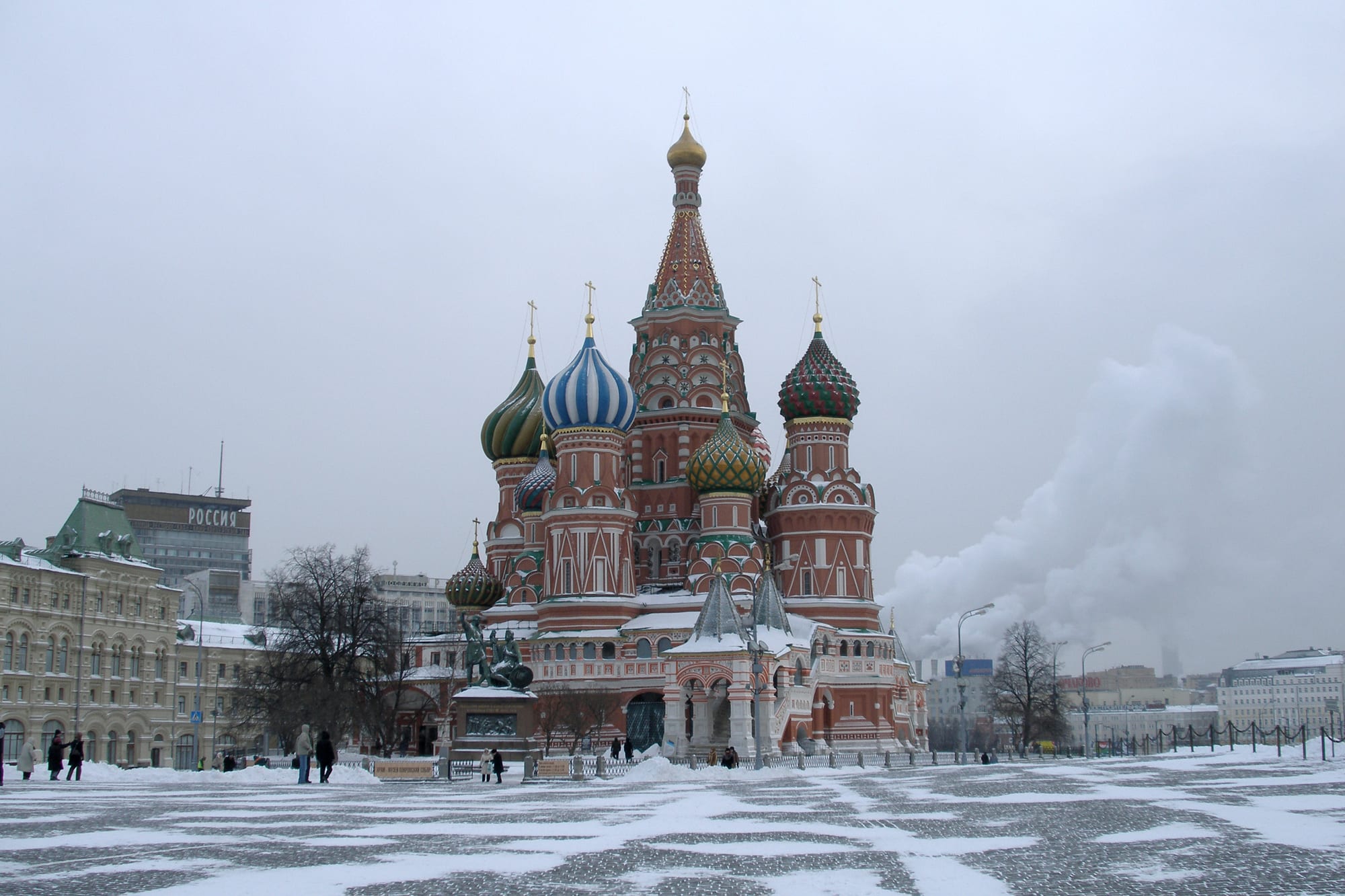
A cluster of brightly coloured, patterned onion domes on a stone Orthodox cathedral, seen across the open expanse of Red Square under a clear sky

Russia

Saint Basil's Cathedral on Red Square in Moscow, commissioned by Ivan the Terrible in the 1550s. (Vyacheslav Argenberg / Wikimedia Commons · CC BY 4.0)

The largest country on Earth, spanning eleven time zones from Eastern Europe to the Pacific — heir to the tsarist and Soviet empires, ruled since 2000 by Vladimir Putin, and since 2022 fighting the largest war in Europe since 1945 and cut off from the West by sanctions.

Explore Russia

History

Russia's story runs from Kievan Rus' — a medieval realm whose legacy Russia, Ukraine, and Belarus all claim — through Mongol domination, the rise of Moscow, and the first tsar, Ivan the Terrible, to the Romanov dynasty from 1613. Peter the Great turned the country toward Europe and built St Petersburg; Catherine the Great expanded the empire; and the nineteenth century brought the defeat of Napoleon, the end of serfdom, and expansion across the Caucasus, Central Asia, and Siberia to the Pacific.

The revolutions of 1917 ended the monarchy and brought the Bolsheviks to power, followed by civil war and the creation of the Soviet Union in 1922. Stalin's forced collectivisation and its famines, the Gulag, and the Great Terror preceded the enormous sacrifice and victory of the "Great Patriotic War", in which some 27 million Soviet citizens died — a memory now central to national identity. Cold War superpower decades followed, and then Gorbachev's reforms, which led to the dissolution of the USSR in 1991.

The chaotic 1990s under Yeltsin brought privatisation, the oligarchs, a collapse in living standards, the first Chechen war, and the 1998 default, and then the rise of Vladimir Putin, an ex-KGB officer made acting president on the last day of 1999. Over two decades, an oil-and-gas windfall funded rising living standards while independent media, courts, elections, and civil society were hollowed out, and Russia fought wars in Chechnya, Georgia, and Ukraine and intervened in Syria. On 24 February 2022 it launched the full-scale invasion of Ukraine, the largest war in Europe since 1945, which has brought an ICC arrest warrant for Putin, an unprecedented wall of Western sanctions, a partial mobilisation that drove hundreds of thousands to flee, sweeping wartime censorship, the death of the opposition leader Alexei Navalny in an Arctic prison in 2024, and a deepening alignment with China, Iran, and North Korea.

  • Russia: The Empire That Keeps Returning The largest country on Earth — a Moscow principality that grew into a Eurasian empire, collapsed into revolution, rebuilt itself as the Soviet Union, dissolved again in 1991, and reconstituted a centralised state under Vladimir Putin

Culture & Customs

Russian high culture casts a long shadow — the novels of Tolstoy, Dostoevsky, and Chekhov; the poetry of Pushkin; the music of Tchaikovsky and Shostakovich; the Bolshoi and Mariinsky ballet; and the icon painting and onion-domed churches of an Orthodox Christianity long bound to the state.

Everyday culture prizes deep, unshowy friendship over surface warmth, endurance and irony in the face of hardship, and rituals of hospitality around the table — tea from a samovar, zakuski appetisers, and toasts. The dacha, a modest country cottage and garden, is where much of urban Russia spends the summer, and the wood-fired banya steam bath is a social institution.

Victory Day and the memory of the war are sacralised, with "Immortal Regiment" marches of families carrying portraits of relatives who fought. Since 2022, culture has been increasingly bent to the war effort, dissenting artists have left or been silenced, and a "traditional values" campaign has hardened the repression of LGBT people and of independent expression.

Daily Life

About three-quarters of Russians live in cities, concentrated in European Russia west of the Urals, with Moscow — wealthy, fast, expensive, and heavily surveilled — in a class of its own, and St Petersburg, the imperial capital, its cultured rival. East of the Urals, Siberia and the Far East hold vast territory and few people, in cities strung along the Trans-Siberian Railway.

Living standards rose substantially in the 2000s but stagnated after 2014 and have been reshaped by the war: a defence-driven boom in industrial regions and for soldiers' families, labour shortages and high wages in some sectors, alongside the exit of Western brands, higher prices, and the emigration of many educated young people. Outside the big cities, incomes are far lower and the population is ageing and shrinking.

Life is lived under a pervasive, and since 2022 sharply tightened, set of controls on speech, assembly, media, and movement, with the war a constant if unevenly felt presence.

Food

Russian cooking is built for a cold climate: soups, grains, root vegetables, cabbage, dill, sour cream, and preserved and pickled foods. Borsch, a beetroot soup that originates in Ukraine, and shchi, a cabbage soup, are the classic first courses, followed by pelmeni meat dumplings, beef stroganoff, stuffed cabbage rolls, and blini pancakes with caviar, smoked fish, or curd — eaten in vast quantities at Maslenitsa before Lent.

Zakuski — pickled cucumbers and mushrooms, herring "under a fur coat", cured fish, salads, and black bread — open a proper meal, alongside vodka and toasts. Kasha grain porridge, cold okroshka soup in summer, and stuffed pirozhki buns are everyday food. Tea drunk strong with jam, and mildly fermented rye kvass, are the traditional non-alcoholic staples.

Attractions & Natural Wonders

Moscow's Red Square, ringed by the Kremlin walls, the candy-coloured domes of St Basil's Cathedral, and Lenin's mausoleum, is the symbolic centre of the country, with the Tretyakov Gallery, the palatial metro, and the Bolshoi nearby. St Petersburg, built on the Neva by Peter the Great, is a Baroque and Neoclassical city of canals and palaces — the Hermitage in the Winter Palace, the gilded Peterhof fountains, the Church of the Saviour on Spilled Blood — best seen in the near-endless light of the June "White Nights".

The "Golden Ring" of old towns northeast of Moscow — Sergiev Posad, Suzdal, Vladimir, Yaroslavl — preserves medieval Russia. The Trans-Siberian Railway is the classic long journey, across the Urals and the taiga to Lake Baikal, the deepest and oldest lake on Earth, and on to Vladivostok on the Pacific.

Beyond lie the volcanoes and bears of Kamchatka, the Arctic tundra, the Caucasus mountains and the Black Sea resorts around Sochi, and the Muslim-Tatar city of Kazan on the Volga. All of this, at present, sits behind the strong advice against travel.

  • Russia: Ten Attractions and Natural Wonders The world's largest country by far, holding an onion-domed cathedral known the world over, the deepest lake on earth, and an entire wooden church built without a single nail — described here for reference amid an ongoing war and sweeping international sanctions

Planning basics

Budget

Costs vary hugely between expensive Moscow and St Petersburg and the far cheaper regions. The practical difficulty is not price but payment: Western bank cards do not work, and foreign money transfers are largely blocked, so travellers rely on cash roubles exchanged from cash brought in.

Daily Budget Midrange
RUB 8,000–18,000 / USD 90–200 (mid-range hotel, restaurants, domestic flights or fast trains, museums)
Daily Budget Shoestring
RUB 3,000–6,000 / USD 35–70 (hostel, canteens and markets, metro and trains)

Bring enough hard currency in cash for the whole trip; Visa and Mastercard issued abroad are unusable and there is no easy workaround.

Visa Requirements

Almost all nationalities need a visa, obtained in advance with an invitation, and an electronic visa scheme operates for some. Consular capacity has been cut sharply since 2022. Dual Russian citizens are treated as Russian nationals, may be denied consular help, and can be subject to military call-up.

Typical Validity
30 days on an e-visa; longer on a standard tourist visa with an invitation

Most governments advise against all travel to Russia; a visa being obtainable does not make travel safe or advisable.

Safety

Beyond the ordinary crime of a large European city, the decisive risks are political and legal: near-total loss of consular support, a real risk of arbitrary arrest and lengthy detention of foreigners on politically motivated charges (and their use in prisoner swaps), sweeping wartime censorship laws, and the possibility that men of certain ages, including dual nationals, face conscription or exit bans. Drone and missile activity affects regions near Ukraine and, at times, Moscow.

High Risk Areas
The North Caucasus republics (terrorism); all regions bordering Ukraine and occupied Ukrainian territory (active conflict)

Worldlore covers Russia so it can be understood, not to encourage travel there now. Read your government's advisory in full; LGBT people face severe legal repression, and photographing military or infrastructure sites can bring espionage charges.

Climate

Mostly cold and continental, and extreme in Siberia. European Russia has warm summers and cold, snowy winters. Siberia ranges from severe to among the coldest inhabited places on Earth. The Black Sea coast around Sochi is humid subtropical, and the Arctic north has polar night and midnight sun.

Moscow
January around −6 to −10°C; July around 19°C
Siberia
Winter lows below −50°C in Yakutia; short warm summers

Transportation

Moscow and St Petersburg are the hubs, but since 2022 there are no direct flights to Western Europe or North America — travel is via Istanbul, Dubai, Yerevan, or Belgrade. Rail is a genuine strength: the Moscow–St Petersburg high-speed Sapsan, and the Trans-Siberian to Vladivostok, the world's longest continuous rail journey. Moscow's palatial metro is deep, fast, and cheap.

Carry your passport, visa, and migration card at all times, and use the Yandex Go app rather than street taxis.

Best Time to Visit

May to September for European Russia and the Golden Ring; June and July for St Petersburg's "White Nights"; and, for the well-equipped, February–March for a frozen Lake Baikal. Victory Day on 9 May is the biggest state occasion, with a large military parade on Red Square.

Events
Victory Day (9 May); Maslenitsa (before Lent); Orthodox Easter and Christmas (7 January)

Currency

The currency is the rouble (RUB). International Visa and Mastercard do not function in Russia, ATMs will not accept foreign cards, and SWIFT restrictions block most transfers. Cash brought in and exchanged is the only reliable means of payment.

Cards
Foreign-issued cards do not work
Symbol
Currency Code
RUB — Russian rouble

Language

Russian is the official language of the federation and the common language across it, written in Cyrillic, and a lingua franca of much of the former USSR. The ethnic republics have their own co-official languages — Tatar, Chechen, Yakut, Buryat, and many more. English is spoken by younger people in Moscow and St Petersburg but far less widely elsewhere, and signage outside the big cities is often Cyrillic only.

Also Official
Republic languages such as Tatar, Chechen, and Yakut
Official Language
Russian