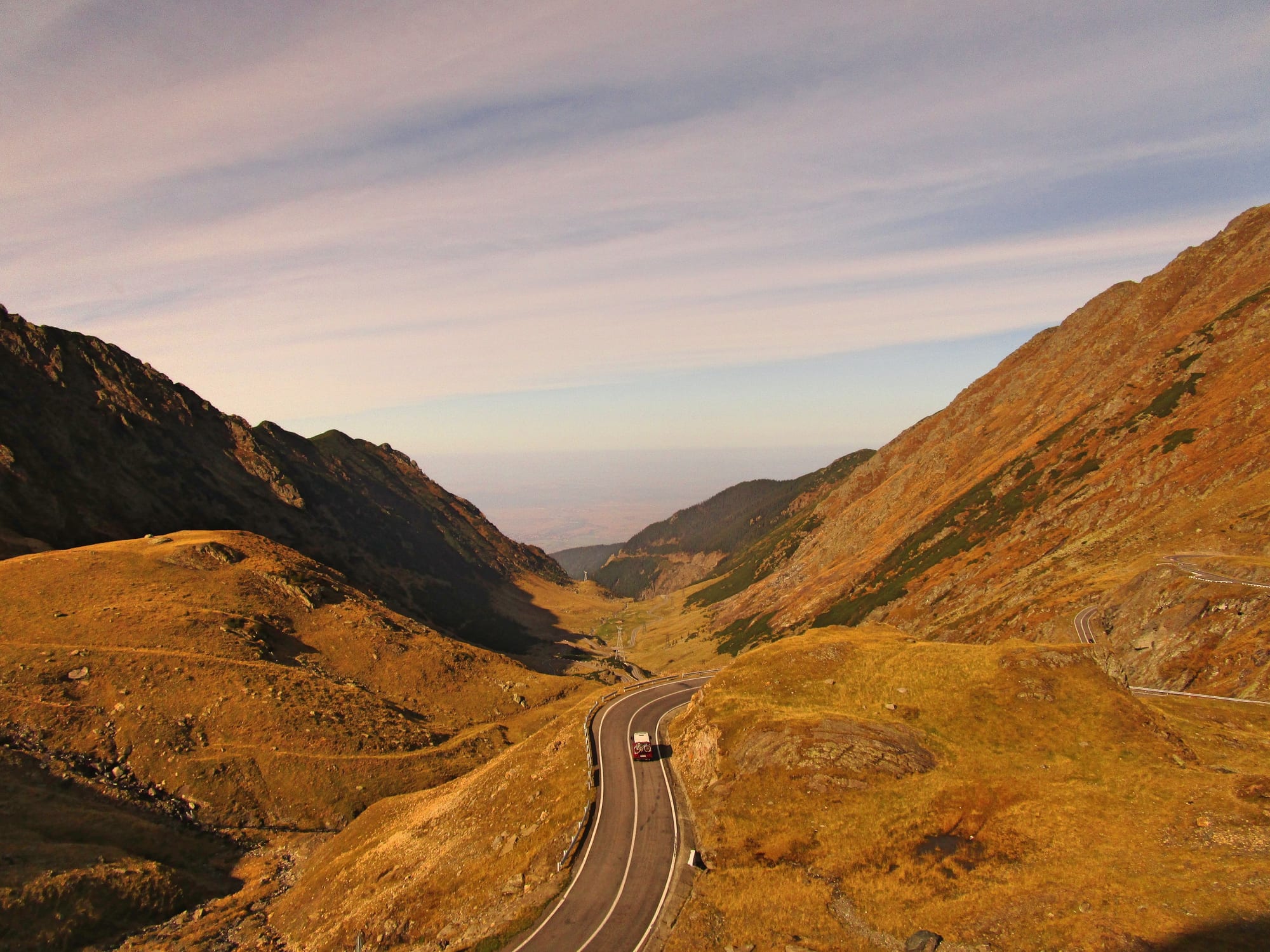
A paved road switchbacking in tight hairpins up a steep green mountainside toward jagged peaks under a bright sky

Romania

The Transfăgărășan, a high mountain road built across the Făgăraș range of the Carpathians in the 1970s on Ceaușescu's orders. (Livin4wheel / Wikimedia Commons · CC0 (public domain dedication))

A country of the Carpathians, the lower Danube, and the Black Sea coast — Latin-speaking in a Slavic and Hungarian neighbourhood, once ruled by the bizarre cult of Ceaușescu, and since a violent 1989 revolution an EU and NATO state on the front line of the war in Ukraine.

Explore Romania

History

Romania traces its language and a founding national myth to Roman Dacia, conquered by the Emperor Trajan in AD 106. In the Middle Ages three principalities took shape: Orthodox Wallachia and Moldavia, under Ottoman suzerainty but never fully absorbed — the homelands of Vlad the Impaler and Stephen the Great, remembered for resisting the Turks — and Transylvania, long tied to Hungary and then the Habsburgs, with its Hungarian, Saxon, and Székely communities and a Romanian majority. Wallachia and Moldavia united in 1859 to form Romania, which gained independence in 1878 and expanded after the First World War into "Greater Romania".

In the Second World War, Romania under General Antonescu allied with Nazi Germany, was complicit in the Holocaust, and then switched sides in a 1944 royal coup. Four decades as a communist state followed, culminating in the bizarre and brutal personality cult of Nicolae Ceaușescu, whose forced natalism, village demolitions, monumental building projects, and export of the country's food to pay off debt made the 1980s years of cold, dark, and hunger.

The revolution of December 1989 — the only violent one in the Eastern bloc — ended with Ceaușescu and his wife shot on Christmas Day. A rocky transition run by former communists, with miner-mob crackdowns and endemic corruption, gave way to EU accession in 2007 and an anti-corruption drive that jailed much of the political class. In 2024–2025 a court annulled a presidential election won in the first round by a Russia-linked nationalist, before a pro-EU centrist, the mayor of Bucharest, won the re-run.

  • Romania: The Latin Island in a Slavic Sea A Romance-speaking people at the mouth of the Danube — principalities caught between three empires, a kingdom forged in the 19th century, a wartime dictatorship, forty years of communism ending in the bloc's only violent revolution, and a hard road into the West

Culture & Customs

Romanian identity rests on the Latin-descended language, Orthodox Christianity, and a deep rural tradition of wooden churches, painted monasteries, hand-carved gates, embroidered blouses, and the doina folk song and lăutari fiddle music of the Roma musicians. Village life — hay meadows scythed by hand, shepherds moving flocks to the mountains, feast days and elaborate weddings — survives more strongly than in most of Europe, and Maramureș in the north is its showcase.

The country has produced outsized figures: the sculptor Brâncuși, the playwright Ionesco and the essayist Cioran, the historian of religion Eliade, the composer Enescu, and the gymnast Nadia Comăneci, the first to score a perfect 10. Vampire folklore is a small, real strand of rural belief that the outside world, via Bram Stoker, has magnified into an industry around "Dracula".

Café culture is strong in the cities, and hospitality — pressing food and țuică plum brandy on a guest — is a point of honour.

Daily Life

Romania is emptying and ageing: since 1990 several million people, disproportionately young and skilled, have left for Italy, Spain, Germany, and the UK, and the population has fallen by well over two million, with rural areas and the poorer south and east hit hardest.

The counterweight is a fast-growing urban economy — Bucharest, and the Transylvanian cities of Cluj-Napoca, Timișoara, Brașov, and Sibiu, along with Iași — driven by a large, well-paid IT and software sector, a big automotive industry, and EU-funded infrastructure. Wages remain among the lowest in the EU, though rising quickly, and the gap between the booming cities and villages where subsistence farming and remittances are still the norm is wide.

Corruption, slow public administration, and a chronically underbuilt motorway network are the standing frustrations, and the country lives with the war next door as a front-line NATO and EU state supporting Ukraine.

Food

Romanian cooking is hearty, pork-heavy, and shaped by Balkan, Turkish, Hungarian, and German influence. Mămăligă, a firm cornmeal polenta, is the traditional staple, eaten with cheese, sour cream, and a fried egg or alongside stews. Sarmale — minced pork and rice rolled in pickled cabbage, simmered for hours — is the festive centrepiece, especially at Christmas.

Ciorbă, a large family of sour soups, ranges from tripe to chicken to meatball, and the grill gives mici, skinless minced-meat rolls eaten with mustard and bread. Zacuscă, a roasted-pepper and vegetable spread put up in jars each autumn, telemea cheese, and pickles are everywhere.

Sweets include cozonac, a rich walnut or poppy-seed sweet bread for holidays, and papanași, fried doughnuts with sour cream and jam. Wine is a serious and improving industry with native grapes such as Fetească Neagră, and țuică and pălincă plum spirits, often homemade, are the strong drinks.

Attractions & Natural Wonders

Transylvania is the tourist heart: the fortified Saxon churches and villages of Viscri and Biertan, the medieval towns of Sibiu, Brașov, and Sighișoara (Vlad the Impaler's birthplace), and the castles the Dracula industry has attached itself to — clifftop Bran and the grander Corvin at Hunedoara.

The Carpathians, curving through the country, offer the Bucegi and Piatra Craiului massifs, the Retezat and Făgăraș ranges, brown bears and wolves, highland shepherd culture, and the two spectacular alpine roads, the Transfăgărășan and Transalpina. In the northeast, Bucovina's painted monasteries — Voroneț, Moldovița, Sucevița — are covered inside and out in Renaissance frescoes, and neighbouring Maramureș keeps its tall wooden churches, carved gates, and the "Merry Cemetery" of Săpânța.

The Danube Delta, where Europe's second-longest river fans out into a vast wetland before the Black Sea, is one of the continent's great birding and wilderness areas. Bucharest itself mixes belle-époque boulevards, Ceaușescu's colossal Palace of Parliament, and a lively café and nightlife scene.

  • Romania: Seven Attractions and Natural Wonders A hilltop castle inseparably linked to the Dracula legend, one of the world's largest wetlands teeming with pelicans, a fortified medieval town still lived in, and a mountain road built as a Cold War military escape route

Planning basics

Budget

Romania is one of the cheaper countries in the EU. Guesthouses (pensiuni), village homestays, and traditional restaurants cost little; Bucharest and the Transylvanian cities are pricier but still moderate. Hiring a car adds the most, and it is close to essential for the villages and mountain roads.

Daily Budget Midrange
RON 400–850 / EUR 80–170 (mid-range hotel, restaurants, a hire car, guided monastery or mountain trips)
Daily Budget Shoestring
RON 150–280 / EUR 30–56 (guesthouse, traditional restaurants, trains and buses)

A hire car opens up the Saxon villages, the painted monasteries, and the Transfăgărășan road, none of which are easy by public transport.

Visa Requirements

Romania is in the EU and, since 2025, fully in the Schengen Area. Citizens of the EU, the UK, the US, Canada, Australia, New Zealand, and many other countries need no visa for stays of up to 90 days in any 180-day period.

Typical Stay
90 days in any 180-day period, visa-free, for most Western passports

Safety

Romania is a safe country with low violent crime. The common issues are pickpocketing on Bucharest public transport, taxi overcharging, and occasional distraction scams (including "fake police" asking to see your wallet — refuse). Driving is the real risk, with one of the EU's highest road-death rates. In the Carpathians, a large and increasingly bold brown bear population means keeping distance, never feeding them, and storing food carefully when camping.

Natural
Fast-changing mountain weather on serious ridge trails, ticks in summer, and heat on the plains

Book taxis by app, drive defensively on two-lane roads, don't approach or feed roadside bears, and check conditions before high Carpathian hikes.

Climate

Temperate-continental, with four distinct seasons. Summers are hot, reaching the high thirties on the southern plains; winters are cold and snowy, especially in the Carpathians and the northeast. The mountain arc through the centre of the country is cooler and wetter, with a long ski season. Spring and autumn are pleasant.

Summer
June–August, 25–38°C on the plains
Winter
December–February, snow in the Carpathians and the north

Transportation

Bucharest's Otopeni airport is the main gateway, with Cluj, Timișoara, and Iași also well served. The railway is extensive but slow, and scenic on the Carpathian lines and the narrow-gauge Mocănița steam routes. Motorway coverage is still thin, but the Transfăgărășan and Transalpina mountain roads (open roughly June–October) are attractions in themselves.

Use taxi apps (Bolt, Uber) rather than street taxis, buy a road vignette if driving, and watch for horse carts and unlit pedestrians on rural roads at night.

Best Time to Visit

May–June and September–October are ideal for Transylvania's towns, the Carpathians, the villages, and the painted monasteries, with fewer crowds than July–August. Summer suits the Black Sea coast and the Danube Delta, where birdlife peaks in late spring. December to February is the ski season.

Events
Sighișoara Medieval Festival (July); the George Enescu Festival, Bucharest (September, odd years); Orthodox Easter and Christmas traditions

Currency

Romania uses the leu (RON), not the euro. Cards and contactless payment are widely accepted in cities and towns; carry cash for village guesthouses, markets, small restaurants, and monastery donations.

Symbol
lei
Currency Code
RON — Romanian leu

Language

Romanian is the official language, a Romance language descended from Latin and the only one of its family in this part of Europe. Hungarian is widely spoken in parts of Transylvania and has local co-official use where the Hungarian minority is large; German survives among the remaining Saxons. English is widely spoken by younger people and in tourism and the tech sector.

Also Spoken
Hungarian in parts of Transylvania; German; English among younger people
Official Language
Romanian