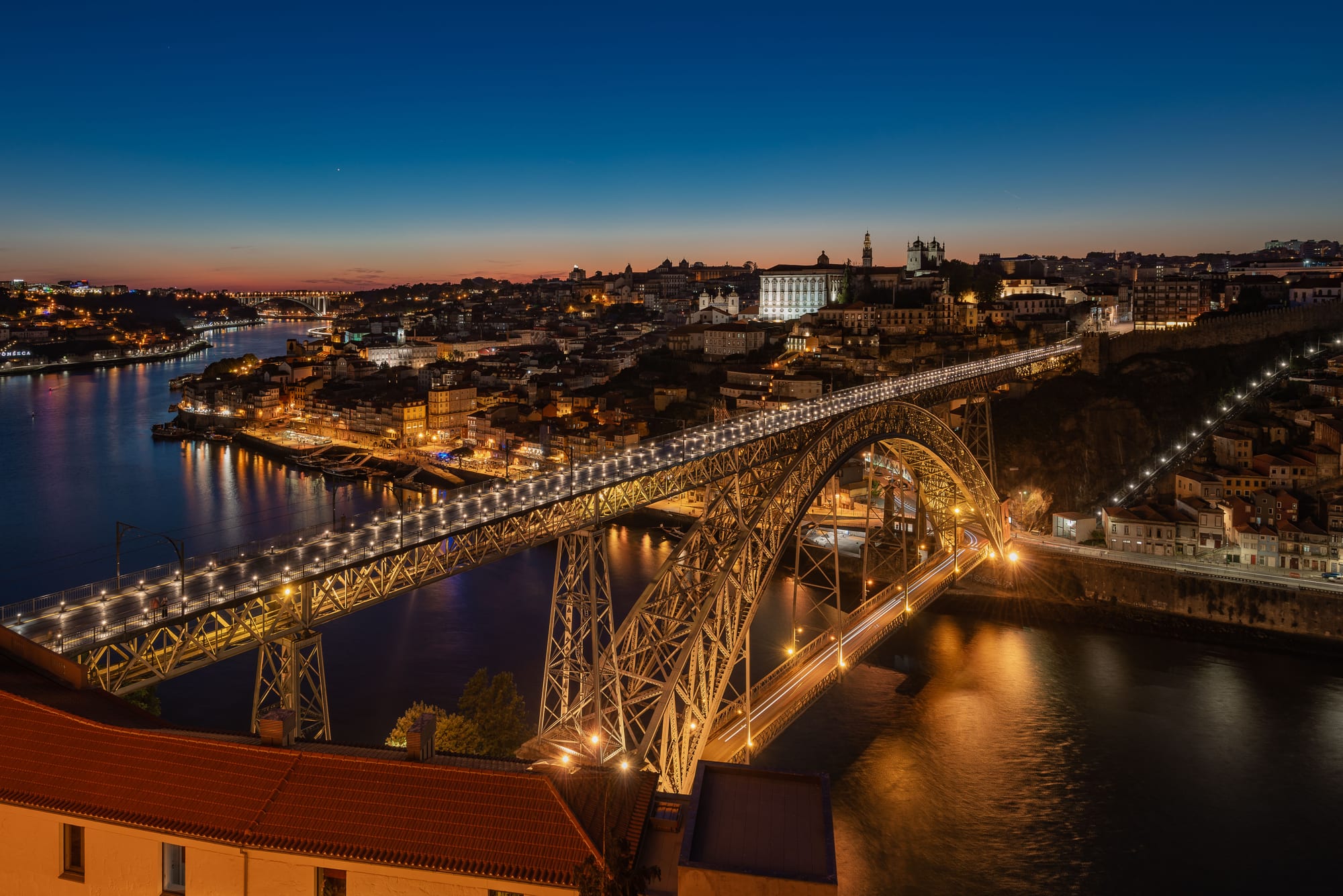
A double-deck iron arch bridge lit in gold spans a dark river at twilight, with the lights of a hillside old town behind and an orange glow on the horizon under a deep blue sky

Portugal

The Dom Luís I Bridge across the Douro in Porto at twilight, seen from the Serra do Pilar viewpoint. (T meltzer / Wikimedia Commons · CC BY-SA 4.0)

A country on the Atlantic edge of Iberia with some of Europe's oldest borders — once the seat of a global maritime empire, ruled by a long 20th-century dictatorship, and since the 1974 Carnation Revolution a settled, EU-anchored democracy and a booming tourist destination.

Explore Portugal

History

Portugal became independent under Afonso Henriques in the twelfth century and completed the reconquest of its territory from the Moors by 1249, giving it some of the oldest stable borders in Europe. In the fifteenth and sixteenth centuries this small kingdom pioneered European ocean exploration — down the African coast, round the Cape with Bartolomeu Dias, to India with Vasco da Gama, and to Brazil with Cabral — building a global empire and growing rich on spices, Brazilian gold, and the Atlantic slave trade. The 1755 Lisbon earthquake, tsunami, and fire killed tens of thousands and reshaped both the capital and European thought.

The Napoleonic invasion sent the court fleeing to Brazil, which declared independence in 1822, and a long nineteenth-century decline followed. The monarchy fell in 1910, and from 1926 Portugal was ruled by the authoritarian "Estado Novo" of António de Oliveira Salazar — repressive, poor, and, in its final years, bogged down in a colonial war against independence movements in Angola, Mozambique, and Guinea-Bissau.

The near-bloodless Carnation Revolution of 25 April 1974, led by junior officers and joined by the public, ended the dictatorship. Rapid decolonisation brought about half a million settlers home, and after a turbulent few years Portugal settled into democracy, joined the EU in 1986, and adopted the euro. The 2010–2014 sovereign-debt crisis brought a bailout and austerity; the recovery since has been real, though a long two-party alternation has recently been disrupted by the rise of the hard-right Chega party.

  • Portugal: The Atlantic Edge Europe's oldest fixed border and its first global empire — the country that opened the sea route to Asia, lost and regained its independence from Spain, endured Europe's longest dictatorship, and freed itself in an afternoon with almost no blood

Culture & Customs

Portuguese culture carries a distinctive mood of saudade — a wistful longing for people, places, and times that are gone — expressed above all in fado, the melancholic urban song of Lisbon and Coimbra, now UNESCO-listed. The sea and the age of discoveries run through the national story, in monuments, the Manueline architecture of Belém, and a self-image as a small country with a large past.

Catholicism shaped the calendar — Holy Week, the Fátima pilgrimages, and the June "popular saints" festivals of grilled sardines, paper decorations, and street dancing — though observance has fallen sharply. Family and the long Sunday lunch matter, hospitality is warm and unshowy, and café culture over a bica espresso and a custard tart is universal.

Football is the mass passion, with Benfica, Porto, and Sporting and a golden generation from Figo to Cristiano Ronaldo. Craft traditions remain visible everywhere, from the blue-and-white azulejo tiles on churches and metro stations to filigree gold, cork, and ceramics.

Daily Life

Portugal is a coastal country: most people live in the strip from the Minho down through Porto and the centre to Greater Lisbon and on to the Algarve, while the interior — the Alentejo's vast estates, the hills of Trás-os-Montes and the Beiras — ages and empties. Lisbon and Porto are increasingly cosmopolitan, tech-inflected, and expensive, and a housing affordability crisis, sharpened by tourism and foreign buyers, dominates domestic politics.

Wages are low by Western European standards, which drives a persistent emigration of young graduates, and the population is among the oldest and least fertile in the EU. The economy leans heavily on tourism, alongside exports of vehicles and parts, footwear, cork — Portugal is the world's largest producer — wine, and canned fish, a growing startup scene, and a fast build-out of wind and solar power.

Summer brings a recurring wildfire emergency to the forested centre and north, worsening with climate change and the abandonment of rural land.

Food

Portuguese cooking is Atlantic, generous, and rooted in the sea and the land. Bacalhau — salt cod, said to have a recipe for every day of the year — is the national obsession, baked with potatoes and onions or fried as fritters. Fresh fish and seafood are everywhere: charcoal-grilled sardines in summer, octopus, clams, goose barnacles, and the seafood cataplana of the Algarve.

Meat dishes include cozido à portuguesa, a boiled dinner of meats and vegetables; roast suckling pig; Porto's towering, sauced francesinha sandwich; and pork with clams, Alentejo style. Bread, olives, and Serra da Estrela cheese start meals, and soups such as kale-and-potato caldo verde are staples.

Portugal has an outstanding wine culture — the fortified ports and Madeiras, the faintly fizzy vinho verde, the Douro reds, and the Alentejo — plus ginjinha cherry liqueur and, to finish, the pastel de nata, best eaten warm.

Attractions & Natural Wonders

Lisbon spreads over hills above the Tagus: medieval Alfama and its castle, the grid of the Baixa rebuilt after 1755, the Bairro Alto and Chiado, and the riverside monuments of Belém — the Jerónimos Monastery and the Tower, both World Heritage sites — with yellow trams, tiled facades, and fado houses in the old quarters. Sintra, a short train ride away, packs Romantic palaces into a misty wooded hill, with the beaches of Cascais and Europe's westernmost point, Cabo da Roca, nearby.

Porto, at the mouth of the Douro, has the steep Ribeira waterfront, the Dom Luís I bridge, the São Bento station tiles, and the port lodges of Vila Nova de Gaia across the river, with the Douro valley's terraced vineyards — a World Heritage landscape — reached by a spectacular railway or a river cruise.

The centre holds the university city of Coimbra, the monastery towns of Batalha, Alcobaça, and Tomar, and the walled village of Óbidos. The Alentejo offers the museum-city of Évora and cork-oak plains; the Algarve has carved-rock coves and long beaches; and out in the Atlantic, subtropical Madeira with its levada walks and the volcanic, whale-rich Azores are worlds of their own.

  • Portugal: Ten Attractions and Natural Wonders A fortified tower built to guard the mouth of an ocean-faring empire, a fairytale palace painted in clashing colours on a misty hilltop, and terraced vineyards carved into a river valley for two thousand years of winemaking

Planning basics

Budget

Portugal is still one of Western Europe's better-value countries, though Lisbon, Porto, and the Algarve in summer have risen sharply. Tascas and set-lunch menus, guesthouses, and trains and coaches keep costs down; the interior and the shoulder seasons are cheaper again.

Daily Budget Midrange
EUR 110–230 (three-star hotel, restaurants, a hire car, a Douro cruise or port tastings)
Daily Budget Shoestring
EUR 50–85 (hostel or guesthouse, tasca lunches, trains and trams)

Eat the prato do dia set lunch, and travel Lisbon–Porto by the Alfa Pendular train booked in advance for the cheap fare.

Visa Requirements

Portugal is in the EU and the Schengen Area. Citizens of the EU, the UK, the US, Canada, Australia, New Zealand, and many other countries need no visa for stays of up to 90 days in any 180-day period.

Typical Stay
90 days in any 180-day period, visa-free, for most Western passports

Safety

Portugal is one of the safest countries in Europe, with low violent crime. The real issue for visitors is skilled pickpocketing on Lisbon's tram 28, the metro, and in Alfama and Bairro Alto, and in Porto and Faro tourist areas. Car break-ins occur at beach and viewpoint car parks. Natural hazards are the main concern.

Natural
Strong Atlantic currents and rip tides, crumbling Algarve cliffs, and summer wildfires in the forested centre and north

Keep bags zipped and in front on public transport, leave nothing visible in a car, heed beach flags and stay back from cliff edges, and avoid forest hikes on high-fire-risk days.

Climate

Mediterranean, but milder and wetter than inland Spain thanks to the Atlantic. The green north and centre have rainy winters and warm summers; the interior Alentejo is very hot and dry in summer; and the Algarve in the south is the sunniest and warmest, with a long swimming season. Madeira is spring-like all year; the Azores are mild, green, and changeable.

Lisbon
Winter 10–16°C and wet; summer 25–32°C and dry
Interior
Alentejo summers over 40°C; colder winters

Transportation

Lisbon and Porto are the main gateways, with Faro serving the Algarve and airports on Madeira and in the Azores. The Lisbon–Porto rail line is decent, with scenic branches to the Douro and the Algarve, but much of the interior has no passenger rail — long-distance coaches (Rede Expressos) fill the gaps. Lisbon has a metro, trams, funiculars, and Tagus ferries; Porto has a modern metro.

If you hire a car, set up the electronic toll system at pickup — many Portuguese motorways have no toll booths and unpaid tolls become fines.

Best Time to Visit

April–June and September–October are ideal — warm, long days, everything open, and fewer crowds than the hot, packed July–August peak. Winter is mild on the coast and good for city breaks. The Azores are best May–September; Madeira is a year-round destination.

Events
Santos Populares (June) — Santo António in Lisbon, São João in Porto, sardines and street parties; the Fátima pilgrimages (13 May, 13 October)

Currency

Portugal uses the euro. Cards and contactless payment are accepted almost everywhere; carry a little cash for small tascas, markets, and rural cafés. The domestic Multibanco network is dense, and ATMs are common.

Symbol
Currency Code
EUR — euro

Language

Portuguese is the official language, spoken by the whole population; European Portuguese sounds markedly different from the Brazilian variety. Mirandese, a small language of the northeast, has co-official status locally. English is widely spoken in tourism and by younger people — helped by the fact that Portugal does not dub foreign film and television.

English
Widely spoken in tourism and among younger people
Official Language
Portuguese