History
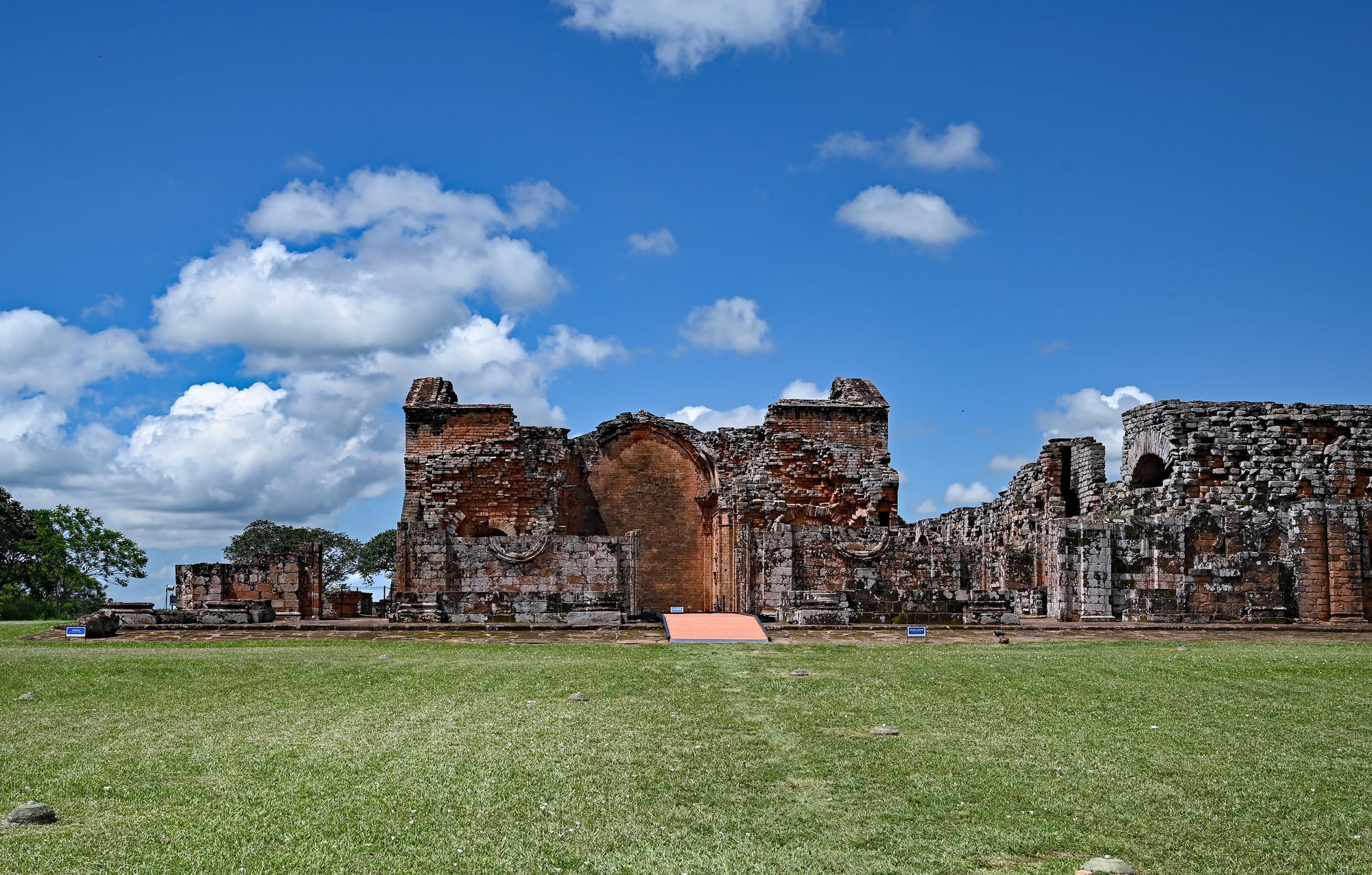
The Spanish founded Asunción in 1537, and it became the base from which much of southern South America was colonised. In the seventeenth and eighteenth centuries, Jesuit missionaries and Guaraní people built the "Reductions" — self-governing mission towns of farming, craft, music, and defence — until Spain expelled the Jesuits in 1767; the red-stone ruins of Trinidad and Jesús are now World Heritage sites. Paraguay declared independence in 1811 and was then ruled by a succession of strongmen: Dr Francia, who sealed the country off almost completely, and the López family, who modernised it and then led it into the War of the Triple Alliance of 1864–1870 against Brazil, Argentina, and Uruguay.
That war was the deadliest in Latin American history. Paraguay lost perhaps half its population and most of its adult men, along with large territory, and recovery took generations. The Chaco War of 1932–1935 against Bolivia, fought over the Gran Chaco and hoped-for oil, Paraguay largely won, at the cost of some 100,000 lives on both sides.
From 1954 to 1989 the country was ruled by Alfredo Stroessner, one of the longest dictatorships in the Americas, notorious for corruption, torture, sheltering Nazi fugitives, its role in the region's Operation Condor, and the vast Itaipú hydroelectric dam built with Brazil. A 1989 coup ended Stroessner's rule, and democracy has held since — dominated almost throughout by the Colorado Party — while Paraguay has become one of the world's biggest soybean and beef exporters.
- Paraguay: The Landlocked Heart — A bilingual country where almost everyone speaks Guaraní — a Jesuit mission province, an isolationist dictatorship, a catastrophic war that killed most of its men, and the longest one-party rule in the Americas