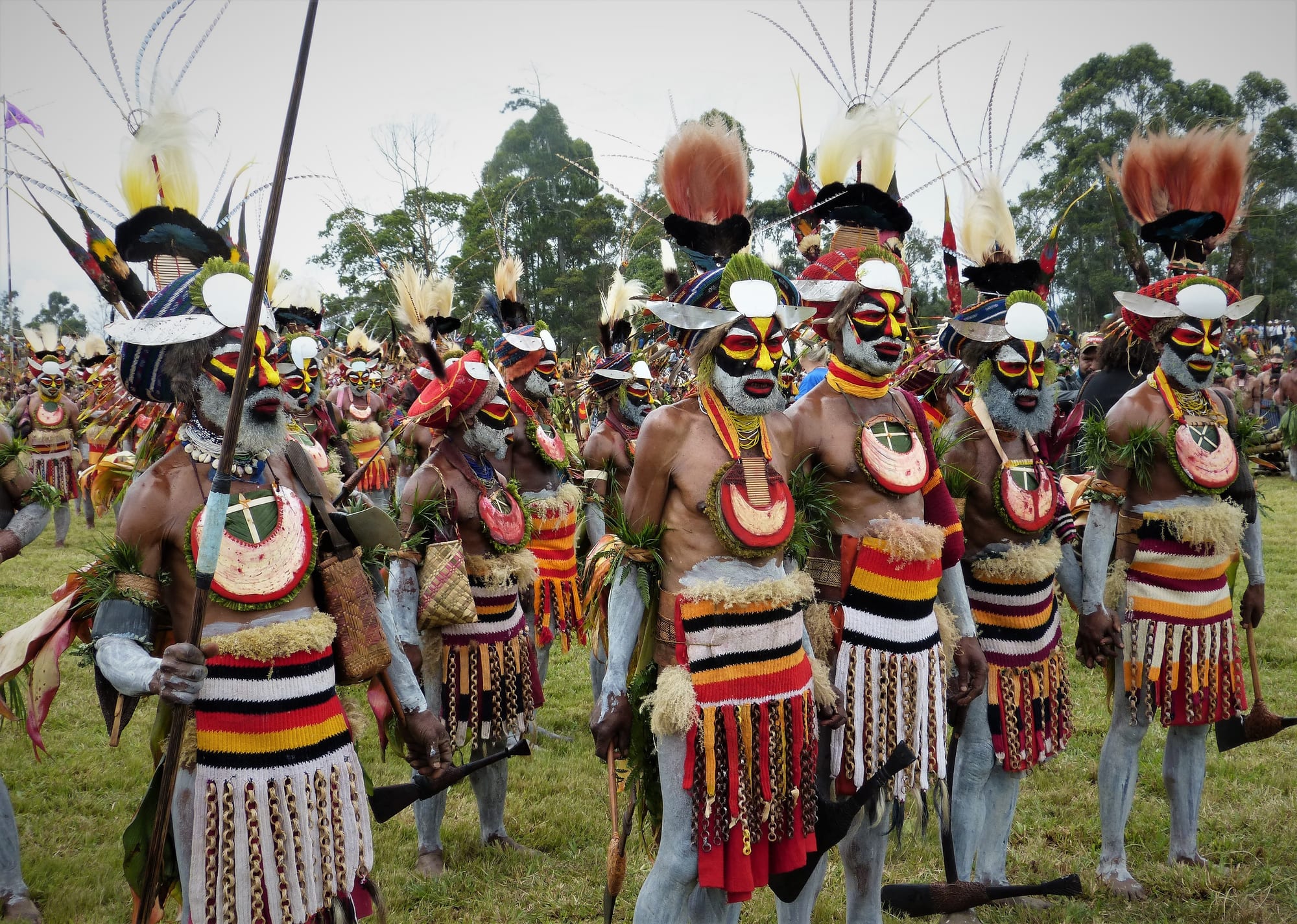
A group of performers in towering headdresses of bird-of-paradise plumes, with painted faces and shell ornaments, gathered close together at a cultural festival

Papua New Guinea

A sing-sing group at the Mount Hagen Show, one of the Highlands festivals where dozens of clan groups gather to dance in ceremonial dress. (gailhampshire / Wikimedia Commons · CC BY 2.0)

The eastern half of the island of New Guinea plus 600 islands — mountainous, overwhelmingly rural, and the most linguistically diverse country on Earth with some 840 languages — rich in resources that have barely reached a village-based majority.

Explore Papua New Guinea

History

People reached New Guinea more than 50,000 years ago, among the earliest human migrations beyond Africa and Asia, and in the Highlands they independently developed agriculture some 7,000 to 10,000 years ago. Long isolation between valleys and islands produced one of the most fragmented societies on Earth — thousands of small clan-based groups, hundreds of unrelated languages, and cultures built on gift exchange, "big man" leadership, and cycles of warfare and payback. The Highlands, home to perhaps a million people, were unknown to the outside world until Australian gold prospectors walked into them in the 1930s.

Colonial partition split the island: the Dutch in the west, Britain and then Australia in the southeast as "Papua", and Germany in the northeast, which Australia seized in the First World War. In the Second World War, Japanese forces who landed in 1942 were fought back toward Port Moresby over the Kokoda Track in months of appalling jungle warfare, and Rabaul became a vast besieged Japanese base.

Australia administered the combined territory and handed it to independence, somewhat reluctantly on both sides, in 1975 under Michael Somare. Politics since has been formally democratic but chronically unstable, dominated by no-confidence votes and money politics. A civil war on Bougainville from 1988 to 1998, sparked by grievances over a giant copper mine, killed up to 20,000 people and ended in an autonomy deal and a 2019 vote for independence still being negotiated. A resource economy built on gold and liquefied natural gas has largely bypassed the rural majority, and recent years have brought escalating Highlands violence, deadly 2024 riots, and a catastrophic landslide in Enga.

  • Papua New Guinea: A Thousand Nations The most linguistically diverse country on Earth — highland societies unknown to the outside world until the 1930s, a colony split between Germany, Britain and Australia, a Pacific War battleground, and a fragile democracy troubled by a secession war on Bougainville

Culture & Customs

Papua New Guinea is often called the most culturally diverse country in the world, with around 840 languages and no single national culture, only a mosaic of them. What many groups share is a life organised around the clan and the wantok — the obligation to help those who speak your language — and around exchange: bride-price, compensation payments to settle disputes and killings, and ceremonial gifts of pigs and shell valuables that build a "big man's" standing.

The sing-sing — massed groups in feathered headdresses, shell ornaments, and body paint, dancing and drumming — is the great public expression of identity, seen at the Highlands shows and countless local festivals; the Huli "wigmen" of Hela and the mud men of Asaro are among the best known. The Sepik river is famed for its carved spirit houses and masks, and the Trobriand Islands still practise the kula, a vast inter-island exchange of shell valuables.

Christianity is near-universal but sits alongside strong beliefs in ancestors, spirits, and sorcery, and rugby league is a genuine national passion — the one thing that unites the country.

Daily Life

Four in five Papua New Guineans live in rural villages and grow most of their own food — sweet potato above all in the Highlands, sago in the lowland swamps, taro, yam, banana, and pigs — with little cash income. Towns are small and troubled: Port Moresby, cut off by road from the rest of the country, is a security-conscious city of compounds and fences; Lae is the industrial port; Mount Hagen and Goroka are the Highlands hubs.

The formal economy is dominated by resource enclaves — gold and copper mines and the ExxonMobil-led LNG project — whose wealth has done little for the rural majority, while logging, palm oil, coffee, and cocoa provide most rural cash. Human-development indicators are low, with high malaria and maternal mortality, a serious HIV problem, limited schooling, and villages that can be days from a road.

Land is almost entirely held under customary clan tenure, which shapes — and often blocks — everything from development projects to the settlement of disputes.

Food

Everyday food is starchy and plain: kaukau (sweet potato) roasted or boiled, taro, yam, cooking bananas, and, in the lowlands, sago beaten from the pith of the sago palm. The feast dish is the mumu, an earth oven in which pork, chicken, and vegetables are steamed for hours over hot stones, and the killing of pigs is central to ceremonies and compensation payments.

Fish, shellfish, and coconut dominate island and coastal cooking, with leafy greens such as aibika as the everyday vegetable. Town food adds rice, tinned fish and corned beef, instant noodles, and takeaways of lamb flaps and fried chicken.

Betel nut, chewed with lime and a mustard stick, is a pervasive, red-staining social habit, and PNG's Highlands coffee, grown by smallholders, is prized by roasters abroad.

Attractions & Natural Wonders

Papua New Guinea rewards travellers who go with a reputable operator. The Highlands cultural shows — the Mount Hagen Show in August and the Goroka Show in September — bring dozens of sing-sing groups together in an overwhelming display of feathers, paint, and drumming. The Kokoda Track, an eight-to-ten-day jungle trek over the Owen Stanley Range following the wartime campaign, is a demanding pilgrimage for many Australians.

The Sepik river offers dugout-canoe journeys between villages with towering spirit houses and a living carving tradition. The islands hold some of the world's best diving — Kimbe Bay off New Britain, Milne Bay, Tufi's fjords, and the wrecks and reefs around volcano-buried Rabaul — and the Trobriands keep the kula exchange and the yam-harvest festivals.

Wildlife is extraordinary and elusive: birds of paradise in their courtship dances, best seen at lodges in the Highlands, along with tree kangaroos and the world's largest butterflies. Mount Wilhelm, the highest peak, can be climbed in a few days, and the war relics of Kokoda, Milne Bay, and Rabaul round out a country that is difficult but unlike anywhere else.

Planning basics

Budget

Papua New Guinea is expensive and hard to travel cheaply. Domestic flights are unavoidable and costly, security concerns push visitors toward hotels and organised tours rather than budget options, and remote lodges and trek operators charge accordingly.

Daily Budget Midrange
USD 250–500+ (hotel, domestic flights, guided tours, a Highlands show, a dive package)
Daily Budget Shoestring
USD 90–160 (guesthouse or mission lodging, self-catering, a share of a tour) — rarely practical for independent travellers

Most people visit on an organised tour, a dive package, or through a trusted local host; the security situation makes independent budget travel unwise.

Visa Requirements

Many nationalities can get a tourist visa on arrival at Port Moresby's international airport, or an e-visa online in advance; rules and the list of eligible countries change. A yellow-fever certificate is required if arriving from an endemic country.

Typical Validity
30–60 days, single entry

Check the current visa-on-arrival list with a PNG mission before travel, and carry proof of onward travel and accommodation.

Safety

Papua New Guinea has one of the most challenging security environments for visitors. Governments advise a high degree of caution or reconsidering travel, with "do not travel" for the Highlands provinces (Hela, Southern Highlands, Enga) where tribal warfare is now fought with automatic weapons. Armed carjackings, home invasions, and gang ("rascal") robbery are common in Port Moresby, Lae, and Mount Hagen, and unrest can spread fast, as 2024's riots showed.

Health
Chloroquine-resistant malaria is a serious risk below about 1,600 m; medical care is very limited and evacuation to Australia is the plan for anything serious

Travel with a reputable operator or trusted local host, avoid walking in towns and using ATMs in public, never travel by road at night, and carry insurance with evacuation cover.

Climate

Tropical: hot and humid in the lowlands year-round, cooler in the Highlands, where nights are cold and frost occurs at altitude. Rainfall is high, with a wetter northwest monsoon season (roughly December–March) and a drier southeast trade season (May–October), though it varies greatly by region. El Niño brings drought and frost to the Highlands.

Lowlands
25–32°C, humid, wet much of the year
Highlands
Mild days, cold nights; Mount Hagen and Goroka around 2,500 m

Transportation

Port Moresby's Jacksons airport is the main gateway, and flying is essential — no road connects the capital to the rest of the country. Air Niugini and PNG Air link the towns, and mission aircraft serve hundreds of bush airstrips. The Highlands Highway is the one major road, potholed, landslide-prone, and periodically closed by disputes. Coastal travel is by small ship and open dinghy.

Do not use local PMV minibuses or self-drive; arrange transfers through your hotel or operator, and build wide buffers around bush flights.

Best Time to Visit

May to October, the drier trade-wind season, is best for travel and trekking. The great Highlands cultural shows fall in this window — the Mount Hagen Show in August and the Goroka Show in September — along with many smaller festivals such as the Sepik Crocodile Festival and the Rabaul Mask Festival.

Events
Mount Hagen Show (August); Goroka Show (September); Independence Day (16 September); Sepik and island festivals

Currency

The currency is the kina (PGK). It is largely a cash economy; ATMs exist in the main towns but can be unreliable and are a security risk to use in public. Cards are accepted at hotels and some restaurants in Port Moresby and Lae.

Symbol
K
Currency Code
PGK — kina

Language

Three languages are official: Tok Pisin, an English-based creole that is the true lingua franca; English, used in government, courts, and education; and Hiri Motu, a southern trade language now in decline. Beyond them are around 840 indigenous languages — more than any other country — most spoken by only a few hundred to a few thousand people.

Official Languages
Tok Pisin, English, Hiri Motu
Indigenous Languages
Around 840