History
Palau was settled more than three thousand years ago by voyagers from island Southeast Asia, who built a society of matrilineal clans and chiefs, painted "bai" meeting houses, and a currency of foreign beads and bars still used in customary exchange today. Spain claimed the islands and sold them to Germany in 1899, and Japan took them in the First World War, making Koror the capital of its entire South Seas Mandate and settling so many Japanese that they came to outnumber Palauans.
In 1944 the islands saw some of the fiercest fighting of the Pacific war, above all the ten-week Battle of Peleliu, which left that small island's caves and bunkers full of wreckage that remains today. After the war Palau was administered by the United States as part of the Trust Territory of the Pacific Islands.
Palau chose to negotiate separately from the Federated States of Micronesia, and its path to independence was long and bitter: its 1979 constitution was the world's first to be nuclear-free, which clashed with US defence plans, and it took eight referendums — shadowed by the assassination of one president and the suicide of another — before the Compact of Free Association was approved and Palau became independent in 1994. Under the Compact, the United States is responsible for defence and is now building new military installations as US–China rivalry sharpens; Palau recognises Taiwan, and has felt economic pressure from Beijing as a result. It has also become a world leader in ocean conservation, from the first national shark sanctuary to a marine sanctuary covering most of its waters.
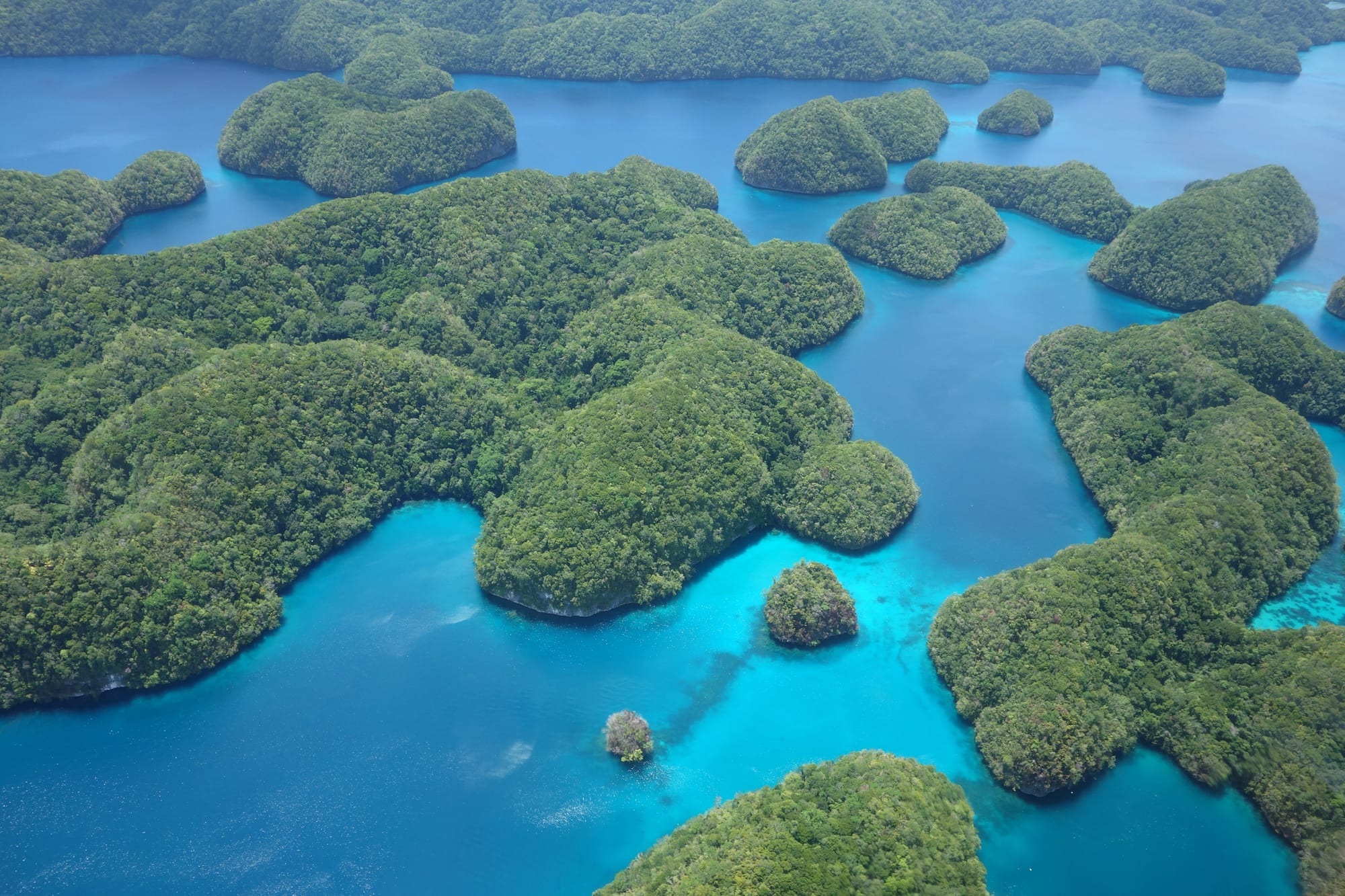
- Palau: The Rock Islands Republic — A scatter of limestone islands at the western edge of Micronesia — a matrilineal society ruled in turn by Spain, Germany, Japan and the United States, the scene of one of the Pacific War's bloodiest battles, and now a small state in free association with America