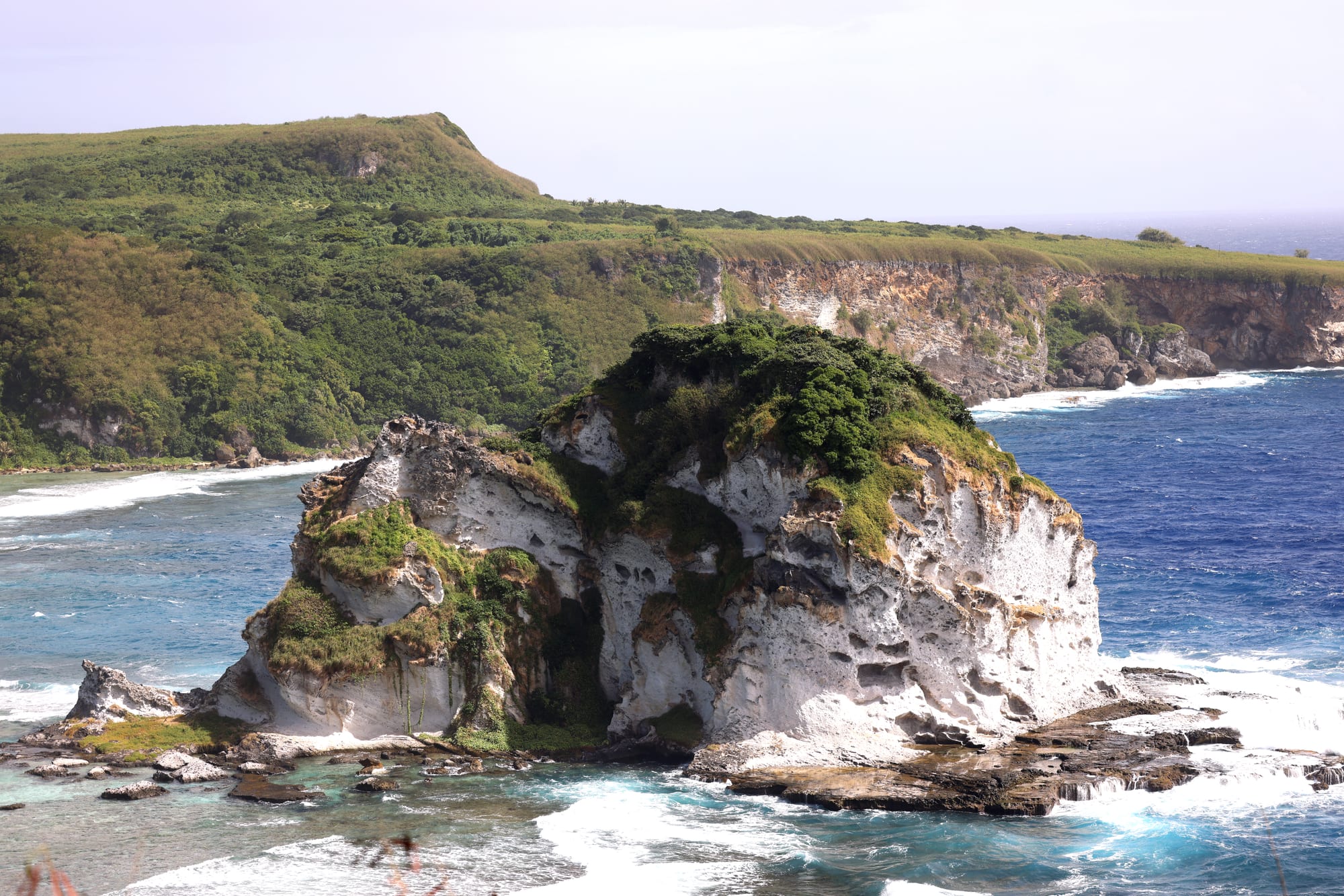
A steep white rock islet capped with green vegetation standing in a bay of turquoise and deep-blue surf, with forested sea cliffs stretching along the coast behind it

Northern Mariana Islands

Bird Island, a rocky islet in a surf-washed bay at Maddok on the coast of Saipan. (Gage Skidmore / Wikimedia Commons · CC BY-SA 4.0)

A chain of 14 tropical islands north of Guam — a Commonwealth in political union with the United States, home to the CHamoru and Carolinian peoples, fought over ferociously in 1944, and dependent on a tourism economy that has struggled since a garment boom and a casino venture both collapsed.

Explore Northern Mariana Islands

History

The Marianas were settled by the ancestors of the CHamoru millennia ago, and the latte stones of Tinian and Rota are among the largest anywhere. After the Chamorro-Spanish Wars of the seventeenth and early eighteenth centuries, Spain forcibly moved most of the northern islands' population to Guam, leaving them nearly empty for about 150 years; Carolinian voyagers from the atolls to the south, and returning CHamorus, resettled Saipan and Rota from the early nineteenth century, which is why the CNMI has two indigenous peoples.

Spain sold the Northern Marianas to Germany in 1899, after losing Guam and the Philippines to the United States. Japan seized the islands in the First World War and governed them under a League of Nations mandate from 1919 to 1944, settling Japanese, Okinawan, and Korean workers who outnumbered the islanders and building a sugar economy on Saipan.

The Battle of Saipan in June–July 1944 was one of the Pacific War's bloodiest, ending with mass suicides of Japanese civilians at Marpi Point. Tinian then became a vast US airbase, and the aircraft that dropped the atomic bombs on Hiroshima and Nagasaki took off from its North Field; the bomb-loading pits are preserved. The islands were administered as part of the UN-mandated Trust Territory of the Pacific Islands until, in the 1970s, the Northern Marianas — unlike the rest of Micronesia — voted to become a US Commonwealth, which took effect in 1978. CNMI-born residents are US citizens, with an elected governor and, since 2009, a non-voting delegate to Congress.

  • Northern Mariana Islands: The Islands That Voted In A Chamorro and Carolinian archipelago ruled in turn by Spain, Germany, Japan and the United States — the launch point for the atomic bombings, and the one Pacific territory that chose union with America rather than independence

Culture & Customs

CHamoru and Carolinian cultures coexist in the CNMI, both Austronesian, both strongly Catholic after the Spanish era, and both organised around the extended family and clan, respect for elders (shown by mannginge', sniffing an elder's hand), and reciprocal obligation at weddings, funerals, and christenings. Village fiestas for patron saints, with open houses and mountains of food, punctuate the year.

The islands are also shaped by the large Filipino population, the legacy of Japanese rule, and the more recent influx of Chinese and Korean tourism and investment, giving Saipan a mixed, layered feel. Carolinian communities on Saipan maintain distinct dance, canoe-building, and weaving traditions and, historically, long-distance navigation.

Sunday church, family gatherings, and fishing organise social life, and there is a strong sense of a shared wartime history — Liberation Day on 4 July is the biggest celebration of the year.

Daily Life

About 48,000 people live in the CNMI, roughly 90 per cent of them on Saipan; Tinian and Rota have a few thousand each, and the northern islands are all but uninhabited. As US citizens, CNMI residents move freely to Guam, Hawaii, and the mainland, and many do.

The economy has been turbulent. A garment industry boomed on Saipan in the 1990s and 2000s, using imported contract labour to produce "Made in USA" clothing with duty-free access, before collapsing around 2009 after trade rules changed and amid sweatshop lawsuits and a US lobbying scandal; US federal control of immigration and the minimum wage followed. Tourism then became the mainstay, heavily dependent on visitors from China, South Korea, and Japan, and a large casino built on Saipan in the mid-2010s became a notorious failure, with money-laundering allegations, unpaid contractors, and worker deaths before it was shut down, leaving the government in fiscal crisis. The pandemic then gutted the tourism that remained.

Daily life is American in its institutions, Pacific and Asian in its texture, and closely tied to the fortunes of the tourism trade and the weather.

Food

The food mixes CHamoru and Carolinian home cooking with a heavy Filipino presence. CHamoru staples include kelaguen (meat or seafood "cooked" in lemon with grated coconut, onion, and hot pepper), hineksa' aga'ga' (red rice), barbecue chicken and ribs, and kå'du soups, with finadene' sauce on everything and apigigi' (grated cassava and coconut baked in a leaf) for a sweet.

Filipino turo-turo canteens serving adobo, pancit, lumpia, and grilled fish are everywhere on Saipan, and Japanese and Korean restaurants cluster in the Garapan tourist strip. Spam and tinned meats are Pacific staples, and reef fish, breadfruit, taro, and tropical fruit fill out the local diet.

Fiesta culture means large communal spreads for village saints' days, and imported American and Asian groceries stock the supermarkets. Beer and imported drinks are the norm; coconut water and local fruit juices are the fresh options.

Attractions & Natural Wonders

Saipan's lagoon is the tourism centre: Managaha, a tiny islet ringed by turquoise water, is the classic day-trip for snorkelling and swimming, and American Memorial Park in Garapan honours those killed in the 1944 campaign. The war is still very present — the Last Command Post, the Banzai and Suicide cliffs at Marpi, and Japanese tanks and landing craft rusting in the shallows. The Grotto, a collapsed limestone sinkhole connected to the open sea by underwater tunnels, is a world-renowned (and demanding) dive site, and Bird Island and Forbidden Island are scenic lookouts. Mount Tapochau, at 474 metres, is the high point.

Tinian is dominated by North Field, the vast, quiet Second World War airbase from which the atomic missions flew, with the two glass-covered bomb pits preserved, and by the House of Taga, a set of the largest latte stones ever raised. Taga Beach, a blowhole, and the shell of a failed casino resort are the other sights.

Rota, the "friendly island", is the quietest and greenest: the Taga latte-stone quarry, where partly cut pillars still lie in the bedrock; a bird sanctuary and sea caves; and some of the clearest, least-crowded diving in the Marianas.

Planning basics

Budget

The CNMI is priced like the US and has been through hard economic times, so some hotels and attractions are faded or closed. Saipan has budget and mid-range hotels, guesthouses, and plentiful cheap Filipino and CHamoru eateries; Tinian and Rota have only a few small hotels each. A rental car is close to essential.

Daily Budget Midrange
USD 150–300 (Saipan hotel, restaurants, rental car and fuel, a Managaha trip or dives)
Daily Budget Shoestring
USD 65–110 (guesthouse, Filipino and local eateries, shared rental car)

Eat at Saipan's Filipino turo-turo and CHamoru barbecue spots, rent a car, and treat Tinian and Rota as separate short trips by small plane.

Visa Requirements

The Northern Marianas are US territory. US entry rules apply — ESTA under the Visa Waiver Program, or a US visa — plus the joint Guam-CNMI Visa Waiver Program, which admits several additional nationalities for tourism. Arrivals from Guam or the US mainland are domestic.

Typical Stay
As for the US (ESTA/visa), plus the Guam-CNMI Visa Waiver Program for some additional countries (up to 45 days)

Check whether you qualify under the US Visa Waiver Program (with ESTA) or the separate Guam-CNMI program; otherwise obtain a US visa.

Safety

The CNMI is generally safe, with petty theft and some drug-related crime away from the tourist areas the main concern. Ocean hazards are real — strong currents at the Grotto and around the coasts, and drownings occur — and the islands are fully within the typhoon belt. Some infrastructure remains patched from Typhoon Yutu.

Health
Tap water quality varies — many drink bottled or filtered; dengue can occur; diving hazards at the Grotto require experience; there is a hospital on Saipan, with evacuation to Guam or Manila for serious cases

Only dive the Grotto with a guide and within your certification, swim inside the reef and heed currents, don't leave valuables in cars, and follow typhoon warnings in season.

Climate

Tropical, hot and humid year-round, around 28–32°C, with fairly steady trade winds. The drier season runs roughly December to June and the wetter one July to November, which is the peak of the western Pacific typhoon season — Super Typhoon Yutu devastated Tinian and Saipan in October 2018.

Dry Season
December–June
Wet Season
July–November (typhoon season)

Transportation

Saipan International Airport has flights from South Korea, Japan, Guam, and elsewhere in Asia and Micronesia; small aircraft link Saipan with Tinian and Rota. A rental car is standard on Saipan; Tinian and Rota are small enough for a car or scooter and the odd taxi.

Rent a car on Saipan (driving is on the right), and book the short Tinian and Rota flights ahead, as the aircraft are small and schedules thin.

Best Time to Visit

December to June, the drier season, has the most reliable weather and the calmest water for diving and boat trips. July to November is wetter and carries the typhoon risk. Temperatures barely change through the year.

Events
Commonwealth Covenant Day (24 March); Liberation Day on Saipan (4 July), marking the end of the 1944 fighting, with a month of festivities; the Flame Tree Arts Festival (spring); village fiestas for patron saints

Currency

The currency is the US dollar. Cards are accepted at hotels and larger shops on Saipan; carry cash for small eateries, markets, and anything on Tinian and Rota. ATMs are mainly on Saipan.

Symbol
$
Currency Code
USD — United States dollar

Language

English is the language of government, business, and schooling. CHamoru and Carolinian (Refaluwasch) are co-official indigenous languages, and Filipino languages, chiefly Tagalog and Ilocano, are very widely spoken given the large Filipino community; Chinese and Korean are common in the tourism sector.

Also Spoken
Tagalog, Ilocano, Chinese, Korean
Official Languages
English, CHamoru, and Carolinian