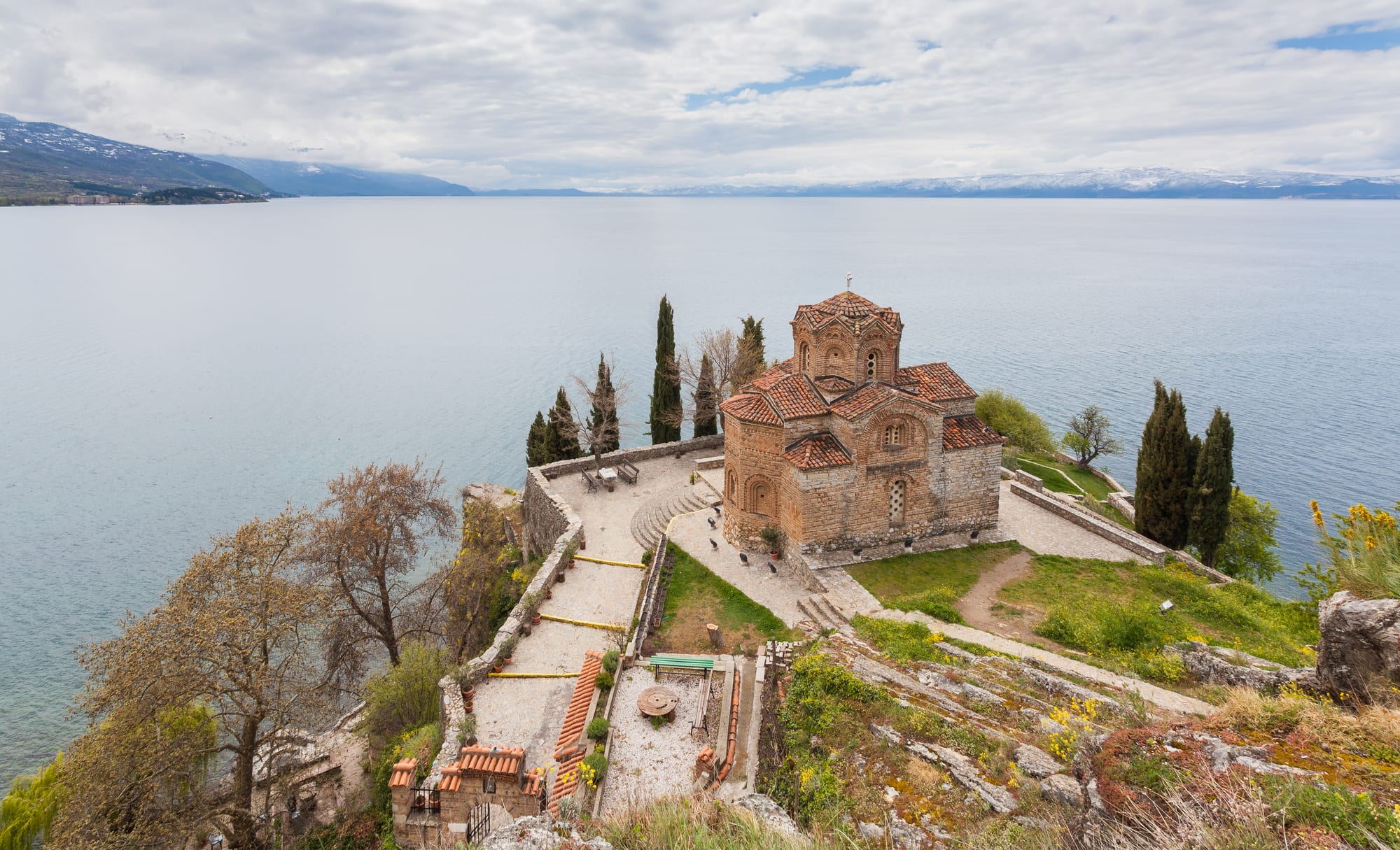
A small brick-and-stone Byzantine church with a dome standing on a cliff above a wide blue lake, wooded hills across the water

North Macedonia

The 13th-century church of Sveti Jovan Kaneo on its cliff above Lake Ohrid, a UNESCO World Heritage Site. (Diego Delso / Wikimedia Commons · CC BY-SA 3.0)

A small, landlocked country in the central Balkans, home to Orthodox Macedonians and Muslim Albanians — the only Yugoslav republic to leave without war, kept out of NATO and the EU for decades by a name dispute with Greece finally settled in 2018.

Explore North Macedonia

History

This land sat on the Byzantine frontier for centuries, and Ohrid became a cradle of Slavic Christianity and letters, where the disciples of Saints Cyril and Methodius taught and, tradition says, 365 churches were built. Bulgarian and Serbian empires held the region in turn — Skopje was briefly a Serbian imperial capital — before some five centuries of Ottoman rule left the mosques, hammams, and covered bazaars of the old towns.

As Ottoman power receded, the "Macedonian Question" — who the region's Slavs were, and which neighbouring state they belonged to — turned violent, through the revolutionary VMRO, the 1903 Ilinden Uprising and its short-lived Kruševo Republic, and the Balkan Wars of 1912–13, which partitioned Macedonia among Greece, Serbia, and Bulgaria. The Vardar portion joined Yugoslavia, and under socialist Yugoslavia it was made a republic with a recognised Macedonian nation, a codified language, and its own Orthodox Church.

Independence came peacefully in 1991 — the only Yugoslav republic to leave without war — but was overshadowed for nearly three decades by Greece's objection to the name "Macedonia", which blocked NATO and EU membership. A brief 2001 conflict with ethnic-Albanian insurgents was ended by the Ohrid Framework Agreement, which expanded Albanian rights. A nationalist government's costly "Skopje 2014" building spree ended in corruption scandals, and in 2018 the Prespa Agreement renamed the country North Macedonia, allowing it to join NATO in 2020 and to open EU accession talks — which have since stalled again, this time over Bulgarian demands about history and identity.

  • North Macedonia: The Contested Name A landlocked Balkan republic at the crossroads of Greek, Slavic, Ottoman and Albanian worlds — a nationhood recognised late, a 27-year dispute with Greece over its name, and a near civil war settled by power-sharing

Culture & Customs

Two main communities live largely side by side: Orthodox Macedonians and Muslim Albanians, with smaller Turkish, Roma, and Vlach populations. Macedonian folk culture is rich in polyphonic singing, the oro chain dance, the shawm-and-drum zurla and tapan, and the brass bands of the south; the Galičnik wedding, revived each July in a mountain village, is a showcase of costume and ritual. Icon-painting and church-building have a long tradition centred on Ohrid, whose frescoes are among the finest in the Orthodox world.

Albanian western towns have their own music, weddings, and religious life, including a strong Bektashi tradition. Coffee is taken slowly and at length, hospitality is generous, and the autumn ritual of ajvar-making — roasting and milling red peppers into a relish, put up by the jarful — is close to a national event.

Basketball and handball are the big spectator sports, along with football, and the mountains keep an old hunting and herding culture.

Daily Life

With under two million people and heavy emigration, North Macedonia can feel like a country steadily losing its young. Skopje — rebuilt on a modernist plan after a devastating 1963 earthquake, then given a contested neoclassical facade in the 2010s — holds a third of the population and most of the jobs; Bitola, Tetovo, Kumanovo, Ohrid, and Štip are the other centres.

The economy runs on foreign-owned factories in special economic zones, making car parts, wiring, and catalysts, along with textiles, agriculture — tobacco, wine, peppers, lamb, and early vegetables — mining, and money sent home by the diaspora. Wages are low by EU standards, unemployment has long been high, and corruption and weak courts are the recurring criticism from Brussels.

Winter brings a tangible problem: Skopje and Tetovo, sitting in basins under temperature inversions, with wood and coal heating and old cars, record some of the worst air quality in Europe.

Food

Macedonian cooking is Balkan and Ottoman-influenced, built around grilled meat, peppers, beans, and dairy. Tavče gravče, beans baked in an earthenware dish with paprika, is the national dish; ajvar is on every table; and šopska salad — tomato, cucumber, onion, and grated white sirenje cheese — starts most meals.

The grill turns out kebapi, pleskavica, and šiš, and pastrmajlija, a boat-shaped bread topped with diced pork, is a speciality of Štip. Burek and other filled pita, stuffed peppers and vine leaves, and vegetable-and-meat stews round out the table. Lake Ohrid supplies trout — including the endemic, protected Ohrid trout — and tiny fried whitebait.

Wine is a serious business, centred on the Tikveš region and its Vranec and Temjanika grapes; rakija is the spirit, and Turkish-style coffee ends the meal.

Attractions & Natural Wonders

Lake Ohrid, shared with Albania, is the country's jewel and a World Heritage Site for both its nature and its culture. The old town of Ohrid climbs from the water to Tsar Samuel's fortress past Byzantine churches — Sveti Jovan Kaneo on its cliff, Sveta Sofia, Sveti Kliment — an ancient theatre, and, near the Albanian border, the spring-fed monastery of Sveti Naum.

Skopje offers the Ottoman Old Bazaar, the Stone Bridge, the Kale fortress, the fifteenth-century Mustafa Pasha Mosque, a memorial to Mother Teresa, who was born in the city, and the polarising statuary of the "Skopje 2014" project. Bitola, the elegant former consular city, sits beside the Roman ruins of Heraklea Lyncestis below Pelister National Park.

The mountains — Mavrovo National Park with its ski slopes and the half-submerged church at Mavrovo Lake, the Šar range on the Kosovo border, and Korab, the highest peak — offer hiking and skiing. Closer to the capital are the Millennium Cross above Skopje, the Kokino megalithic observatory, and the Matka Canyon, with its caves and kayaking a short drive out of town.

  • North Macedonia: Six Attractions and Natural Wonders A lakeside church perched on a cliff above one of Europe's oldest lakes, a canyon you can kayak into caves, a mosque painted like a picture book, and a capital that erected a giant statue of Alexander the Great

Planning basics

Budget

North Macedonia is one of the cheapest countries in Europe. Guesthouses and private rooms, bakeries and grill houses, and intercity buses cost little; Ohrid in July and August is the one place where prices climb.

Daily Budget Midrange
EUR 60–120 (three-star hotel, restaurants, a hire car, wine tours and lake trips)
Daily Budget Shoestring
EUR 30–50 (hostel or private room, bakeries and grills, buses)

Visit Ohrid in June or September to avoid the peak-summer price rise and crowds.

Visa Requirements

Citizens of the EU, the UK, the US, Canada, Australia, New Zealand, and many other countries can enter visa-free for up to 90 days in any 180-day period. Holders of valid Schengen visas may also enter for short stays.

Typical Stay
90 days in any 180-day period, visa-free, for most Western passports

Safety

North Macedonia is a safe country for visitors, with low violent crime. The usual issues are pickpocketing in Skopje's bazaar and station and at Ohrid in high season, car break-ins, and reckless driving on rural roads. Winter air pollution in Skopje and Tetovo is a genuine health concern for those with respiratory conditions.

Check the air-quality index if visiting Skopje in winter, watch bags in crowds, and take care on mountain roads and trails near the Kosovo and Albania borders.

Climate

Transitional between Mediterranean and continental. Summers are hot and dry, with Skopje among the hotter capitals in Europe; winters are cold and snowy, and in the Skopje and Tetovo basins the winter air becomes badly polluted. The Ohrid region and the higher west are milder, and the mountains hold deep snow.

Summer
June–August, 30–40°C in Skopje
Winter
December–February, around 0°C; smog in the cities

Transportation

Skopje's airport is the main gateway, dominated by low-cost carriers, with a seasonal airport at Ohrid. Rail is slow and limited, so intercity buses are the way to travel — frequent on the Skopje–Ohrid, Skopje–Bitola, and Skopje–Tetovo routes. Taxis in Skopje are cheap and metered, and car hire is straightforward on the main corridors.

Allow about three hours by bus for Skopje–Ohrid, and expect narrow, winding roads once you leave the Vardar valley motorway.

Best Time to Visit

May–June and September–October are ideal — warm but not scorching, good for Ohrid, hiking, and the wine harvest. July and August are hot and busy at Lake Ohrid, with its summer arts festival. December to March is the ski season at Mavrovo and Popova Šapka; winter in the cities means smog.

Events
Ohrid Summer Festival (July–August); the Galičnik Wedding (July); Skopje Jazz Festival (October); Vevčani Carnival (January)

Currency

The currency is the Macedonian denar (MKD). Cards are accepted in Skopje, Ohrid, and larger towns; carry cash for buses, markets, and rural areas. Euros are easily exchanged.

Symbol
ден
Currency Code
MKD — denar

Language

Macedonian, a South Slavic language written in Cyrillic and close to Bulgarian, is the official language nationwide. Albanian is co-official across the country, and Turkish, Romani, Serbian, and Aromanian have official status where those communities are concentrated. English is widely spoken by younger people and in tourism.

Co Official
Albanian (nationwide); Turkish, Romani and others regionally
Official Language
Macedonian