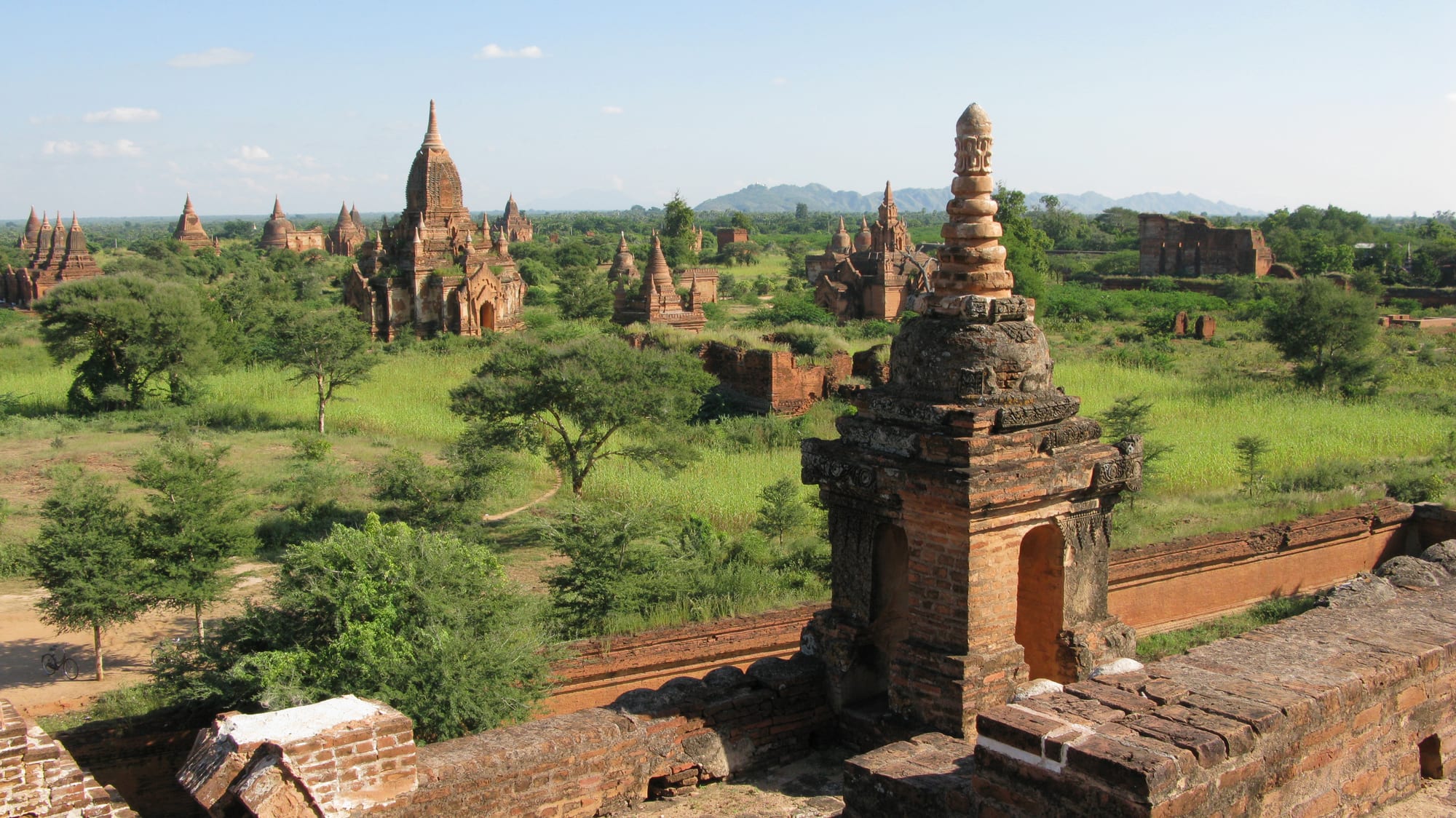
Dozens of brick Buddhist temples and stupas rising from a hazy, tree-dotted plain that stretches toward distant low hills

Myanmar

The plain of Bagan, where more than 2,000 temples and stupas survive from the kingdom that ruled the Irrawaddy valley from the 11th to the 13th centuries. (Vyacheslav Argenberg / Wikimedia Commons · CC BY 4.0)

A large Southeast Asian country on the Bay of Bengal, also known as Burma — heir to the temple kingdom of Bagan, ruled by the military for most of its independent history, and since a 2021 coup gripped by a nationwide civil war.

Explore Myanmar

History

The Bagan kingdom, from the ninth to the thirteenth centuries, unified the Irrawaddy valley and made it a stronghold of Theravada Buddhism, raising thousands of temples on the Bagan plain before falling to the Mongols. Later Burmese dynasties, the Toungoo and the Konbaung, expanded aggressively — the Konbaung sacked the Thai capital Ayutthaya in 1767 — until three wars with Britain ended Burmese independence, and the country was annexed as a province of British India by 1886.

Japan occupied Burma in the Second World War; the independence leader Aung San, who had first allied with Japan, switched to the Allies. He was assassinated in 1947, months before independence in 1948. A fragile democracy, beset from the start by ethnic insurgencies, was ended by General Ne Win's 1962 coup, which began decades of military rule, isolation, and economic decline.

A 1988 uprising was crushed with thousands of deaths; the military ignored the 1990 election won by Aung San Suu Kyi's National League for Democracy and kept her under house arrest for years. A cautious opening from 2011 freed prisoners, eased censorship, and brought a tourism boom, and the NLD governed after 2015 — but in 2016–17 the military drove some 740,000 Rohingya into Bangladesh in what UN investigators called ethnic cleansing. In February 2021 the military seized power again, detained Suu Kyi, and met mass protest with lethal force. The resistance took up arms, and Myanmar has been in a fragmented civil war since, with the military losing ground across the borderlands while holding the central lowlands and cities.

  • Myanmar: The Kingdom, the Junta, and the War The Bagan temple plain and the Konbaung kings — British conquest, a fractured independence, sixty years of military rule, a brief opening, the Rohingya expulsion, and a country now at war with its own army

Culture & Customs

Theravada Buddhism saturates daily life for the Bamar majority and many others: the gilded pagoda, the monk on the morning alms round, the shinbyu ceremony when a boy briefly enters the monastery, and constant small acts of merit-making. Older nat spirit worship runs alongside it, centred on Mount Popa. People of all ages wear the longyi sarong, and many wear thanaka, a pale paste ground from bark, on their cheeks.

Astrology and numerology weigh on personal and even state decisions — the move of the capital and past currency changes were tied to auspicious numbers. Traditional arts include marionette theatre, the arched saung harp, and Bagan lacquerware, and the teashop is the country's essential social institution, over cups of sweet, strong milk tea.

Myanmar is also deeply diverse and deeply divided: a patchwork of ethnic nationalities with their own languages, dress, and Christian or Muslim as well as Buddhist faith, and a long history of the centre's domination of the periphery, of which the exclusion and expulsion of the Rohingya is the starkest example.

Daily Life

Before 2021, Myanmar was a poor country cautiously opening up. Since the coup the reversal has been severe: around half the population is near or below the poverty line, more than three million people are displaced within the country, and health and education have collapsed in many areas after teachers and doctors joined a civil-disobedience strike and were purged.

Rolling blackouts, fuel queues, cash shortages, censorship, and surveillance are now part of ordinary life, and young people leave in large numbers — to Thailand, to resistance-held areas, or abroad — to escape conscription. The parts of the economy that still function include delta rice farming, jade and ruby mining in the north (which funds armed groups), offshore gas piped to Thailand and China, garment factories, and a large border economy of drugs and online scams; Myanmar is again the world's biggest opium producer.

A major earthquake near Mandalay and Sagaing in March 2025 killed thousands and deepened a humanitarian emergency the authorities have limited capacity, and limited will, to address.

Food

Burmese cooking is milder and more oil-forward than its neighbours', with sour and fermented notes all its own. The national breakfast is mohinga, rice vermicelli in a fish and banana-stem broth. Laphet thoke, a salad of fermented tea leaves with fried beans, nuts, and garlic, is unique to Myanmar and eaten at any time.

A main meal is built around one or more curries (hin) of pork, chicken, or fish cooked slowly in oil with turmeric, served with rice, a light soup, and a spread of relishes — including pungent ngapi fermented-fish dips — with fried snacks and raw and blanched vegetables to dip. Shan food, from the eastern hills, adds its own noodle dishes and a tofu made from chickpeas.

Indian and Chinese influences are strong in the cities: samosas, biryani, flatbreads, and stir-fries. Sweets tend to be based on sticky rice, coconut, and palm jaggery, and the teashop milk tea is the social lubricant of the country.

  • Myanmar: Food and the National Dish A fish and rice noodle soup eaten for breakfast from street stalls at dawn, at the meeting point of Indian, Chinese and Southeast Asian cooking

Attractions & Natural Wonders

Yangon holds the Shwedagon Pagoda, a vast gilded stupa topped with jewels and the spiritual centre of the country, along with one of Asia's best-preserved British-colonial downtowns. Bagan, a World Heritage Site, is the singular sight: a plain scattered with more than two thousand brick temples and stupas from the eleventh to thirteenth centuries, once toured by e-bike and hot-air balloon.

Mandalay, the last royal capital, has its hill, palace, and the Mahamuni image, with the teak U Bein bridge and the monastery towns of Sagaing and Inwa nearby. Inle Lake in Shan State is known for its leg-rowing fishermen, floating gardens, stilt villages, and lotus-fibre weaving, and for treks in from the hill town of Kalaw.

Elsewhere are the balancing gilded boulder of Golden Rock at Kyaiktiyo, the upmarket beach at Ngapali, the karst country and caves around Hpa-an, and the remote temple field of Mrauk U in Rakhine. Almost all of these are currently affected by the conflict, and much of the country is closed to travel.

  • Myanmar: Six Attractions and Natural Wonders A golden pagoda that has drawn pilgrims for a thousand years, a plain scattered with thousands of ancient temples, a lake worked by leg-rowing fishermen, and a gilded boulder balanced on the edge of a cliff

Planning basics

Budget

Prices are low in kyat terms, but the practical costs are the difficulty and risk of travel: cash-only budgeting in US dollars, unreliable domestic flights, and the ethical problem that much tourist spending — hotel taxes, entry fees, some airlines — reaches the military.

Daily Budget Midrange
USD 70–160 (better hotel, restaurants, a domestic flight, a guide)
Daily Budget Shoestring
USD 25–45 where travel is possible (guesthouse, teashops and street food, buses)

International cards and ATMs do not work under sanctions; every kyat must be bought with cash US dollars carried in.

Visa Requirements

A tourist visa is required for almost all nationalities. An e-visa for short stays has been available at times through the military authorities, but availability and advisability change. Entry is essentially only by air to Yangon or Mandalay; most land borders are closed or unsafe.

Typical Validity
28 days, single entry (e-visa), when issued

Check your government's travel advisory first; a visa being available does not mean travel is safe or advised.

Safety

This is the decisive fact. Most governments advise against all or all-but-essential travel to Myanmar. A nationwide armed conflict since the 2021 coup brings air strikes, artillery, an expanding landmine problem, arbitrary arrest and detention of foreigners, and a conscription law affecting men and women of a wide age range. Banking is broken, power and fuel are short, and consular help is unavailable across much of the country.

Scam Compounds
Trafficking into online-scam compounds is a serious risk near the Thai and Chinese borders — never follow a job offer into Myawaddy or Shwe Kokko

Worldlore covers Myanmar so it can be understood, not to encourage travel there now. Read your government's advisory in full and note that tourist money can reach the military.

Climate

Tropical monsoon with three seasons. The cool, dry season from November to February is the only comfortable time; the hot season from March to May pushes Bagan and Mandalay past 40°C; and the southwest monsoon from May–June to October brings heavy rain to the coast, the delta, and Rakhine, though the central "dry zone" stays much drier.

Monsoon
May/June–October, heavy on the coast and delta
Cool Dry
November–February, 20–32°C in the lowlands, cold in the hills

Transportation

Yangon and Mandalay have the international airports, with a reduced set of routes. Domestic airlines link the main towns, but some are under sanctions and reliability and safety are concerns. The colonial-era railway is slow and rough; the long-distance buses and Irrawaddy river boats that once carried travellers now run through a landscape of checkpoints and fighting.

Overland border crossings with Thailand and India are mostly closed or dangerous; assume domestic movement is restricted and unpredictable.

Best Time to Visit

November to February is the season for weather, but it must be weighed against the security situation, which has made most of the country unsafe or off-limits since 2021. The Thingyan water festival around mid-April marks the new year but coincides with peak heat and widespread closures.

Events
Thingyan (mid-April new year); Thadingyut festival of lights (October); the Phaung Daw Oo festival on Inle Lake (September–October)

Currency

The currency is the kyat (MMK), which has lost much of its value since 2021 and trades at several different rates. The tourist economy runs on US dollars in cash: bring pristine, unmarked, unfolded, large-denomination notes, as worn or older bills are refused. International bank cards do not function.

Cards
Do not work; bring US dollars cash
Symbol
K
Currency Code
MMK — kyat

Language

Burmese is the official language, written in a rounded script and spoken by most people as a first or second language. Each ethnic state has its own languages — Shan, Karen, Kachin, Chin, Rakhine, Mon, and more. English, once widespread under British rule, faded during the decades of isolation but survives in tourism and among older and educated people.

Also Spoken
Shan, Karen, Kachin, Chin, Rakhine, Mon and other minority languages
Official Language
Burmese