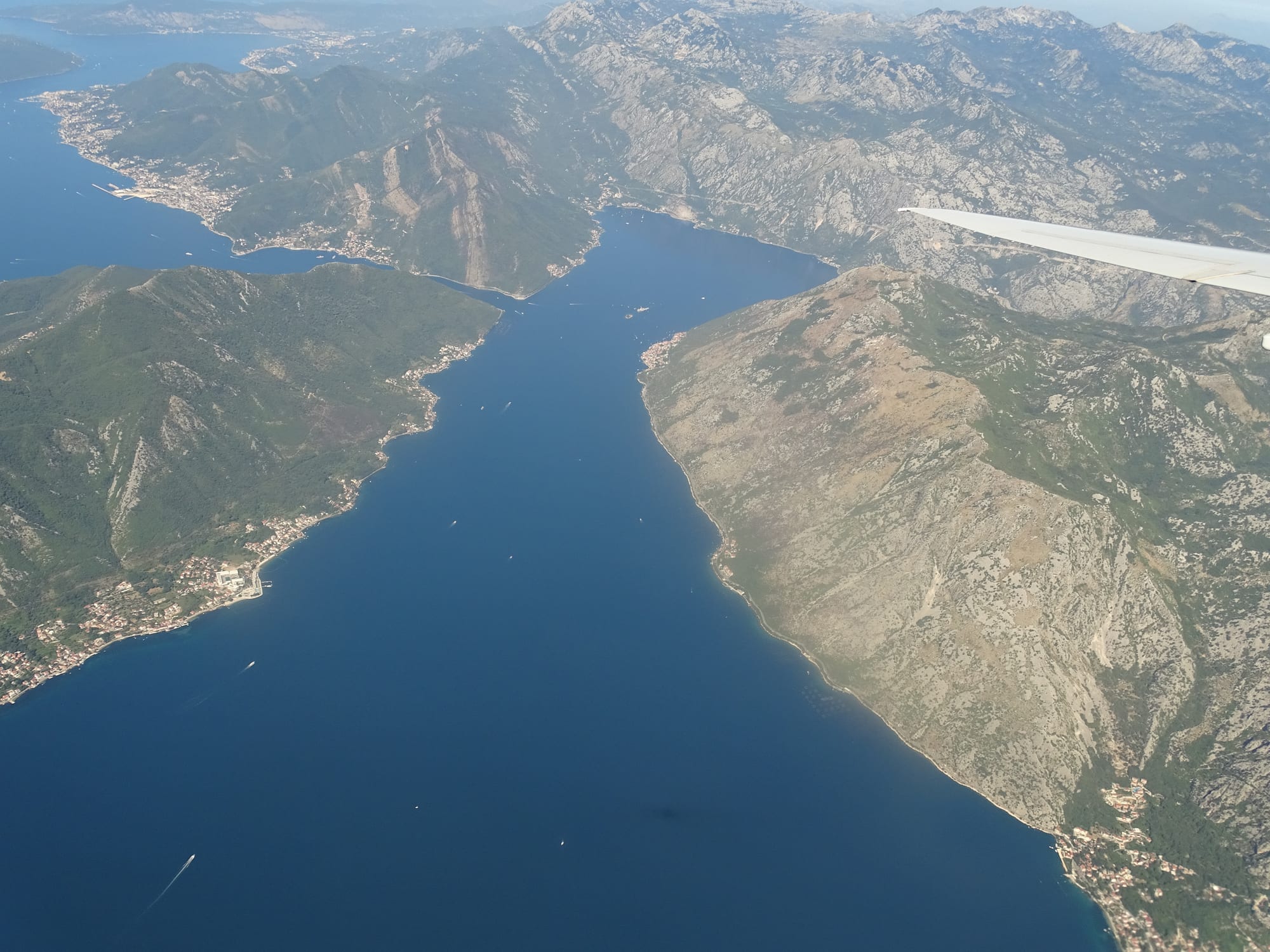
An aerial view of a deep blue bay winding between steep grey mountains, with a small red-roofed old town on the shore

Montenegro

The Bay of Kotor, a UNESCO-listed drowned river canyon on the Adriatic, ringed by the Dinaric mountains. (Ad Meskens / Wikimedia Commons · CC BY-SA 4.0)

A small Adriatic country where the Dinaric mountains drop straight into the sea — a highland principality that held out against the Ottomans, spent a century tied to Serbia, and voted for independence in 2006, and is now a NATO member and the frontrunner to join the EU.

Explore Montenegro

History

The mountains around Cetinje were the one corner of the Balkans the Ottomans never fully subdued. From 1696 a line of prince-bishops, the vladikas of the Petrović-Njegoš family, ruled a small warrior theocracy there; the greatest of them, Petar II Petrović-Njegoš, was also the national poet. The Congress of Berlin recognised Montenegro as an independent state in 1878, and it became a kingdom under Nikola I in 1910.

After the First World War, Montenegro was absorbed — against much local opposition — into the new Kingdom of Serbs, Croats and Slovenes, later Yugoslavia, and it remained one of the six Yugoslav republics through the socialist era. When Yugoslavia broke apart in the 1990s, Montenegro stayed with Serbia, first as Federal Yugoslavia and then in a loose "State Union" from 2003.

Milo Đukanović, dominant in Montenegrin politics from 1991, steered the country away from Belgrade, and a 2006 referendum backed independence by a narrow margin. Montenegro joined NATO in 2017 over Russian objections and is now the leading candidate for EU membership, with negotiations well advanced. A 2020 election brought the first change of government in three decades, and politics has been unsettled since.

  • Montenegro: The Black Mountain A highland redoubt the Ottomans never held, ruled for centuries by warrior prince-bishops — a kingdom, then part of Yugoslavia, then in 2006 the last piece of it to become independent

Culture & Customs

Montenegro carries a highland heritage of clans (bratstva), epic poetry sung to the one-stringed gusle, and an honour code that prized bravery and generosity to guests. That austere Dinaric world sits alongside a Mediterranean coast shaped by centuries of Venetian rule, with its own architecture, food, and easier rhythm.

Orthodox Christianity is the majority faith, but it is itself contested between a dominant Serbian Orthodox Church and a smaller Montenegrin one — a split bound up with the wider question of whether Montenegrins are a distinct nation or part of the Serbian one. There are also long-settled Muslim (Bosniak and Albanian) and, around the Bay of Kotor, Catholic communities. Families mark a slava, the day of their patron saint.

Montenegrins joke about their own reputation for taking it easy — a mock set of "commandments" begins "man is born tired and lives to rest". They are also, in fact, among the tallest people in the world, and produce national teams to match in basketball, water polo, and handball.

Daily Life

With only around 600,000 people, Montenegro is a country of small towns. Podgorica, hot and functional, is the administrative and business centre; Cetinje, in the hills, keeps the status of old royal capital. The coast — Herceg Novi, Kotor, Budva, Bar, Ulcinj — lives largely off a summer tourist season that transforms it and then empties, while the northern mountains around Žabljak, Kolašin, and Pljevlja are poorer, colder, and losing people.

The economy leans heavily on that coastal tourism, along with hydropower, aluminium, and a great deal of foreign real-estate investment, including a superyacht marina built on a former naval base at Tivat. A Chinese-financed motorway toward Serbia has left the small state with a heavy debt.

Since 2022, large numbers of Russians and Ukrainians have settled, especially on the coast, adding to the seasonal swing in prices and pressure on housing. Family and clan networks, and political patronage, still count for a lot in a place this size.

Food

On the coast the food is Dalmatian: grilled fish and squid, black cuttlefish risotto, shellfish na buzaru, olive oil, and cured ham and cheese from the village of Njeguši near Cetinje. Inland it turns hearty — lamb and veal cooked ispod sača under an iron bell heaped with embers, kačamak and cicvara (maize porridges enriched with cheese and kajmak), and priganice, fried dough with honey and cheese.

Balkan staples run through both: ćevapi grilled minced-meat fingers, burek and other filled pita, stuffed peppers, and ajvar relish. Lake Skadar supplies carp and eel to the restaurants along its shore.

The national wines are the dark red Vranac and the white Krstač, most of the country's output coming from one enormous vineyard on the Ćemovsko plain near Podgorica. Rakija, usually grape loza, is the spirit, and coffee is taken strong and slow.

Attractions & Natural Wonders

The Bay of Kotor is the country's showpiece: the walled Venetian town of Kotor under a mountain topped by the fortress of San Giovanni, the baroque town of Perast with its island church of Our Lady of the Rocks, and a serpentine road climbing to the Njegoš mausoleum on Mount Lovćen. Along the coast, Budva has a compact old town and a strip of busy beaches, and the fortified islet of Sveti Stefan is one of the Adriatic's iconic sights.

Inland, Ostrog Monastery is dug into a sheer cliff and draws pilgrims of several faiths. Durmitor National Park around Žabljak has the Black Lake, glacial peaks, and the Tara River canyon — among the deepest in the world and the country's rafting run — spanned by the Đurđevića Tara bridge. Biogradska Gora protects one of Europe's last primeval forests.

In the south, Lake Skadar, the largest lake in the Balkans, is a national park of reed beds, pelicans, monasteries, and small wineries, and Old Bar has a ruined hill town beside an olive tree said to be over two thousand years old.

Planning basics

Budget

Montenegro is cheaper than Croatia but no longer a bargain on the coast in summer, when rooms, sunbeds, and restaurants near Kotor and Budva rise sharply. The mountainous north is much cheaper. Private apartments (sobe) and guesthouses are the mainstay.

Daily Budget Midrange
EUR 90–190 (three-star hotel or apartment, restaurants, a hire car, a boat trip)
Daily Budget Shoestring
EUR 40–70 (hostel or private room, bakeries and grills, buses)

Visit the coast in June or September, or base in the north, to avoid the July–August price spike.

Visa Requirements

Citizens of the EU, the UK, the US, Canada, Australia, New Zealand, and many other countries may enter visa-free, generally for up to 90 days. Holders of valid Schengen, US, UK, or Irish visas may also enter. Register your stay with the police within 24 hours — hotels and hosts normally do this for you.

Typical Stay
90 days visa-free for most Western passports

Safety

Montenegro is a safe country for visitors, with low levels of violent crime. There are entrenched organised-crime clans linked to cocaine smuggling, and a violent feud between them, but this does not touch tourists. The real dangers are reckless driving on narrow mountain and coastal roads and summer wildfires.

Drive defensively and slowly on the corniche and canyon roads, and check fire warnings in high summer before hiking.

Climate

The coast is Mediterranean — hot, dry summers and mild, wet winters — and the inner Bay of Kotor is one of the rainiest places in Europe in winter, when Adriatic storms pile against the mountains. The interior and the northern ranges are continental and alpine, with cold, snowy winters and cooler summers.

Mountains
Cold snowy winters (skiing at Žabljak and Kolašin); mild summers
Coast Summer
June–September, 28–33°C, little rain

Transportation

Podgorica and Tivat have airports, with Tivat busy in summer beside the coast; Dubrovnik in Croatia serves the far south. A slow, scenic railway runs Bar–Podgorica–Kolašin–Bijelo Polje toward Belgrade. Buses link every town. The coastal road is winding and jams in summer, but the Kamenari–Lepetane ferry cuts across the Bay of Kotor.

Hire a car for the mountains and Lake Skadar, but expect slow, twisting roads and heavy coastal traffic in July and August.

Best Time to Visit

May–June and September are best for the coast — warm, swimmable, and far less crowded than the July–August peak. June to September suits the mountains and Tara River rafting; December to March is the ski season at Žabljak and Kolašin.

Events
Kotor Carnival (February); summer festivals in Kotor, Budva, and Herceg Novi; Mimosa Festival, Herceg Novi (February)

Currency

Montenegro uses the euro, adopted unilaterally in 2002, though it is not in the eurozone. Cards are widely accepted on the coast and in cities; carry cash in the northern mountains and small villages.

Symbol
Currency Code
EUR — euro (used unilaterally)

Language

Montenegrin is the official language; Serbian, Bosnian, Croatian, and Albanian are also in official use. The South Slavic variants are mutually intelligible, and the Montenegrin–Serbian distinction is more political and religious than linguistic. Albanian is spoken in the southeast around Ulcinj. English is widely used in tourism.

Also Official
Serbian, Bosnian, Croatian, Albanian
Official Language
Montenegrin