A small white church with a bell tower on a grassy limestone ridge above a wide bend of a river, with cave openings in the cliff below

Moldova

Orheiul Vechi, a cliff-cut cave monastery and ridge-top church above a loop of the Răut river — Moldova's most celebrated site. (Bertramz / Wikimedia Commons · CC BY-SA 3.0)

A small, landlocked country of vineyards and villages between Romania and Ukraine — the old region of Bessarabia, split from Romania by the Soviet Union, now a fast-changing EU candidate with a breakaway Russian-backed region on its eastern edge.

Explore Moldova

History

This land, historically Bessarabia, was the eastern half of the medieval Principality of Moldavia, whose fifteenth-century prince Stephen the Great (Ștefan cel Mare) held off the Ottomans and founded painted monasteries still revered today. Moldavia later fell under Ottoman suzerainty, and in 1812 Russia annexed Bessarabia. After the First World War the region united with Romania.

In 1940, under the Molotov–Ribbentrop Pact, the Soviet Union took Bessarabia and joined most of it to a thin strip on the east bank of the Dniester to form the Moldavian Soviet Socialist Republic. Soviet rule brought deportations, a famine in 1946–47, industrialisation of the east-bank strip, and decades of Russification. Moldova declared independence in 1991 as the USSR collapsed.

A short war in 1992 left the east-bank region of Transnistria a Russian-backed, unrecognised breakaway state, a "frozen conflict" that persists. Gagauzia, in the south, negotiated autonomy within Moldova in 1994. Politics swung for years between pro-Russian and pro-European camps amid deep corruption, including a 2014 bank fraud that drained the equivalent of an eighth of the economy. After Russia's 2022 invasion of Ukraine, Moldova applied to join the European Union, was granted candidate status, and opened accession talks in 2024.

  • Moldova: The Borderland of Bessarabia The eastern half of a Romanian principality, taken by Russia in 1812 — a Soviet republic, an independence shadowed by a breakaway region, and a poor country now pulling hard toward Europe

Culture & Customs

Moldova's culture is essentially Romanian — the same language, the same Orthodox Christianity, the same folk music of the doina lament and the circle-dance hora, played on pan-flute and cimbalom. The Church is divided between a Moscow-linked Moldovan Orthodox Church and a Bucharest-linked Bessarabian one, a rivalry that mirrors the country's wider tug between east and west.

Custom is village-rooted. Homes keep a casă mare, a best room reserved for guests and celebrations; hospitality means the table, and almost every rural family makes its own wine. Spring is marked by Mărțișor, when people pin red-and-white tokens to their coats on 1 March, and the Christmas season by carolling from house to house.

The Gagauz of the south are a distinct people — Orthodox Christians who speak a Turkic language — with their own wine, carpet-weaving, and sheep-farming traditions. Many Moldovans feel a strong pull toward Romania, some favouring outright union, while others hold to a separate Moldovan civic identity, and a Russian-speaking minority looks the other way.

Daily Life

Chișinău, a leafy Soviet-planned city, is the only large urban centre and holds a growing share of the country's life, including a notable information-technology and outsourcing sector. Beyond it, Moldova is a land of farming villages, many of them half-empty: perhaps a third of the working-age population lives and works abroad, historically in Russia and now increasingly in Romania, Italy, and the rest of the EU.

Remittances sent home are a large part of the economy, visible in new houses in otherwise ageing villages, and grandparents raising grandchildren while the middle generation is away is a common arrangement. Agriculture dominates — grain, sunflower, fruit, walnuts, and above all wine, with one of the highest densities of vineyards of any country.

Energy has been a running crisis: long total dependence on Russian gas piped through Ukraine ended when transit stopped in early 2025, hitting Transnistria hardest. The cost of living is low, roads are improving with EU funding, and daily life for many revolves around the garden, the church calendar, and the harvest.

Food

Moldovan cooking is close to Romanian and built for the table. Mămăligă, a firm maize porridge, is served with sheep's cheese (brânză), sour cream, and pork cracklings. Sarmale — minced meat and rice rolled in cabbage or vine leaves — is the festive dish, and plăcinte, pan-fried or baked pastries filled with cheese, potato, cabbage, apple, or pumpkin, are eaten at any time.

Soups are important: zeamă, a chicken and noodle broth soured with fermented wheat bran, and various ciorbă. Grilled mititei (skinless minced-meat rolls), friptură (roast or braised pork), and tochitură stew round out a meal, with plenty of tomatoes, peppers, aubergines, and pickles in season.

Wine is inseparable from Moldovan life — house wine at every meal, and a serious industry behind it, from the estate of Purcari to the vast underground cellars of Cricova and Mileștii Mici, the latter holding what is recorded as the world's largest wine collection. Divin, the local brandy, and fruit spirits are the stronger options.

  • Moldova: Food and the National Dish A firm cornmeal porridge eaten with cheese and cream, from a small country that keeps some of the largest wine cellars in the world underground

Attractions & Natural Wonders

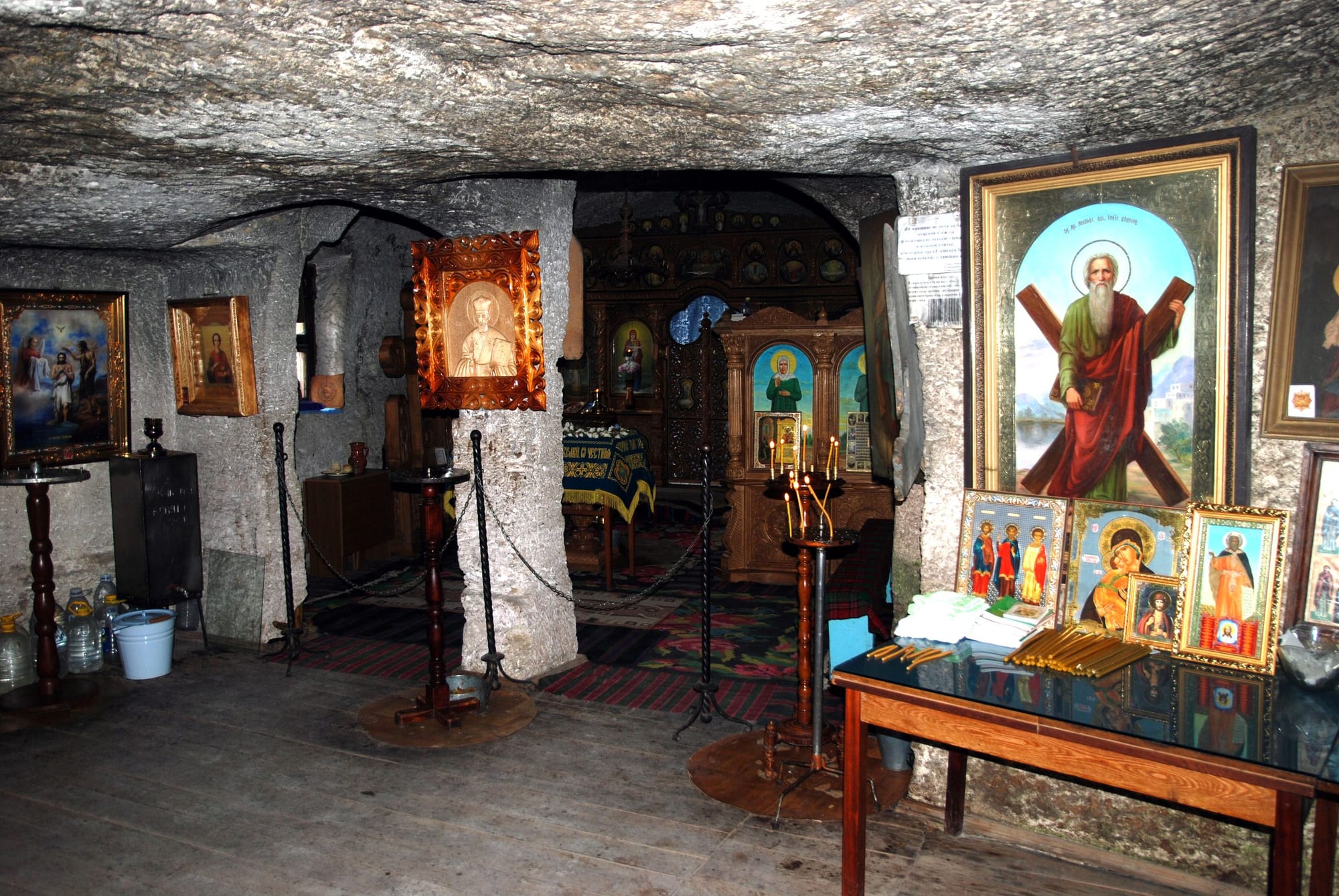
Orheiul Vechi, "Old Orhei", is Moldova's signature sight: a cave monastery cut into a limestone cliff, a small church on the ridge above, and the traditional village of Butuceni, all set on a dramatic loop of the Răut river with layers of Dacian and medieval remains around them.

Wine tourism is the other main draw. Cricova and Mileștii Mici are underground "wine cities" with tens of kilometres of tunnels driven through by car for tastings, and estates such as Purcari, Château Vartely, and Asconi offer tours and lunches. Monasteries are scattered across the countryside: Căpriana, linked to Stephen the Great; grand, restored Curchi; and the cliff-and-waterfall monasteries of Saharna and Țipova above the Dniester.

Chișinău itself has the Nativity Cathedral and its bell tower, the Ștefan cel Mare park and monument, the Triumphal Arch, and a lively wine-bar and café scene. In the north, Soroca has a compact riverside fortress built by Stephen the Great and, on the hill above, the extravagant mansions of Roma community leaders. Transnistria, across the Dniester, draws the curious for its open-air display of Soviet symbols in Tiraspol, though it is visited with care and on its own terms.

  • Moldova: Seven Attractions and Natural Wonders A cave monastery carved into a river cliff, the world's largest wine cellar with its own underground streets, and a Soviet-nostalgic breakaway republic still flying the hammer and sickle

Planning basics

Budget

Moldova is one of the cheapest countries in Europe for visitors. Chișinău has a growing range of guesthouses, hostels, and mid-range hotels; rural stays are often on wine estates or in village homes. Cash is common outside the capital, though cards work well in Chișinău.

Daily Budget Midrange
EUR 60–120 (mid-range hotel, restaurants, a driver or hire car, winery tours)
Daily Budget Shoestring
EUR 25–45 (hostel or guesthouse, canteens and markets, marshrutka minibuses)

Winery tastings with lunch are the main planned expense and are still inexpensive by Western European standards.

Visa Requirements

Citizens of the EU, the UK, the US, Canada, Australia, New Zealand, and many other countries can enter visa-free for up to 90 days in any 180-day period. A passport valid for the stay is required.

Typical Stay
90 days in any 180-day period, visa-free, for most Western passports

Transnistria, the breakaway region on the east bank of the Dniester, has its own checkpoints and issues a short entry slip; read current advice before going.

Safety

Moldova is generally safe, with low levels of violent crime; the usual issues are petty theft and taxi overcharging in Chișinău. The wider concerns are the unresolved Transnistria dispute, where about 1,500 Russian troops remain, and the country's position next to the war in Ukraine, which has brought refugees, energy shocks, and occasional stray debris.

Follow your government's advice on Transnistria, use ride-hailing apps rather than street taxis, and keep an eye on regional news.

Climate

Moderate continental. Summers are warm to hot, sometimes reaching the mid-thirties with drought; winters are cold, around freezing or below, with snow. Spring and autumn are long and pleasant, and the grape harvest runs through September and October.

Summer
June–August, 25–35°C
Winter
December–February, around −5 to 3°C, snow

Transportation

Chișinău has the only international airport, with a limited but growing route network. Rail is slow and sparse, mostly overnight trains to Bucharest and Iași. Intercity travel is by frequent, cramped marshrutka minibuses and buses from Chișinău's terminals. Car hire is available; roads vary from good to poor.

For Orheiul Vechi and the wineries, a hired car or a driver-guide saves a lot of time over minibuses.

Best Time to Visit

May–June and September–October are the most rewarding: mild weather, green or golden countryside, and the wine harvest. The National Wine Day, on the first weekend of October in Chișinău, is the country's biggest celebration.

Events
National Wine Day (early October); Mărțișor (1 March); Orthodox Easter and Christmas

Currency

The currency is the Moldovan leu (MDL). Cards are widely accepted in Chișinău; carry cash elsewhere. Euros and US dollars are easily exchanged. Transnistria uses its own unrecognised currency, so change only a small amount there for local transport.

Symbol
L
Currency Code
MDL — Moldovan leu

Language

The state language is Romanian (long also called "Moldovan" — the two names refer to the same language). Russian is widely understood, especially in the north, in Chișinău, and in Transnistria and Gagauzia, which also use Ukrainian and Gagauz respectively. English is spoken by many younger people in the capital.

Also Spoken
Russian; Gagauz and Ukrainian in their autonomous areas
State Language
Romanian