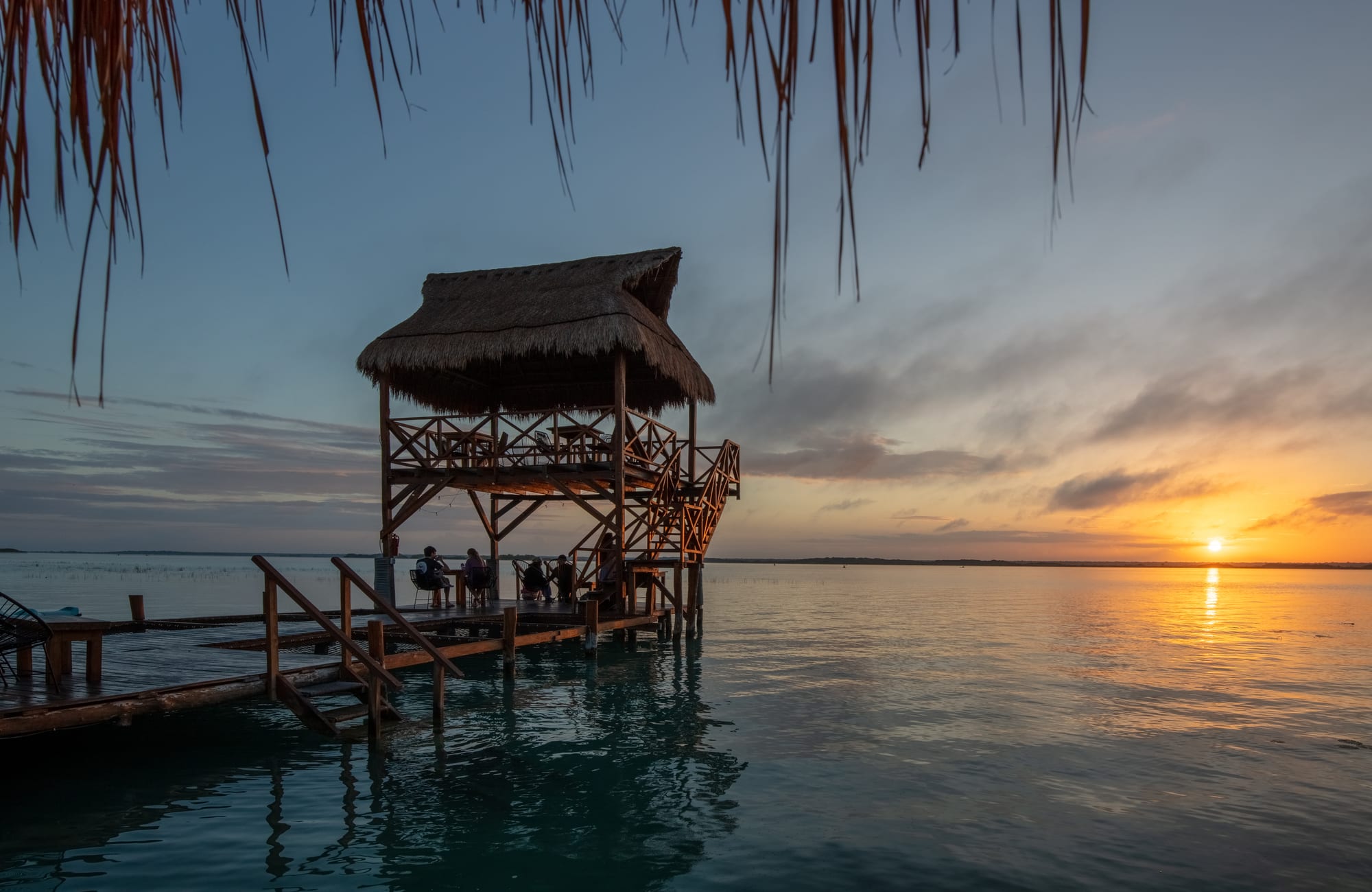
A two-storey thatched wooden pavilion on a pier over calm turquoise water, with the sun rising orange on the horizon and palm fronds hanging in the foreground

Mexico

Sunrise over the Bacalar Lagoon in Mexico, seen past a thatched pier pavilion standing in the calm water. (Diego Delso / Wikimedia Commons · CC BY-SA 4.0)

A vast country between the United States and Central America — heir to the Maya, Aztec, and other civilisations, shaped by Spanish conquest and a bloody revolution, and today the most populous Spanish-speaking nation and a manufacturing power alongside deep inequality.

Explore Mexico

History

Mesoamerica was one of the world's cradles of civilisation. The Olmec carved colossal heads on the Gulf coast; Teotihuacan, near modern Mexico City, grew into one of the largest cities on Earth; the Maya built city-states across the southeast; and, by the fifteenth century, the Mexica (Aztecs) ruled a tribute empire from Tenochtitlán, an island capital in a highland lake.

Hernán Cortés landed in 1519, allied with the Aztecs' enemies, and — with European disease doing much of the work — destroyed Tenochtitlán by 1521. Three centuries of Spanish rule as the Viceroyalty of New Spain followed, built on silver, forced labour, a rigid caste hierarchy, and the Catholic Church, with the apparition of the Virgin of Guadalupe becoming a unifying national symbol. Independence, launched by the priest Miguel Hidalgo in 1810, was secured in 1821.

The young republic lost half its territory to the United States in the war of 1846–48, endured French invasion and a brief Habsburg emperor, and was then held for decades by the strongman Porfirio Díaz. The Revolution that began in 1910 — Madero, Villa, Zapata, Carranza — cost well over a million lives and produced the 1917 constitution and, from 1929, seventy years of one-party rule by the PRI. Power finally alternated in 2000. A militarised campaign against drug cartels launched in 2006 has been followed by years of high violence. Claudia Sheinbaum, elected in 2024, is the country's first woman president.

  • Mexico: The Many Conquests A cradle of civilisation where maize was domesticated and the Aztecs built Tenochtitlan — Spanish conquest and three centuries of New Spain, a violent 19th century that cost half the country, a revolution, seventy-one years of one-party rule, and a democracy shadowed by its cartels

Culture & Customs

Modern Mexican identity is built on mestizaje, the blending of Indigenous and Spanish worlds, and it shows in everything from language to religion. Catholicism is overwhelmingly the majority faith, threaded through with Indigenous practice — nowhere more visibly than at Day of the Dead, when families build altars and visit cemeteries to welcome back the dead with marigolds, food, and candles.

Family is the centre of life, extended by ties of compadrazgo (godparenthood), and milestones such as the quinceañera fifteenth-birthday celebration are major events. Regional identity is strong: a Oaxacan, a norteño, and a chilango from the capital will each claim their own food, music, and character.

Mexico's cultural exports are large. The muralists Rivera, Orozco, and Siqueiros and the painter Frida Kahlo shaped twentieth-century art; mariachi, ranchera, son jarocho, banda, and, lately, regional Mexican corridos reach global audiences; and lucha libre wrestling, with its masked técnicos and rudos, is part sport, part theatre. Football is the mass passion.

Daily Life

Mexico has around 130 million people, roughly a fifth of them in Greater Mexico City, one of the largest metropolitan areas on Earth. The industrial north, tied closely to the US economy through manufacturing and the maquiladora export plants, is the wealthiest region; the centre mixes services, industry, and farming; and the south — Chiapas, Oaxaca, Guerrero — is the poorest and most Indigenous.

A large share of work is informal, from street vending to day labour. Remittances sent home by the roughly 38 million people of Mexican origin living in the United States are one of the country's biggest sources of foreign income, and many towns in the centre and west depend on them. Mexico is also a country of transit, with large numbers of migrants from Central America, Haiti, and Venezuela moving through it toward the US border.

Daily rhythms vary with region and class, but a late, substantial comida in the early afternoon, markets for fresh food, and a strong culture of neighbourhood and extended family are common threads. Fiestas for local patron saints punctuate the year in almost every town.

Food

Traditional Mexican cuisine is on UNESCO's heritage list, and it begins with corn: dried maize treated with lime (nixtamal), then ground for tortillas, tamales, pozole, and sopes. Around it are chillies in dozens of varieties, beans, squash, tomatoes, and native chocolate and vanilla. The taco appears in endless forms — al pastor, carnitas, barbacoa, birria, fish tacos on the coasts.

Regional kitchens are distinct. Oaxaca and Puebla are known for their complex moles, sauces of chillies, spices, nuts, and chocolate; the Yucatán for cochinita pibil, pork marinated in achiote and sour orange and pit-roasted; the north for grilled beef and flour tortillas; the coasts for ceviche and aguachile. Street stalls and markets serve tlacoyos, tlayudas, elotes, chilaquiles, and quesadillas through the day.

To drink there are the agave spirits — tequila from Jalisco and mezcal, smokier and increasingly sought after, from Oaxaca and beyond — along with pulque, fresh fruit aguas frescas, atole, and a fast-growing craft-beer scene.

  • Mexico: Food and the National Dish A dark, complex sauce built from dozens of ingredients including chocolate and chilli, at the head of a cuisine UNESCO has recognised as living cultural heritage

Attractions & Natural Wonders

Mexico City rewards several days: the Zócalo and the excavated Aztec Templo Mayor, the National Museum of Anthropology, Frida Kahlo's Casa Azul, the canals of Xochimilco, and the pyramids of Teotihuacan an hour away. The colonial cities of the Bajío — Guanajuato, San Miguel de Allende, Querétaro, Zacatecas — and Puebla with the great pyramid of Cholula are within easy reach.

The southeast holds the Maya country: Chichén Itzá and Uxmal in Yucatán, Palenque in the Chiapas jungle, the cliff-top ruins of Tulum, the cenote sinkholes, and the reefs off Cozumel and the Riviera Maya. Oaxaca combines a beautiful colonial capital with the Zapotec city of Monte Albán, the mineral terraces of Hierve el Agua, and a string of Pacific surf and beach towns.

Elsewhere, the Copper Canyon in the northwest is crossed by the El Chepe railway; Baja California Sur offers grey-whale lagoons, whale sharks off La Paz, and the resorts of Los Cabos; and the fir forests of Michoacán fill each winter with millions of migrating monarch butterflies.

  • Mexico: Thirteen Attractions and Natural Wonders Maya pyramids on turquoise coasts, a capital city built over an Aztec lake, sinkholes filled with impossibly clear water, and enough colonial silver towns and canyon country to fill a dozen trips

Planning basics

Budget

Mexico is affordable for most travellers outside the international resort zones. Street food, markets, and second-class buses cost little; Los Cabos, Cancún, and the Riviera Maya run to US and European prices. Cards work in cities and tourist towns; cash is needed for markets, small towns, and tips.

Daily Budget Midrange
USD 70–170 (mid-range hotel, restaurants, first-class buses or domestic flights, guided sites)
Daily Budget Shoestring
USD 30–55 (hostel or budget hotel, taquerías and markets, buses and the metro)

Prices in the Yucatán resort belt and Baja can be several times those in Oaxaca, Puebla, or central Mexico for the same thing.

Visa Requirements

Citizens of the US, Canada, the UK, the EU, Australia, New Zealand, Japan, and many other countries need no visa for tourism. Arrivals fill in a tourist permit (FMM); the length of stay is now set by the immigration officer on entry and is often less than the old 180-day maximum, so check the date stamped in your passport.

Typical Stay
Up to 180 days, but frequently granted for less — confirm the stamped date

Keep the entry stamp or FMM slip; you may need to show it on departure or when checking into hotels.

Safety

Safety varies enormously by state and even neighbourhood. Organised-crime violence makes several states — parts of the north and the Pacific, including Tamaulipas, Sinaloa, Michoacán, Guerrero, Zacatecas, and Colima — subject to "reconsider" or "do not travel" advisories, while heavily visited areas such as Yucatán, central Mexico City, Oaxaca city, and Baja California Sur are far safer. Petty theft, "express" kidnapping, and highway robbery are the main risks for visitors.

Read your government's state-by-state advisory, use toll roads and travel by day, use registered taxis or apps, and withdraw cash inside banks and malls.

Climate

Enormously varied by altitude and latitude. The central highlands around Mexico City and Guadalajara are mild all year with a summer rainy season; the coasts are hot and humid, with an Atlantic and Pacific hurricane season from June to November; the north is desert. The dry season is roughly November to April.

Coasts
Hot and humid, 25–35°C; hurricane risk June–November
Highlands
Mild, 10–25°C, rain concentrated May–September

Transportation

Mexico City is a major air hub, with regional airports across the country. There is little intercity passenger rail beyond tourist lines such as El Chepe through the Copper Canyon and the new Tren Maya, but the first-class long-distance bus network (ADO, Primera Plus, ETN) is excellent. Mexico City has a large, cheap metro, and ride-hailing apps operate in most cities.

Driving
Use the toll highways (cuotas) rather than free roads (libres), and travel between cities by day

Book first-class (primera or ejecutivo) buses for comfort and safer routing on long trips.

Best Time to Visit

October to April, the dry season, suits most of the country. Day of the Dead around 1–2 November is a highlight, especially in Oaxaca and Michoacán. Grey whales gather off Baja California Sur from December to April, and monarch butterflies fill the Michoacán fir forests from November to March.

Events
Day of the Dead (late Oct–2 Nov); Independence night (15–16 September); Guelaguetza in Oaxaca (July)

Currency

The currency is the Mexican peso (MXN), written with a dollar sign. ATMs are everywhere; US dollars are taken in border and resort areas but at poor rates. Cards are widely accepted in cities and tourist areas, less so in villages and markets.

Symbol
$
Currency Code
MXN — Mexican peso

Language

Spanish is the de facto national language and Mexico has the largest Spanish-speaking population in the world. It is not the sole "official" language: 68 Indigenous languages are recognised, several — Náhuatl, Yucatec Maya, Zapotec, Mixtec, Tzeltal — with hundreds of thousands or millions of speakers. English is common in tourist areas and near the US border.

National Language
Spanish
Indigenous Languages
68 recognised, led by Náhuatl and Yucatec Maya