History · Mexico
Mexico: The Many Conquests
A cradle of civilisation where maize was domesticated and the Aztecs built Tenochtitlan — Spanish conquest and three centuries of New Spain, a violent 19th century that cost half the country, a revolution, seventy-one years of one-party rule, and a democracy shadowed by its cartels
By Worldlore Editorial · 19 September 2026
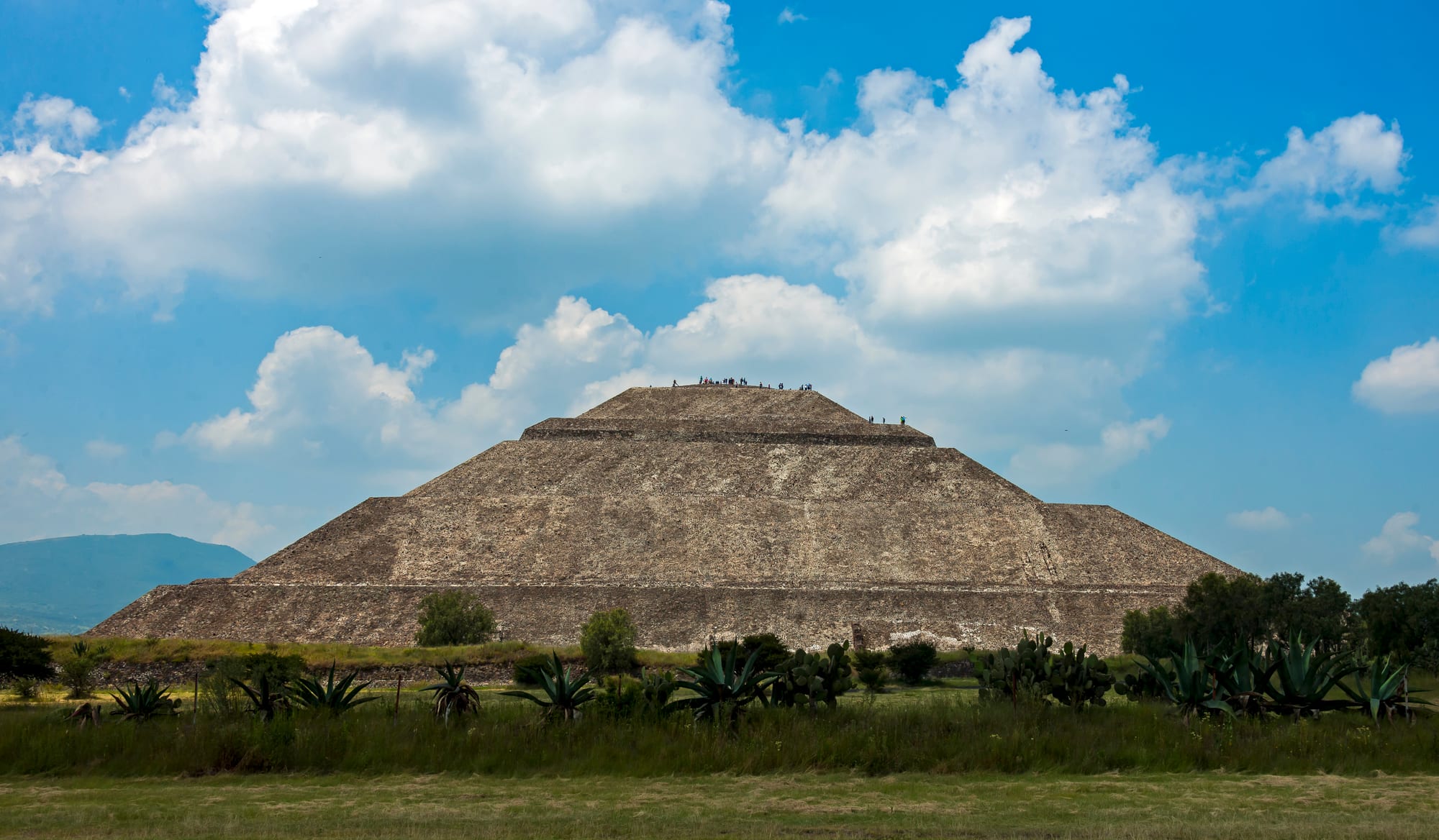
A country of layers
Mexico is one of the few places on Earth where civilisation arose independently. Maize was domesticated from wild grass in its valleys roughly nine thousand years ago, and on that foundation a succession of cultures built one of humanity's original centres of urban life: the Olmec, the Maya, the Zapotec, the unknown builders of Teotihuacan, the Toltec, and finally the Mexica, better known as the Aztecs. On top of all that came three centuries of Spain, a bloody and prolonged independence, the loss of more than half the national territory to the United States, a decade of revolution, and seventy-one unbroken years of rule by a single party. Modern Mexico — about 130 million people, the most populous Spanish-speaking country in the world — carries every layer.
A short history
- c. 1500–400 BCE
The Olmec
Mesoamerica's "mother culture" on the Gulf coast; the colossal heads.
- c. 250–900 CE
Classic Maya
City-states across the south-east; the Long Count calendar and full writing.
- c. 100–550 CE
Teotihuacan
A planned city of over 100,000 people near modern Mexico City.
- 1325
Tenochtitlan
The Mexica found their island capital in Lake Texcoco.
- 1428
The Triple Alliance
Tenochtitlan, Texcoco and Tlacopan build a tribute empire.
- 1519–1521
The Spanish conquest
Cortés and Indigenous allies destroy the Aztec empire.
- 1521–1821
New Spain
A viceroyalty ruled from Mexico City; a global silver economy.
- 1810–1821
Independence
From Hidalgo's revolt to a conservative criollo break with Spain.
- 1846–1848
War with the United States
Mexico cedes about 55 per cent of its territory.
- 1858–1867
The Reforma and the French
Juárez's liberals defeat the conservatives and the emperor Maximilian.
- 1876–1911
The Porfiriato
Thirty-five years of Porfirio Díaz: railways, foreign capital, landlessness.
- 1910–1920
The Revolution
A many-sided civil war; the progressive 1917 Constitution.
- 1929–2000
The PRI
Seventy-one years of one-party rule.
- 2006–
The drug war
Militarised anti-cartel campaigns and mass violence.
Mesoamerica
Over three millennia the peoples of central and southern Mexico developed a shared civilisation with common features across many languages and states: a 260-day ritual calendar interlocking with a 365-day solar year, a ballgame played with a rubber ball, stepped pyramid-temples, sacred markets, and — among the Maya — a complete hieroglyphic writing system and a mathematics that used a true zero.
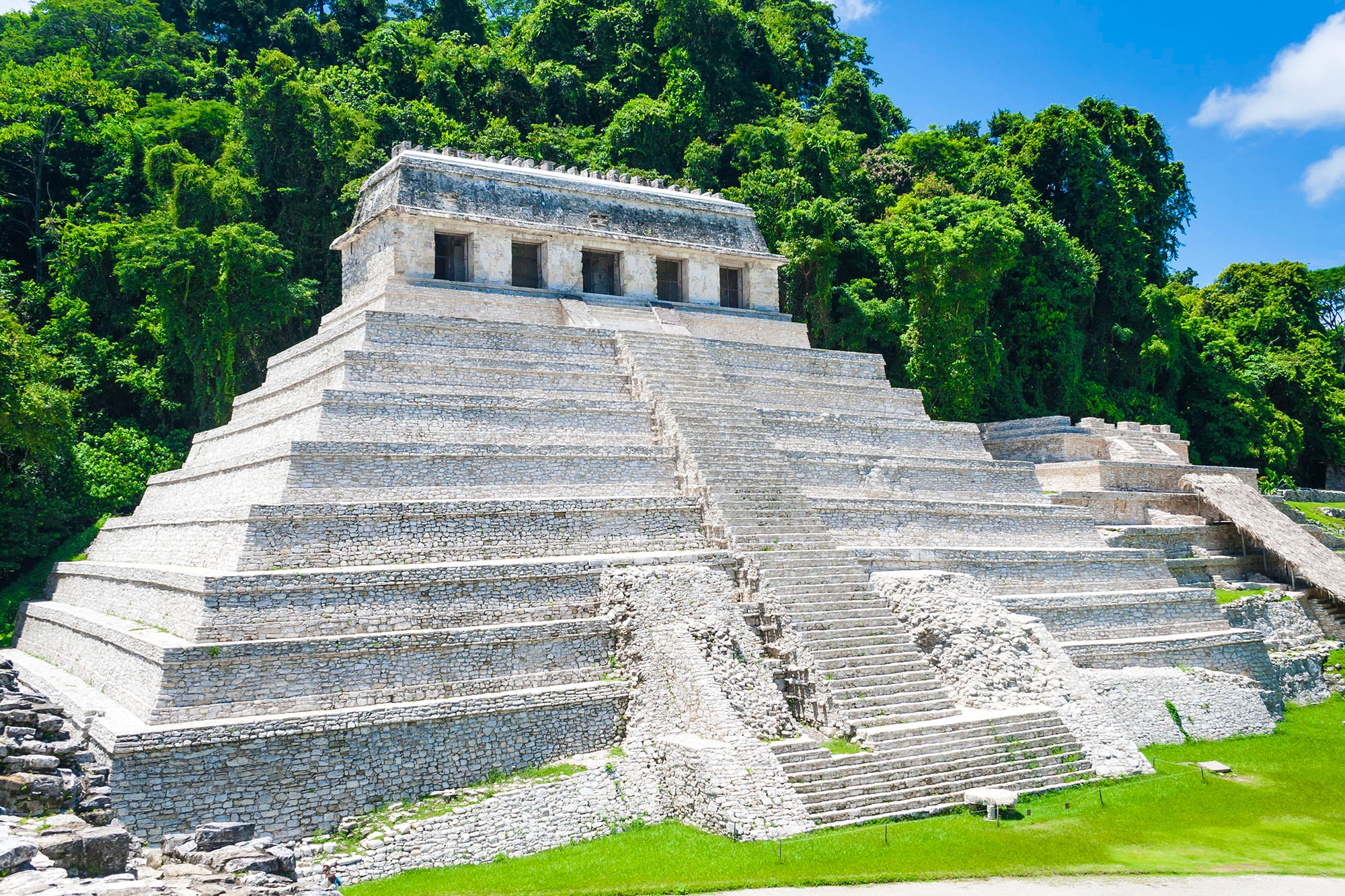
The Olmec of the humid Gulf coast, from about 1500 BCE, carved the multi-tonne basalt heads and set the template later cultures drew on. In the highlands, Teotihuacan grew from about 100 CE into a rigorously planned metropolis of more than 100,000 people, dominating central Mexico for four centuries before it burned around 550; who its rulers were, and what language they spoke, is still not known. The Maya to the south-east built dozens of competing city-states — Tikal, Calakmul, Palenque, Copán — that flourished from around 250 to 900 CE and then, in the "Classic collapse", were mostly abandoned, probably under the combined pressure of drought, warfare and overpopulation. The Zapotec ruled from the hilltop city of Monte Albán in Oaxaca; the Toltec, from Tula, became a semi-legendary imperial model for those who came after.
Before the conquest
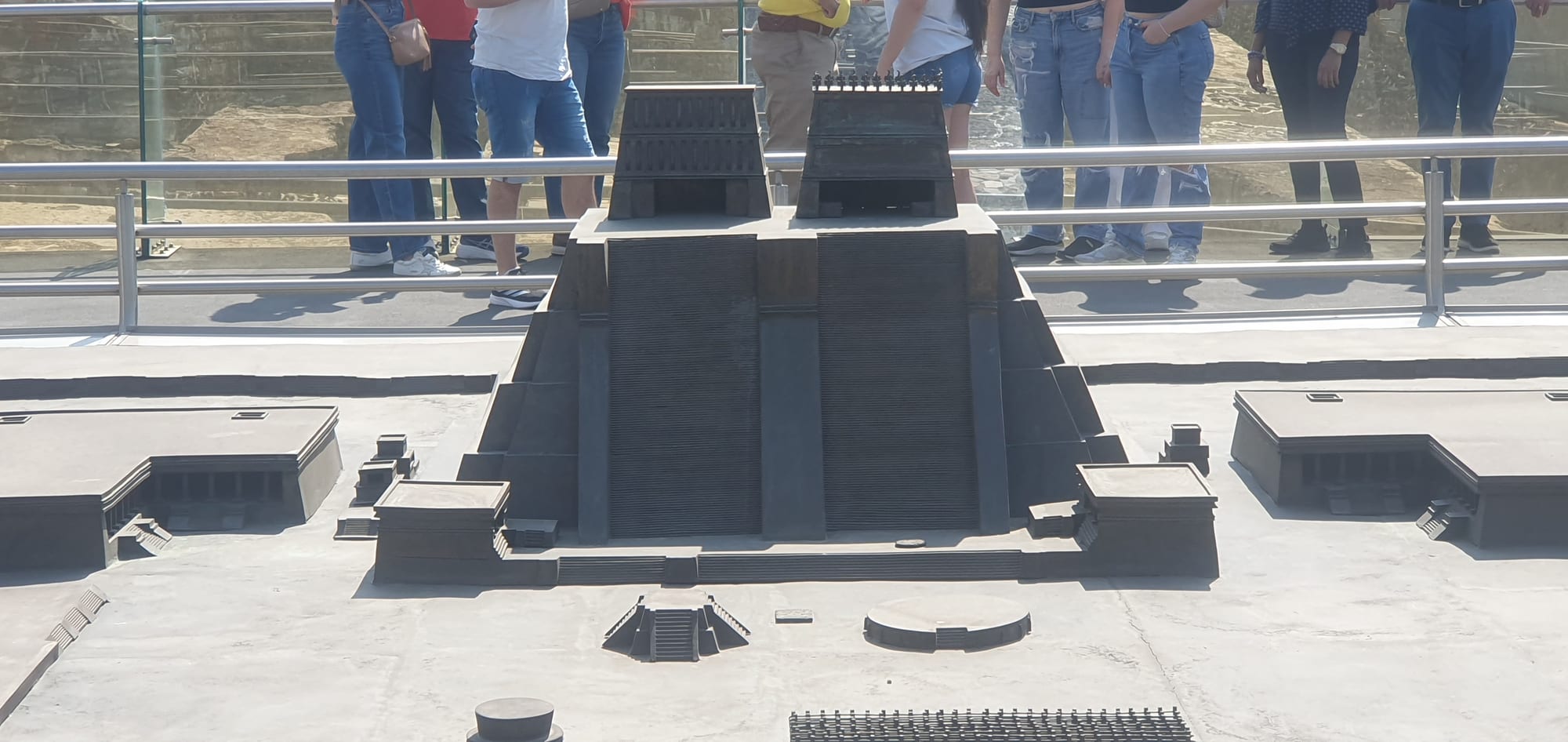
The Mexica, a Nahuatl-speaking people who arrived late in the Valley of Mexico, founded Tenochtitlan on a lake island in 1325. In 1428 they joined Texcoco and Tlacopan in the Triple Alliance, and over the next 90 years built a tribute empire covering much of central and southern Mexico — extracting textiles, food, gold and captives for sacrifice from subject peoples, many of whom resented the arrangement bitterly.
Conquest and New Spain
Hernán Cortés landed near Veracruz in 1519 with about 500 men, burned his ships, and marched inland, gathering Indigenous allies — above all the city-state of Tlaxcala, a bitter enemy of the Mexica — and relying on the interpreter and adviser Malinche (Doña Marina). Received into Tenochtitlan by the emperor Moctezuma II, the Spanish seized him as a hostage; a massacre by Cortés's men provoked a revolt that drove the invaders out with heavy losses on the "Sad Night" (La Noche Triste) of 1520. The Spanish regrouped, and in 1521, after a three-month siege in which smallpox — newly arrived from the Old World — killed a large part of the city's population and its new emperor Cuauhtémoc, Tenochtitlan fell on 13 August.
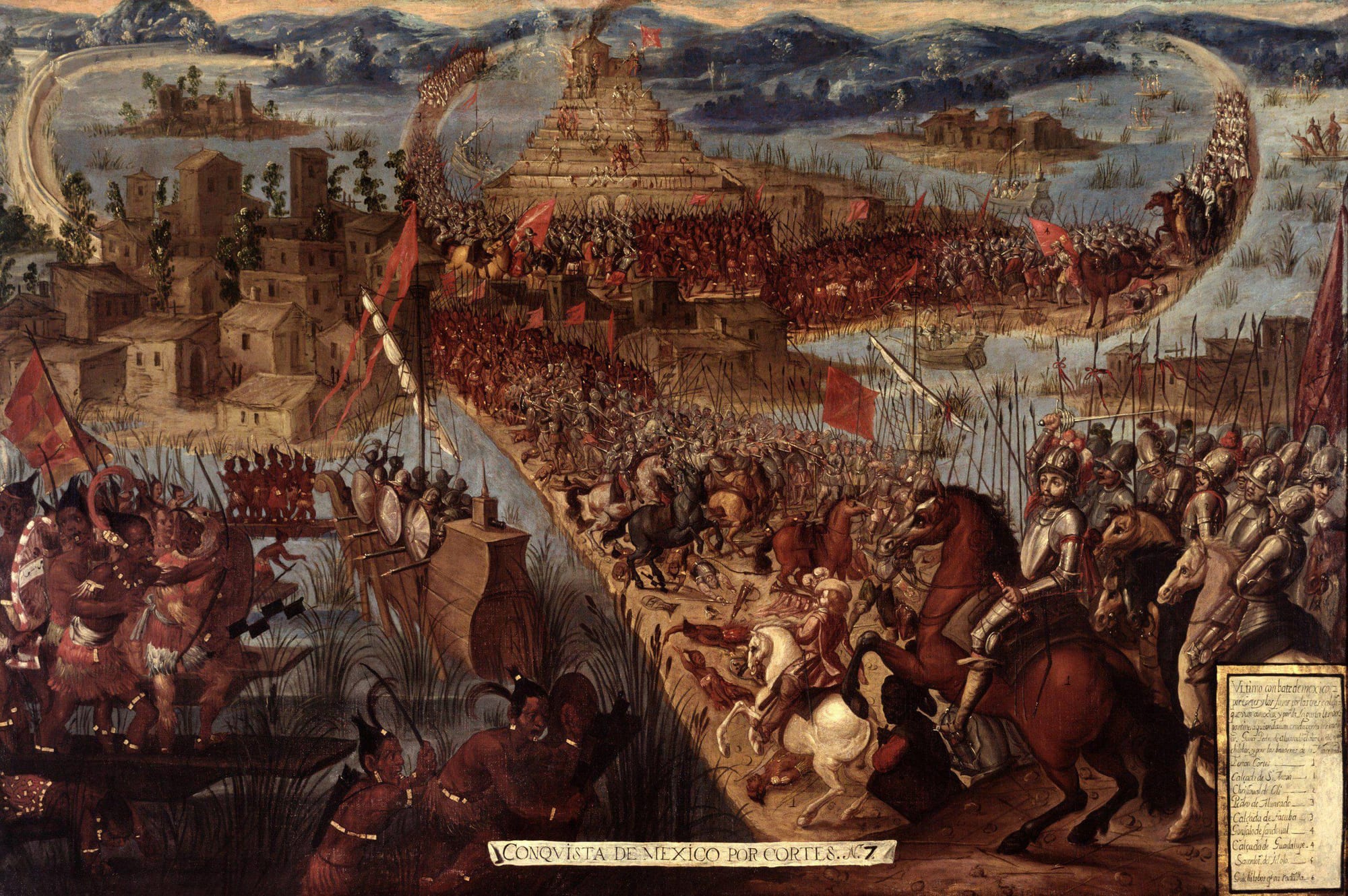
For three centuries Mexico was the Viceroyalty of New Spain, governed from Mexico City — rebuilt on the ruins and grid of Tenochtitlan — and stretching at its height from Central America to what is now the western United States, plus the Philippines, linked to Asia by the annual Manila galleon. Its defining wealth was silver, mined at Zacatecas, Guanajuato and Taxco, which financed the Spanish crown and lubricated the entire early-modern world economy.
The human cost was catastrophic. Under the encomienda system, conquistadors were granted the labour and tribute of Indigenous communities; that, forced resettlement, and above all wave after wave of Old World epidemics reduced the Indigenous population from perhaps 15–25 million in 1519 to around one million by 1600 — one of the largest demographic collapses in history. A new society formed on top of the survivors: a small Spanish-born (peninsular) elite; American-born Spaniards (criollos); a large mixed-race (mestizo) majority; Africans brought as slaves; and the Indigenous communities, taxed and segregated but never eliminated. Their descendants' many overlapping categories were catalogued obsessively in the colonial casta system.
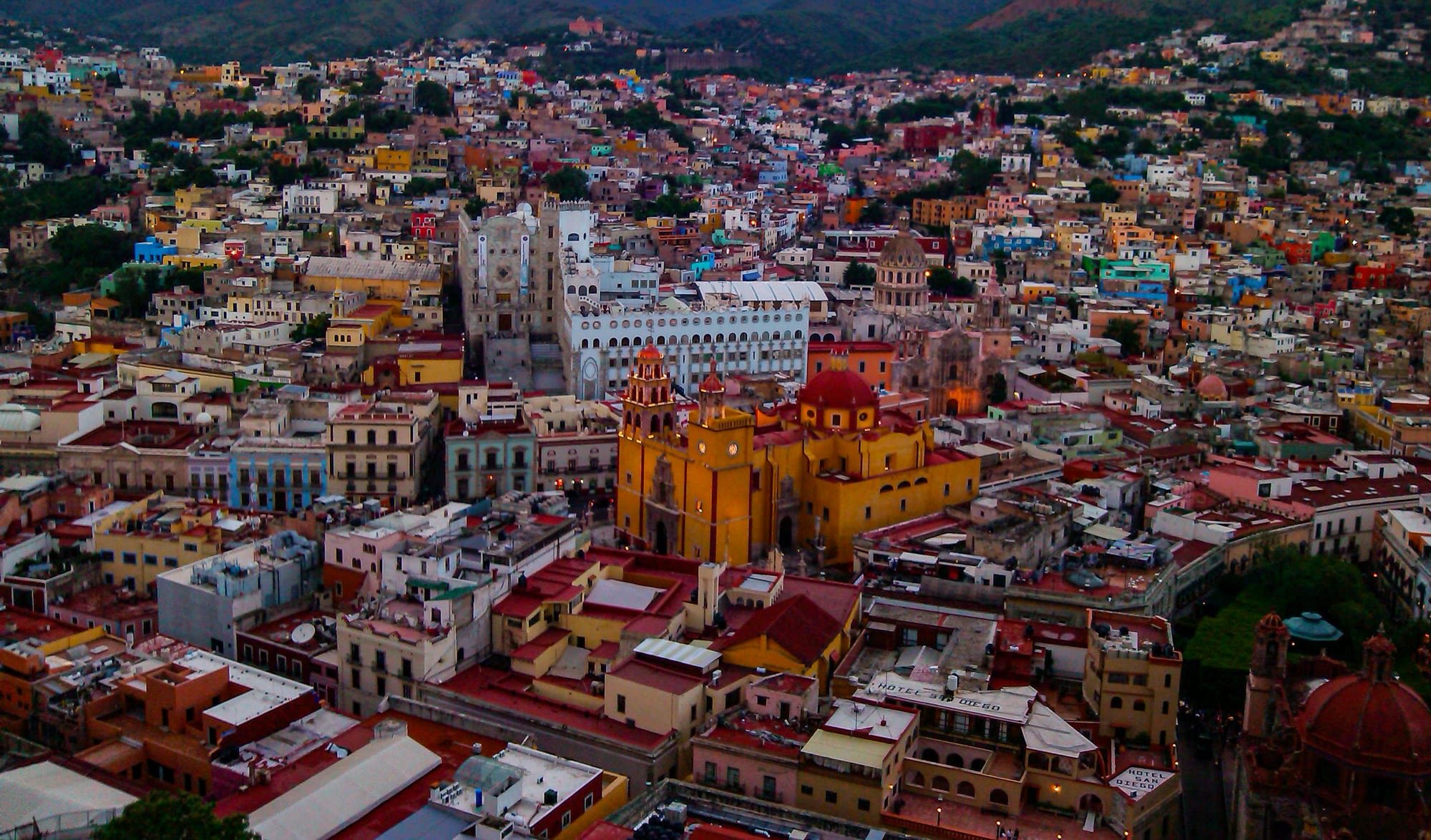
The Catholic Church was the other pillar of New Spain — evangelising, educating, banking, and owning perhaps half the productive land. From the 1760s the Bourbon reforms tried to squeeze more revenue and control from the colony, curbing Church and criollo privileges and expelling the Jesuits; the resentment this bred among American-born elites helped set the stage for independence.
Independence, and the loss of the north
On 16 September 1810 the parish priest Miguel Hidalgo rang his church bell in the town of Dolores and called for revolt — the Grito de Dolores, now Mexico's independence day. His movement drew tens of thousands of Indigenous and mestizo peasants, frightened the criollo elite with its social radicalism, and was crushed within a year; Hidalgo was executed, and leadership passed to another priest, José María Morelos, until he too was caught and shot in 1815. The insurgency survived as a guerrilla war in the south under Vicente Guerrero.
Independence finally came in 1821 — from the other direction. When a liberal revolution in Spain in 1820 threatened criollo interests, the royalist commander Agustín de Iturbide switched sides, made a deal with Guerrero (the Plan of Iguala), and marched into Mexico City. Iturbide crowned himself emperor; within two years he was overthrown and Mexico became a republic.
The new nation then spent decades tearing itself apart between federalists and centralists, with the caudillo Antonio López de Santa Anna in and out of the presidency eleven times. In 1836 the Anglo settler population of Texas seceded and, after a decade as an independent republic, was annexed by the United States. That triggered the Mexican–American War of 1846–48: US forces occupied Mexico City, and the Treaty of Guadalupe Hidalgo forced Mexico to cede roughly 55 per cent of its territory — the future California, Nevada, Utah, and most of Arizona and New Mexico — for $15 million. The Gadsden Purchase of 1853 sold a further strip.
The Reforma, the French, and the Porfiriato
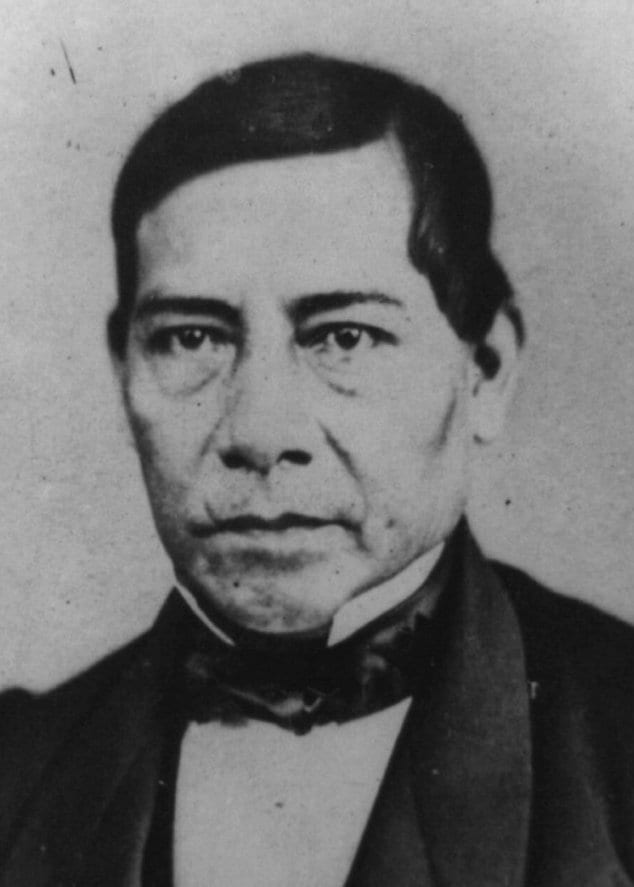
A new generation of liberals took power in the 1850s, determined to break the privileges of the Church and the army. Under Benito Juárez — a Zapotec lawyer from Oaxaca, and Mexico's first Indigenous head of state — they separated Church and state, ended special legal courts, and forced the sale of Church and communal lands. The conservatives fought back in the three-year War of the Reform (1858–61), lost, and then invited France to intervene: Napoleon III's army installed the Habsburg archduke Maximilian as Emperor of Mexico in 1864. The republic never surrendered; when French troops withdrew, Juárez's forces captured and executed Maximilian in 1867.
Reform and revolution
From 1876, the war hero Porfirio Díaz ruled Mexico for 35 years, at first directly and then through a placeman before returning. The Porfiriato brought railways, telegraphs, electricity, foreign investment and a balanced budget, under the technocratic slogan "order and progress". It also concentrated land as never before: by 1910 a few thousand haciendas held most of the arable land, more than nine in ten rural Mexicans owned none, and dissent was met with the rurales and the army.
The Revolution, and the PRI
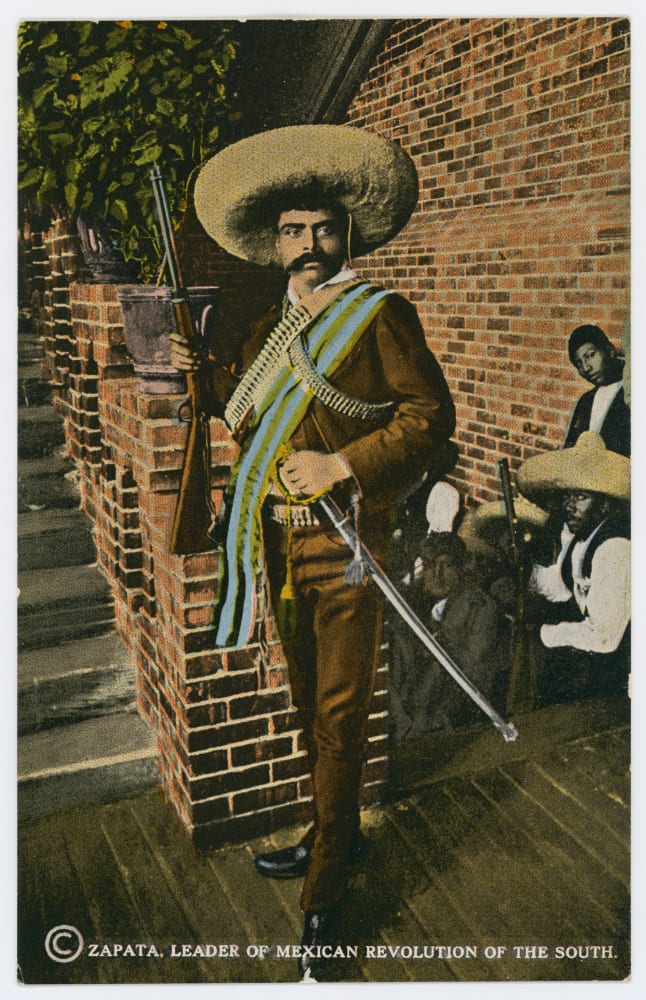
The Mexican Revolution began in 1910 when Francisco Madero, a liberal landowner, called for free elections and an end to Díaz's rule. Díaz fell quickly; what followed was a decade-long, many-sided civil war. Madero was overthrown and murdered in 1913 by his own general Victoriano Huerta; a coalition of "Constitutionalists" under Venustiano Carranza and Álvaro Obregón defeated Huerta and then turned on their former allies — Pancho Villa's cavalry army in the north and Emiliano Zapata's agrarian movement in the south. Perhaps one to two million people died, from fighting, disease and famine.
The 1917 Constitution, still in force, was strikingly radical for its time: land reform, an eight-hour day and the right to strike, national ownership of the subsoil and its minerals and oil, and anticlerical clauses so severe that they provoked the Catholic Cristero War of 1926–29.
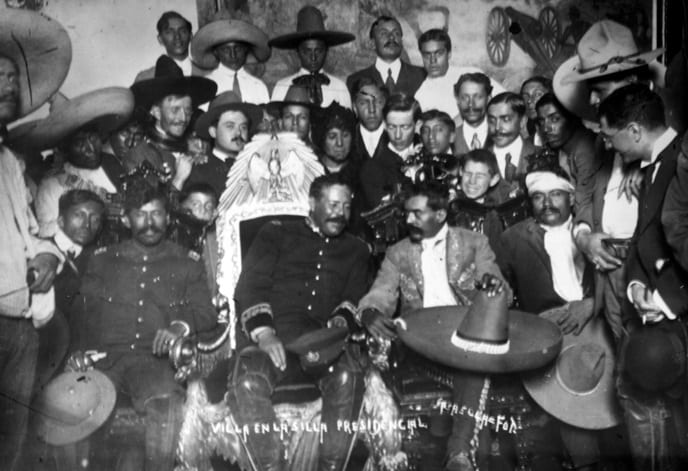
In 1929 the victorious revolutionary generals founded a party to contain their own rivalries — renamed over time until, from 1946, it was the Institutional Revolutionary Party, the PRI. It ruled Mexico for 71 unbroken years: a one-party state with real elections that it always won, holding together unions, peasant leagues and business under the president's patronage, and passing power peacefully every six years from one hand-picked successor to the next. The system's high point was the presidency of Lázaro Cárdenas (1934–40), who distributed land to millions of peasants through communal ejidos and, in 1938, nationalised the foreign-owned oil industry to create the state company Pemex — still a national symbol.
Decades of industrial growth — the "Mexican miracle" — followed, but so did the system's decay: the army's massacre of student protesters at Tlatelolco in Mexico City days before the 1968 Olympics; a debt crisis and default in 1982 after the oil boom collapsed; the devastating 1985 Mexico City earthquake, whose bungled official response fed public anger; and a turn to free-market policy that culminated in the North American Free Trade Agreement with the US and Canada in 1994.
Mexico now
The year 1994 was a hinge: NAFTA took effect on 1 January, the same day the Maya Zapatista rebels rose in Chiapas; the PRI's presidential candidate Luis Donaldo Colosio was assassinated in March; and a peso crisis at year's end required a large US-led bailout. In 2000, after gradual electoral reform, the opposition candidate Vicente Fox of the conservative PAN won the presidency, ending the PRI's monopoly in a genuine democratic transition.
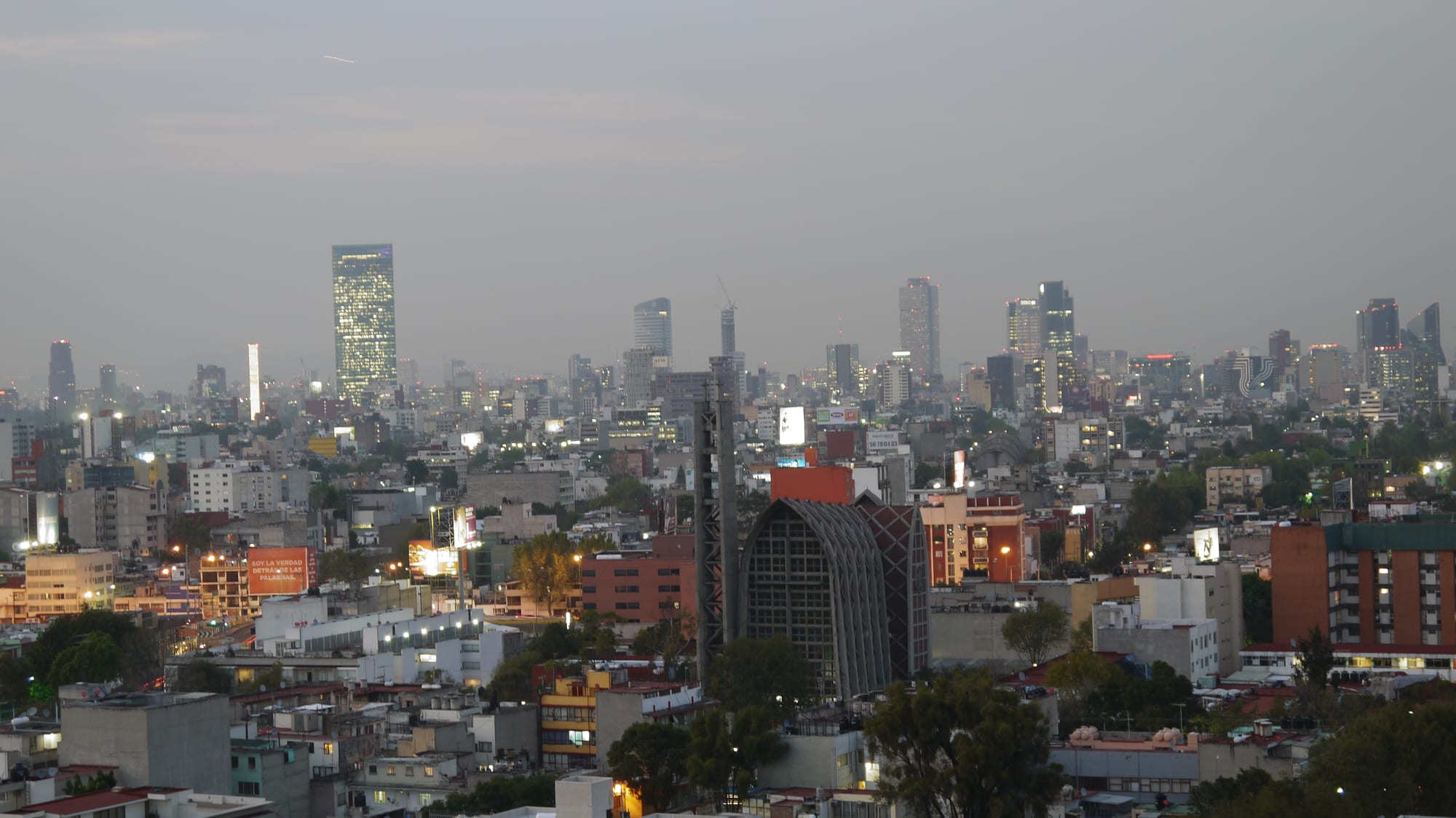
Power has since alternated between parties, but the defining feature of the past two decades has been violence. A militarised "war on drugs", launched by President Felipe Calderón in 2006, splintered the big cartels into more numerous and more vicious groups; the fighting between them, and with the state, has killed an estimated 400,000 people and left more than 100,000 disappeared. In 2018 the veteran leftist Andrés Manuel López Obrador won a landslide with his new party Morena; in 2024 his ally Claudia Sheinbaum, a climate scientist and former Mexico City mayor, became the country's first woman president and the first of Jewish heritage.
What Mexico carries
Mexico's very name is the Aztec one — Mexica — and its modern identity was built, after the Revolution, on claiming the Indigenous past that the conquest had tried to erase: in the muralism of Rivera and Orozco, in the archaeology of Teotihuacan and Palenque, in a national story of continuity from before Cortés. The country has been conquered and remade repeatedly — by Spain, by the United States, by France, by its own revolutionary party — and each of those episodes left behind an institution, a border, a grievance or a myth that Mexico is still working with today.