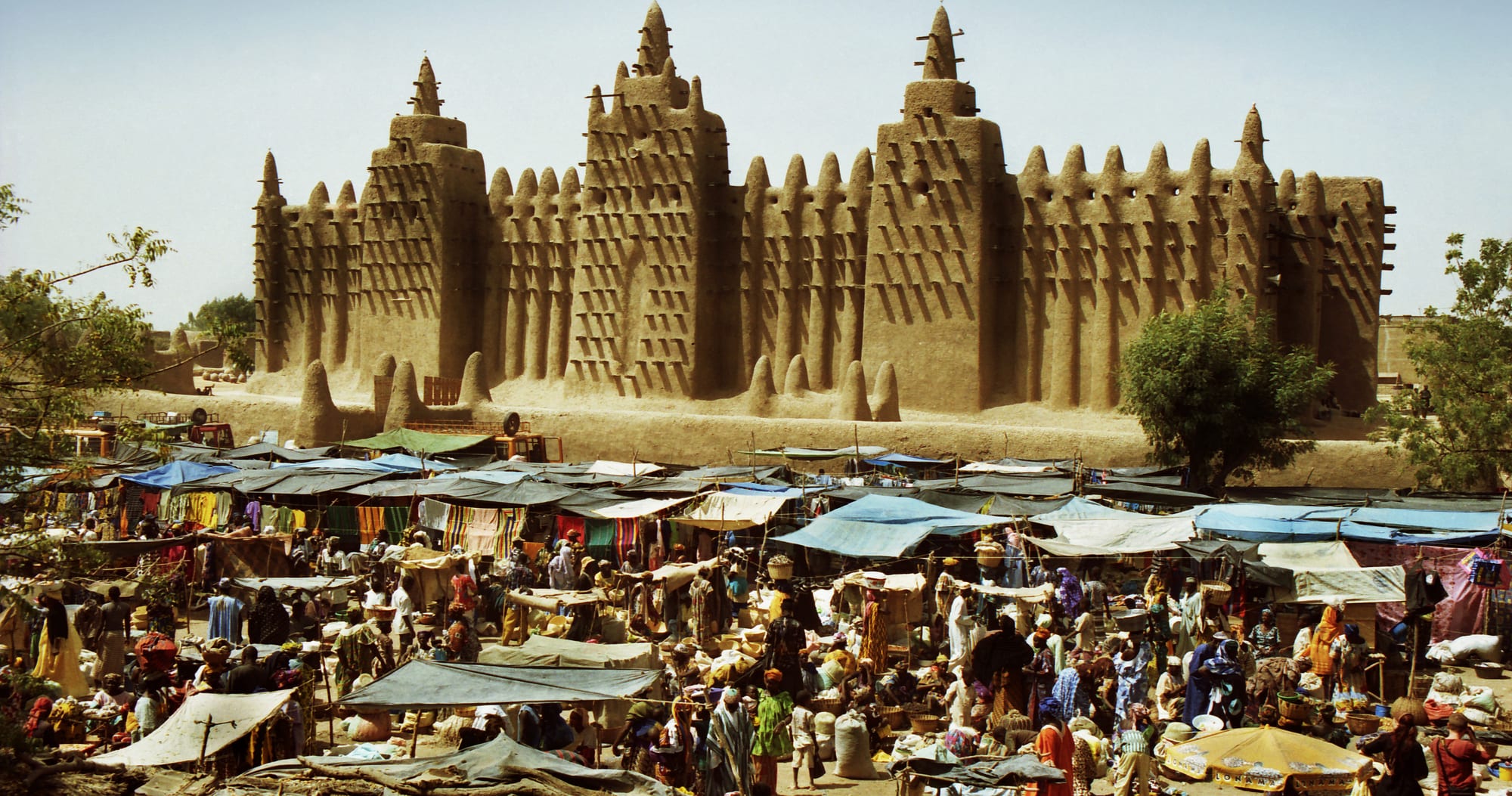
History
Mali sits on the ground of three of West Africa's greatest states. The Ghana Empire flourished in the first millennium; the Mali Empire ruled from the thirteenth to the sixteenth centuries, and its emperor Mansa Musa — often called the richest person in history — made a legendarily lavish pilgrimage to Mecca in 1324; and the Songhai Empire, centred on Gao and Timbuktu, made Timbuktu a famed centre of Islamic scholarship, with universities, book markets, and a manuscript tradition of hundreds of thousands of texts.
A Moroccan invasion broke Songhai in 1591. Smaller states followed, then French conquest in the late nineteenth century and rule as "French Sudan." Independence came in 1960, first under a socialist one-party state and then, after a 1968 coup, a long dictatorship that a popular uprising and a 1991 coup replaced with a multiparty democracy widely praised as a regional model.
That model collapsed in 2012: a Tuareg separatist rebellion in the north was hijacked by al-Qaeda-linked jihadists who seized Timbuktu and Gao, an army coup followed in Bamako, and a French military intervention pushed the militants back but could not defeat them. Two more coups, in 2020 and 2021, brought a junta under Colonel Assimi Goïta to power; it has expelled French forces and the UN mission, turned to Russian mercenaries, left the West African bloc ECOWAS with fellow juntas in Burkina Faso and Niger, and postponed a return to civilian rule. Much of the north and centre is outside government control.
- Mali: The Empires of the Sahel — The Niger Bend where Ghana, Mali and Songhai grew rich on gold and where Timbuktu became a city of scholars — then a French colony, a praised democracy, and, since 2012, a jihadist war zone