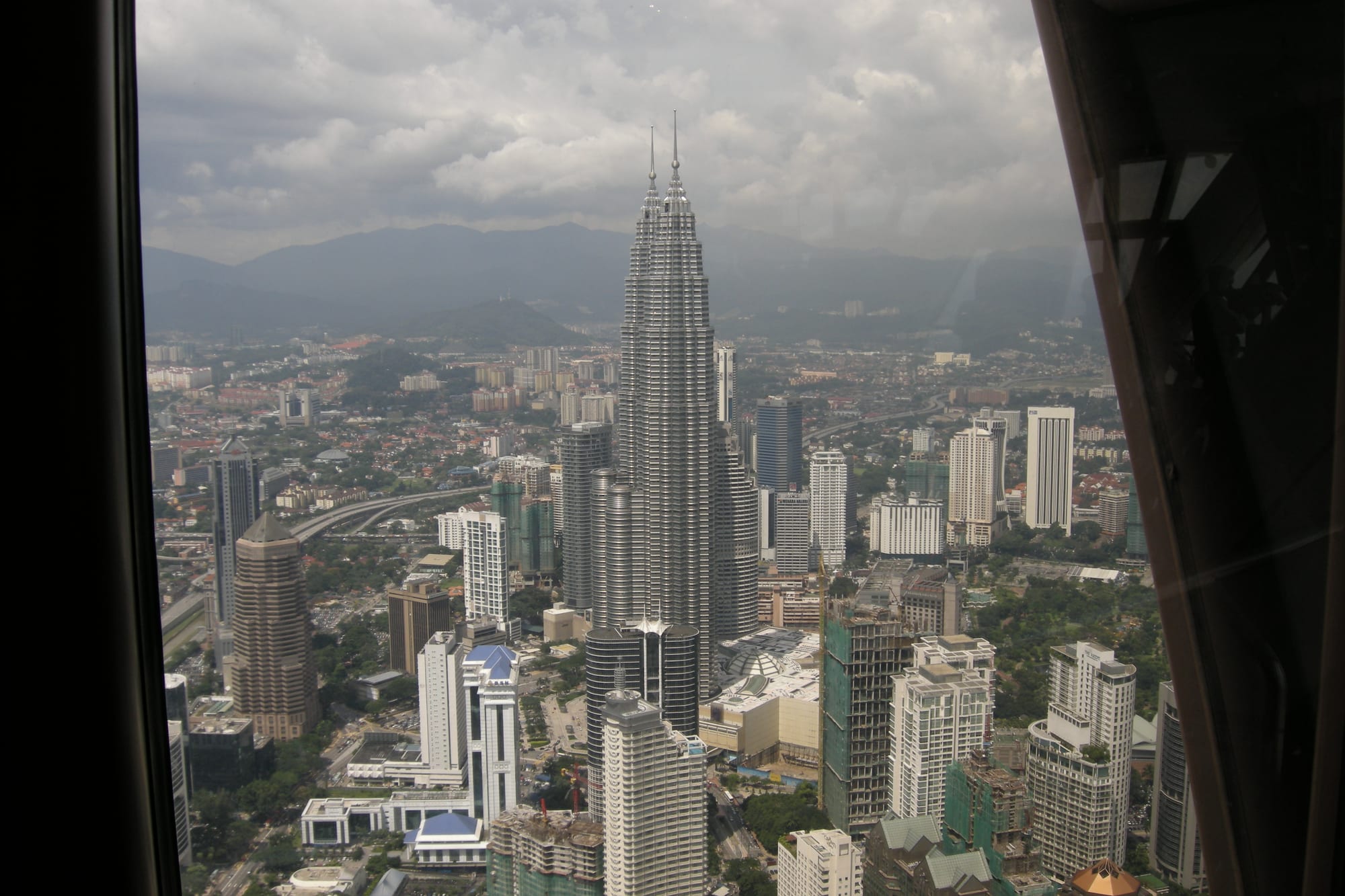
The twin steel-clad Petronas Towers rising above a dense green-and-grey city skyline seen from a high vantage point

Malaysia

The Petronas Twin Towers and the KLCC district of Kuala Lumpur, seen from the KL Tower. (Vyacheslav Argenberg / Wikimedia Commons · CC BY 4.0)

A Southeast Asian federation in two halves — the Malay Peninsula and the northern third of Borneo — that blends Malay, Chinese, Indian, and Indigenous cultures, tropical rainforest, and one of the region's more developed economies.

Explore Malaysia

History

The Malay Peninsula and the Borneo coasts were shaped by maritime trade, with Hindu-Buddhist and then Muslim sultanates, of which Malacca — founded around 1400 — became the region's greatest entrepôt and the seedbed of Malay court culture, before it fell to the Portuguese in 1511, then the Dutch, then the British.

Britain assembled control of the peninsula and, in Borneo, of Sarawak (ruled for a century by the British "White Rajahs," the Brooke family) and North Borneo. Colonial rule brought large-scale Chinese immigration to the tin mines and towns and Indian, mostly Tamil, immigration to the rubber estates, permanently reshaping the population. After a harsh Japanese occupation and a communist insurgency (the "Malayan Emergency," defeated by 1960), independence came in 1957 for Malaya, and in 1963 Malaysia was formed by joining Malaya with Singapore, Sarawak, and Sabah — though Singapore left in 1965.

Deadly Malay–Chinese riots in Kuala Lumpur in 1969 led to the New Economic Policy, a sweeping system of affirmative action for the Malay and Indigenous majority (the "bumiputera") that reshaped the economy and remains politically untouchable. The long-ruling UMNO-led coalition finally lost power in 2018 amid the multi-billion-dollar 1MDB corruption scandal, and the reformist figure Anwar Ibrahim became prime minister in 2022.

  • Malaysia: The Strait, the Races, and the Bargain The Malacca sultanate that spread Islam and the Malay language, a British tin-and-rubber colony that imported a Chinese and Indian workforce, and an independent federation built on an ethnic power-sharing deal

Culture & Customs

Malaysia is a genuinely plural society whose Malay, Chinese, Indian, and Bornean-Indigenous communities live side by side more than they blend, each with its own languages, schools, temples and mosques, festivals, and foods. Islam is the official religion and the faith of essentially all Malays and about 63 percent of the population; there are large Buddhist, Christian (strong in Sabah and Sarawak), Hindu, and Chinese-folk-religion minorities, and a dual legal system with Sharia courts for Muslims in family matters.

Shared touchstones include an all-consuming food culture, with the 24-hour Indian-Muslim mamak stall as the great social leveller; the "open house" tradition at festivals — Hari Raya, Chinese New Year, Deepavali, Christmas, and Sabah and Sarawak's Kaamatan and Gawai — where you visit friends of other faiths and are fed; badminton as a national obsession; and the longhouse communities of Borneo.

The country is a constitutional monarchy with an unusual rotating throne: the nine hereditary Malay rulers elect one of their number to be King of Malaysia for a five-year term. Race and religion remain sensitive in public life, and modest dress and behaviour are expected around religious sites and in the conservative east-coast states.

Daily Life

The Klang Valley around Kuala Lumpur and Petaling Jaya is the economic heart, with the federal administration at Putrajaya nearby. Penang, Johor Bahru (across from Singapore), Ipoh, and Kota Kinabalu and Kuching in Borneo are the other main cities; much of the rest is oil-palm and rubber plantation, padi fields, and rainforest.

The economy is upper-middle-income and diversified: electronics and semiconductors (Penang is a major global chip-testing hub), palm oil (Malaysia and Indonesia grow most of the world's supply), oil and gas funding a large share of the federal budget through Petronas, plus manufacturing, tourism, and Islamic finance.

Daily life mixes the air-conditioned mall, the ride-hailing app, and the office with the hawker centre, the mosque or temple, the balik kampung return to the home village at festival time, and, in Borneo, the river and the longhouse.

Food

Malaysian food is a national passion and a fusion. Nasi lemak — coconut rice with sambal, anchovies, peanuts, egg, and cucumber — is the unofficial national dish and a common breakfast. Char kway teow, Hokkien mee, Hainanese chicken rice, and other Chinese hawker classics; roti canai, banana-leaf rice, and mee goreng mamak from the Indian-Muslim kitchen; and Malay rendang, asam laksa, satay, and nasi kandar all share the same food courts.

Penang is widely held to have the best hawker food in the country; Melaka and the Peranakan (Baba-Nyonya) communities contribute a distinctive Chinese-Malay cuisine of ayam pongteh and cendol; and Borneo adds jungle ferns, river fish, and the sour-and-spicy dishes of the Kadazan-Dusun and Iban.

Teh tarik ("pulled tea"), kopi, fresh lime and sugarcane juice, and air bandung are the everyday drinks; alcohol is available but taxed heavily and less prominent than in neighbouring countries.

Attractions & Natural Wonders

Kuala Lumpur has the Petronas Twin Towers and the KLCC park, the Batu Caves — a Hindu shrine in a limestone cavern up 272 painted steps — Merdeka Square, the Islamic Arts Museum, and the street food of Chinatown and Jalan Alor. George Town in Penang is a UNESCO-listed old town of Chinese shophouses, clan jetties, temples, and street art, with a food scene to match, and Melaka on the west coast adds Dutch and Portuguese colonial remains and Peranakan mansions.

The Cameron Highlands offer tea plantations and cool-climate walks; Taman Negara, one of the oldest rainforests on Earth, has a canopy walkway and river trips; Langkawi is a duty-free island of beaches, a cable car, and mangrove tours; and the Perhentian and Tioman islands have cheap diving and clear water in the non-monsoon months.

Borneo is the wild half: Mount Kinabalu, Southeast Asia's most-climbed peak, in a UNESCO park; Sabah's orangutans at Sepilok, proboscis monkeys and pygmy elephants along the Kinabatangan River, and the dive site of Sipadan; and Sarawak's Gunung Mulu (vast caves and limestone pinnacles, a World Heritage Site), Bako National Park's coastal trails, and Iban longhouse visits up the rivers.

  • Malaysia: Eleven Attractions and Natural Wonders Twin towers above a modern capital, a cave temple guarded by a golden god, a UNESCO trading port, and rainforest older than the Amazon holding orangutans and Southeast Asia's highest peak

Planning basics

Budget

Malaysia is inexpensive to mid-range. Hawker-stall food, guesthouses, and public transport cost very little; the cost creeps up with mid-range hotels, internal flights, and Borneo's permit-limited wildlife experiences (Sipadan diving, Mulu). Card payment is common in cities; carry cash for hawker centres and small towns.

Daily Budget Midrange
USD 60–130 (hotel, restaurants, some domestic flights, tours)
Daily Budget Shoestring
USD 25–45 (guesthouse, hawker food, buses and trains)

Peninsular travel is cheap by bus and train; Borneo's wildlife trips (Kinabatangan, Sipadan, Mulu) are where the budget goes.

Visa Requirements

Citizens of the EU, the UK, the US, Australia, and many other countries enter visa-free for 90 days. A "Malaysia Digital Arrival Card" must be filled in online within three days before arrival. Sabah and Sarawak run their own immigration and re-stamp your passport on entry, even from Peninsular Malaysia.

Typical Stay
90 days visa-free for most Western passports

Complete the digital arrival card before you fly, and keep your passport handy for the internal border into Borneo.

Safety

Malaysia is generally safe and easy for visitors, with low levels of violent crime; bag-snatching by motorcyclists, card skimming, and taxi overcharging are the common problems (use Grab). The specific caution is eastern Sabah: the UK government advises against all but essential travel to all islands and dive sites off the coast of eastern Sabah, from Sandakan to Tawau, because of the threat of kidnapping; mainland Sabah is not included in that warning.

Source
US Department of State and UK FCDO travel advisories — check for the latest wording.

Check the latest advice before booking any island or dive trip off eastern Sabah, wear bags on the traffic-free side, dress modestly around mosques and in the religious east-coast states, and note that drug trafficking carries a mandatory death penalty.

Source: US Department of State and UK FCDO travel advisories — check for the latest wording.

Climate

Equatorial — hot, humid, and rainy year-round, with no dry season but regional monsoon patterns. The east coast of the peninsula and much of Borneo get heavy rain and rough seas in the northeast monsoon (roughly November–February), when some islands close; the west coast is wettest around April–May and October–November. The highlands are cool.

Lowlands
hot and humid, 27–33°C, daily downpours
Highlands
cool; Cameron Highlands and Kinabalu can be chilly

Transportation

Kuala Lumpur is the main air hub, with AirAsia and others flying cheaply across the country, including to Sabah and Sarawak. The peninsula has good intercity buses and an improving rail spine (the ETS trains north–south). Cities use ride-hailing (Grab); Borneo travel mixes flights, minibuses, and river boats.

Fly between the peninsula and Borneo; there is no land or short sea link.

Best Time to Visit

Roughly December to February for the west coast and Borneo's interior, and March to September for the peninsula's east-coast islands (Perhentians, Tioman), which close in the monsoon. Haze from regional land-clearing fires is worst around August–October in some years.

Currency

The currency is the Malaysian ringgit (MYR). ATMs are widespread; cards work in cities and malls; carry cash for hawker centres, markets, and rural areas.

Symbol
RM
Currency Code
MYR — Malaysian ringgit

Language

Bahasa Malaysia (Malay) is the national and official language. English is very widely spoken, especially in business, the professions, and among urban Malaysians, and functions as a de facto second language. Mandarin and Chinese dialects, Tamil, and dozens of Indigenous languages in Borneo are all in daily use.

English
Very widely spoken
Official Language
Bahasa Malaysia (Malay)