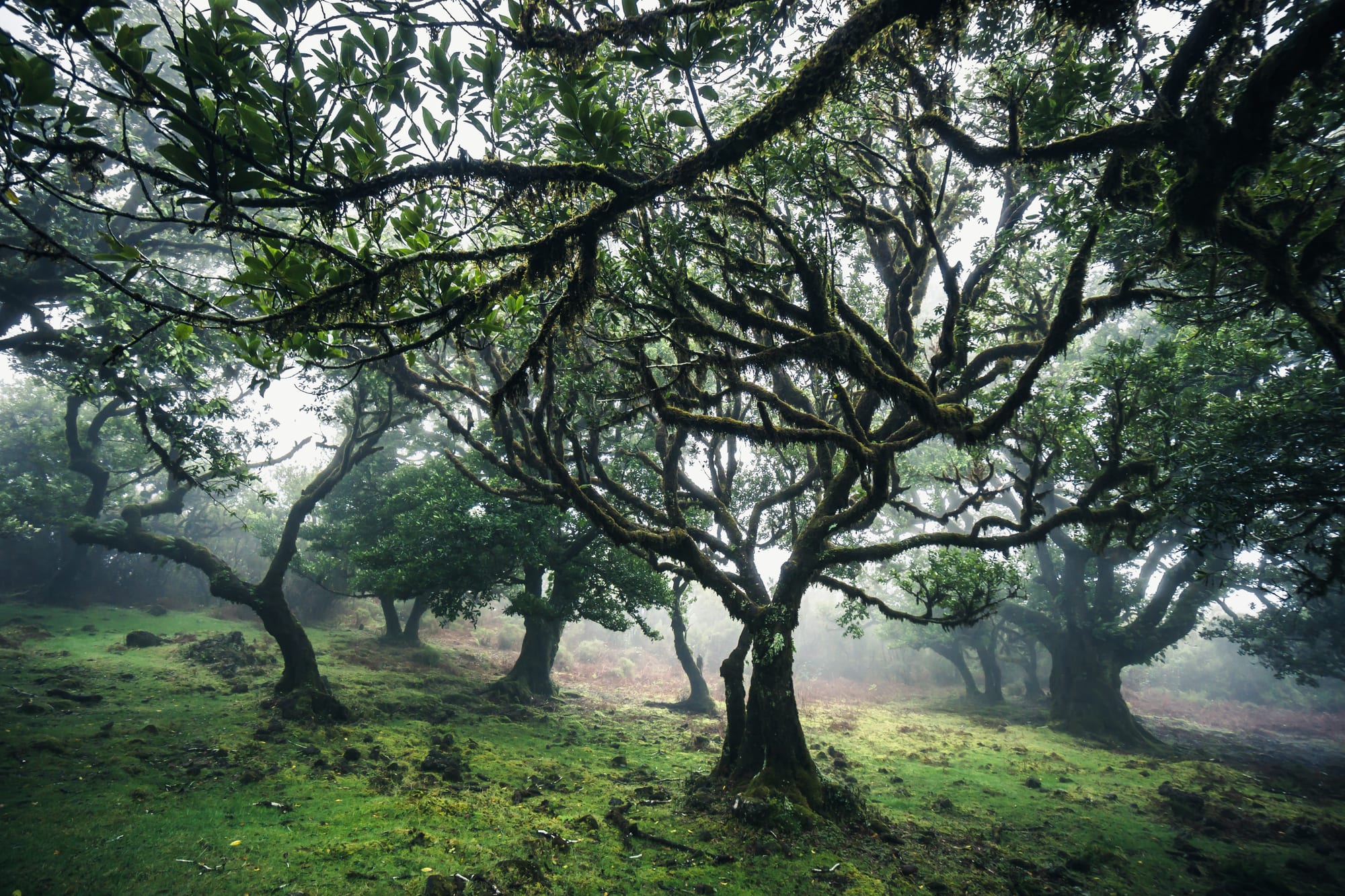
A dense, mossy forest of gnarled evergreen trees on a steep mountainside, mist drifting through the canopy

Madeira

The laurisilva of Madeira, a UNESCO-listed relic laurel forest of a type that once covered much of southern Europe. (Artur Sienkiewicz '85 / Wikimedia Commons · CC BY-SA 4.0)

A steep, green Atlantic island about 500 km off the coast of Morocco, an autonomous region of Portugal — the first territory of the Age of Discovery, known for its fortified wine, its ancient laurel forest, its network of levada water-channel walks, and a mild "eternal spring" climate.

Explore Madeira

History

Madeira was uninhabited when Portuguese navigators under João Gonçalves Zarco landed in 1419, making it the first territory claimed in what became the Portuguese Age of Discovery. Settlers cleared and burned the dense forest — the name means "wood" — and planted sugar cane, which by the late fifteenth century made Funchal wealthy and was worked in part by enslaved Africans and Canary Islanders. Christopher Columbus lived on Madeira and neighbouring Porto Santo, married to the daughter of Porto Santo's governor.

When cheaper Atlantic and Brazilian sugar undercut the island, Madeira turned to wine. Madeira wine — fortified, deliberately heated, and almost indestructible once opened — became a major export, especially to Britain and its American colonies, and was reputedly used to toast the US Declaration of Independence. A long-standing British merchant community, and later British and northern European tourists wintering at hotels such as Reid's, shaped Funchal.

After Portugal's 1974 revolution, Madeira became an autonomous region with its own parliament and government, keeping Portuguese sovereignty, the euro, and EU membership. Regional politics was long dominated by one figure, Alberto João Jardim, from 1978 to 2015. In 2010, flash floods and mudslides killed around 50 people in and above Funchal. The economy today is heavily tourism-based, along with bananas, wine, flowers, and a business free-trade zone, and the island is proud of its most famous son, the footballer Cristiano Ronaldo, after whom the airport is named.

  • Madeira: The First Atlantic Colony An uninhabited Atlantic island settled by Portugal from 1420 — the laboratory where the sugar-and-slavery plantation was invented, then a wine island, and now an autonomous region living on tourism

Culture & Customs

Madeiran culture is rural Portuguese and Catholic, with festivals — Carnival, the spring Flower Festival, the autumn wine and chestnut harvests, and the huge New Year fireworks — structuring the year. Folk music with the braguinha (a small guitar that is an ancestor of the ukulele) and bailinho dancing, wicker craft from Camacha, and embroidery, once a major cottage industry, are the traditional arts.

Emigration is woven into island life: hardship sent Madeirans to Venezuela, Brazil, South Africa, the United States, and the Channel Islands, and returnees and their remittances have long shaped Funchal and the villages, visible in the grander houses and in businesses funded from abroad.

Hospitality is warm and food- and wine-centred, the pace outside Funchal is slow, and there is a strong attachment to the parish, the levada, and the family plot of vines or bananas.

Daily Life

About 250,000 people live in Madeira, more than half in the Funchal area, which climbs the slopes of a natural amphitheatre above the harbour; the north coast and the interior villages are far quieter and, in places, losing population.

The economy is dominated by tourism and the services around it, along with agriculture on the terraces — bananas for export, wine, sugar cane for rum, tropical fruit, and flowers — and the international business centre in Funchal. The cost of imported goods is high, and jobs outside tourism and the public sector are limited, which continues to send some young Madeirans to the mainland and abroad.

Daily life runs on the steep roads and tunnels, the levada for water and walking, the café and the market, and a climate that never really turns cold.

Food

The Madeiran table has a few unmistakable items. Espetada is beef rubbed with garlic and bay, skewered on a laurel stick, and grilled over embers, served hanging from a stand with milho frito (fried cubes of cornmeal) and bolo do caco — a soft, round flatbread cooked on a stone and slathered with garlic butter, which accompanies almost everything.

From the sea comes espada (black scabbardfish), a deep-water fish with an alarming look, classically fried and served with banana; lapas (limpets); and tuna steaks with molho de vilão. Picado (garlicky beef strips and chips to share) and sopa de tomate e cebola with a poached egg are everyday dishes, and bolo de mel (a dark, spiced molasses cake) is the festive sweet.

The island's drink is poncha — sugarcane spirit (aguardente de cana) mixed with honey and lemon, or with orange and passion-fruit in the "pescador" version — stirred with a wooden caralhinho. Madeira wine, in its Sercial, Verdelho, Bual, and Malmsey styles, is tasted at the Funchal wine lodges, and Coral beer and the passion-fruit soda Brisa are the local soft options.

  • Madeira: Food and the National Dish Beef skewers grilled over an open fire on branches of laurel wood, on a volcanic Portuguese island famous well beyond its size for one fortified wine

Attractions & Natural Wonders

Funchal has the fifteenth-century cathedral, the vivid Mercado dos Lavradores, the wine lodges, and cable cars up to Monte — with its gardens and the famous wicker toboggan ride, in which two straw-hatted carreiros steer a sledge down the steep streets. The airport's viewing area and the Cristiano Ronaldo museum draw their own visitors.

The interior is the real attraction. The Pico do Arieiro to Pico Ruivo ridge walk crosses Madeira's roof — Ruivo, at 1,862 metres, is the summit — on a spectacular, exposed path of steps and tunnels. The laurisilva forest, protected as a World Heritage Site, is best seen on the levada walks: the Levada do Caldeirão Verde to a fern-hung amphitheatre, and the Levada das 25 Fontes to a cluster of springs. Fanal, where ancient stag-headed laurel trees stand in drifting fog, is otherworldly.

Around the coast are the Ponta de São Lourenço, a bare, striated peninsula at the eastern tip; the fishing village of Câmara de Lobos and the Cabo Girão skywalk above one of Europe's highest sea cliffs; the natural volcanic swimming pools at Porto Moniz; and the A-frame thatched houses of Santana. A short hop away, Porto Santo has the nine-kilometre golden beach that Madeira itself lacks.

Planning basics

Budget

Madeira is mid-priced and generally cheaper than mainland Western Europe. Funchal has hostels, guesthouses, and hotels across the range; the countryside has quintas and rural houses. Levada walks, viewpoints, and churches are free; the main paid extras are a hire car or transfers, cable cars, and boat trips.

Daily Budget Midrange
EUR 110–210 (hotel or quinta, restaurants, car hire, cable cars and a boat trip)
Daily Budget Shoestring
EUR 45–80 (hostel or guesthouse, bakery and tasca meals, buses)

Hire a car for a few days for the mountains and the north coast, use the aluguer minibuses and Funchal buses otherwise, and pre-book the Pico do Arieiro sunrise if driving.

Visa Requirements

Madeira is part of Portugal, the European Union, and the Schengen Area, so the same rules apply as for mainland Portugal. EU and EEA citizens have free movement; UK, US, Canadian, Australian, and many other visitors enter visa-free for 90 days in any 180, with the EU's ETIAS pre-authorisation expected once launched.

Typical Stay
90 days in any 180 (Schengen) for most Western passports

The 90-day allowance is shared across the whole Schengen Area; flights from mainland Portugal are domestic.

Safety

Madeira is very safe, with low crime — bag theft in busy parts of Funchal is the main concern. The real hazards are outdoors: exposed sections of levada and mountain trails with big drops and no railings, rockfall, sudden cloud and cold on the ridges, flash flooding in ravines after heavy rain, and strong Atlantic swell on the rocky coast.

Health
Tap water is safe; the main risks are falls on narrow paths, exposure on the peaks, and the sea; medical care in Funchal is good

Check trail status and the forecast before levada and ridge walks, carry a torch for tunnels on the Caldeirão Verde and 25 Fontes routes, and don't enter ravines when heavy rain is forecast.

Climate

Mild subtropical year-round — the "island of eternal spring" — with Funchal averaging around 19°C in winter and 25°C in summer. Micro-climates are strong: the south coast is sunnier and drier, the north and the high interior are cooler, wetter, and often cloud-wrapped. There is no cold season.

South Coast
Warm and sunny most of the year
North And Mountains
Cooler, wetter, frequent cloud

Transportation

Cristiano Ronaldo Airport near Funchal, with its dramatic pillared runway extension, has flights from Lisbon, Porto, mainland Europe, and the UK; a small airport and a ferry serve Porto Santo. On Madeira, a hire car handles the steep, tunnel-threaded roads best; buses (Horários do Funchal in the city, aluguer minibuses in the country) are cheap but slow.

Hire a car for the interior and the north coast; take the ferry or short flight to Porto Santo for the beach.

Best Time to Visit

Madeira is a genuine year-round destination. April to June brings flowers and the Flower Festival; summer is warmest and busiest; autumn has the wine and chestnut festivals; and the New Year fireworks display over Funchal bay is a major draw. The mountains can be cold and cloudy at any time.

Events
Carnival (Feb/Mar); the Flower Festival (Festa da Flor, spring); the Atlantic Festival with fireworks (June); the Madeira Wine Festival (September); the record-setting Funchal New Year's Eve fireworks

Currency

The currency is the euro. Cards are accepted almost everywhere; carry a little cash for rural bars, small bakeries, and levada-trailhead kiosks.

Symbol
Currency Code
EUR — euro

Language

Portuguese is the language, spoken with a distinctive Madeiran accent. English is widely spoken in Funchal and the tourist areas thanks to a long British connection; German and French are also common in hospitality.

English
Widely spoken in tourism
Language
Portuguese