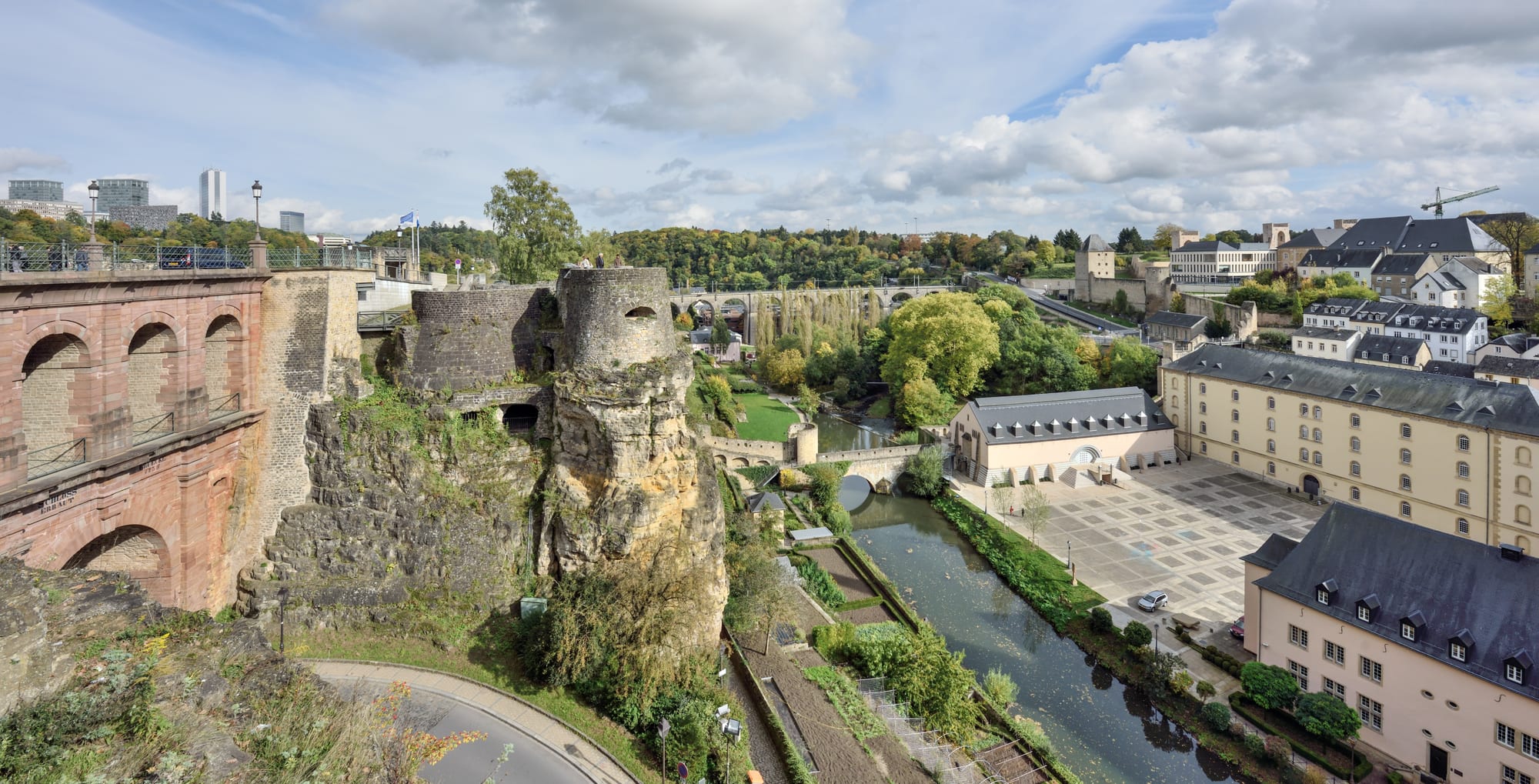
A tightly packed old quarter of stone houses and a church spire in a deep green river gorge, viewed from a cliff-top walkway

Luxembourg

The Grund, the lower town of Luxembourg City, seen from the Corniche ramparts above the Alzette gorge. (Cayambe / Wikimedia Commons · CC BY-SA 4.0)

A small, trilingual grand duchy at the meeting point of Belgium, France, and Germany — a founding member of the European Union, one of the world's wealthiest countries, and built around a fortress city on dramatic river gorges.

Explore Luxembourg

History

Luxembourg grew around a rocky promontory above the deep gorges of the Alzette and Pétrusse, where a fortress was founded in 963. Successive powers — Burgundians, Spanish and Austrian Habsburgs, France, and Prussia — fought over and rebuilt it into one of the strongest fortifications in Europe, the "Gibraltar of the North."

The 1815 Congress of Vienna made Luxembourg a grand duchy in personal union with the Netherlands and a member of the German Confederation. The 1867 Treaty of London guaranteed its independence and neutrality and required the great powers to demolish the fortress; the surviving casemates — kilometres of tunnels bored into the rock — and the ramparts are now a UNESCO World Heritage Site. The crowns of Luxembourg and the Netherlands separated in 1890.

Germany occupied Luxembourg in both world wars, ending its neutrality and turning it into an enthusiastic founder of European integration. It is a founding member of the EU and hosts several EU institutions, including the Court of Justice and the European Investment Bank. The economy, built first on iron and steel, pivoted to finance from the late twentieth century and is now one of the world's largest investment-fund centres.

  • Luxembourg: The Fortress That Became a Crossroads A castle on a rock in 963 that grew into a county, a European dynasty, one of the strongest fortresses on the continent — halved in 1839, occupied in both world wars, and now a financial and EU capital

Culture & Customs

Luxembourgish identity rests heavily on the language — a Germanic tongue, standardised only recently, that is spoken at home and increasingly in public life even though French and German dominate paperwork and the press — and on the motto "Mir wëlle bleiwe wat mir sinn," "we want to remain what we are."

Nearly half the resident population, and a large share of the workforce, are foreign nationals or cross-border commuters from France, Belgium, and Germany, so daily life is genuinely multilingual and multinational, especially in the capital. Roman Catholicism shapes the calendar and traditions, though practice is low.

Distinctive customs include the hopping "dancing procession" of Echternach on Whit Tuesday, a UNESCO-listed pilgrimage; the Éimaischen pottery market in the capital on Easter Monday; the Schueberfouer, a large late-summer funfair dating to the fourteenth century; and the Buergbrennen bonfires on the first Sunday of Lent.

Daily Life

The roughly 670,000 residents are concentrated in and around Luxembourg City in the south-centre, and in the former steel towns of the "Minett" further south, around Esch-sur-Alzette. The north, the Éislek/Ardennes, is more rural and forested. Every working day the population swells by around 200,000 commuters crossing the borders.

The economy is one of the wealthiest per head in the world: financial services — funds, private banking, and holding companies — plus what remains of the steel industry (ArcelorMittal is headquartered here), the satellite operator SES, and, more recently, a push into space and logistics. The country's role in aggressive corporate tax structuring drew scrutiny after the "LuxLeaks" disclosures and has since been partly reformed.

Daily life is comfortable and international, built around the commute, the office, and weekends in the countryside or over a border, with free public transport making the whole small country easy to move around.

Food

Luxembourgish cooking is hearty and Germanic with a strong French influence. The national dish is judd mat gaardebounen — smoked pork collar with broad beans in a cream sauce, served with boiled potatoes. Bouneschlupp (green-bean soup), Kachkéis (a soft melted cheese spread on bread with mustard), and Träipen (black pudding) with apple sauce are traditional.

Gromperekichelcher, deep-fried grated-potato patties, are a market and festival staple, and the country's rivers supply trout and, historically, fried Friture of small fish. Bakeries turn out Bretzel (a sweet almond pretzel associated with a spring custom) and rich pastries.

The Moselle valley in the southeast makes the country's wines — dry Rieslings, Pinots, Auxerrois, and the sparkling Crémant de Luxembourg — and these, with beer and coffee, are the everyday drinks.

Attractions & Natural Wonders

Luxembourg City repays a day or two: the Bock casemates and the "Corniche" walkway billed as "Europe's most beautiful balcony," the old lower town of the Grund down in the gorge, the Adolphe Bridge, the Grand Ducal Palace, and the Notre-Dame Cathedral, contrasted with the modern Kirchberg plateau, where the EU buildings, the Philharmonie, and I. M. Pei's Mudam contemporary-art museum stand.

In the north, Vianden has a large, beautifully restored hilltop castle above the Our river, with a Victor Hugo museum in the house where the writer stayed. Echternach, the country's oldest town, has a Benedictine abbey and the famous dancing procession, and Clervaux Castle houses Edward Steichen's "The Family of Man" photography exhibition.

"Little Switzerland," the Mullerthal region around Berdorf and Consdorf, is a walkers' landscape of sandstone rock formations, gorges, and streams. The Moselle wine road runs southeast through villages like Remich and Grevenmacher to Schengen, where the border-free agreement was signed on a boat in 1985, and the industrial-heritage south around Esch-sur-Alzette has museums and a heritage railway in the old iron-mining country.

  • Luxembourg: Seven Attractions and Natural Wonders A fortified capital cut by deep river gorges, 17 kilometres of tunnels honeycombed through the rock beneath it, a fairy-tale castle above the Our river, and a sandstone forest known as 'Little Switzerland'

Planning basics

Budget

Luxembourg is expensive — among the highest-income countries in the world, with hotel and restaurant prices to match. Bakeries, supermarkets, and the free nationwide public transport keep costs manageable. Card and contactless payment is standard.

Daily Budget Midrange
EUR 160–300 (mid-range hotel, restaurants, museums, day trips)
Daily Budget Shoestring
EUR 70–120 (hostel, bakery and supermarket food, free public transport)

Public transport — trains, trams, and buses — is free for everyone nationwide, which cuts getting-around costs to zero.

Visa Requirements

Luxembourg is in the EU and the Schengen Area. Citizens of the EU, the UK, the US, Canada, Australia, and many other countries need no visa for stays of up to 90 days in any 180-day period.

Typical Stay
90 days in any 180-day period, visa-free, for most Western passports

Safety

Luxembourg is a very safe, prosperous country with low crime. The main nuisance is pickpocketing and some drug-related street activity around Luxembourg City's railway-station quarter, especially after dark.

Take normal care around the station area at night; elsewhere the country is calm.

Climate

Mild oceanic shading into continental — cool, changeable, and often damp, with warm summers and cold winters. The forested Ardennes (Éislek) in the north are cooler and snowier; the Moselle valley in the southeast is the mildest corner.

Summer
June–August, generally 18–24°C
Winter
December–February, around 1–5°C, some snow, more in the north

Transportation

There is no airport of note besides Luxembourg's own (Findel), served from across Europe; many visitors also arrive by train from Brussels, Paris, or Trier. All public transport in the country — trains, the Luxembourg City tram, and buses — has been free since 2020. The country is small enough to cross in an hour.

You do not need a car; the free trains and buses reach Vianden, Echternach, the Moselle, and Esch easily.

Best Time to Visit

May to September for mild weather, the wine road, and hiking in the Mullerthal and the Ardennes. Late spring brings the Echternach dancing procession; December fills Luxembourg City with Christmas markets. The national day is 23 June.

Currency

Luxembourg uses the euro, adopted in 1999 as a founding member. Cards work everywhere; carry a little cash for markets and small shops.

Symbol
Currency Code
EUR — euro

Language

Three official languages: Luxembourgish (Lëtzebuergesch), a Germanic language and the everyday spoken tongue and a strong national marker; French, the language of law and much administration; and German, used in the press and schools. English is very widely spoken in the international workforce.

English
Widely spoken, especially in the capital
Official Languages
Luxembourgish, French, German