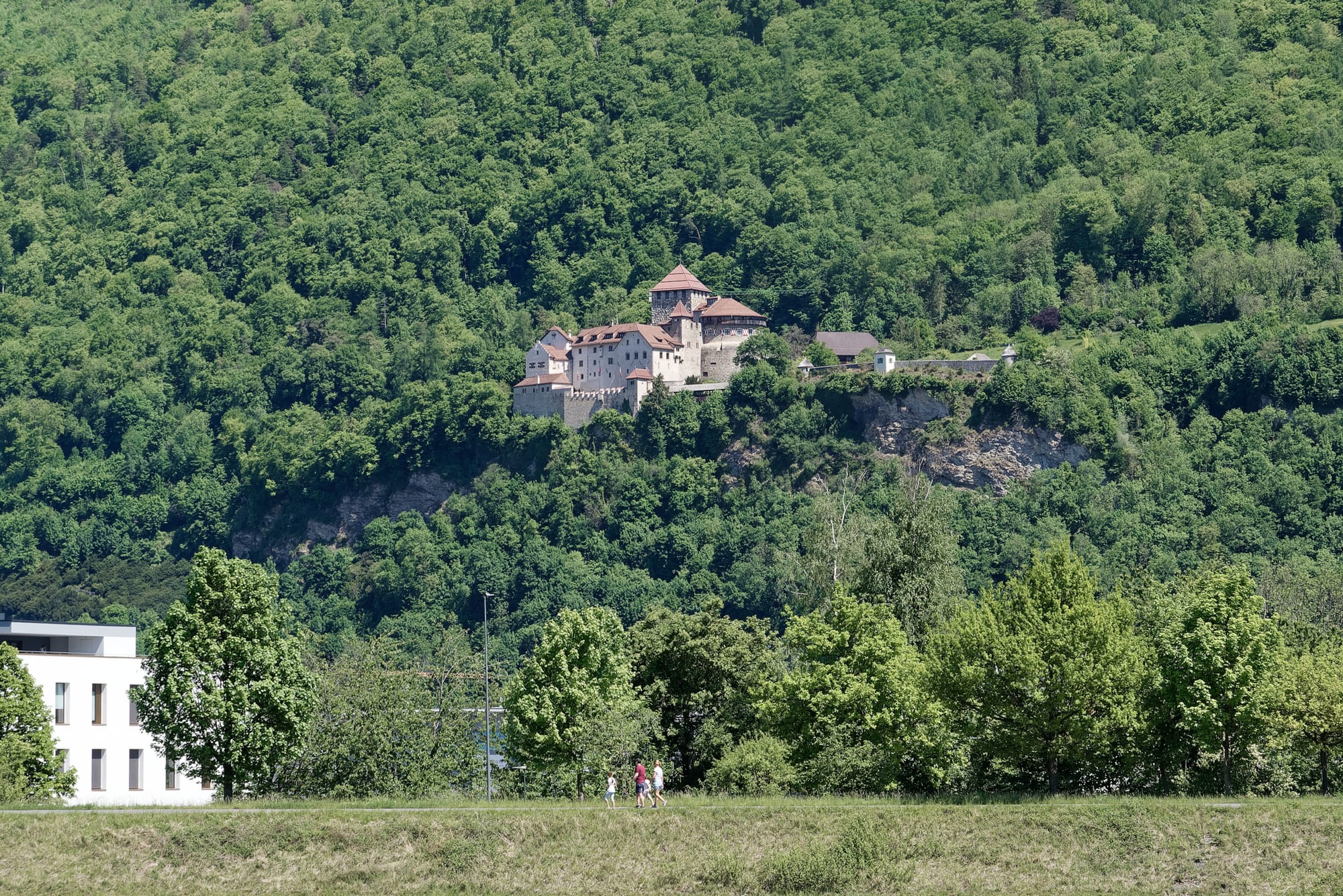
A medieval castle with a square keep and red roofs on a wooded hillside above a small town and a broad river valley

Liechtenstein

Vaduz Castle above the capital, the residence of the Princely Family and not open to the public. (Jakub Hałun / Wikimedia Commons · CC BY 4.0)

A tiny Alpine principality on the upper Rhine between Switzerland and Austria — one of the world's smallest and richest countries, ruled by a princely family that bought it to gain a seat in the Holy Roman Empire.

Explore Liechtenstein

History

The principality exists because the Princely House of Liechtenstein, wealthy landowners in Austria and Bohemia, wanted a seat in the Holy Roman Empire's assembly — which required territory held directly from the emperor. They bought the lordships of Schellenberg (1699) and Vaduz (1712), and in 1719 the emperor combined them into the Principality of Liechtenstein, named for the family. The princes did not actually visit for well over a century.

Liechtenstein survived the Napoleonic upheavals and joined the German Confederation. After the First World War it shifted its alignment from a collapsing Austria to Switzerland, adopting the Swiss franc, a customs union, and Swiss diplomatic representation abroad; the two countries have an open border and deep everyday integration. It stayed neutral through both world wars.

It remains a constitutional monarchy in which the prince retains real power: a 2003 referendum gave Prince Hans-Adam II expanded rights to veto laws and dismiss the government, and day-to-day duties passed to his son, Hereditary Prince Alois, in 2004. Women gained the vote only in 1984. The economy, once agricultural, industrialised in the twentieth century and added a large financial-services sector.

  • Liechtenstein: The Principality That Was Bought Two tiny Alpine fiefs purchased by a wealthy Austrian family to gain a seat in the imperial diet — a sovereign accident of 1806, reoriented to Switzerland after 1918, and now one of the richest places on Earth

Culture & Customs

Liechtenstein's culture is Alemannic and Alpine, closely tied to eastern Switzerland and the Austrian Vorarlberg, and strongly Roman Catholic by heritage. The local dialect is a marker of identity, standardised in writing only recently, and the national day on 15 August — when the reigning prince invites the whole country to a reception in the castle grounds — is the year's big civic occasion.

The Princely Family is central to national life, both symbolically and as one of Europe's great art collectors; part of the collection is shown in the family's palaces in Vienna. Village brass bands, marksmen's clubs, hiking associations, and Alpine farming traditions structure community life, and the country punches above its weight in the giant slalom, having produced Olympic and World Cup ski medallists.

For all its wealth and its low-tax, letterbox-company reputation, everyday Liechtenstein feels like a quiet cluster of Rhine-valley and mountain villages, where a large share of the workforce commutes in each day from Switzerland and Austria.

Daily Life

The roughly 40,000 residents are spread across eleven municipalities in a strip about 25 kilometres long, from Ruggell in the north to Balzers in the south, with Vaduz — the capital, and not the largest town (that is Schaan) — in the middle. Nearly half the population holds a foreign passport, and citizenship is hard to obtain.

The economy is astonishingly industrial for the country's size: precision engineering and manufacturing firms such as Hilti, Hoval, and Ivoclar are global players, and there are more registered jobs than residents. Alongside industry sits a private-banking, fund, and holding-company sector that was reformed after 2008–09 under international pressure. GDP per head is among the highest in the world.

Daily life is comfortable, orderly, and low-drama: the commute, the local bus, the sports club, and weekends in the mountains or over the border in Switzerland.

Food

Liechtenstein's cooking is the hearty Alemannic and Alpine fare of the region. Käsknöpfle, small flour dumplings baked with mountain cheese and topped with fried onions and served with apple sauce, is the closest thing to a national dish. Ribel, a fried maize-semolina dish eaten with coffee or apple compote, is a traditional breakfast.

Rösti, sausages, Alpine cheeses, cured meats, and Torkarebl (a corn dish) round out the everyday table, and the influence of Swiss and Austrian cooking — fondue, Wiener Schnitzel, strudel — is strong. The Prince's own vineyard, the Hofkellerei, and other small growers on the valley slopes make Pinot Noir and white wines.

Coffee and cake, and beer or a glass of the local wine, are the social staples.

Attractions & Natural Wonders

Vaduz, the capital, has a compact pedestrian centre — the "Städtle" — with the Liechtenstein National Museum, the Kunstmuseum with the Hilti Art Foundation, the Postage Stamp Museum (philately was long a real source of revenue), the cathedral, and the government building, all beneath Vaduz Castle on its wooded spur. The castle is the prince's home and closed to visitors, but the walk up gives the classic view.

Above Balzers stands the medieval Gutenberg Castle, open in summer. Malbun, a small ski resort in a high side valley, and neighbouring Steg, with cross-country trails, are the winter draws, and in summer the Fürstensteig — a cabled cliff-edge path high above the Rhine valley — is the country's signature hike. The waymarked Liechtenstein Trail links all eleven municipalities over about 75 kilometres.

Many visitors simply pass through for an hour or a day, stamping a souvenir passport and photographing the castle, but the mountains and the quiet villages reward anyone who stays.

Planning basics

Budget

Liechtenstein uses the Swiss franc and Swiss prices apply — it is expensive. There are only a handful of hotels; many visitors day-trip from Switzerland or Austria. Bakery and supermarket food, the free-to-enter museums' modest fees, and hiking keep costs down. Cards are accepted everywhere.

Daily Budget Midrange
CHF 220–380 (hotel in Vaduz or Malbun, restaurants, museums, a cable car)
Daily Budget Shoestring
CHF 90–150 (day trip or hostel in nearby Switzerland, self-catering, buses)

The tourist office in Vaduz sells a souvenir passport stamp for a couple of francs.

Visa Requirements

Liechtenstein is in the Schengen Area (via a customs and monetary union with Switzerland) though not in the EU. Citizens of the EU, the UK, the US, Canada, Australia, and many others need no visa for stays of up to 90 days in any 180-day period. There are no border controls with Switzerland or Austria.

Typical Stay
90 days in any 180-day period, visa-free, for most Western passports

Safety

Liechtenstein is one of the safest countries in the world, with essentially no crime. The only real hazards are alpine: mountain weather, and exposure on the cabled Fürstensteig and other ridge routes.

Check conditions before the Fürstensteig; it involves narrow paths and drops and is not for anyone uneasy with heights.

Climate

Alpine-influenced continental, moderated by the warm föhn wind from the south. Winters are cold with snow, especially up at Malbun; summers are mild and pleasant, with the Rhine valley floor warmer than the mountains.

Malbun
snowy winters with a small ski area; cool summers
Valley
cold winters, warm summers

Transportation

There is no airport; the nearest is Zurich, about an hour and a quarter away by road, or by train to Sargans or Buchs in Switzerland (or Feldkirch in Austria) and then a local bus. Liechtenstein's own bus network links all eleven municipalities frequently and cheaply. The country is small enough to see in a day.

From Switzerland, take the train to Sargans or Buchs and the bus 11 into Vaduz.

Best Time to Visit

June to September for hiking the ridge trails and the country-long Liechtenstein Trail, and December to March for skiing at Malbun. The national day, 15 August, brings a public celebration at the castle with fireworks.

Currency

Liechtenstein uses the Swiss franc (CHF) under a monetary union with Switzerland. Cards and contactless work everywhere.

Symbol
CHF / Fr.
Currency Code
CHF — Swiss franc

Language

German is the official language, spoken locally in an Alemannic dialect close to Swiss German. English is widely understood, given the international workforce in finance and industry.

English
Widely understood
Official Language
German (Alemannic dialect in speech)