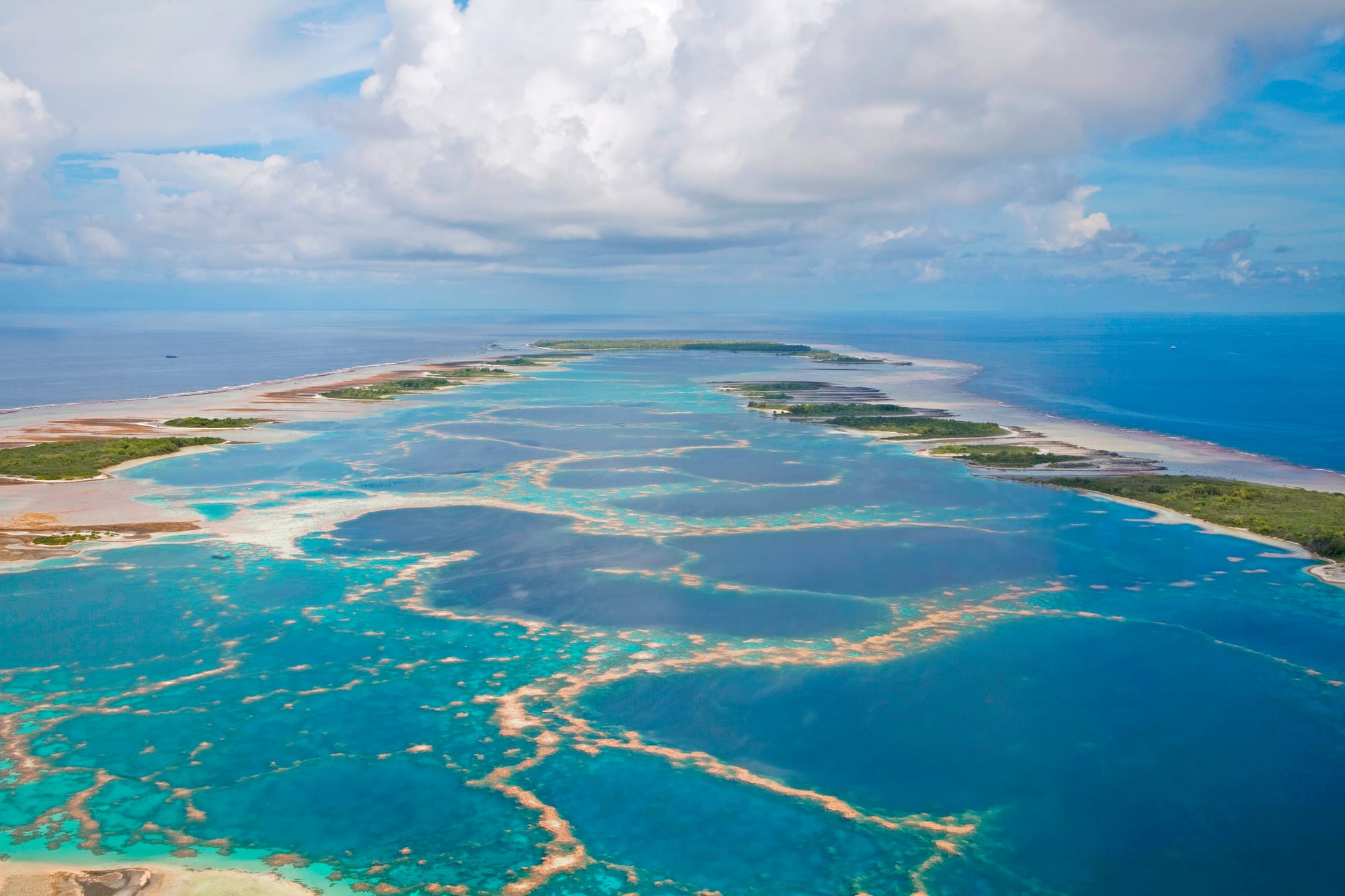
Aerial view of a long coral atoll, its deep-blue lagoon laced with pale orange reef ridges and turquoise shallows, ringed by low green islets under towering white clouds

Kiribati

Millennium Atoll, also known as Caroline Island, in Kiribati's southern Line Islands, seen from the air. (The TerraMar Project / Wikimedia Commons · CC BY 2.0)

A nation of 33 low coral atolls scattered across an ocean area the size of India, straddling the equator and the date line — remote, thinly resourced, and among the most exposed places on Earth to rising seas.

Explore Kiribati

History

The islands were settled by Micronesian voyagers around three thousand years ago, with later contact and intermarriage with Samoans, Tongans, and Fijians. Society was organised around the extended family and the maneaba, the great open meeting house that was — and remains — the centre of village decision-making and identity.

European whalers and traders arrived in the nineteenth century, followed by missionaries and, in 1892, a British protectorate over the Gilbert Islands, later joined administratively with the Ellice Islands (now Tuvalu). Phosphate was mined intensively on Banaba (Ocean Island) for decades, stripping the island bare; most Banabans were resettled to Rabi Island in Fiji. In November 1943, Tarawa was the scene of one of the bloodiest amphibious assaults of the Pacific War, as US Marines took the Japanese-held atoll at heavy cost.

The Gilbert Islands became independent as Kiribati in 1979, the Ellice Islands having separated earlier as Tuvalu. Since then the country has faced the slow emergency of climate change: with land averaging around two metres above the sea, king tides, coastal erosion, and saltwater intrusion into freshwater and taro pits are already problems. One government bought land in Fiji as a contingency and spoke of "migration with dignity"; a later one played the threat down and switched diplomatic recognition from Taiwan to China in 2019.

  • Kiribati: Atolls on the Equator Thirty-three low islands scattered across an ocean the size of the continental United States — a navigator society, a strip-mined phosphate island, one of the bloodiest battles of the Pacific War, and a front line of sea-level rise

Culture & Customs

I-Kiribati culture is built on the extended family, the village, and the maneaba, where matters are debated at length and decisions reached by consensus, and where seating is arranged by clan. Respect for elders, modesty, and communal obligation are strong, and land and reef rights are inherited and closely held.

Christianity — Catholic and Protestant — is near-universal and central to community life, layered over older beliefs. The sitting dance (te buki) and the standing dance (te mwaie), performed with sharp head and arm movements to chanted song, are the signature art form, taught from childhood and performed at every gathering.

Fishing is life: reef and lagoon fishing by canoe and by line, and the tapping of coconut palms for sweet or fermented "toddy." Navigation lore, canoe-building, and a deep knowledge of the sea and stars are part of the heritage, and the diaspora of I-Kiribati seafarers working on foreign ships is a mainstay of many families.

Daily Life

More than half the population is crowded onto South Tarawa, a chain of islets joined by causeways, where the density in places rivals a major city and pressure on water, land, and sanitation is severe. The rest of the population is spread thinly across the outer atolls of the Gilbert group, living a subsistence life of fishing, gardening in shallow pits, and harvesting coconuts.

Kiribati is one of the poorest and most remote countries in the world. Its cash economy depends on fishing-licence fees from foreign tuna fleets working its huge ocean territory, on remittances from seafarers, on a sovereign fund built from the old phosphate royalties, and on aid. Imported food and fuel arrive by ship, and shortages are common.

Daily life on the outer islands moves with the tides, the church calendar, and the maneaba; on South Tarawa it is more urban and cash-based, with minibuses, markets, and a livelier weekend scene.

Food

Kiribati food is simple and rooted in what the atoll provides: reef and lagoon fish, eaten grilled, raw with lime and coconut, or in a coconut-cream soup; coconut in every form; breadfruit; pandanus; and bwabwai, a giant swamp taro grown laboriously in dug pits and reserved for feasts.

Rice, flour, tinned meat and fish, and sugar are imported staples, and their prevalence, along with sugary drinks, has driven high rates of diabetes. Te kamaimai, a sweet coconut-toddy syrup, is drizzled on almost everything, and fresh and fermented toddy are the traditional drinks.

Feasts centre on whole roast pig, mounds of rice and taro, and platters of fish, laid out in the maneaba and shared according to custom.

  • Kiribati: Food and the National Dish A Pacific atoll nation with almost no farmland, where coconut, fish and one carefully cultivated giant taro carry most of the everyday diet

Attractions & Natural Wonders

Kiribati is not a conventional destination; it draws a trickle of visitors for specific reasons. Tarawa has the relics and memorials of the 1943 battle — bunkers, guns, and wrecks on the reef and beach around Betio — and the everyday life of a Pacific atoll capital, best experienced by staying with a family or in a village guesthouse and spending time at a maneaba.

The outer Gilbert islands — Abemama, Butaritari, Maiana, and others — offer near-untouched atoll life, lagoons, and warm hospitality for the very few who make the trip by small plane or boat. Abaiang and North Tarawa are the easiest to reach from the capital.

Far to the east, in the Line Islands, Kiritimati (Christmas Island) is the largest coral atoll in the world by land area and the main draw for anglers, who come for world-class bonefishing and giant trevally on its flats, and for birdwatchers, since it hosts enormous seabird colonies. The uninhabited Phoenix Islands, one of the planet's largest and most pristine marine areas, are visited only by the rare expedition.

  • Kiribati: Six Attractions and Natural Wonders Thirty-three low coral islands scattered across an ocean territory bigger than India — a fierce WWII battlefield, a fly-fishing atoll on the date line, and one of the world's largest marine reserves

Planning basics

Budget

Kiribati is expensive and awkward to reach, with very limited infrastructure. Accommodation on Tarawa is a handful of basic guesthouses and one or two mid-range hotels; almost everything is imported. There is little to spend money on beyond lodging, food, and the odd boat trip. Cash (Australian dollars) is essential.

Daily Budget Midrange
AUD 200–350 (hotel, meals, a boat or fishing charter)
Daily Budget Shoestring
AUD 90–150 (guesthouse, local food, shared minibus on Tarawa)

Fishing lodges on Kiritimati (Christmas Island) are booked as costly all-inclusive packages.

Visa Requirements

Citizens of many countries — including the EU, the UK, and the US — can enter visa-free or obtain a visa on arrival for stays of around 30 days, with an onward ticket and proof of funds. Requirements are not always consistently applied, so confirm with a Kiribati mission or your airline before travel.

Typical Stay
Around 30 days, visa-free or visa on arrival for many passports

Safety

Kiribati has very low levels of crime and visitors are rarely troubled. The real concerns are practical: limited and basic medical care (serious cases are evacuated to Fiji or Australia), water quality and sanitation on crowded South Tarawa, dengue, strong lagoon-pass currents and sharks, and the heat. Alcohol-related disorder occurs on Tarawa at weekends.

Carry comprehensive travel and medical-evacuation insurance, be careful with drinking water, and take local advice on where it is safe to swim.

Climate

Hot, humid, and tropical year-round, with little seasonal variation. Rainfall is very uneven across the country and from year to year, strongly influenced by El Niño and La Niña — some years bring drought and stress on the freshwater lens, others heavy rain. Temperatures sit around 28–32°C.

Drier
May to October, though the equatorial islands can be dry any time
Wetter
roughly November to April in the Gilbert Islands

Transportation

International flights reach Tarawa via Fiji (Nadi) and, on some routes, via Brisbane and Nauru; Kiritimati is served from Fiji and, seasonally, from Honolulu. Schedules are thin and prone to change. Within the country, inter-island travel is by small Air Kiribati plane or slow government and copra boats. On Tarawa, shared minibuses run the length of the atoll.

Build long buffers around flights; a cancelled service can strand you for days.

Best Time to Visit

May to October is generally drier and slightly less humid in the Gilbert group. Kiritimati's bonefishing and birdwatching are good much of the year. There is no real tourist season; travel is dictated by the sparse flight schedule.

Currency

Kiribati uses the Australian dollar (AUD) and mints a few of its own coins. There are ATMs on Tarawa but they are unreliable, and cards are rarely accepted — bring enough Australian cash for the whole trip.

Symbol
$
Currency Code
AUD — Australian dollar

Language

Gilbertese (te taetae ni Kiribati), a Micronesian language, is spoken by almost everyone, and English is the co-official language of government but is not widely spoken outside Tarawa and officialdom.

English
Limited outside government and South Tarawa
Official Languages
Gilbertese, English