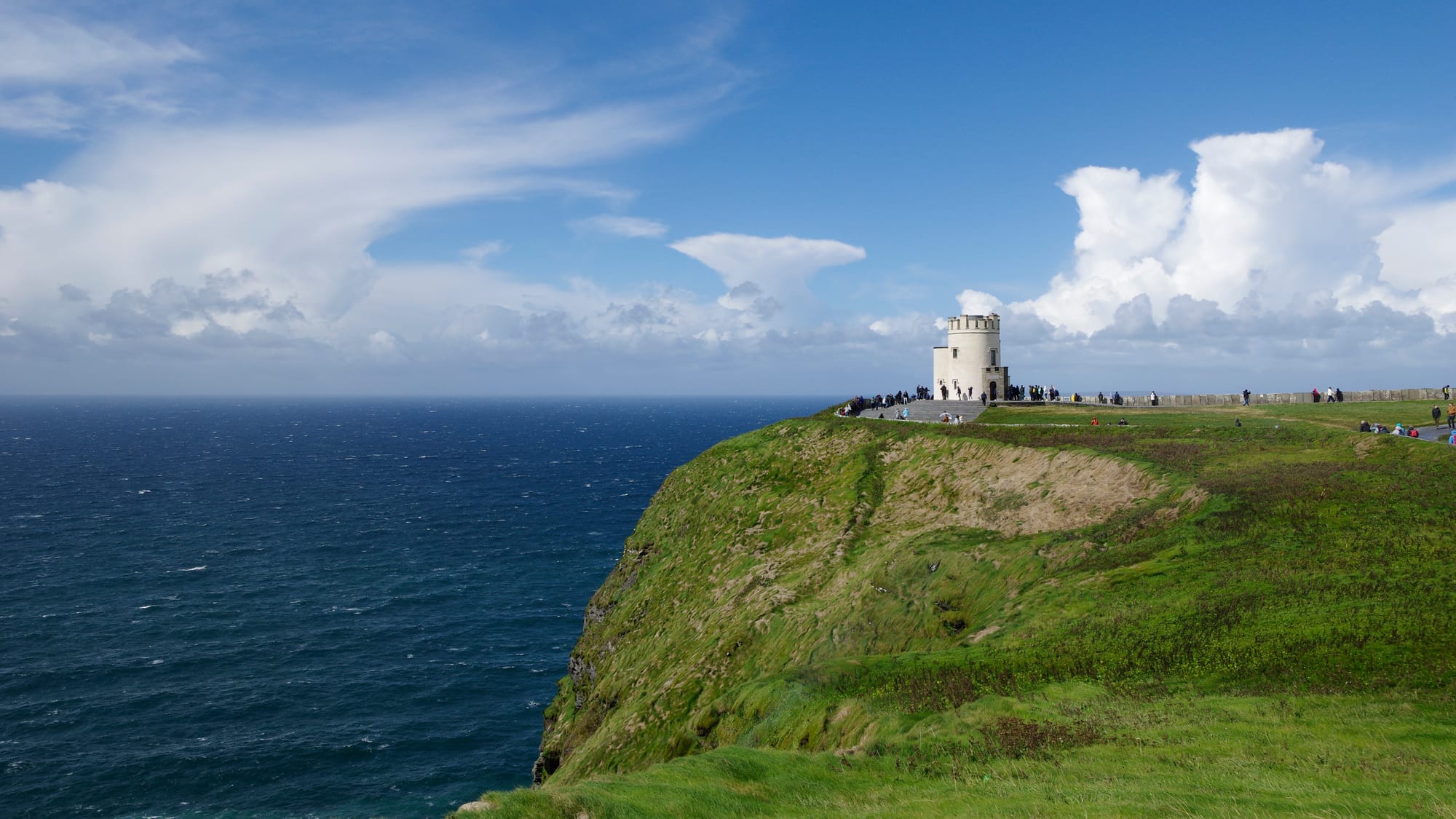
Sheer dark sea cliffs dropping hundreds of feet to the Atlantic, grassy clifftop in the foreground under a bright sky

Ireland

The Cliffs of Moher on the coast of County Clare, rising to about 214 metres above the Atlantic. (Berthold Werner / Wikimedia Commons · CC BY-SA 4.0)

A green, rain-washed island in the North Atlantic — the Republic covers most of it, with Northern Ireland to the northeast — with a Celtic heritage, a vast global diaspora born of famine and emigration, and a literary and musical tradition out of all proportion to its size.

Explore Ireland

History

Ireland was never part of the Roman Empire, and its Celtic society of small kingdoms was Christianised from the fifth century by missionaries associated with St Patrick. In the early medieval "Dark Ages," Irish monasteries were among Europe's great centres of learning and manuscript art. Viking raiders founded Dublin and other port towns, and the Normans invaded from 1169, beginning centuries of English and then British involvement.

English control tightened through plantations — the settlement of English and Scottish Protestants, especially in Ulster — the penal laws against Catholics, and the dispossession of Irish landowners. The Great Famine of 1845–52, caused by potato blight and worsened by British policy, killed around a million people and drove one to two million to emigrate; the population halved and never recovered, and mass emigration continued for a century, creating a diaspora tens of millions strong.

The 1916 Easter Rising and the War of Independence led to the 1921 treaty that partitioned the island: the 26-county Irish Free State (a republic from 1949) and Northern Ireland, which stayed in the United Kingdom. The Republic was poor and inward-looking for decades, then joined the European Community in 1973 and, in the 1990s and 2000s, boomed as the "Celtic Tiger" on the back of EU funds, education, low corporate tax, and US multinationals — crashing hard in 2008 before recovering. It has also transformed socially, legalising divorce, same-sex marriage, and abortion by referendum as the Catholic Church's authority collapsed amid abuse scandals.

  • Ireland: The Island and the Nation Passage tombs older than the Pyramids, a monastic golden age, eight centuries of English involvement, the Great Famine, a war of independence, partition, the Troubles, and a late, rapid transformation

Culture & Customs

Ireland's cultural reputation rests heavily on its writers — Joyce, Yeats, Beckett, Wilde, Shaw, Heaney, and many living novelists and playwrights — and on its music: the traditional "session," an informal gathering of fiddle, tin whistle, bodhrán, and uilleann pipes in the corner of a pub, is a living form, and Irish dance reached a global audience through Riverdance.

The pub is the central social institution, valued as much for conversation — "the craic" — as for drink. Gaelic games, hurling and Gaelic football, run by the amateur Gaelic Athletic Association and organised by parish and county, command fierce local loyalty. Storytelling, quick verbal wit, and a self-deprecating humour are widely claimed national traits.

Catholicism shaped the country deeply and still marks the calendar and the landscape, though weekly practice has fallen sharply. St Patrick's Day, once a solemn holy day, is now a national and diaspora celebration, and holy wells, pilgrimages, and saints' days persist alongside a largely secular public life.

Daily Life

About a third of the Republic's 5.3 million people live in the Greater Dublin area; Cork, Limerick, Galway, and Waterford are the other cities, and much of the country is farmland, small towns, and a thinly populated, spectacular western seaboard.

The economy is high-income and very open, dominated by the Irish operations of US technology and pharmaceutical firms (Apple, Google, Meta, Pfizer, and more), along with agriculture and food, tourism, and financial services. Growth has been strong, but a severe housing shortage, high rents and prices, and pressure on health services are the dominant domestic issues, and the young still emigrate for work, though many now return.

Daily life mixes a modern, cosmopolitan urban Ireland with a slower rural one: the commute or the farm, the GAA match at the weekend, the pub, the church or the walk, and a strong sense of the parish and the extended family, including relatives abroad.

Food

Irish food has shed its plain reputation. The traditional base is potatoes, bacon and cabbage, Irish stew (lamb, potato, onion), colcannon and champ (mashed potato with kale or scallions), soda bread, and the "full Irish" breakfast with rashers, sausages, black and white pudding, egg, and fried tomato.

The island's real strength is its raw ingredients — grass-fed beef and lamb, dairy and farmhouse cheeses, and seafood: Galway Bay oysters, Dublin Bay prawns, mussels, crab, and smoked salmon, often in a creamy chowder. A generation of artisan producers, farmers' markets, and ambitious restaurants has built on this.

Guinness, the dry stout poured with a long settle, is the national drink, now joined by a large craft-beer scene; Irish whiskey (Jameson, Bushmills, Redbreast) is enjoying a revival, and Irish coffee and the herbal-tasting "tea" habit — Ireland is among the world's top tea consumers per head — round things out.

  • Ireland: Food and the National Dish A humble mutton and potato stew that carries the weight of the Great Famine behind it, and a modern Irish food scene rebuilding pride in what the land actually produces

Attractions & Natural Wonders

Dublin is the usual start: Trinity College and the Book of Kells, the Georgian squares, Kilmainham Gaol and the 1916 story, the Guinness Storehouse, the National Museum and galleries, and the traditional-music pubs of the Temple Bar area and beyond. Day trips reach Glendalough's monastic ruins in the Wicklow Mountains and the passage tombs of Newgrange in the Boyne Valley, older than the pyramids.

The west coast is the scenic heart, marketed as the "Wild Atlantic Way": the Cliffs of Moher and the limestone Burren in County Clare; Galway city and the Aran Islands and Connemara beyond it; and, in the southwest, Killarney National Park, the Ring of Kerry, and the Dingle Peninsula, with Skellig Michael's island monastery offshore.

Other highlights include the Rock of Cashel in Tipperary, Kilkenny's medieval core, Cork city and Cobh's emigration and Titanic history, and — across the border in Northern Ireland — the Giant's Causeway and the Antrim coast. Ancient and literary Ireland are never far apart: ring forts, high crosses, round towers, and the settings of the myths and the modern books are threaded through the whole landscape.

Planning basics

Budget

Ireland is expensive, on a par with the pricier parts of Western Europe, and accommodation in Dublin in particular is costly and often scarce. Pub meals, self-catering, and the intercity bus network keep costs down; rural B&Bs are better value than city hotels. Card and contactless payment is near-universal.

Daily Budget Midrange
EUR 150–280 (B&B or mid-range hotel, restaurants, a rental car, attractions)
Daily Budget Shoestring
EUR 70–120 (hostel, pub and supermarket food, buses)

Book Dublin accommodation well ahead; a car makes the west coast far easier but adds cost.

Visa Requirements

Ireland is in the EU but not in the Schengen Area; it shares a Common Travel Area with the UK. Citizens of the EU, the UK, the US, Canada, Australia, and many other countries need no visa for stays of up to 90 days.

Typical Stay
90 days, visa-free, for most Western passports

Because Ireland is outside Schengen, time here does not count against the Schengen 90/180 limit.

Safety

Ireland is a very safe country, with low levels of violent crime. The main issues for visitors are petty theft and some antisocial behaviour in parts of central Dublin (around O'Connell Street and the north inner city) after dark, car break-ins at scenic car parks, and the weather and driving conditions on narrow rural roads.

Keep valuables out of parked cars, take normal care in central Dublin at night, and drive cautiously on single-track roads, pulling in for oncoming traffic.

Climate

Mild, wet, and famously changeable oceanic weather — rarely hot, rarely freezing, and "four seasons in a day" is a genuine description. Rain is possible any time; the east is drier than the west. Summer days are long, winter days short and often grey.

Summer
June–August, generally 15–20°C, occasional warmer spells
Winter
December–February, around 4–8°C, wet and windy, little snow at low levels

Transportation

Dublin Airport is the main gateway, with Cork, Shannon, and others. Intercity trains (Irish Rail) and coaches (Bus Éireann, and low-cost lines like Citylink and GoBus) link the main towns; rural public transport is thin. A rental car is close to essential for the west coast and the peninsulas.

Driving
On the left; rural roads are narrow, hedged, and winding, and distances take longer than the map suggests

Best Time to Visit

May, June, and September for the best balance of milder, brighter weather, long evenings, and manageable crowds. July and August are the warmest and busiest. St Patrick's Day (17 March) fills Dublin; winter is quiet, cheaper, and cosy but with short days and closed rural attractions.

Currency

The Republic uses the euro (Northern Ireland uses the pound sterling). Cards and phone payment work everywhere; carry a little cash for rural pubs, small shops, and honesty boxes at some sites.

Symbol
Currency Code
EUR — euro (Republic); GBP in Northern Ireland

Language

English is the everyday language of almost the entire population. Irish (Gaeilge), a Celtic language, is the first official language, compulsory in school, and used daily by a small minority, mainly in Gaeltacht areas in the west; road signs and official documents are bilingual.

Everyday Language
English (Hiberno-English)
First Official Language
Irish (Gaeilge), spoken daily by a minority