A steep, symmetrical green-and-grey mountain peak beside a small waterfall, with a wide sky and low clouds

Iceland

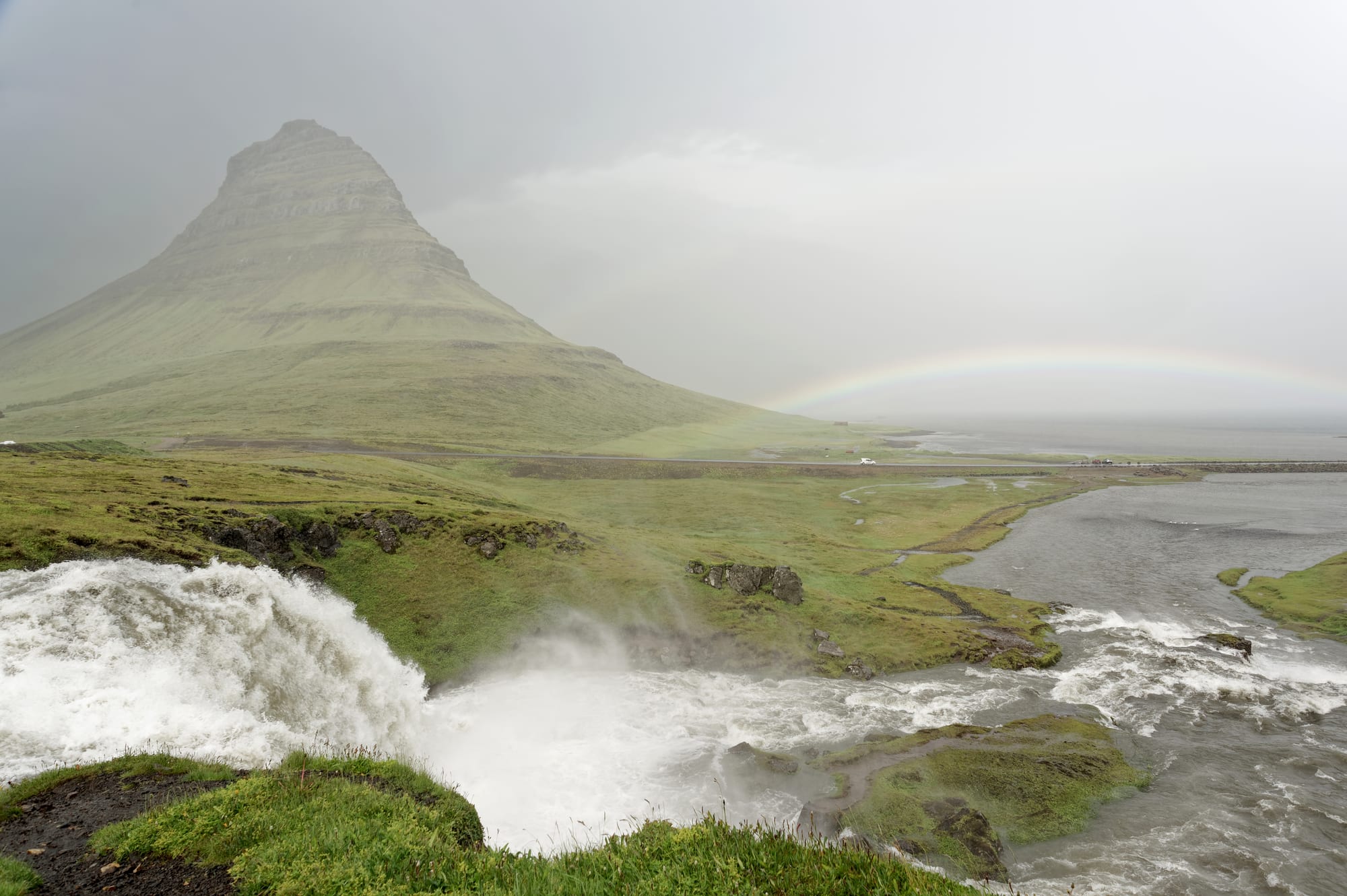
Kirkjufell and Kirkjufellsfoss on the Snæfellsnes peninsula, one of Iceland's most photographed spots. (Jakub Hałun / Wikimedia Commons · CC BY 4.0)

A young volcanic island in the North Atlantic, straddling two tectonic plates — a landscape of glaciers, geysers, lava fields, and waterfalls, with the world's oldest parliament and a population smaller than many cities.

Explore Iceland

History

Iceland was settled from about 874, mostly by Norse chieftains and their households, along with people of Celtic origin, many of them enslaved. In 930 the settlers established the Althing, a general assembly at Þingvellir, now regarded as the oldest still-functioning parliament in the world. The medieval sagas, written down in the thirteenth century, record this era in prose of remarkable quality.

Iceland came under the Norwegian and then the Danish crown, and endured centuries of hardship: volcanic eruptions (the 1783 Laki eruption caused famine and killed a fifth of the population), plague, and a trade monopoly. A nineteenth-century independence movement led to home rule, then sovereignty in 1918 in a union with the Danish king, and finally a fully independent republic in 1944, declared while Denmark was under Nazi occupation.

Post-war Iceland modernised fast on cod and, later, aluminium smelting and finance. It fought the "Cod Wars" with Britain over fishing limits, joined NATO (but never the EU), and in 2008 suffered one of the most spectacular banking collapses of the financial crisis — its banks had grown to many times the size of the economy. Recovery came partly through a tourism boom so rapid that visitor numbers went from a few hundred thousand to well over two million a year within a decade.

  • Iceland: The Island of the Sagas Settled by Norse farmers in the 9th century, home to the oldest parliament and the medieval sagas — then six hard centuries under Norway and Denmark, independence in 1944, the Cod Wars, and a spectacular financial crash

Culture & Customs

Icelanders combine a frontier self-reliance with a strong welfare state and among the world's highest measures of gender equality and social trust. Belief in the "hidden people" (huldufólk) is a gently held folk tradition; a genuine and widely shared value is respect for the land, which visitors are expected to match by staying on marked paths and roads.

Literature runs deep: Iceland publishes more books per head than almost anywhere, the "Christmas book flood" (jólabókaflóð) is a real phenomenon, and the sagas are living culture rather than museum pieces. Music punches far above the country's weight, from Björk and Sigur Rós to a dense local scene.

The swimming pool — outdoor, geothermally heated, open year-round, with hot pots for soaking and chatting — is the true social centre of every town, more so than the pub. Knitting the lopapeysa wool sweater, foraging, and weekend trips to a summer house are common pastimes.

Daily Life

About two-thirds of Iceland's roughly 390,000 people live in the Reykjavík capital area; Akureyri in the north is the only other town of any size. The interior highlands are uninhabited, and settlement clings to the coast, often as single farms or small fishing villages.

The economy rests on fishing and fish products, tourism (now the largest export earner), aluminium smelting powered by cheap hydro and geothermal energy, and a growing tech and data-centre sector. Nearly all electricity and home heating comes from renewable sources. Housing costs in Reykjavík and the pressure of visitor numbers on infrastructure and nature are current concerns.

Daily life is shaped by the extreme light cycle — bright nights in June, dark mornings and afternoons in December — the weather, the pool, and, for many, a second job or a small-scale farming or fishing sideline.

Food

Traditional Icelandic food was about preserving protein through long winters: wind-dried fish (harðfiskur) eaten with butter, smoked and salted lamb (hangikjöt), skyr (a thick, strained fresh-milk product, technically a cheese), dense dark rye bread baked slowly in geothermal heat, and, at the midwinter þorrablót feast, fermented shark (hákarl), singed sheep's head, and ram's testicles — mostly a test of nerve now.

Everyday eating is simpler and good: lamb (free-ranging and much of it organic), cod, haddock, and Arctic char, langoustine soup in the Höfn area, and the ubiquitous pylsur, a lamb-and-pork hot dog with fried and raw onion, ketchup, sweet mustard, and remoulade, best from the Bæjarins Beztu stand in Reykjavík.

Kleina (twisted doughnuts), cinnamon buns, and liquorice in many forms are the sweets. Brennivín, a caraway-and-cumin schnapps nicknamed "Black Death," is the national spirit; Icelandic craft beer and gin have taken off since a full beer ban was lifted only in 1989.

  • Iceland: Food and the National Dish A simple lamb soup that warms an island with almost no farmland to spare, and a fermented shark delicacy that has become the country's most talked-about food dare

Attractions & Natural Wonders

The Golden Circle, a short loop from Reykjavík, packs in Þingvellir — where the Mid-Atlantic Ridge surfaces and the old parliament met — the erupting Strokkur geyser, and the two-tiered Gullfoss waterfall. The capital itself has the Hallgrímskirkja church, the Harpa concert hall, the Perlan nature exhibition, and whale-watching and puffin trips from the harbour.

The Ring Road (Route 1) circles the island in about 1,330 kilometres, past the south coast's waterfalls (Seljalandsfoss, Skógafoss), the black beach and basalt columns at Reynisfjara, the glacier tongues of Vatnajökull — Europe's largest ice cap — and the Jökulsárlón glacier lagoon and its "Diamond Beach." The east fjords, Lake Mývatn's craters and mud pots in the north, thundering Dettifoss, and the whale-watching town of Húsavík complete the circuit.

Beyond the road are the Snæfellsnes peninsula with its glacier-topped volcano and Kirkjufell, the remote and cliff-lined Westfjords, the highland trekking of Landmannalaugar and the Laugavegur trail, and — for those who time it — the northern lights from autumn to spring and the sites of the recent Reykjanes peninsula eruptions near Grindavík. The Blue Lagoon and the many local geothermal pools are the classic way to end a cold day.

Planning basics

Budget

Iceland is one of the most expensive countries in the world. Accommodation, restaurants, alcohol, and tours are all costly; the ways to control spending are self-catering from supermarkets (Bónus, Krónan), guesthouses or campsites, and a rental car shared between travellers. The country is effectively cashless.

Daily Budget Midrange
ISK 35,000–65,000 (guesthouse or mid-range hotel, some restaurant meals, tours)
Daily Budget Shoestring
ISK 15,000–25,000 (hostel or campsite, supermarket food, shared car)

Fill up on supermarket meals and the free geothermal pools rather than the Blue Lagoon and restaurants every day.

Visa Requirements

Iceland is in the Schengen Area (though not the EU). Citizens of the EU, the UK, the US, Canada, Australia, and many other countries need no visa for stays of up to 90 days in any 180-day period.

Typical Stay
90 days in any 180-day period, visa-free, for most Western passports

Safety

Iceland has almost no violent crime and is one of the safest countries in the world. The real dangers are environmental and catch out unprepared visitors: sudden storms and whiteouts, hypothermia, sneaker waves on the black-sand beaches (Reynisfjara has caused deaths), unstable glacier ice and crevasses, geothermal areas with scalding water, and river crossings on F-roads.

Check the forecast and road conditions every day, dress for wind and rain in any season, keep well back from the surf at Reynisfjara, and take guides for glaciers and ice caves.

Climate

Subpolar oceanic, milder than the name suggests thanks to the Gulf Stream, but famously changeable and windy — sun, rain, and sleet can pass in an hour. Summers are cool with near-24-hour daylight in June; winters are dark and stormy but rarely extremely cold on the coast, colder inland.

Summer
June–August, 10–15°C, long light nights
Winter
December–February, around -1 to 4°C on the coast, short days, frequent storms

Transportation

Keflavík Airport, southwest of Reykjavík, is the gateway. There are no trains. A rental car — a 4x4 if you plan to leave the paved Ring Road (Route 1) — is the standard way to explore; the mountain "F-roads" are 4x4-only and open only in summer. Buses cover the Ring Road and some regions in summer; day tours run from Reykjavík year-round.

Driving
Weather and wind can be extreme; check road.is and vedur.is daily, and never drive off-road (it is illegal and damages fragile ground).

Best Time to Visit

June to August for the long days, open highland roads, puffins, and the most reliable driving; this is also the busiest and priciest season. September to March offers the northern lights (best on clear, dark nights away from towns), ice caves, and lower prices, at the cost of short days and weather-driven road closures.

Currency

The currency is the Icelandic króna (ISK). Cards, including contactless, are used for everything — parking, tolls, toilets, remote fuel pumps — and cash is almost never needed. Bring a card with a PIN for unattended petrol stations.

Symbol
kr
Currency Code
ISK — Icelandic króna

Language

Icelandic is the official language, a North Germanic language that has changed so little that Icelanders can read the medieval sagas. Names are patronymic (or matronymic) rather than family surnames. English is spoken fluently by almost everyone, so travel is easy for English speakers.

English
Near-universal and fluent
Official Language
Icelandic