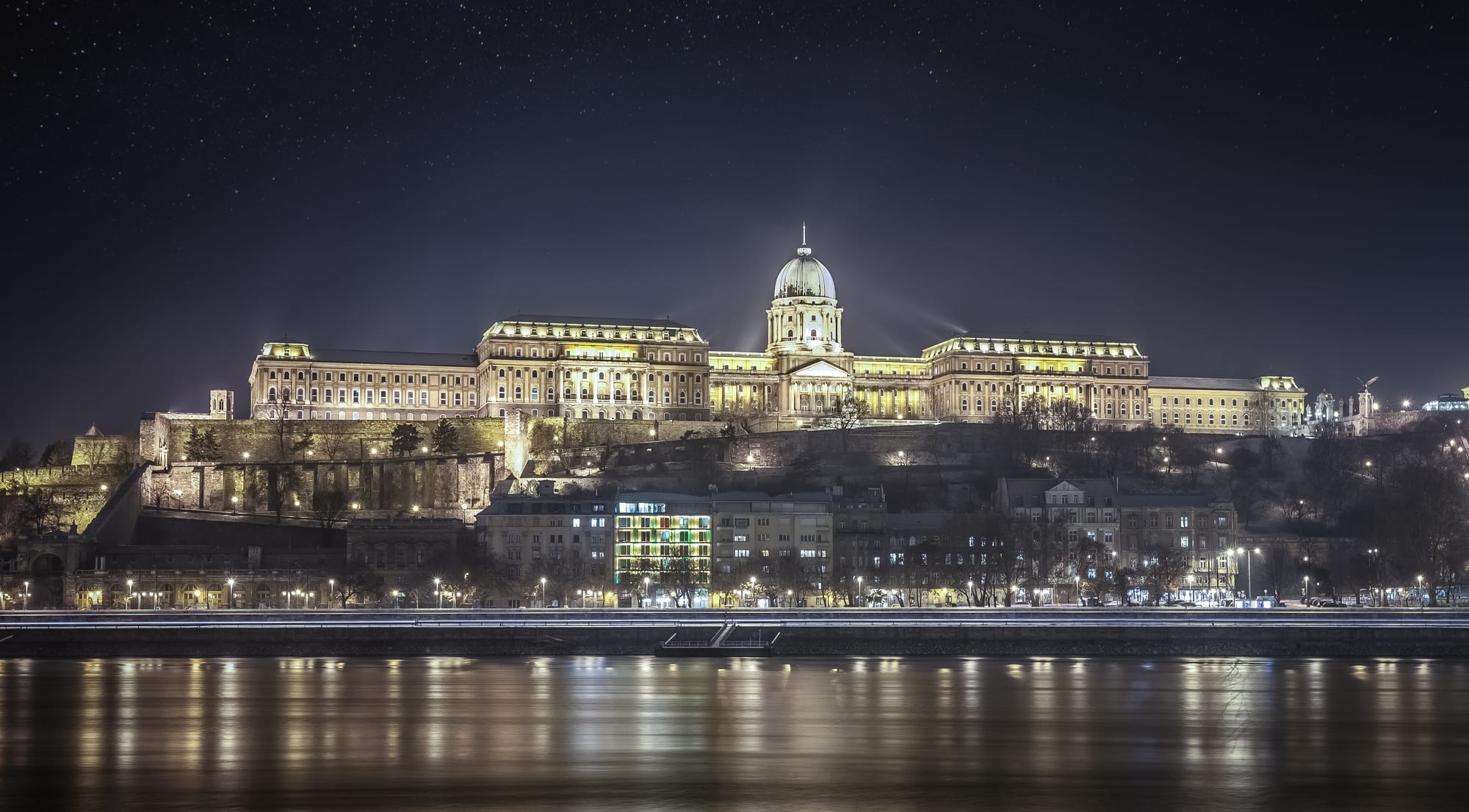
A huge floodlit palace with a green central dome on a fortified hill at night, its lights reflected in a wide river under a starry sky

Hungary

Buda Castle floodlit at night above the Danube in Budapest. (Andrés Nieto Porras / Wikimedia Commons · CC BY-SA 2.0)

A landlocked country in the Carpathian Basin whose people speak a language unrelated to their neighbours' — with a grand river capital, Europe's richest thermal-spa culture, paprika-laced food, and a defining sense of historical loss.

Explore Hungary

History

The Magyars, a people from the Eurasian steppe speaking a Uralic language, arrived in the Carpathian Basin around 895 and, under King Stephen I, adopted Christianity and founded a kingdom in the year 1000. Medieval Hungary was a substantial Central European power until the Ottomans crushed its army at Mohács in 1526 and occupied the centre of the country for a century and a half.

The Habsburgs drove the Ottomans out and absorbed Hungary into their empire. A revolution in 1848–49 was suppressed with Russian help, but in 1867 a compromise created Austria-Hungary, a dual monarchy in which Hungary governed a large multi-ethnic territory. Its collapse in 1918, and the 1920 Treaty of Trianon, stripped Hungary of two-thirds of its territory and left millions of ethnic Hungarians in neighbouring states — a loss still central to national feeling.

Hungary allied with Nazi Germany in the Second World War; most of its large Jewish population was murdered in 1944. A communist regime followed, and the 1956 uprising against it was crushed by Soviet tanks, though the later decades were comparatively liberal ("goulash communism"). Hungary helped open the Iron Curtain in 1989, joined NATO in 1999 and the EU in 2004, and since 2010 has been governed by Viktor Orbán, whose consolidation of media and courts and clashes with the EU over the rule of law have made it a European outlier.

  • Hungary: The Magyar Kingdom in the Basin A Uralic people who seized the Carpathian Basin in 895 — a medieval great power, cut in three by the Ottomans, ruled from Vienna, dismembered at Trianon, crushed in 1956, and today the EU's most defiant member

Culture & Customs

Hungarians tend to describe themselves as proud, a little melancholic, and conscious of standing linguistically alone in Europe. The Trianon loss, the 1956 revolution, and a long list of scientists, mathematicians, composers, and Olympians are common reference points, along with a dry, self-deprecating humour.

Thermal bathing is a genuine part of life, not just a tourist attraction: Budapest sits on a field of hot springs and has grand bath complexes — Széchenyi, Gellért, Rudas — where locals soak, play chess, and socialise year-round. Folk music and dance were revived through the "táncház" (dance-house) movement, and Hungarian classical music (Liszt, Bartók, Kodály) has an outsized reputation.

The Catholic and Calvinist calendars, name-days, the wine harvest, and Christmas and Easter customs structure the year. Coffee-house culture, chess, and a strong literary tradition — much of it untranslated because of the language barrier — round out the picture.

Daily Life

About a fifth of Hungary's 9.6 million people live in Budapest, formed in 1873 from hilly Buda and flat Pest across the Danube. Debrecen, Szeged, Pécs, and Győr are the main regional cities; much of the country is farmland — the Great Plain (puszta) in the east, the Transdanubian hills and Lake Balaton in the west.

The economy is industrial and export-oriented, tightly linked to Germany, with car manufacturing (Audi, Mercedes, BMW, and a large Chinese battery investment), pharmaceuticals, and agriculture prominent. Wages have risen but remain below the Western European average, and emigration of young workers to Austria, Germany, and Britain has been significant.

Daily life is comfortable and home-centred: an early start, a hot lunch as the main meal for many, the market hall for produce, and weekends at a Balaton cottage, a spa, or a village pincesor (row of wine cellars).

Food

Hungarian cooking is hearty and defined by paprika, introduced from the Americas via the Ottomans and now grown around Szeged and Kalocsa. Gulyás is properly a brothy soup of beef, potato, and paprika cooked over a fire, not the thick stew sold abroad as "goulash"; the thick version is closer to pörkölt. Chicken paprikás with nokedli dumplings and sour cream is the Sunday classic.

Other staples: halászlé, a fiery river-fish soup; töltött káposzta (stuffed cabbage); lecsó, a pepper-and-tomato stew; lángos, deep-fried dough with garlic, sour cream, and cheese; and hortobágyi palacsinta, savoury filled pancakes. Sweet dishes such as somlói galuska and Dobos torte, and the spiral kürtőskalács chimney cake, are taken seriously.

Hungary is a serious wine country: the sweet, botrytised Tokaji Aszú (a historic royal favourite), the robust reds of Eger ("Bull's Blood"), and crisp whites from around Balaton. Pálinka, a strong fruit brandy, and the bitter herbal Unicum are the spirits.

  • Hungary: Food and the National Dish A paprika-red meat stew that began as herders' campfire cooking, in a country that treats its signature spice as a point of genuine national pride

Attractions & Natural Wonders

Budapest is one of Europe's great capitals: the riverfront Parliament, the Chain Bridge, Castle Hill with the Matthias Church and Fishermen's Bastion, the grand boulevards and Heroes' Square of Pest, the ruined-building "ruin bars" of the old Jewish Quarter, and the thermal baths, all threaded by the Danube. The banks of the Danube, the Castle Quarter, and Andrássy Avenue are a UNESCO listing.

North of the city, the Danube Bend turns sharply through wooded hills past the artists' town of Szentendre, the basilica at Esztergom, and the castle at Visegrád. West lies Lake Balaton, Central Europe's largest lake, with resort towns, the Tihany peninsula, and vineyards on its northern shore. Eger, to the northeast, has a castle, baroque streets, and the wine cellars of the Valley of the Beautiful Women; Tokaj, further on, is the home of the famous sweet wine.

Pécs, near the Croatian border, keeps a former mosque as its cathedral and early Christian tombs from Roman times; the Hortobágy on the Great Plain is a protected grassland of shepherds, grey cattle, and huge skies; and the caves of Aggtelek in the north are a World Heritage Site shared with Slovakia.

Planning basics

Budget

Hungary is one of the better-value countries in the EU. Budapest is pricier than the rest of the country but still cheaper than Vienna or Prague; thermal baths, hearty restaurant meals, and wine are all affordable. Card payment is widespread; carry some cash for markets, small bakeries, and rural buses.

Thermal Bath Entry
Roughly EUR 20–30 for a day at one of Budapest's grand baths
Daily Budget Midrange
EUR 90–170 (mid-range hotel, restaurants, a bath entry, day trips)
Daily Budget Shoestring
EUR 40–70 (hostel or guesthouse, bakery and canteen food, public transport)

Visa Requirements

Hungary is in the EU and the Schengen Area. Citizens of the EU, the UK, the US, Canada, Australia, and many other countries need no visa for stays of up to 90 days in any 180-day period.

Typical Stay
90 days in any 180-day period, visa-free, for most Western passports

Safety

Hungary is a safe country with low levels of violent crime. The main issues for visitors are pickpocketing around Budapest's tourist sites and on public transport, overpriced or scam bars (the "konzumlány" trick, where hosts run up a huge bill), and dishonest taxis.

Use the official Főtaxi or a ride-hailing app, agree what you are ordering in bars, and keep bags secure on trams and the metro.

Climate

Continental, with four clear seasons. Summers are warm to hot, sometimes with heat waves and thunderstorms; winters are cold and often grey, with some snow. Spring and autumn are mild and pleasant.

Summer
June–August, generally 24–32°C
Winter
December–February, around -3 to 4°C, some snow

Transportation

Budapest's Ferenc Liszt Airport is the main gateway. The rail network (MÁV) radiates from Budapest and reaches most towns cheaply; intercity coaches (Volánbusz) fill the gaps. Budapest itself has an extensive metro (line 1 is the oldest on the European continent), trams, and buses. A rental car suits the wine regions and the Great Plain.

Most highlights beyond Budapest — the Danube Bend, Eger, Pécs, Balaton — are easy day trips by train or bus.

Best Time to Visit

May, June, and September for warm, bright weather and lighter crowds. July and August are hottest and busiest, and the season for Lake Balaton and the Sziget festival. Autumn brings the wine harvest in Tokaj and Eger, and winter the Budapest baths at their most atmospheric under steam, plus Christmas markets.

Currency

The currency is the Hungarian forint (HUF). Despite EU membership Hungary has kept its own currency and has no near-term plan to adopt the euro. Prices carry many zeros. Cards are widely accepted; some places quote euros but usually at a poor rate.

Symbol
Ft
Currency Code
HUF — Hungarian forint

Language

Hungarian (Magyar) is the official language, a Uralic language related distantly to Finnish and Estonian and to no other language in the region — and famously difficult for outsiders. English is spoken by younger people and in Budapest tourism; German is also widely understood, especially near the Austrian border.

English
Common among the young and in Budapest; patchier in rural areas
Official Language
Hungarian (Magyar)