A wall of dense skyscrapers along a harbour front, green mountains rising steeply behind them under a bright sky

Hong Kong

The skyline of Hong Kong Island along Victoria Harbour, backed by the ridge of The Peak — one of the most concentrated clusters of tall buildings on Earth. (Diego Delso / Wikimedia Commons · CC BY-SA 3.0)

A dense financial city of some 7.5 million people on the south coast of China — a British colony for 156 years, returned in 1997 under "one country, two systems", and since 2020 a Special Administrative Region whose promised autonomy and civil liberties have been sharply curtailed.

Explore Hong Kong

History

Hong Kong's islands and peninsula were farming and fishing country on the edge of the Chinese empire until the nineteenth century. After the First Opium War, China ceded Hong Kong Island to Britain in 1842; the Kowloon peninsula followed in 1860, and the New Territories were leased for 99 years in 1898. Britain ran it as a free port, and it grew into a major entrepôt between China and the world. Japan occupied the territory from 1941 to 1945.

Waves of refugees from the Chinese civil war and then from Mao's China swelled the population and the workforce, and Hong Kong industrialised — textiles, plastics, electronics — before pivoting to finance, shipping, and services and becoming one of the world's richest economies. Leftist riots in 1967 and the 1984 Sino-British Joint Declaration, which set the terms of a handover, were the main political landmarks; the Tiananmen killings of 1989 shook local confidence and spurred emigration.

Hong Kong was returned to China on 1 July 1997 as a Special Administrative Region, with a mini-constitution, the Basic Law, promising its capitalist system, courts, and freedoms would be unchanged for 50 years. Friction over that promise built through the shelved national-security bill of 2003, the 2014 Umbrella Movement for open elections, and the massive anti-extradition-bill protests of 2019, which turned violent. In 2020 Beijing imposed a National Security Law directly: opposition politicians were jailed or fled, newspapers closed, the electoral system was remade for "patriots only", and civil-society groups disbanded. A further local security law passed in 2024. Several hundred thousand residents emigrated, many to Britain on a special visa route.

  • Hong Kong: The Borrowed Place A fishing coast taken by Britain in the Opium Wars, built into a global port and financial centre, returned to China in 1997 under "one country, two systems" — and remade again since 2020

Culture & Customs

Hong Kong culture is Cantonese and Han Chinese at its core, with a distinct local identity shaped by a century and a half apart from the mainland: the common law, the English language in officialdom, Christianity alongside Chinese folk religion, and institutions from horse racing to the Star Ferry. Chinese tradition remains strong — ancestral rites, feng shui, Cantonese opera, and a full calendar of festivals from Lunar New Year to the Cheung Chau Bun Festival and Mid-Autumn.

The city has had an outsized cultural reach through Cantopop and through Hong Kong cinema — the action films of Bruce Lee and Jackie Chan, the art films of Wong Kar-wai — though the film industry has contracted. Everyday life is famously fast and hard-working, with long hours, tiny flats, and an intense focus on property and money, softened by the rituals of yum cha, night markets, and weekend hikes in the country parks.

Press freedom and the rule of law were long regarded as the city's defining strengths; both have narrowed sharply since 2020, and self-censorship has grown.

Daily Life

About 7.5 million people live in one of the most densely populated territories on Earth, most in high-rise flats that are among the world's smallest and least affordable; "subdivided flats" and "cage homes" house the poorest. Yet more than two-fifths of the land is protected country park, and the mountains and coast are never far from the towers.

The economy runs on banking and finance, trade and logistics, professional services, and tourism, the last now dominated by mainland visitors. Cantonese is the home language for most; the population is ageing; and the emigration wave after 2020 has been partly offset by arrivals from the mainland.

Daily life leans on the MTR and the Octopus card, cheap and constant eating out, and a rhythm set by the working week, the racing calendar, and, in summer, the typhoon signals that can grant a sudden day off.

Food

Hong Kong is a high point of Cantonese cooking. Yum cha — tea and dim sum trolleys — is the social meal; roast goose, char siu and other siu mei, wonton noodles, claypot rice, congee, and steamed seafood are everyday classics. Dai pai dong open-air stalls do fierce "wok hei" stir-fries.

The cha chaan teng, or "tea restaurant", is the city's own institution: strong milk tea strained through a cloth "stocking", pineapple buns, macaroni in soup, Hong Kong-style French toast, and yuenyeung, a coffee-tea mix. Street snacks run to egg waffles, curry fish balls, and stinky tofu; bakeries sell egg tarts and cocktail buns.

Fine dining and cheap eats sit side by side — Hong Kong has many Michelin stars, and also the restaurant often cited as the world's cheapest Michelin meal. Every regional Chinese cuisine and a full range of international food are represented, a legacy of the city's role as a crossroads.

  • Hong Kong: Food and the National Dish Small steamed and fried plates ordered by the cartload, glossy roast meats hanging in shop windows, and a Cantonese food culture sharpened by a century under British rule

Attractions & Natural Wonders

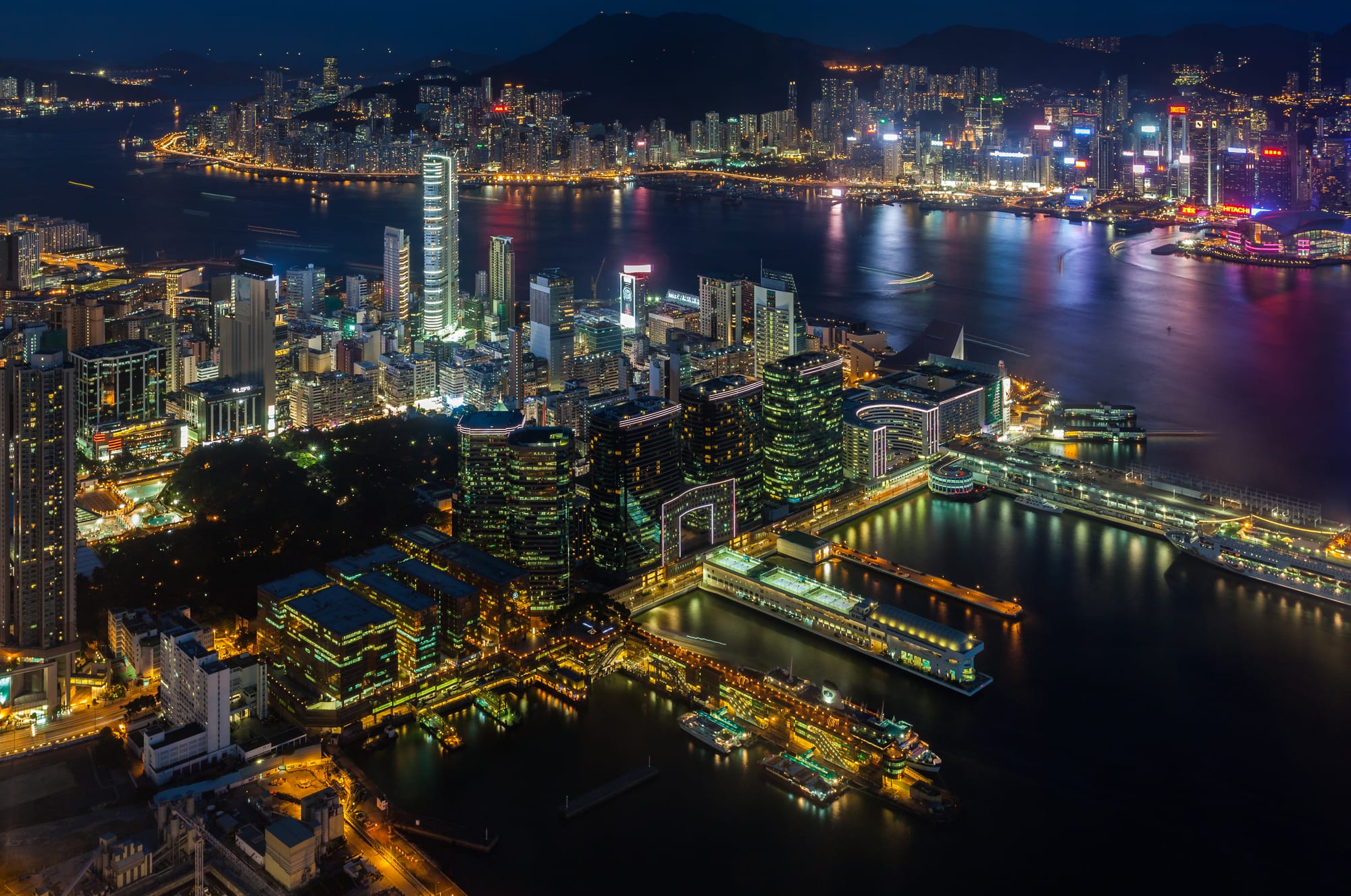
Victoria Peak, reached by the funicular tram, gives the classic view over the skyline and harbour, best at dusk for the nightly "Symphony of Lights". The Star Ferry crosses to Tsim Sha Tsui, with its waterfront promenade and museums, the Avenue of Stars, and the shopping and neon of Nathan Road, Mong Kok, and the Temple Street night market.

On Hong Kong Island, the Central–Mid-Levels escalator, Man Mo Temple, the PMQ design hub, and the bars of Soho and Lan Kwai Fong cluster in the old core, while Wong Tai Sin Temple and the Chi Lin Nunnery lie in Kowloon. Lantau Island holds the Tian Tan "Big Buddha" and Po Lin Monastery, reached by the Ngong Ping cable car, plus the stilt village of Tai O and Hong Kong Disneyland; Ocean Park is on the south side of Hong Kong Island.

The country parks and coast are the counterpoint to the density: the Dragon's Back ridge walk, the volcanic hexagonal columns of the Sai Kung UNESCO Geopark, and the ferries to Cheung Chau, Lamma, and Peng Chau for seafood and slow days. Everyday sightseeing, hiking, and eating are unaffected by the political changes described above.

Planning basics

Budget

Hong Kong has some of the world's most expensive hotel rooms for the space you get, but public transport is cheap and efficient and street food and cha chaan teng meals cost little. Hostels and guesthouses in Kowloon (Chungking Mansions, Mongkok) are the budget option; mid-range hotels are dear.

Daily Budget Midrange
HKD 1,600–3,200 / USD 200–410 (mid-range hotel, restaurant meals, drinks, paid sights)
Daily Budget Shoestring
HKD 500–850 / USD 65–110 (hostel or guesthouse, street food and cha chaan teng, Octopus on the MTR)

Eat at cha chaan teng and dai pai dong, get an Octopus card for everything, and use the hostels of Kowloon if money is tight.

Visa Requirements

Hong Kong controls its own immigration, separate from mainland China. British citizens get 180 days visa-free; citizens of the EU, US, Canada, Australia, and many others get 90 days; some nationalities get 30 or 14. A separate Chinese visa is needed to cross into the mainland.

Typical Stay
90 days visa-free for most Western passports (180 for UK citizens)

A Hong Kong entry is not a Chinese entry — arrange a mainland China visa separately if you plan to cross the border.

Safety

Violent crime is very low and the city is safe to walk at any hour; pickpocketing happens in crowds. The significant change since 2020 is legal and political: the National Security Law and a 2024 local security law are broadly drawn, and people have been arrested for protest activity, for social-media posts, and for carrying items deemed seditious. Typhoons and, rarely, landslides are the natural hazards.

Health
Tap water is generally safe but many drink filtered or bottled; air quality varies; summer heat and humidity are intense

Avoid protests and political gatherings, be mindful of what you post and carry, monitor typhoon signals in summer, and pace yourself in the heat.

Climate

Humid subtropical. Summers (May–September) are hot and very humid at 28–33°C and bring the typhoon season, when a "T8" signal shuts the city down. Autumn (October–early December) is warm, dry, and clear — the best time. Winter (January–February) is cool at 12–18°C and sometimes damp; spring is grey, foggy, and drizzly.

Autumn
Warm, dry, clear (October–December)
Summer
Hot, humid, typhoon-prone (May–September)

Transportation

Hong Kong International Airport at Chek Lap Kok is a major global hub, linked to the city in 24 minutes by the Airport Express. The MTR metro is fast, cheap, and extensive; historic trams ("ding dings") run along Hong Kong Island; the Star Ferry crosses the harbour; buses, minibuses, and ferries to the outlying islands fill in the rest. A car is unnecessary.

Load an Octopus card and use the MTR and Star Ferry; take the tram along the north shore of Hong Kong Island for the view.

Best Time to Visit

October to early December is the ideal window — comfortable temperatures, low humidity, and clear harbour views. Avoid the sticky, storm-prone summer. Around Lunar New Year (late January or February) many shops and restaurants close for several days.

Events
Lunar New Year (Jan/Feb) with the parade and harbour fireworks; the Cheung Chau Bun Festival (spring); Dragon Boat races (early summer); Mid-Autumn Festival lanterns; the Tin Hau and Tam Kung temple festivals

Currency

The Hong Kong dollar is pegged to the US dollar at about 7.8. The contactless Octopus card is used for transport, convenience stores, and many shops; cards and mobile wallets (including mainland apps) are widely accepted.

Symbol
HK$
Currency Code
HKD — Hong Kong dollar

Language

Cantonese is the everyday language of the great majority. English is co-official and widely used in business, law, government, signage, and tourism. Mandarin (Putonghua) has become more common. Written Chinese uses traditional characters.

Co Official
English (widely used); Mandarin increasingly common
Everyday Language
Cantonese