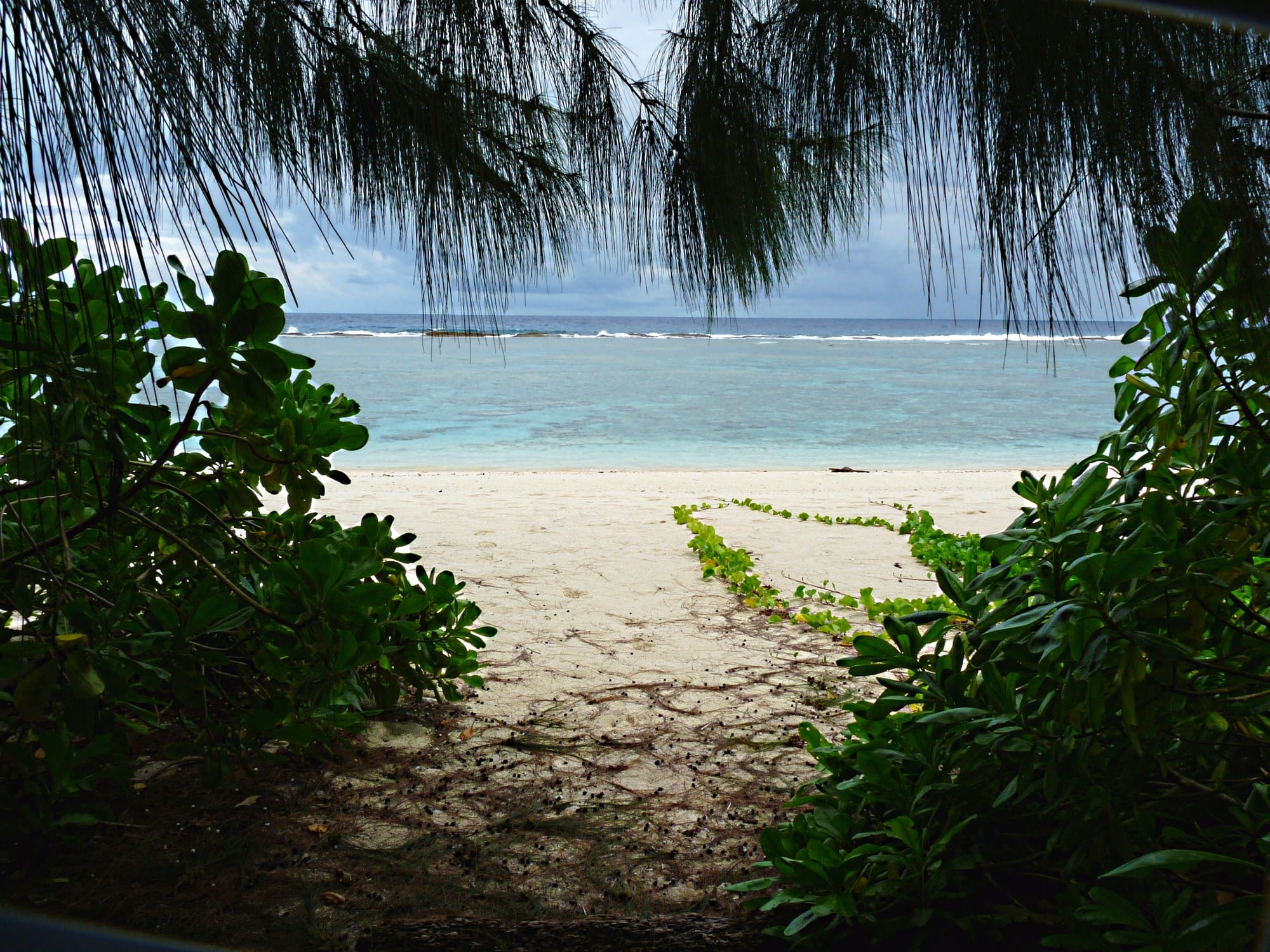
An empty white-sand beach curving beside clear pale-turquoise water, dense green jungle behind under a bright sky

Guam

Ritidian Beach at Guam's northern tip, a protected stretch of the Guam National Wildlife Refuge away from the resort strip. (Laura Beauregard, US Fish and Wildlife Service / Wikimedia Commons · CC BY 2.0)

The largest island in Micronesia and an unincorporated territory of the United States — the indigenous homeland of the CHamoru people, ruled by Spain for over two centuries, occupied by Japan in the Second World War, and now a heavily fortified US military hub known as "the tip of the spear".

Explore Guam

History

Guam was settled by the ancestors of the CHamoru around 3,500 years ago; the latte stones — pillars topped with cup-shaped capstones that held up prestige buildings — are the enduring symbol of that society. Ferdinand Magellan landed in 1521, the first European contact anywhere in the Pacific. Spain claimed the Marianas in 1668 and imposed Catholic missions; the Chamorro-Spanish Wars and introduced disease that followed cut the indigenous population from tens of thousands to a few thousand, and survivors were concentrated on Guam and intermarried with Spanish and Filipino settlers.

The United States took Guam from Spain in 1898 and ran it as a Navy coaling and cable station under naval governors. Japan invaded within hours of Pearl Harbor in December 1941 and occupied the island for 32 months — a period of forced labour, executions, and internment that CHamoru families still commemorate on Liberation Day. US forces retook Guam in a costly battle in July–August 1944, and it became a major air and naval base.

The 1950 Organic Act made CHamorus US citizens and created a civilian government; Guam has had an elected governor since 1970 and sends a non-voting delegate to Congress, but its residents cannot vote for president. Around a third of the island is US military land, and a large relocation of Marines from Okinawa is under way. Guam remains on the UN list of non-self-governing territories, and a long-running effort to hold a self-determination plebiscite — restricted to "native inhabitants" — has been tied up in the courts.

  • Guam: Where America's Day Begins The CHamoru homeland in the western Pacific — settled 3,500 years ago, claimed by Spain for 230, taken by the United States in 1898, occupied by Japan, and a US military stronghold ever since

Culture & Customs

CHamoru culture blends Austronesian roots, three centuries of Spanish and Catholic influence, and, since 1898, American life. The guiding value is inafa'maolek — roughly "to make good", an ethic of reciprocity and restoring harmony within the extended family and clan. Respect for elders is shown through mannginge', taking an elder's hand and drawing it to one's face to inhale.

Catholicism is deeply woven in: each village holds an annual fiesta for its patron saint, with open houses and huge spreads of food, and rosary and nobena gatherings mark deaths. Family obligation (chenchule', the system of mutual contribution at weddings, funerals, and christenings) is a serious social duty.

The population is very mixed — CHamoru, Filipino (about a quarter of residents), other Micronesians who have migrated under the Compacts of Free Association, plus military families and communities of Korean, Japanese, and Chinese origin — and Guam's identity debates centre on decolonisation, land, and the weight of the military presence.

Daily Life

About 155,000 people live on Guam, concentrated in the centre and north around Hagåtña, Tamuning, and Dededo; the south is greener, more rural, and more CHamoru. The economy rests on the US military and its spending, federal transfers, and tourism — historically dominated by visitors from Japan, South Korea, and Taiwan, and hit hard by the pandemic and by regional tensions.

Life is American in its institutions — dollars, US schools, big-box stores, the NFL on TV — and CHamoru and Pacific in its family structure, food, and Sunday routines. Typhoons are a recurring fact, with homes built of concrete and shutters, and the recovery from Typhoon Mawar in 2023 shaped recent years.

Emigration to Hawaii and the US mainland, especially for military service and university, is common, and remittances and visits keep island and diaspora families connected.

Food

CHamoru cooking centres on grilled meat, rice, and bold sauces. Kelaguen — meat or seafood chopped fine and "cooked" in lemon juice with grated coconut, onion, and hot pepper — is the signature dish, served with warm titiyas (tortillas) or hineksa' aga'ga' (red rice coloured and flavoured with achote seeds). Finadene', a dipping sauce of soy, lemon or vinegar, onion, and chilli, goes on everything.

The village fiesta table piles up barbecue chicken and ribs, estufao (a Spanish-influenced stew), kå'du soups, pancit and lumpia from the Filipino community, and latiya and coconut ahu for dessert. Spam and other tinned meats, a Pacific-wide staple, are eaten without irony.

Fresh reef fish, tropical fruit, and — traditionally, though now protected — the fruit bat (fanihi) round out the diet. Imported American groceries fill the supermarkets, and the Wednesday night market in the Chamorro Village is the place to sample the local dishes.

  • Guam: Food and the National Dish Grilled chicken chopped fine with lemon, onion and coconut, a fiesta culture built around feeding an entire village, and a Chamorro food tradition older than any of the powers that later ruled the island

Attractions & Natural Wonders

Tumon Bay, a protected marine preserve backed by the hotel strip, is the tourism centre, with calm reef swimming and, above it, Two Lovers Point — a cliff wrapped in a CHamoru legend of star-crossed lovers, with wide views along the coast. The Latte Stone Park in Hagåtña, the capital, displays relocated latte pillars near the Spanish-era Plaza de España and the ruined forts that guarded the harbour.

The War in the Pacific National Historical Park spreads across several sites — the invasion beaches at Asan and Agat, gun emplacements, and a museum — telling the story of the 1944 battle, and the Japanese soldier Shoichi Yokoi hid in a jungle cave near Talofofo Falls until 1972. Fort Nuestra Señora de la Soledad above Umatac marks Magellan's landfall.

The wilder south and north reward a drive: the Cetti Bay overlook, the Spanish bridge and church at Inarajan (Inalåhan) with its natural saltwater pools, and, at the island's northern tip, the Ritidian unit of the Guam National Wildlife Refuge, with a white-sand beach, limestone forest, and caves with ancient pictographs. Divers head for the Blue Hole off Orote and the wrecks in Apra Harbor, where a Second World War Japanese ship lies across a First World War German one.

  • Guam: Eight Attractions and Natural Wonders America's western edge in the tropical Pacific — a resort bay of turquoise reef, the stone pillars of an ancient people, and the beaches where the 1944 battle was fought

Planning basics

Budget

Guam is priced like the US, with sales-style taxes on some services and tipping expected in restaurants. The Tumon hotel strip is the expensive option; guesthouses, the Chamorro Village market, and roadside barbecue and Filipino eateries keep costs down. A rental car is close to essential.

Daily Budget Midrange
USD 180–350 (Tumon hotel, restaurants, rental car and fuel, a boat or dive trip)
Daily Budget Shoestring
USD 70–120 (guesthouse, market and barbecue-plate food, shared rental car)

Eat at the Wednesday Chamorro Village night market in Hagåtña and the local BBQ and Filipino spots, and rent a car to reach the southern villages and the north.

Visa Requirements

Guam is US territory, so US entry rules apply, with one addition: Guam (and the Northern Marianas) operate a Guam-CNMI Visa Waiver Program that admits several extra nationalities, mainly for tourism. Visa Waiver Program travellers still need ESTA; others need a US visa. Arrivals from the US mainland or Hawaii are domestic.

Typical Stay
As for the US (ESTA/visa), plus the Guam-CNMI Visa Waiver Program for some additional countries (up to 45 days)

Check whether your nationality qualifies under the US Visa Waiver Program (with ESTA) or the separate Guam-CNMI program; otherwise get a US visa.

Safety

Guam is generally safe, with petty theft, car break-ins at trailheads and beaches, and some alcohol-related trouble in the nightlife area the main concerns. Ocean hazards are significant — strong currents and surf outside the reef, and drownings occur. North Korea has periodically named Guam in missile threats, but this does not affect daily life or travel.

Health
Tap water is treated and generally safe; dengue can occur; the sun and the reef currents are the main hazards; there is a full hospital

Swim inside the reef and heed current warnings, don't leave valuables in cars at beaches and trailheads, and take normal night-time precautions in the Tumon bar district.

Climate

Tropical, hot and humid year-round, around 28–32°C. The dry season runs roughly December to June and the wet season July to November, which is also the peak of the western Pacific typhoon season — Typhoon Mawar struck Guam directly in May 2023.

Dry Season
December–June
Wet Season
July–November (typhoon season)

Transportation

A. B. Won Pat International Airport at Tamuning has flights from Japan, South Korea, the Philippines, Micronesia, Hawaii, and the US mainland. A rental car is the standard way around the island; there is a limited public bus service and hotel shuttles along the Tumon strip.

Rent a car to see anything beyond Tumon; drive on the right, and note that large areas in the north and around Apra Harbor are military land and off-limits.

Best Time to Visit

December to June, the drier season, has the most reliable weather and the calmest sea for diving and boat trips. July to November is wetter and carries the typhoon risk. Temperatures barely change through the year.

Events
Liberation Day (21 July), marking the end of the Japanese occupation, with a parade and carnival; the Guam Micronesia Island Fair; village fiestas for patron saints throughout the year; the CHamoru month of March (Mes CHamoru)

Currency

The currency is the US dollar. Cards are accepted almost everywhere; carry small bills for the village markets, buses, and tips.

Symbol
$
Currency Code
USD — United States dollar

Language

English is the language of government, business, and schooling and is spoken by nearly everyone. CHamoru, the indigenous Austronesian language, is co-official and the focus of revitalisation efforts. Filipino languages, chiefly Tagalog and Ilocano, are widely spoken given the large Filipino community.

Languages
English and CHamoru (official)
Also Spoken
Tagalog, Ilocano, and other Micronesian languages