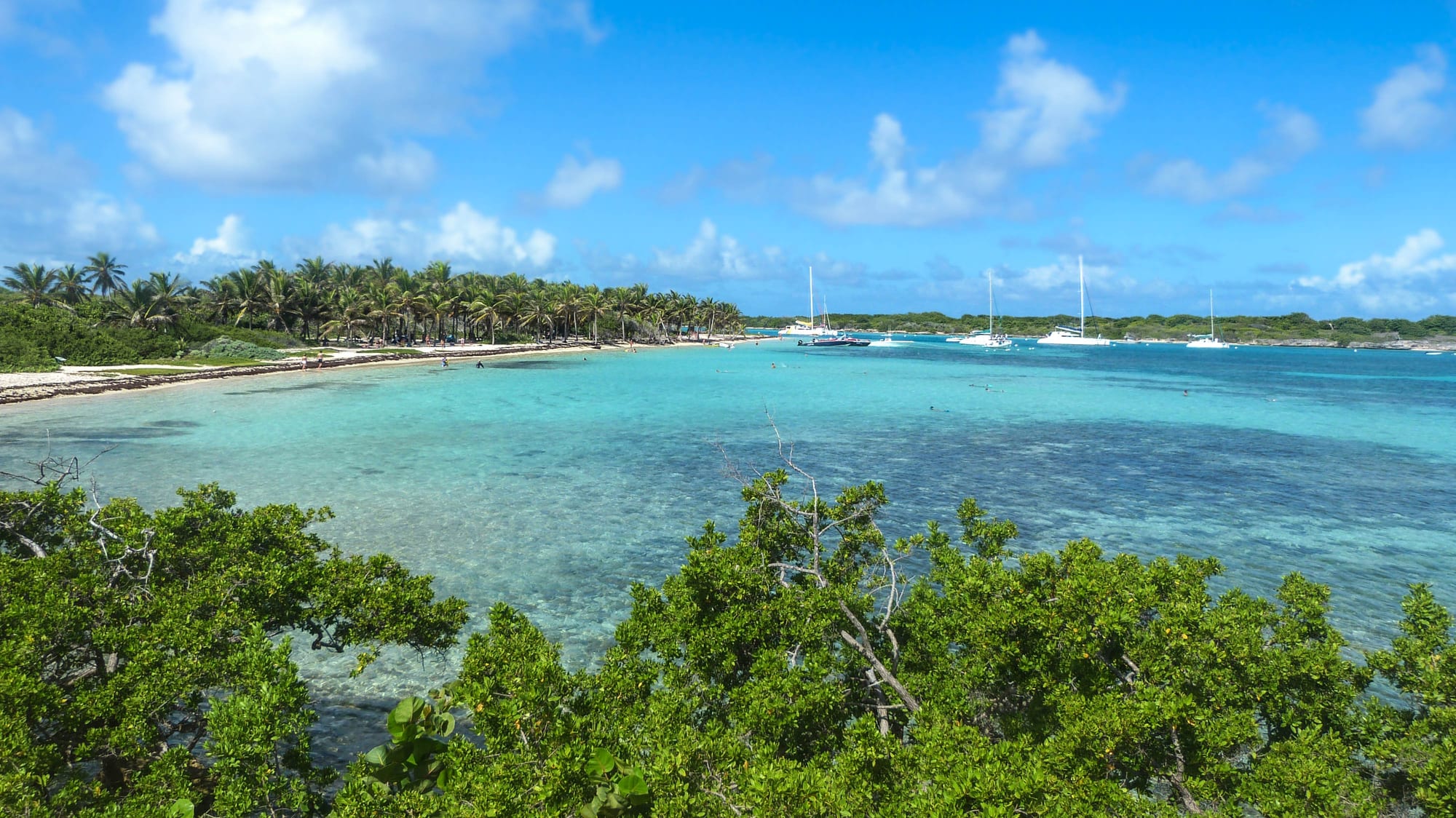
A shallow lagoon of vivid turquoise water curving past a white-sand beach lined with coconut palms, with sailing boats at anchor and green shrubs in the foreground under a bright blue sky

Guadeloupe

The turquoise lagoon and palm-lined beach of Petite Terre, Guadeloupe, with sailing boats at anchor. (Quentinjosso / Wikimedia Commons · CC BY-SA 4.0)

A butterfly-shaped group of Caribbean islands that is an overseas region of France and part of the European Union — a volcanic, rainforested wing and a flat, beach-fringed one, joined by a narrow channel, with a Creole culture and a euro economy.

Explore Guadeloupe

History

The islands were settled by Arawak and then Kalinago (Island Carib) peoples, who called Guadeloupe Karukera. France colonised it from 1635, clearing the land for sugar worked by enslaved Africans; the plantation economy made Guadeloupe valuable enough that France, at the 1763 Treaty of Paris, kept it and handed Britain all of Canada. Britain occupied the islands several times, and during one occupation in 1794 the revolutionary commissioner Victor Hugues briefly abolished slavery and armed the freed population before Napoleon reimposed it in 1802, crushing resistance led by Louis Delgrès.

Slavery was abolished for good in 1848, largely through the campaigning of Victor Schoelcher. Indentured labourers from India were then brought to the estates, adding another strand to the population. Guadeloupe was governed as a colony until 1946, when it became an overseas department of France — fully part of the Republic, and later of the European Union — with French law, the franc and then the euro, and social benefits, alongside continuing debate about autonomy and the cost of living.

A defining modern grievance is chlordécone, a pesticide used on banana plantations from the 1970s until 1993 despite known toxicity, which has contaminated soil and water across much of Guadeloupe and Martinique for generations and is the subject of long-running legal and political battles. A weeks-long general strike in 2009 over "profitation" — profiteering and inequality — and further unrest in 2021 have marked the relationship with Paris.

  • Guadeloupe: The Sugar Islands That Stayed French A butterfly-shaped archipelago in the Lesser Antilles — Carib resistance, a rich slave-sugar colony France once valued above Canada, a crushed 1802 rebellion, and a French department still arguing about it

Culture & Customs

Guadeloupean identity is Creole: French in language of instruction and institutions, but African, Indian, and Caribbean in music, food, faith, and family life. Gwoka — a family of drum rhythms, call-and-response singing, and dance that grew out of the enslaved population's music — is central to the culture and is on UNESCO's intangible heritage list, performed at léwòz gatherings and festivals.

Carnival is the great annual event, months of neighbourhood groupes à peau (skin-drum bands) and groupes à caisse building to Mardi Gras. Catholicism is the majority faith, blended in places with African-derived practice, and there are Hindu temples serving the Indian-descended community. Zouk, the dance music pioneered by the Guadeloupe-Martinique band Kassav', went global from here.

Family, the Sunday meal, the market, and community festivals organise social life, and Creole proverbs, storytelling, and a strong oral tradition remain alive.

Daily Life

About 380,000 people live in Guadeloupe, most on Grande-Terre and around Pointe-à-Pitre, the commercial hub, with the smaller administrative capital of Basse-Terre on the volcanic island. The population is ageing and slowly declining, as many young Guadeloupeans move to mainland France for study and work.

The economy runs on the public sector, tourism, EU and state transfers, and agriculture — bananas, sugar cane and rum, melons, coffee, and vanilla. Structural unemployment is high, the cost of living well above the mainland, and the islands depend heavily on imports. Water supply is a recurring problem due to an ageing, leaking network.

Daily life is French in its administration and Caribbean in its rhythm, shaped by the heat, the sea, the family, and the long shadow of the chlordécone question.

Food

Guadeloupean cooking is Creole and generously spiced. Colombo — a curry of chicken, goat, or fish with a local spice blend brought by Indian labourers — is a staple, as is court-bouillon de poisson (fish in a tomato and lime broth) and bébélé, a Marie-Galante dish of tripe, breadfruit, and green banana. Accras de morue (salt-cod fritters) and boudin créole (spiced blood sausage) are the classic starters.

The lolo, a simple roadside eatery, grills fish and chicken with rice and red beans, and the markets sell bokit (a fried-bread sandwich), fresh spices, and tropical fruit. Blaff, fricassée de chatrou (octopus), and matété (crab and rice, eaten at Easter) are other classics, with tourment d'amour coconut tarts from Les Saintes for dessert.

Ti-punch — rhum agricole, cane syrup, and lime — is the ritual aperitif, and Guadeloupe's agricultural rums (Damoiseau, Bologne, Séverin, Montebello, Bielle on Marie-Galante) are well regarded, alongside shrubb (orange-peel rum liqueur) at Christmas.

  • Guadeloupe: Food and the National Dish A turmeric-spiced curry stew brought by 19th-century Indian labourers, saltfish fritters served alongside rum punch, and a Creole table shaped by Africa, France and India at once

Attractions & Natural Wonders

Basse-Terre, the western wing, is mountainous and green, dominated by the Guadeloupe National Park and the active La Soufrière volcano at 1,467 metres, which can be climbed to its steaming, sulphurous summit. The park also holds the three-tiered Carbet Falls, rainforest trails, the cross-island Route de la Traversée, and, on the west coast, the Jacques Cousteau underwater reserve around the Pigeon islets for snorkelling and diving. Deshaies has the botanical garden and the beach of Grande-Anse.

Grande-Terre, the eastern wing, is flat limestone and sugar country with the best beaches — Sainte-Anne, Saint-François, and the calm lagoon of the Gosier hotel strip — ending at the dramatic sea cliffs of Pointe des Châteaux. Pointe-à-Pitre has the Mémorial ACTe, a major museum of slavery and the slave trade built on the site of an old sugar factory.

The dependencies are a highlight: Les Saintes, a short ferry ride south, has one of the most beautiful bays in the world, the hilltop Fort Napoléon, and Terre-de-Haut's yellow-sailed fishing boats; Marie-Galante is a round, quiet island of windmills, ox-carts, rum distilleries, and empty beaches; and La Désirade is a slender, arid ridge with a real end-of-the-line feel.

  • Guadeloupe: Ten Attractions and Natural Wonders A butterfly-shaped piece of France in the Caribbean — a steaming volcano, rainforest waterfalls, a reef Jacques Cousteau made famous, and a scatter of smaller islands with old sugar windmills

Planning basics

Budget

Guadeloupe carries French prices in the Caribbean, with much imported. There is a good range of gîtes, guesthouses, and small hotels; car hire is close to essential; and eating at lolos (roadside grills) and markets is far cheaper than restaurants. Ferries to Les Saintes and Marie-Galante add up.

Daily Budget Midrange
EUR 130–260 (hotel or good gîte, restaurants, car hire, island ferries and excursions)
Daily Budget Shoestring
EUR 55–90 (gîte or guesthouse, lolo and market food, car shared or local buses)

Hire a car, eat at the lolos and the Saint-François and Sainte-Anne markets, and buy island ferry tickets ahead in high season.

Visa Requirements

Guadeloupe is part of France but not part of the Schengen Area, so a Schengen visa is not automatically valid. Citizens of the EU, UK, US, Canada, Australia, and many others enter visa-free with a passport; those who need a visa require a French visa endorsed for the overseas departments.

Typical Stay
90 days visa-free for most Western passports; separate from Schengen

If you need a French visa, make sure it is valid for the overseas departments; EU citizens can also use a national ID card.

Safety

Guadeloupe is broadly safe for visitors, with burglary of holiday rentals and cars, and some violent crime concentrated in parts of Pointe-à-Pitre and Les Abymes, the main concerns. Occasional social unrest and roadblocks occur, as during the 2021 protests. Natural hazards include hurricanes, earthquakes, strong currents on Atlantic-facing beaches, and the active La Soufrière volcano.

Health
Dengue, chikungunya, and Zika circulate — use repellent; tap water is generally safe though the chlordécone legacy affects some local produce and seafood; the sun and surf are strong

Don't leave valuables in cars or unattended on the beach, check surf conditions on the windward coast, follow volcano-alert guidance on La Soufrière, and use repellent.

Climate

Tropical, hot and humid, around 28–31°C. The drier, cooler "Carême" runs December to April; the wetter, hotter "hivernage" from June to November is also the hurricane season. Basse-Terre's rainforested heights are far wetter than the lowlands of Grande-Terre.

Dry Season
December–April (Carême)
Wet Season
June–November (hurricane season)

Transportation

Pointe-à-Pitre's Pôle Caraïbes airport has flights from Paris, other Caribbean islands, and North America. A hire car is the practical way around the two main islands, linked by bridges over the Rivière Salée channel. Ferries run to Les Saintes, Marie-Galante, and La Désirade, and there is a basic bus network.

Hire a car at the airport; take the morning ferry to Les Saintes or Marie-Galante and return the same day or stay over.

Best Time to Visit

December to April is the best weather and the peak season, busiest and priciest around Christmas, February (Carnival), and Easter. May and November are quieter shoulder months. The hurricane risk is highest August to October.

Events
Carnival, from Epiphany to Ash Wednesday, with the Mardi Gras parades and the black-and-white Mercredi des Cendres; Fête des Cuisinières (women cooks' festival) in Pointe-à-Pitre in August; Route du Rhum transatlantic yacht race finish (every four years); abolition commemoration (27 May)

Currency

The currency is the euro. Cards are widely accepted; carry some cash for lolos, markets, small shops, and rural areas.

Symbol
Currency Code
EUR — euro

Language

French is the official language, used in administration, schooling, and media. Guadeloupean Creole, a French-based Antillean Creole, is the everyday language for most people. English is understood in tourist areas but not widely.

Everyday Language
Guadeloupean Creole
Official Language
French