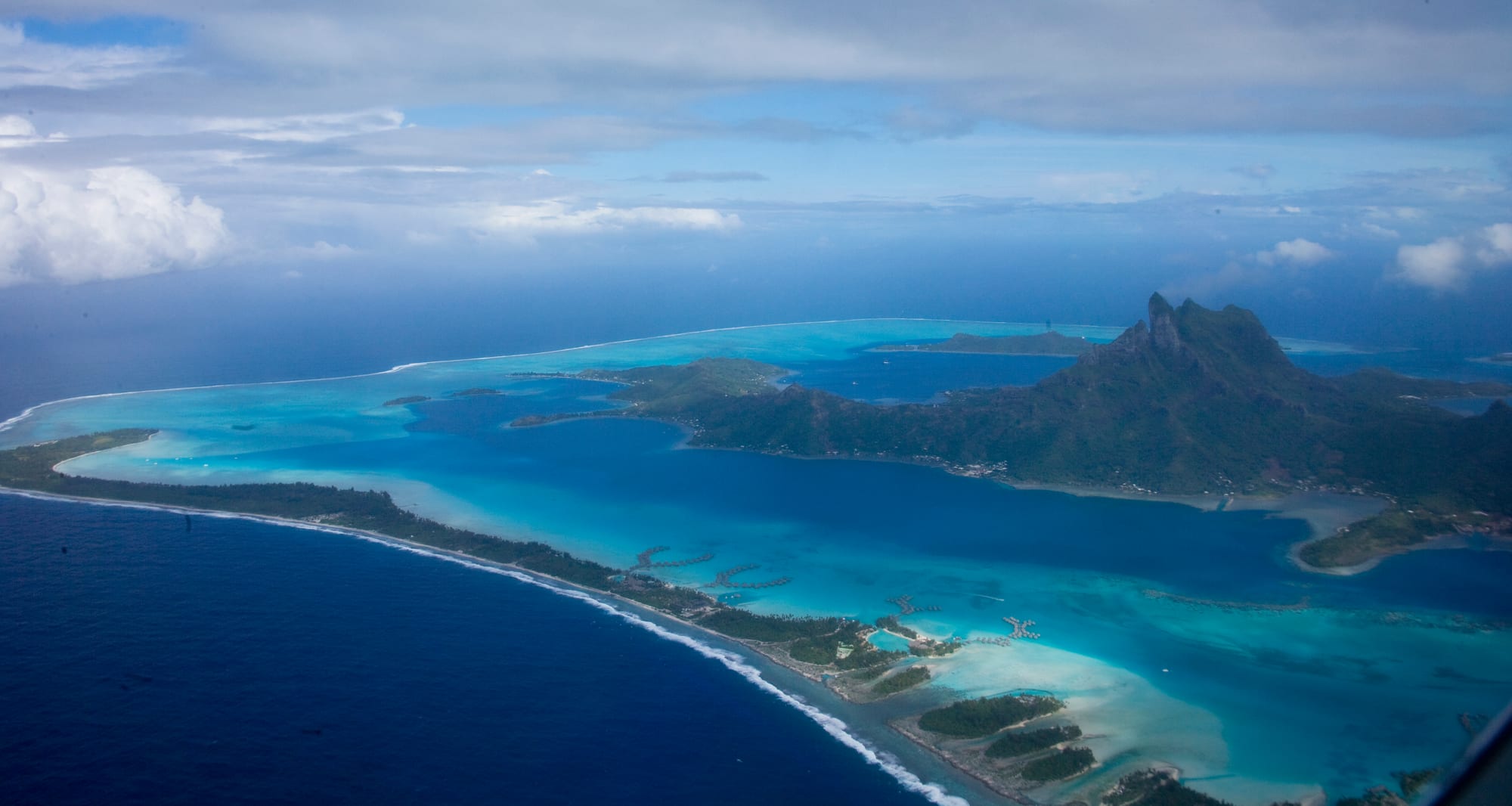
A turquoise and deep-blue lagoon ringed by a reef, with a green island and a single dark peak rising at its centre

French Polynesia

The lagoon of Bora Bora in the Society Islands, enclosing the volcanic peaks of Mount Otemanu and Mount Pahia. (The TerraMar Project / Wikimedia Commons · CC BY 2.0)

An overseas collectivity of France spread across five archipelagos in the South Pacific — 118 islands over an ocean area the size of Europe — the home of Tahiti and Bora Bora, and of a Polynesian culture reshaped by missionaries, French rule, and three decades of nuclear testing.

Explore French Polynesia

History

Polynesian voyagers settled these islands between roughly 1000 and 1300 AD, navigating by stars, swell, and birds. The Society and Marquesas groups were launch points for the wider settlement of the Pacific, including Hawaii, New Zealand, and Rapa Nui. European ships arrived in the eighteenth century — Wallis, Bougainville, and Cook — and with them disease that cut the population sharply.

In the early nineteenth century the Pōmare family, backed by London Missionary Society preachers, unified Tahiti as a Christian kingdom. France imposed a protectorate in 1842, annexed the kingdom in 1880, and had taken the other island groups by 1901. During the Second World War the United States built a base on Bora Bora. The territory gained French citizenship in 1946 and the name French Polynesia in 1957.

From 1966 to 1996 France carried out 193 nuclear tests, atmospheric and then underground, at Moruroa and Fangataufa atolls in the Tuamotus, with lasting health and environmental consequences and a long campaign for recognition and compensation. A series of statutes has widened self-government since the 1980s, and politics is split between autonomist parties and a pro-independence movement led for decades by Oscar Temaru; the United Nations put the territory back on its decolonisation list in 2013, over French objections, and a pro-independence government took office in 2023.

  • French Polynesia: The Scattered Islands 118 islands across an ocean the size of Europe — a heartland of Polynesian voyaging, the Pōmare kingdom, a French protectorate turned colony, and thirty years of nuclear testing

Culture & Customs

Mā'ohi (Polynesian) culture is strong and, since the 1980s, resurgent. Tahitian and the other island languages are widely spoken; tattooing — the English word comes from the Tahitian tatau — has been revived as an art and an identity; and 'ori tahiti dance, himene choral singing, and outrigger-canoe (va'a) racing, the national sport, draw huge participation. The Heiva festival each July is the showcase.

Church life, Protestant and Catholic, is central and layered over older belief and the idea of fenua, the land as homeland and identity. Marquesan carving and the tiki have been revived there. French language, administration, food, and holidays run through everything, and the pace is unhurried — the local word fiu, roughly "fed up" or "over it", is used affectionately for the island tempo.

Daily Life

About 280,000 people live in French Polynesia, roughly three-quarters of them on Tahiti, where Papeete is the only city. The outer islands steadily lose young people to Tahiti and to metropolitan France. The economy rests on high-end tourism, black-pearl farming in the Tuamotus, subsidised copra, and large transfers from the French state, which also funds health care and social benefits.

The cost of living is very high because nearly everything is shipped in. Land is often held undivided by extended families, which complicates development, and the western islands live with a cyclone risk. Daily life mixes French structures — schools, the mairie, the supermarket — with fishing, gardening, church, and the lagoon.

Food

Poisson cru (ia ota) — raw tuna marinated in lime and bathed in coconut milk with cucumber and tomato — is the national dish, eaten everywhere. The ahima'a earth oven produces feast food: suckling pig, breadfruit ('uru), taro, and fāfā (chicken with taro leaves). Grilled and raw reef fish and tuna are everyday fare, and firi firi, figure-of-eight coconut doughnuts, are the breakfast treat.

French bread, subsidised and delivered daily even to small islands, and French patisserie are staples, and the roulottes — food trucks that gather on the Papeete waterfront each evening — serve steak-frites, chow mein, grilled fish, and crêpes. Tahitian vanilla, grown mainly on Taha'a, is world-renowned, and Hinano is the local beer.

Attractions & Natural Wonders

Bora Bora is the emblem: a jewel-coloured lagoon around the peaks of Otemanu and Pahia, ringed by motu with overwater resorts, and snorkelling and diving with rays and reef sharks. Neighbouring Mo'orea, a short ferry from Tahiti, has the deep bays of Cook and 'Ōpūnohu, the Belvédère lookout, pineapple fields, and winter whale-watching.

Tahiti itself offers the Papeete market, the Museum of Tahiti and Her Islands, waterfalls in the Fautaua and Papenoo valleys, black-sand beaches, and the legendary reef-break of Teahupo'o, which hosted the surfing at the 2024 Olympics. The Tuamotu atolls of Rangiroa and Fakarava are among the world's great dives, drifting the passes with sharks in their hundreds.

Raiatea holds Taputapuātea, a UNESCO-listed marae complex that was the religious and political heart of eastern Polynesia; Huahine is quiet and lush; and Taha'a is scented with vanilla. Far to the northeast, the Marquesas rise sheer from the ocean with no protecting lagoon — dramatic, thinly peopled islands of giant tiki, the last home of the painter Gauguin and the singer Jacques Brel, reached by the Aranui voyage.

Planning basics

Budget

French Polynesia is one of the most expensive destinations anywhere. Overwater bungalow resorts run from several hundred to a couple of thousand US dollars a night, and almost everything is imported. Independent travel is possible through pensions de famille (family guesthouses), self-catering, and the inter-island ferry, but is still costly.

Daily Budget Midrange
USD 350–750 (mid-range hotel or upper pension, restaurants, some domestic flights and tours)
Daily Budget Shoestring
USD 130–220 (pension or guesthouse, self-catering and roulottes, ferry and shared transport)

Stay in pensions on Mo'orea, Huahine, and the Tuamotus rather than the Bora Bora resorts, eat at the roulotte food trucks, and use the Aremiti ferry to Mo'orea.

Visa Requirements

French Polynesia is French and part of the EU's overseas association, but it is outside the Schengen Area. EU citizens have free entry. Citizens of the UK, US, Canada, Australia, New Zealand, and many others enter visa-free for up to 90 days. Those who do need a visa require a specific French overseas visa, not a Schengen one.

Typical Stay
Up to 90 days visa-free for most Western passports

A Schengen visa is not valid here; check the French overseas-territory rules for your nationality.

Safety

Generally very safe, with low violent crime, though theft from cars, beaches, and pensions occurs. The main hazards are in the water — strong currents through the reef passes, sharp coral, and, rarely, sharks — along with the tropical sun and, in the wet season, cyclones. Ciguatera poisoning is a risk from certain large reef fish.

Health
Tap water is safe on Tahiti and Bora Bora but not everywhere — ask locally; dengue and other mosquito-borne illnesses occur; medical care is good on Tahiti, limited on outer islands

Heed local advice on passes and currents, use reef-safe sun protection, ask before eating large reef fish, and check cyclone forecasts from December to March.

Climate

Tropical, with two seasons. The wet season (November–April) is hotter and more humid, with heavy showers and a cyclone risk that mainly affects the western archipelagos. The dry season (May–October) is a little cooler and less humid, with steadier trade winds — the main travel season.

Dry Season
May–October, drier, breezier
Wet Season
November–April, hot and humid, cyclone risk in the west

Transportation

Fa'a'ā International Airport on Tahiti is the hub, with flights from Los Angeles, Paris (via the US), Auckland, Tokyo, and elsewhere. Air Tahiti flies a domestic network to about 45 islands; frequent ferries link Tahiti and Mo'orea; and the Aranui 5 cargo-passenger ship serves the Marquesas. Hire a car or scooter on the larger islands and a bicycle on the atolls.

Book Air Tahiti inter-island flights well ahead and consider its multi-island air pass; the Tahiti–Mo'orea ferry needs no booking.

Best Time to Visit

May to October for the driest, most settled weather, best diving visibility, and the humpback whales (roughly July to November). The Heiva i Tahiti cultural festival fills July. Avoid the wettest, most cyclone-prone months from January to March.

Events
Heiva i Tahiti dance and sport festival (July); the Hawaiki Nui Va'a canoe race between the Leeward Islands (late October/November); the Billabong Pro surf at Teahupo'o (varies)

Currency

The currency is the CFP franc, pegged to the euro at a fixed rate of about 119.33 to €1. Cards are accepted on the main islands and in resorts; carry cash for pensions, roulottes, and the remote atolls.

Symbol
Currency Code
XPF — CFP franc

Language

French is the official language, used in government and schools. Tahitian (reo Mā'ohi) is widely spoken and has a semi-official cultural status, along with Marquesan, Paumotu, and the Austral and Mangarevan languages in their own island groups. English is understood at hotels and dive centres but not widely otherwise.

Also Spoken
Tahitian and other Polynesian languages
Official Language
French