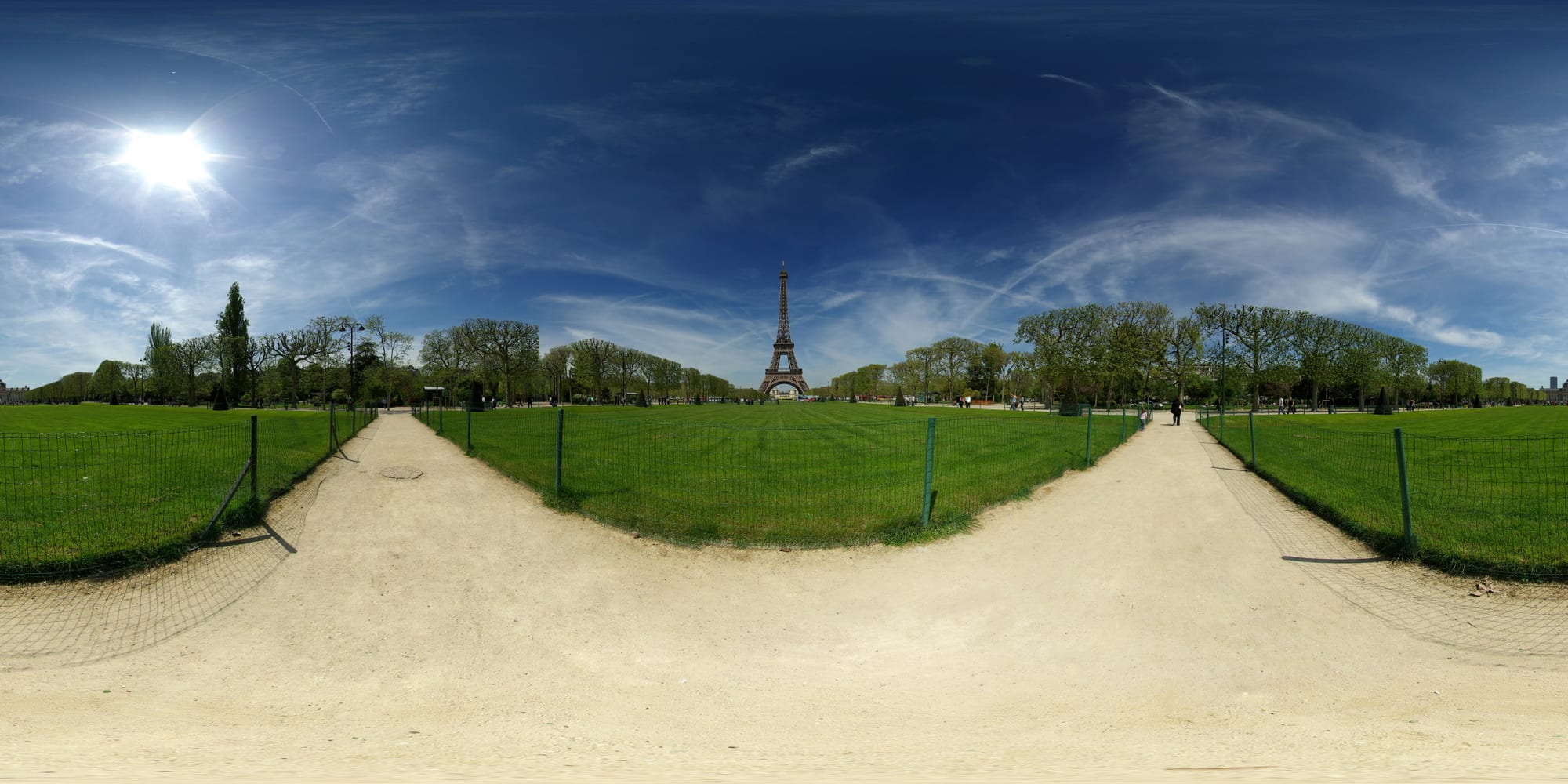
The Eiffel Tower rising above the long green rectangle of the Champ-de-Mars, Paris spreading out beyond

France

The Eiffel Tower over the Champ-de-Mars in Paris, built for the 1889 World's Fair and now the symbol of France. (Alexandre Duret-Lutz / Wikimedia Commons · CC BY-SA 2.0)

The most visited country in the world — a European heavyweight of Atlantic and Mediterranean coasts, alpine and volcanic mountains, wine regions, and a capital that has shaped Western art, food, and politics for centuries.

Explore France

History

France emerged from the western part of Charlemagne's empire, and its kings spent the Middle Ages consolidating a patchwork of duchies and counties into a centralised kingdom, a process pushed further by the Hundred Years' War with England and by absolutist monarchs such as Louis XIV, who built Versailles and made France the dominant power in Europe.

The Revolution of 1789 overthrew the monarchy, proclaimed the Rights of Man, executed the king, and passed through terror into the empire of Napoleon, whose conquests and legal code reshaped the continent before his defeat in 1815. The nineteenth century swung between monarchy, republic, and a second empire, while France built a colonial empire across Africa, Indochina, and the Pacific.

The First World War was fought largely on French soil at enormous cost; in the Second, France was defeated and occupied in 1940, with the collaborationist Vichy regime and the Resistance dividing the nation's memory. Post-war France rebuilt, lost its empire — bloodily in Algeria — and, under Charles de Gaulle, founded the Fifth Republic in 1958. It has been a driving force of European integration ever since, alongside recurring debates over secularism, immigration, and its social model.

  • France: From Gaul to the Fifth Republic Roman Gaul, the Franks, a thousand years of monarchy, the Revolution that redefined politics for the world, Napoleon, two devastating wars on home soil, and the republic that followed

Culture & Customs

France takes its culture seriously as a matter of state and identity: the language, the arts, cuisine, and laïcité (a strict separation of religion and public life) are defended in law and argued about constantly. The café, the long meal, the Sunday market, the summer exodus, and a strong tradition of protest and strike are all part of the national fabric.

Intellectual and artistic life has an outsized global footprint — the Enlightenment philosophers, Impressionism and modern art, the nouvelle vague in cinema, haute couture, and a literary culture where writers are public figures. Regional pride is strong: a Breton, an Alsatian, a Corsican, and a Provençal will each tell you their food, wine, and character are distinct.

Etiquette matters more than in some cultures — greeting shopkeepers on entering, using "bonjour" and "madame/monsieur," and not rushing a meal. Football and rugby are the mass sports, and the Tour de France is a national event.

Daily Life

Around a fifth of France's 68 million people live in the Paris region; Lyon, Marseille, Toulouse, Bordeaux, Lille, and Nice anchor the other metropolitan areas, and much of the country is small towns and productive farmland — France is the EU's largest agricultural producer. High-speed rail has pulled the regions closer to the capital.

The economy is large and diverse: aerospace, luxury goods, nuclear-heavy electricity, agriculture and food, tourism, and a big public sector. The 35-hour working week, five weeks of paid holiday, a generous but costly welfare and pension system, and periodic reform battles over them are defining features.

Daily life is structured around meals taken at set times, shops that still close for lunch in smaller towns, a strong weekend rhythm, and — in August — a country that noticeably slows down as families head to the coast or the countryside.

Food

French cuisine is a national institution and a UNESCO-listed "gastronomic meal," and it is intensely regional. The north and Paris give classic bistro cooking — steak-frites, confit de canard, blanquette de veau, soupe à l'oignon. Normandy and Brittany bring butter, cream, cider, oysters, and buckwheat galettes; Alsace, choucroute and flammekueche; Lyon, its rich bouchon food; the southwest, foie gras, cassoulet, and Armagnac; and Provence, olive oil, garlic, ratatouille, and bouillabaisse.

Bread and cheese are everyday essentials — the baguette is protected by law, and there are hundreds of named cheeses — and the pâtisserie (croissant, éclair, tarte, macaron) is a craft in itself. A meal is a sequence: apéritif, starter, main, cheese, dessert, coffee.

Wine is inseparable from the food and the map — Bordeaux, Burgundy, the Rhône, the Loire, Alsace, and Champagne each with strict appellations — and every region also has its beer, cider, or spirit.

  • France: Food and the National Dish A humble beef-and-vegetable stew at the heart of one of the world's most codified food cultures, built on regional terroir, bread, cheese and wine

Attractions & Natural Wonders

Paris is the obvious centre: the Eiffel Tower, the Louvre and Musée d'Orsay, Notre-Dame and the Île de la Cité, Montmartre and the Sacré-Cœur, the Champs-Élysées and Arc de Triomphe, and Versailles just outside. Its cafés, parks, and river walks are as much the point as the monuments.

Beyond the capital, the Loire Valley strings Renaissance châteaux — Chambord, Chenonceau, Amboise — along the river; Normandy has Mont-Saint-Michel, the Bayeux Tapestry, and the D-Day beaches; and Brittany has a rugged coast, megaliths at Carnac, and walled Saint-Malo. Alsace offers half-timbered towns and the wine road around Colmar.

The south draws the biggest summer crowds: Provence's lavender, Roman remains, and hill villages; the Côte d'Azur from Nice to Cannes; and the Camargue's flamingos. The mountains provide the Alps around Chamonix and Mont Blanc for hiking and skiing, the volcanic Auvergne, and the Pyrenees, while the Dordogne's prehistoric cave art at Lascaux and the wine country around Bordeaux round out a very long list.

Planning basics

Budget

France covers a wide range. Paris, the Côte d'Azur, and the alpine ski resorts are expensive; much of rural France, and the excellent "menu du jour" lunch, remain good value. Card and contactless payment is near-universal.

Daily Budget Midrange
EUR 140–280 (mid-range hotel, restaurant meals, museums, some TGV travel)
Daily Budget Shoestring
EUR 65–110 (hostel or budget hotel, bakery and market food, trains and metro)

A fixed-price lunch menu is often half the cost of the same food in the evening.

Visa Requirements

France is in the EU and the Schengen Area. Citizens of the EU, the UK, the US, Canada, Australia, and many other countries need no visa for stays of up to 90 days in any 180-day period. The EU's ETIAS pre-travel authorisation for visa-exempt visitors is being introduced.

Typical Stay
90 days in any 180-day period, visa-free, for most Western passports

Safety

France is a safe country overall, with violent crime against visitors uncommon. The persistent issue is pickpocketing and bag-snatching, heavily concentrated around Paris tourist sites and transport — the Eiffel Tower, Montmartre, the Louvre area, the RER B from the airport, and the metro — and organised distraction scams. Strikes and demonstrations are frequent and can disrupt transport.

Keep bags zipped and in front of you on the metro and at attractions, ignore petition and "gold ring" scammers, and check for strike action before travel days.

Climate

Four broad zones: oceanic in the west and north (mild, damp, changeable); continental in the east and centre (colder winters, warmer summers); Mediterranean in the south (hot, dry summers, mild winters, the gusty mistral wind); and alpine in the mountains, with a long winter snow season.

Alps
heavy winter snow; ski season roughly December–April
Paris
mild wet winters, warm summers with occasional heat waves
Mediterranean South
hot dry summers 28–35°C, mild winters

Transportation

France has a superb high-speed rail network (TGV) radiating from Paris, linking most large cities in a few hours and connecting to London, Brussels, and beyond. Cities have metros, trams, and buses; a rental car suits the countryside, wine regions, and the Alps. Paris has six main stations, each serving different regions.

Book TGV tickets weeks ahead for the best fares; regional TER trains are cheaper and don't require reservation.

Best Time to Visit

May, June, and September for warm weather, long days, and lighter crowds than midsummer. July and August are peak, hot in the south, and the time much of France itself goes on holiday. December to March is the alpine ski season; spring and autumn suit Paris, the Loire, and the wine harvest.

Currency

France uses the euro, adopted in 1999 as a founding member. Cards work everywhere; carry a little cash for markets, small bakeries, and rural tabacs. Tipping is modest as service is included.

Symbol
Currency Code
EUR — euro

Language

French is the official language, and the state actively protects it. English is widely spoken in Paris, tourist areas, and among younger people, less so in rural areas, and an attempt at a French greeting is appreciated. Regional languages — Breton, Alsatian, Corsican, Basque, Occitan — survive to varying degrees.

English
Common in Paris and tourist areas; patchier in the countryside
Official Language
French