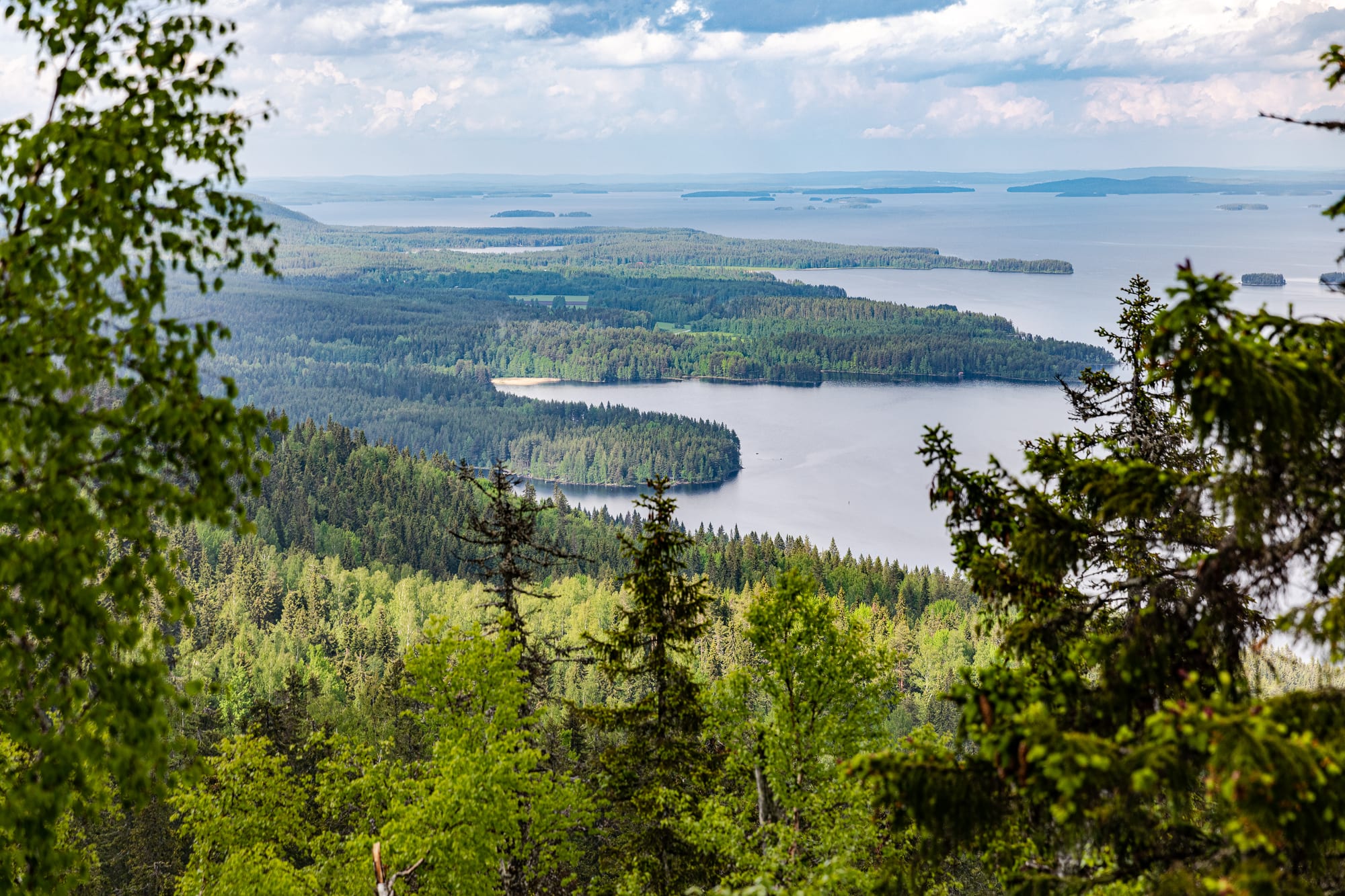
A wide summer view from a forested hilltop over a large lake dotted with islands, framed by spruce trees on rocky outcrops

Finland

The view over Lake Pielinen from the hills of Koli National Park — a landscape long celebrated in Finnish painting and music. (Ninara / Wikimedia Commons · CC BY 2.0)

A sparsely populated Nordic country of forest, tens of thousands of lakes, and a long Arctic north — with a hard-won independence, a distinctive Finno-Ugric language, sauna culture, and a reputation for stability and quiet.

Explore Finland

History

Finnic peoples settled the region over millennia, with the Sámi in the north. From the twelfth century Sweden gradually incorporated Finland, and for some 600 years it was the eastern part of the Swedish realm, its coast Swedish-speaking and its administration and church run from Stockholm. In 1809 Russia took Finland and made it an autonomous Grand Duchy, which allowed a Finnish national movement — a flag, a literature, the epic Kalevala, and the music of Sibelius — to grow.

Finland declared independence in December 1917, in the chaos of the Russian Revolution, and immediately fought a short, bitter civil war between "Reds" and "Whites." In the Second World War it fought the Soviet Union twice — the Winter War of 1939–40 and the Continuation War of 1941–44 — losing territory in Karelia but keeping its independence, unlike the other borderlands of the USSR.

The Cold War decades required a careful neutrality toward Moscow while Finland built a Nordic-style welfare state and, from the 1990s, a high-tech economy (Nokia). It joined the EU in 1995 and the euro at the start. Russia's 2022 invasion of Ukraine ended Finnish non-alignment: the country applied for NATO membership and joined in 2023.

  • Finland: Between Sweden and Russia Six centuries as the eastern half of Sweden, a hundred years as a Russian grand duchy, a bitter birth in 1917–18, two wars against the Soviet Union — and a small democracy that kept its independence through all of it

Culture & Customs

Finns are known, and know themselves to be known, for reserve, directness, and ease with silence — small talk is not a national skill, and a quiet person is not assumed to be unhappy. Trust in institutions and each other is very high, punctuality matters, and there is a strong ethic of sisu, a stubborn, understated perseverance.

Sauna is not a luxury but a normal part of life — there are more saunas than cars — and a place for family, business, and honest talk, traditionally taken naked and followed by a plunge into a lake or the snow. Nature access is a legal right (jokamiehenoikeus): anyone may walk, camp, and pick berries and mushrooms on most land.

Finnish design — Alvar Aalto, Marimekko, Iittala — and a strong music scene from classical to metal are sources of pride, along with a self-deprecating humour and a fondness for the outdoors in every season, including the cottage (mökki) by a lake in summer.

Daily Life

More than a million people live in the Helsinki region on the south coast; Tampere, Turku, and Oulu are the other main cities. The population thins rapidly to the north and east, and much of Finland is forest, lake, and bog with scattered towns. Around 10 percent of the country's surface is fresh water.

The economy is high-income and export-oriented — forestry and paper, machinery, electronics, shipbuilding, and games (Rovio, Supercell) — with a comprehensive welfare state funded by high taxes: free education through university, universal healthcare, and long parental leave. Finland regularly tops international rankings for schooling and reported happiness.

Daily life is orderly and outdoors-friendly: the cycle or tram to work, a hot lunch, an early finish, and evenings and weekends at the sauna, the sports hall, or the summer cottage.

Food

Finnish cooking is northern and seasonal: rye bread at every meal, potatoes, dairy, fish, pork, and forest foods. Ruisleipä (dense sour rye), Karelian pies (rye crust with a rice filling, topped with egg butter), and kalakukko (fish and pork baked in a rye loaf) are the traditional staples.

Salmon appears grilled, in the creamy soup lohikeitto, and cold-smoked; Baltic herring, whitefish, and, in autumn, crayfish are seasonal treats, along with elk and reindeer — sautéed reindeer with mashed potato and lingonberry is a Lapland classic. Berries (bilberry, lingonberry, and the prized cloudberry) and wild mushrooms are gathered and preserved everywhere.

Korvapuusti cinnamon buns, pulla sweet bread, salty liquorice (salmiakki), and Finland's very high coffee consumption round out the picture. Lonkero (a gin long drink), Koskenkorva vodka, and craft beer are the drinks.

  • Finland: Food and the National Dish A rye-crusted pastry from the eastern region of Karelia, sautéed reindeer from the far north, and a food culture shaped by short summers and long, dark winters

Attractions & Natural Wonders

Helsinki has a compact, walkable centre of neoclassical and Art Nouveau architecture around Senate Square and the market harbour, the sea-fortress island of Suomenlinna (a UNESCO site), design and sauna culture, and the rock-hewn Temppeliaukio church. Day trips reach Porvoo's wooden old town and, by fast ferry, Tallinn.

The Lakeland, filling the country's centre and east, is the classic summer Finland: thousands of islands and inlets around Saimaa, best seen from a boat, canoe, or lakeside cottage, with the medieval Olavinlinna castle at Savonlinna hosting a summer opera festival. Turku, the former capital, has a castle and cathedral and the Åland Islands offshore.

Lapland is the winter draw: Rovaniemi (the "official" home of Santa Claus) on the Arctic Circle, husky and reindeer safaris, glass igloos, cross-country and downhill skiing, and — on clear, dark nights from autumn to spring — the northern lights. Its national parks, such as Pallas-Yllästunturi and Urho Kekkonen, offer hiking through open fell country, spectacular in the September "ruska."

Planning basics

Budget

Finland is expensive, on a par with the other Nordic countries. Restaurants, alcohol, and Lapland activities are the big costs; supermarkets, the free "everyman's right" access to nature, and the efficient trains soften it. Card and phone payment is universal; cash is barely used.

Lapland Premium
Winter activities (husky and reindeer safaris, aurora tours) add substantially in the north
Daily Budget Midrange
EUR 150–280 (mid-range hotel, restaurants, museums, some intercity travel)
Daily Budget Shoestring
EUR 70–110 (hostel, self-catering, trains and buses)

Visa Requirements

Finland is in the EU and the Schengen Area. Citizens of the EU, the UK, the US, Canada, Australia, and many other countries need no visa for stays of up to 90 days in any 180-day period.

Typical Stay
90 days in any 180-day period, visa-free, for most Western passports

Safety

Finland is consistently rated one of the safest countries in the world, with very low crime. The genuine hazards are environmental: extreme winter cold, thin lake and sea ice, and getting lost or caught out by weather in the vast, lightly populated wilderness.

Dress properly for the cold, check ice conditions before venturing onto frozen water, and tell someone your route on backcountry hikes.

Climate

Cold temperate in the south, subarctic in the north. Summers are short, cool to mild, and very light, with the midnight sun above the Arctic Circle; winters are long, dark, and snowy, with the polar night (kaamos) in the far north. Snow cover lasts several months across most of the country.

Summer
June–August, 15–25°C in the south, endless daylight in June
Winter
December–March, -5 to -20°C or colder, snow, very short days

Transportation

Helsinki Airport is a major hub for flights to Asia. Trains (VR) are fast, comfortable, and reach the main cities and Lapland; long-distance buses fill the gaps. Ferries link Helsinki with Tallinn and Stockholm. A rental car suits the Lakeland and rural areas; winter driving needs studded tyres.

The overnight train to Rovaniemi or beyond is a comfortable way to reach Lapland.

Best Time to Visit

June to August for the long days, lakes, and hiking; the light nights around midsummer are a highlight. December to March for a proper snowy winter, skiing, and the best odds of the aurora in Lapland. September brings "ruska," the autumn colour, especially in the north.

Currency

Finland uses the euro, adopted in 1999 as a founding member. It is close to cashless; cards and mobile payment work everywhere and many places no longer accept cash.

Symbol
Currency Code
EUR — euro

Language

Finnish and Swedish are both official. Finnish, a Finno-Ugric language unrelated to the Scandinavian languages, is the first language of most people; Swedish is spoken by about 5 percent, mainly on the west and south coasts and in the Åland Islands. Sámi languages are spoken in the far north. English is spoken fluently by most Finns.

English
Near-universal and fluent
Official Languages
Finnish, Swedish