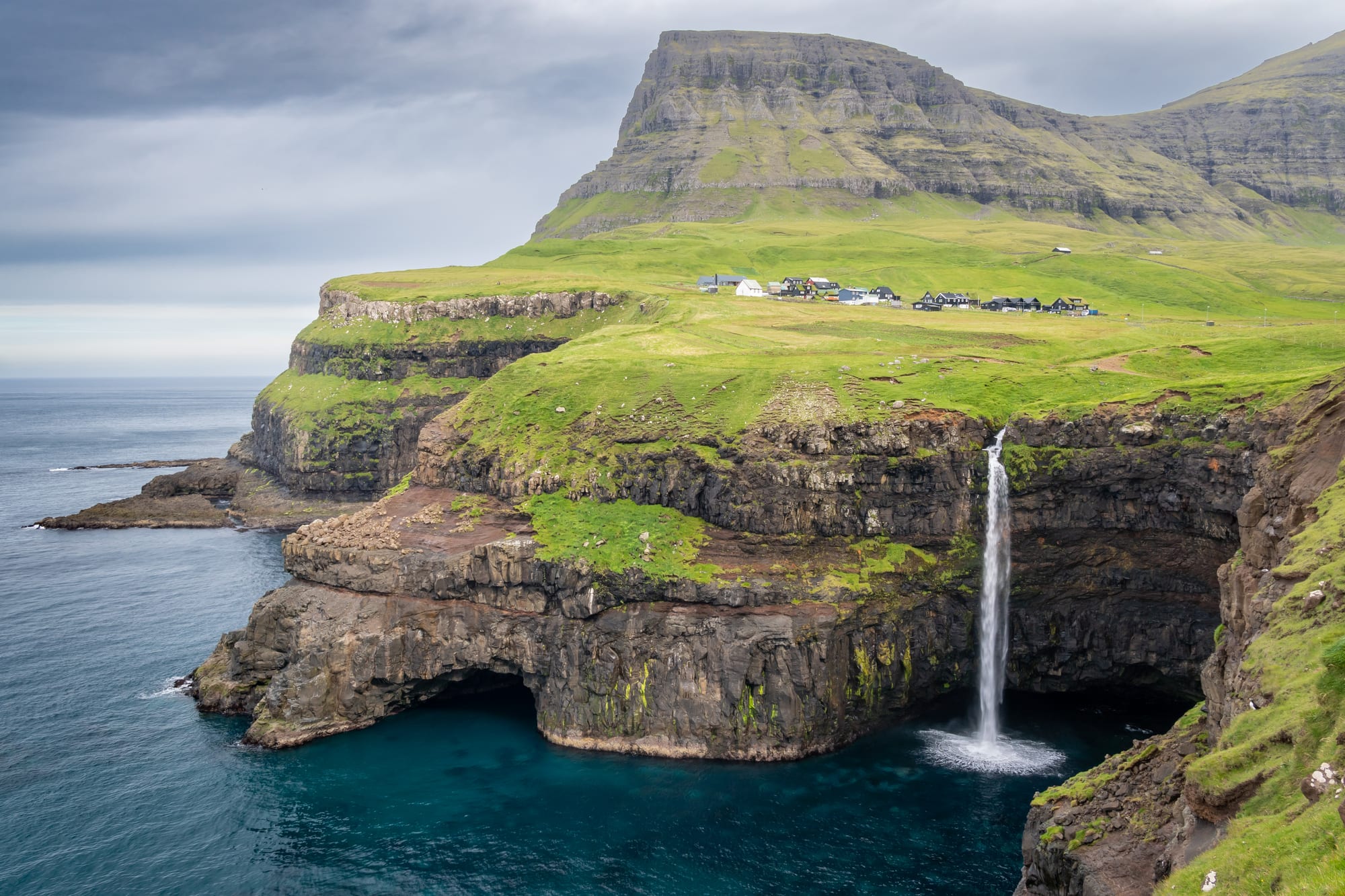
A slender waterfall dropping straight off a green sea-cliff into the ocean, a small village and jagged peaks behind

Faroe Islands

The Múlafossur waterfall beside the village of Gásadalur on the island of Vágar, spilling directly into the Atlantic. (Ekrem Canli / Wikimedia Commons · CC BY-SA 4.0)

A cluster of 18 steep, grass-covered islands in the North Atlantic between Scotland, Iceland, and Norway — a self-governing part of the Kingdom of Denmark, outside the EU, with about 54,000 people, its own Norse-descended language, and famously changeable weather.

Explore Faroe Islands

History

Irish monks may have reached the islands first, but permanent settlement came with Norse farmers in the ninth century. The Faroese trace their parliament, the Løgting, to a Viking-age assembly at Tinganes in Tórshavn, making it one of the oldest in the world. The islands came under the Norwegian crown, and passed with Norway to Denmark in 1380; a royal trade monopoly kept them poor and isolated for centuries.

A national awakening in the nineteenth century revived the Faroese language, which had survived only in speech and ballad, and built a written literature and a movement for self-rule. During the Second World War, Britain occupied the Faroes while Germany held Denmark, and the islands governed themselves and flew their own flag — an experience that fed the push for autonomy.

In 1948 the Home Rule Act made the Faroe Islands a self-governing community within the Kingdom of Denmark, with their own parliament, government, flag, and control over most domestic matters; Denmark handles defence and, formally, foreign affairs, though the Faroes negotiate their own fisheries and trade deals and chose to stay out of the EU when Denmark joined. A modern fishing and salmon-farming economy, a tunnel-building programme that has knitted the islands together, and a fast-growing tourism sector have transformed life since.

Culture & Customs

Faroese culture is rooted in the Norse past and the sea. The chain dance (føroyskur dansur), performed to sung medieval ballads with no instruments, is a living tradition, danced at festivals and celebrations. Knitwear, turf-roofed houses, wooden churches, and the black-tarred boat sheds are part of the visual identity, and the national dress is still worn on formal occasions.

The islands are strongly Lutheran, with a significant Plymouth Brethren community, and Sunday is quiet. Society is small, tight-knit, and law-abiding, with a strong sense of community obligation and a dry humour about the weather.

The grindadráp, the communal drive hunt of long-finned pilot whales and dolphins that are then shared out among households, is a centuries-old practice that Faroese defend as sustainable and traditional and that draws sustained international criticism; visitors will see reference to it and may, by chance, encounter one.

Daily Life

About 54,000 people live in the Faroes, roughly 40 per cent of them in the Tórshavn area on Streymoy; the rest are spread through villages, many now within easy tunnel-commute of the capital. The population has grown in recent years, reversing long-standing emigration, helped by the strong economy.

That economy rests overwhelmingly on fish: wild-caught cod, haddock, mackerel, and herring, and farmed Atlantic salmon, which together make up the great majority of exports. Tourism, shipping, and public services fill out the picture. Incomes are high, unemployment is very low, and infrastructure — tunnels, broadband, a new hospital — is modern.

Daily life is shaped by the weather, the ferry and tunnel timetables, football (the national team has produced famous upsets), outdoor work and recreation, and close family and village ties.

Food

Traditional Faroese food is preserved food, born of a place with little farmland and long winters: skerpikjøt, wind-dried mutton hung for months in slatted sheds and eaten raw in thin slices; ræst kjøt and ræstur fiskur, mutton and fish fermented to a strong flavour; and tvøst og spik, pilot-whale meat and blubber. Salted and dried cod and lamb, and garnatálg (a suet-and-innards pudding), complete the old repertoire.

Everyday cooking now leans on lamb, potatoes, fish, and imported staples, with rhubarb and a few hardy vegetables from the garden. Tórshavn has a serious restaurant scene, including the acclaimed KOKS, which has built a New Nordic cuisine from the islands' own ingredients — seabird, seaweed, fermented lamb, langoustine.

The Faroese brewery Föroya Bjór makes the local beers, and a home-distilled spirit and imported akvavit accompany festive meals.

Attractions & Natural Wonders

The island of Vágar holds the most photographed sights: the Múlafossur waterfall tumbling off the cliff by Gásadalur, and Sørvágsvatn (Leitisvatn), the lake that appears to hover far above the ocean when seen from the right angle. Streymoy has the capital, Tórshavn, with the turf-roofed government buildings on the Tinganes peninsula and the old town of Reyn, plus the classic villages of Saksun, set in a tidal lagoon, and Tjørnuvík, looking out to the Risin og Kellingin sea stacks.

Eysturoy has Slættaratindur, the highest peak at 880 metres, the Gjógv sea gorge, and the "lake in the sea" village of Elduvík. Kalsoy, reached by ferry, is a long thin island whose Kallur lighthouse — perched on a spine of cliff — featured in a recent James Bond film.

Mykines, the westernmost island, is a summer seabird spectacle of puffins and gannets, reached by a weather-dependent ferry or helicopter. Boat trips run to the towering Vestmanna bird cliffs and to Drangarnir, a sea stack with a natural arch, and hikers cross the moors between villages on old postal paths.

Planning basics

Budget

The Faroes are expensive, on a par with Norway and Iceland. Accommodation is limited and books out in summer; a hire car is close to essential; and restaurant meals are costly. Guesthouses, self-catering, hostels, and the supermarket chain keep a trip affordable, and much of the scenery is free to walk to (sometimes for a small landowner fee).

Daily Budget Midrange
DKK 1,700–3,200 / USD 250–460 (hotel or guesthouse, restaurant meals, car hire, tunnel tolls, boat trips)
Daily Budget Shoestring
DKK 700–1,100 / USD 100–160 (hostel or guesthouse, self-catering, shared car or buses)

Book accommodation and the Vágar flight or the ferry months ahead for summer, hire a car, and self-cater from Bónus or FK supermarkets.

Visa Requirements

The Faroe Islands are part of the Kingdom of Denmark but outside the European Union and the Schengen Area. A Schengen visa is not valid here. Citizens of the EU, UK, US, Canada, Australia, and many other countries enter visa-free with a passport; those who need a visa require one issued specifically for the Faroe Islands.

Typical Stay
90 days visa-free for most Western passports; separate from Schengen

If you need a Schengen visa, note that it does not cover the Faroes — you must apply for a Faroese visa. Most visitors just need a passport; arrive via Copenhagen, Reykjavík, or seasonal flights from the UK and Nordic cities.

Safety

The Faroes are extremely safe, with negligible crime. The genuine dangers are the landscape and weather: exposed cliff-edge paths with no railings, sudden fog, strong winds that can blow car doors off and people off their feet, big Atlantic swell, and fast-changing conditions on the fells.

Health
Tap water is excellent; there is a hospital in Tórshavn; the main risks are falls, exposure, and driving in fog and high wind

Keep well back from unfenced cliff edges, check the forecast and hold car doors firmly in wind, tell someone your hiking plan, and respect signs and landowner access rules.

Climate

Cool oceanic and highly changeable — the local saying is that you can have several seasons in a day. Temperatures are mild year-round (around 3°C in winter, 12°C in summer) thanks to the Gulf Stream, but wind, rain, and fog are frequent in every season, and clear days are prized.

Summer
Long daylight, near-midnight-sun in June
All Year
Mild, windy, wet; sudden fog and rain common

Transportation

Vágar Airport has flights from Copenhagen, Reykjavík, and, seasonally, Edinburgh, Oslo, and elsewhere; the Smyril Line car ferry runs from Hirtshals in Denmark via Iceland. Within the islands, a network of road, undersea, and mountain tunnels (some tolled), bridges, ferries, and even helicopters connects almost every settlement; a hire car is by far the easiest way to explore.

Hire a car at the airport; check ferry and helicopter timetables for Mykines, Kalsoy, and the smaller islands, which have limited daily services.

Best Time to Visit

May to September has the longest days, the best chance of settled spells, nesting seabirds (puffins on Mykines from roughly May to August), and open boat trips and hikes. Winter is dark and stormy but atmospheric, with a chance of the northern lights. There is no dry season — waterproofs are needed whenever you go.

Events
Ólavsøka, the national holiday and festival in Tórshavn (28–29 July), with rowing races, chain dancing, and traditional dress; the G! music festival in summer

Currency

The Faroese króna is used, issued at par with and interchangeable with the Danish krone, which also circulates. Cards, including contactless, are accepted almost everywhere; cash is rarely needed.

Symbol
kr
Currency Code
DKK / FOK — Danish and Faroese krone (1:1)

Language

Faroese, a North Germanic language descended from Old Norse and close to Icelandic, is the national language. Danish is taught from an early age and widely understood, and English is spoken fluently by most Faroese, especially younger people.

Also Spoken
Danish; English very widely spoken
National Language
Faroese