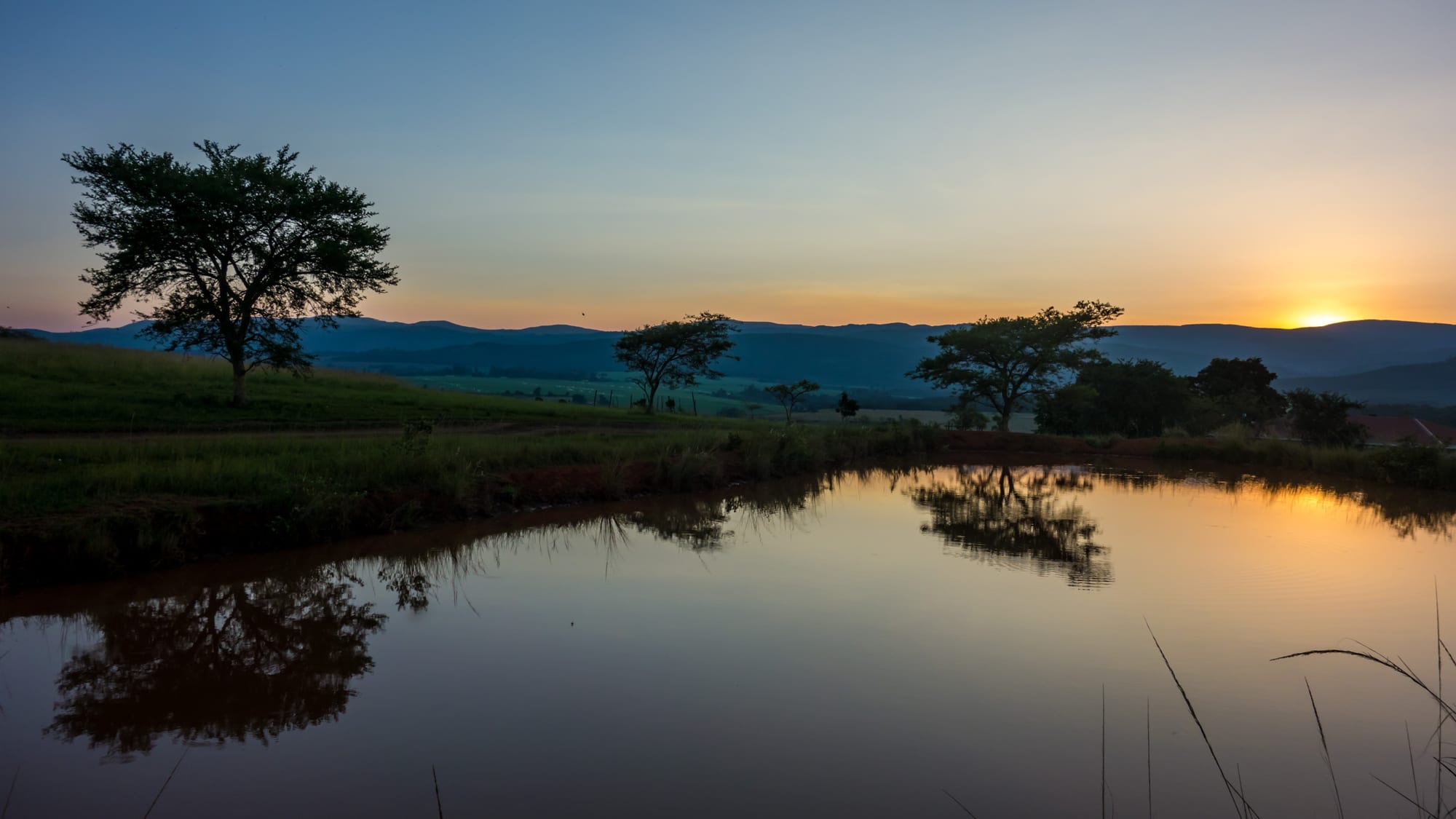
The sun setting behind a line of blue hills, with flat-topped trees silhouetted against an orange and teal sky and mirrored in a still pond

Eswatini

Sunset over a still pond, scattered trees and rolling hills in Eswatini. (Visions of Domino / Wikimedia Commons · CC BY 2.0)

A small landlocked kingdom between South Africa and Mozambique — one of the world's last absolute monarchies — with a compact range of scenery, wildlife reserves, and strong living traditions.

Explore Eswatini

History

The Swazi nation formed in the eighteenth and nineteenth centuries as the Dlamini royal clan, moving south and then north again under pressure from the expanding Zulu kingdom, absorbed Nguni and Sotho groups into a centralised state under a dual monarchy of a king (the Ngwenyama, "Lion") and a queen mother (the Ndlovukati, "She-Elephant").

In the late nineteenth century Swazi kings granted sweeping land and mineral concessions to Boer and British adventurers. The territory came under South African Republic and then, after the Boer War, British administration, becoming one of the "High Commission Territories." Unusually, the monarchy survived the colonial period with much of its authority and land base intact.

Swaziland became independent in 1968 under King Sobhuza II, who in 1973 repealed the constitution, banned political parties, and ruled by decree — a system his son Mswati III, on the throne since 1986, has largely maintained. In 2018 the king renamed the country Eswatini. Pro-democracy protests in 2021 were the most serious in decades and were met with force; calls for political reform continue.

  • Eswatini: Africa's Last Absolute Monarchy A small Nguni kingdom that survived the Zulu wars and the scramble for concessions, kept its throne through British rule, and threw out its own constitution after independence

Culture & Customs

Eswatini has one of the most intact traditional monarchies in Africa, and kingship, clan, and ceremony are central to national life. The two great annual events are the Umhlanga, or Reed Dance, in which tens of thousands of unmarried young women cut and carry reeds to the queen mother's residence over several days of song and dance, and the Incwala, a weeks-long sacred kingship ritual around the summer solstice that renews the monarch and the nation.

Society is largely Christian, often blended with ancestral belief, and remains socially conservative. The extended homestead (umuti), respect for elders and chiefs, and communal land held in trust by the king through local chiefs shape rural life. Traditional healers (tinyanga and tangoma) are widely consulted.

Craft is a strength — Swazi candles, glass, mohair weaving, and basketry are sold across the region — and choral and gospel singing, sibhaca dance, and the colour of the ceremonies are the cultural showcases.

Daily Life

Most of Eswatini's roughly 1.2 million people live in rural homesteads on communally held "Swazi Nation Land," farming maize, keeping cattle — a store of wealth and status — and often depending on a family member's wage from town or from South Africa. Manzini is the commercial hub and Mbabane the administrative capital, both small.

The economy is closely tied to South Africa through the customs union and the currency peg, and rests on sugar (the largest export and employer), soft-drink concentrate, forestry, and textiles. Eswatini has one of the world's highest HIV prevalence rates, though large treatment programmes have brought it under much better control, and poverty and youth unemployment are high.

Daily life follows the farming and school calendar, church on Sunday, the minibus to Manzini market, and the rhythm of the royal ceremonies that punctuate the year.

Food

Swazi cooking is Southern African and maize-based. Sishwala, a stiff maize porridge, or its softer form, is the staple, eaten with a relish of beans, greens (imbhida), or stewed beef, chicken, or offal. Sitfubi (fermented maize) and emahewu, a lightly fermented maize drink, are traditional.

Beef features at ceremonies and family gatherings, often slaughtered on site; sidvudvu (pumpkin cooked with maize meal), groundnuts, sweet potato, and wild greens round out rural meals. Roadside grills serve braai meat, pap, and chakalaka relish, the shared regional fare.

Home-brewed sorghum and maize beer (umcombotsi) is drunk at gatherings and rituals; commercial lager and, from the local factory, soft drinks are widely available, along with strong sweet tea.

  • Eswatini: Food and the National Dish A stiff maize porridge and pumpkin relish shared across Southern Africa, cattle at the centre of Swazi identity, and a kitchen shaped by two great royal festivals

Attractions & Natural Wonders

Eswatini's appeal is a lot of variety in a short drive. The Ezulwini and Malkerns valleys, between Mbabane and Manzini, form the tourist heart: craft markets and workshops (Swazi Candles, Ngwenya Glass, Baobab Batik), the Mantenga cultural village and falls, the House on Fire arts venue, and the Mlilwane Wildlife Sanctuary, a gentle reserve where you can walk, cycle, and ride among zebra, antelope, warthogs, and hippos.

In the eastern lowveld, Hlane Royal National Park has the country's lions, elephants, and white rhino on open plains, and the small, private Mkhaya Game Reserve is one of the best places in the region to see black rhino on foot with a ranger. To the northwest, Malolotja Nature Reserve is highland grassland and gorges with waterfalls, rare birds, and a zip-line canopy tour, next to the ancient Ngwenya iron-ore mine.

The ceremonies themselves — the Umhlanga in late winter and, for those with the right timing and permissions, the public days of the Incwala — are the most distinctive thing a visitor can witness.

Planning basics

Budget

Eswatini is inexpensive, and prices track South Africa's since the currencies are linked. Guesthouses, backpacker lodges, and self-catering are common near the Ezulwini and Malkerns valleys; park fees and guided game drives are the main add-ons. Cards are widely accepted in the main valley; carry cash elsewhere.

Daily Budget Midrange
USD 80–160 (lodge or guesthouse, rental car, park fees, game drives)
Daily Budget Shoestring
USD 30–55 (backpacker lodge, self-catering, minibus taxis)

Visa Requirements

Citizens of the EU, the UK, the US, Canada, Australia, and most Commonwealth and Southern African countries enter visa-free for stays of up to 30 days, sometimes extendable. Most visitors arrive overland from South Africa.

Typical Stay
Up to 30 days, visa-free, for most Western passports

Border posts with South Africa keep varying hours; check closing times if driving.

Safety

Eswatini is relatively safe for visitors, with the tourist valleys quiet and welcoming, though petty theft, vehicle crime, and occasional armed robbery occur, more so around Manzini and Mbabane. Political protests since 2021 have at times turned violent and drawn a heavy security response.

Source
US Department of State and UK FCDO travel advisories — check for the latest wording.

Avoid demonstrations and any criticism of the monarchy in public, don't leave valuables in cars, and take normal urban precautions in Manzini and Mbabane after dark.

Source: US Department of State and UK FCDO travel advisories — check for the latest wording.

Climate

Subtropical, varying with altitude. The highveld in the west is cool and wetter; the lowveld in the east is hot and dry, with the game reserves. The rainy season is the warm summer (about October to March); winter (May to August) is dry, sunny, and mild by day with cold highveld nights.

Lowveld
hot; over 35°C common in summer
Highveld
cooler, misty in summer, frosty winter nights

Transportation

King Mswati III International Airport near Manzini has limited regional flights; most visitors drive in from Johannesburg (about four hours) or Kruger. There is no passenger rail. Minibus taxis cover the country cheaply but slowly; a rental car is the practical way to link the valleys and the reserves.

Driving
On the left; roads between the main centres are good, rural roads rougher; watch for livestock

Best Time to Visit

May to September (the dry winter) for the best game viewing, when animals concentrate at water and the bush thins, and for comfortable hiking on the highveld. The Umhlanga (Reed Dance) is held in late August or early September, and the Incwala kingship ceremony around December and January.

Currency

The currency is the Swazi lilangeni (SZL, plural emalangeni), pegged one-to-one to the South African rand, which also circulates freely and is accepted everywhere. Emalangeni are not usually accepted in South Africa.

Cards
Accepted in the Ezulwini Valley and Manzini; carry rand or emalangeni elsewhere
Symbol
L / E
Currency Code
SZL — lilangeni (1:1 with the South African rand)

Language

SiSwati and English are both official. SiSwati, a Nguni Bantu language close to Zulu, is the everyday language of almost everyone; English is used in government, business, and schooling and is widely understood in the tourist areas.

English
Widely spoken in tourism, business, and government
Official Languages
siSwati, English