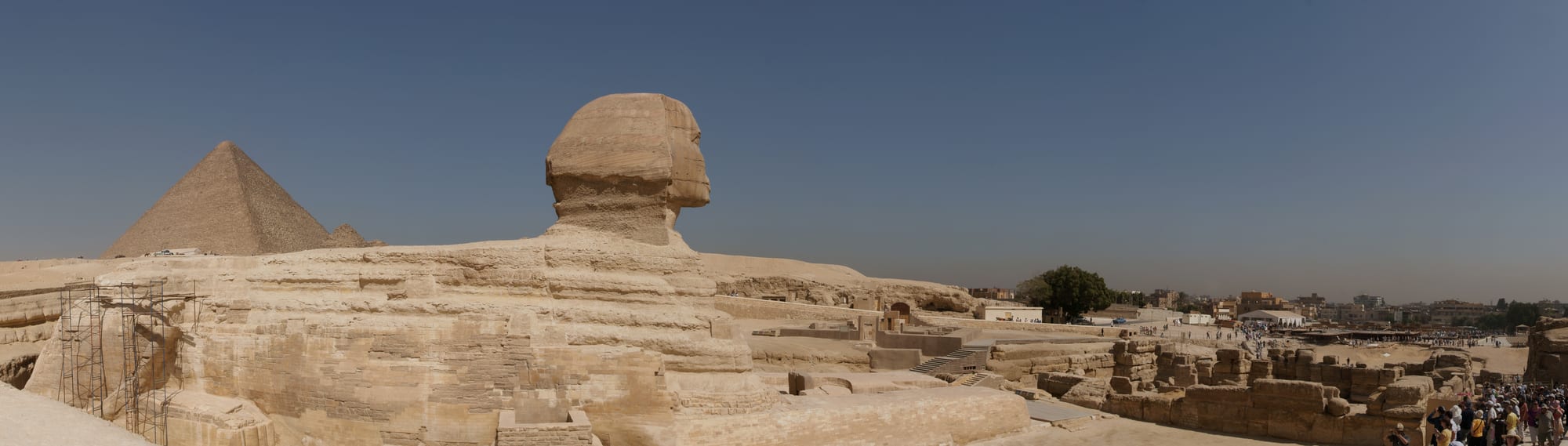
The Great Sphinx in the foreground with the Great Pyramid rising behind it against a clear desert sky

Egypt

The Great Sphinx and the Pyramid of Khufu at Giza, built around 4,500 years ago on the edge of Cairo. (kallerna / Wikimedia Commons · CC BY-SA 3.0)

The gift of the Nile — a narrow green thread through the desert that carried one of the first and longest-lived civilisations, and today the most populous country in the Arab world.

Explore Egypt

History

Egypt's recorded history begins around 3100 BC with the unification of Upper and Lower Egypt, and its pharaonic civilisation lasted, in recognisable form, for roughly three thousand years — the Old Kingdom pyramid builders, the Middle Kingdom, the empire of the New Kingdom under Thutmose, Hatshepsut, Akhenaten, Tutankhamun, and Ramesses, and a long decline through foreign rule by Libyans, Nubians, Assyrians, and Persians.

Alexander the Great took Egypt in 332 BC, and the Greek Ptolemaic dynasty ruled from Alexandria until Cleopatra's death and the Roman annexation of 30 BC. Egypt became an early heartland of Christianity — the Coptic Church dates its foundation to St Mark — before the Arab conquest of 641 brought Islam and Arabic.

Under a succession of Islamic dynasties, then the Ottomans, Egypt was often semi-independent. Muhammad Ali built a modern state in the nineteenth century; the Suez Canal opened in 1869; and Britain occupied the country from 1882. A 1952 army coup ended the monarchy and brought Gamal Abdel Nasser to power. Since then Egypt has been led by former military officers — Nasser, Sadat, Mubarak, and, after the 2011 revolution and a brief elected Islamist government, Abdel Fattah el-Sisi.

  • Egypt: Five Thousand Years on the Nile The gift of the river — pharaohs and pyramids, Greeks and Romans, the coming of Islam, Ottoman and British rule, and the republic of the officers

Culture & Customs

Egypt is an Arab and predominantly Sunni Muslim country, with a significant Coptic Christian minority — one of the oldest Christian communities in the world. Islam structures the week and the year, and Ramadan transforms daily life, with fasting by day and a festive, sociable rhythm after sunset.

Egyptian culture carries outsized weight in the Arab world: Cairo's film studios, singers such as Umm Kulthum, and its writers, including the Nobel laureate Naguib Mahfouz, shaped modern Arab culture, and Egyptian Arabic is understood from Morocco to Iraq. Humour, hospitality, and a fatalistic patience ("ma'alesh" — never mind) are common self-descriptions.

Family is the core social unit, hospitality to guests is a strong obligation, and respect for elders and religious observance are expected. Away from the beach resorts, modest dress is appreciated, more so for women and in rural and religious areas.

Daily Life

Around 100 million people — nearly the whole population — live on the roughly 5 percent of Egypt's land that the Nile and its delta make habitable, one of the highest concentrations of people anywhere. Greater Cairo, with well over 20 million residents, is the largest city in Africa and the Arab world, a sprawl of history, traffic, and unfinished brick apartment blocks, now sprouting a purpose-built "New Administrative Capital" in the desert to its east.

The economy leans on the Suez Canal, tourism, remittances from Egyptians working in the Gulf, natural gas, and agriculture, and has been squeezed by currency crises, debt, and inflation. Subsidised bread ("aish," which also means "life") remains politically sacrosanct.

Daily life runs on crowded microbuses and the Cairo metro, the ahwa (coffee house) for men, street food and juice stalls, and a working day that starts early and stretches late into the cooler evening.

Food

Egyptian food is Mediterranean and Levantine, built on bread, pulses, and vegetables. Ful medames (slow-cooked fava beans) and ta'meya (the Egyptian falafel, made with fava rather than chickpea) are the breakfast staples. Koshari — a bowl of rice, macaroni, lentils, chickpeas, fried onions, and a spiced tomato sauce — is the great cheap street meal and an unofficial national dish.

Molokhia, a green soup of jute leaves, mahshi (stuffed vegetables and vine leaves), grilled kofta and kebab, roast pigeon (hamam), and fatta (rice, bread, and meat in a garlicky broth) fill out the table. Feseekh, fermented mullet, is eaten at the spring festival of Sham el-Nessim.

Sweets are syrup-heavy: basbousa, konafa, om ali bread pudding, and dates. Tea, often heavily sugared, and thick cardamom coffee are constant; karkadeh (hibiscus), sugarcane juice, and sahlab in winter are the other favourites.

  • Egypt: Food and the National Dish A carb-on-carb street food built from rice, lentils and pasta, a fava bean breakfast some trace back to the pharaohs, and a fritter that may be the true origin of falafel

Attractions & Natural Wonders

Giza, on Cairo's edge, holds the last of the ancient Seven Wonders — the pyramids of Khufu, Khafre, and Menkaure and the Sphinx — with the new Grand Egyptian Museum nearby gathering the treasures of Tutankhamun. Cairo itself adds Islamic monuments by the hundred, the Coptic churches of Old Cairo, the Khan el-Khalili bazaar, and the citadel.

Upper Egypt is the concentration of pharaonic wonders. Luxor, ancient Thebes, has the temples of Karnak and Luxor on the east bank and, across the river, the Valley of the Kings, the mortuary temples, and the Colossi of Memnon. A Nile cruise south links the temples of Edfu and Kom Ombo to Aswan, its granite quarries, and the relocated temples of Philae and, further on, the colossal rock-cut facade of Abu Simbel.

Away from the river, Alexandria has its Greco-Roman remains and Mediterranean faded glamour; the Western Desert oases of Siwa, Bahariya, and the sculpted White Desert offer a very different landscape; St Catherine's Monastery sits beneath Mount Sinai; and the Red Sea coast at Sharm el-Sheikh, Dahab, and Marsa Alam has some of the world's best coral-reef diving and snorkelling.

Planning basics

Budget

Egypt is inexpensive for most travellers, especially since the pound's steep devaluations. Local food, trains, and modest hotels cost little; the main expenses are site tickets (many raised sharply in recent years), Nile cruises, guides, and internal flights. Cash is king outside upscale hotels.

Daily Budget Midrange
USD 70–150 (mid-range hotel, guides and drivers, a Nile cruise, some flights)
Daily Budget Shoestring
USD 25–45 (budget hotel, local food, second-class trains, buses)

Carry small notes for the constant small tips ('baksheesh') expected for services large and small.

Visa Requirements

Most nationalities need a visa. A 30-day tourist visa is available as an e-visa online in advance, or on arrival at the main airports (payable in US dollars, euros, or pounds sterling in cash). Some visitors to South Sinai resorts only can enter under a free 15-day "Sinai stamp."

Typical Validity
30 days, single entry (e-visa or visa on arrival)

The Sinai-only stamp does not cover St Catherine's Monastery or trips beyond Sharm and Dahab.

Safety

The main tourist areas — Cairo, the Nile Valley, and the Red Sea resorts — are heavily secured and generally safe, though persistent hassle, scams, and aggressive touting at the sites wear visitors down. North Sinai has an active insurgency and is off-limits; the Western Desert near the Libyan border and the far south near Sudan are also restricted.

Source
US Department of State and UK FCDO travel advisories — check for the latest wording.

Stay out of North Sinai and the western and southern border zones, agree prices before every service, be firm but polite with touts, and take care crossing Cairo's traffic.

Source: US Department of State and UK FCDO travel advisories — check for the latest wording.

Climate

Hot desert. Summers (roughly May to September) are very hot — over 40°C in Upper Egypt and the south — while Cairo and the coast are a little milder. Winters are pleasant by day and cool at night, and the only meaningful rain falls lightly on the Mediterranean coast. The dusty khamsin winds blow in spring.

Cairo
hot summers, mild winters, occasional winter rain
Upper Egypt
scorching in summer; warm, dry, and ideal in winter

Transportation

Cairo is the main air hub, with EgyptAir flights to Luxor, Aswan, Sharm el-Sheikh, and Abu Simbel. Sleeper and day trains run down the Nile Valley between Cairo, Luxor, and Aswan. Nile cruises and dahabiyas link Luxor and Aswan. Intercity coaches serve the coasts and oases. Cairo has a metro and ride-hailing apps.

Book sleeper trains and Nile cruises ahead in winter; hire a licensed guide for the major sites to cut through the crowds and touts.

Best Time to Visit

October to April for comfortable sightseeing, with December and January the coolest and busiest. Spring can bring khamsin dust storms. Summer is very hot for Luxor and Aswan but fine for the Red Sea and diving, and Ramadan shifts daytime hours and closes many eateries until sunset.

Currency

The currency is the Egyptian pound (EGP), which has been devalued repeatedly and floats weakly. Prices in pounds change quickly. ATMs are widespread in cities; carry cash for the countryside, tips, and small vendors.

Cards
Accepted in hotels, malls, and better restaurants; cash elsewhere
Symbol
£E / ج.م
Currency Code
EGP — Egyptian pound

Language

Arabic is the official language; Egyptians speak Egyptian Arabic, the most widely understood dialect in the Arab world thanks to Egypt's film and music industries. English is widely spoken in tourism, and French among some older and educated people. Coptic survives only as a liturgical language.

English
Widely spoken in tourism; less so in the countryside
Official Language
Arabic (Egyptian dialect in speech)