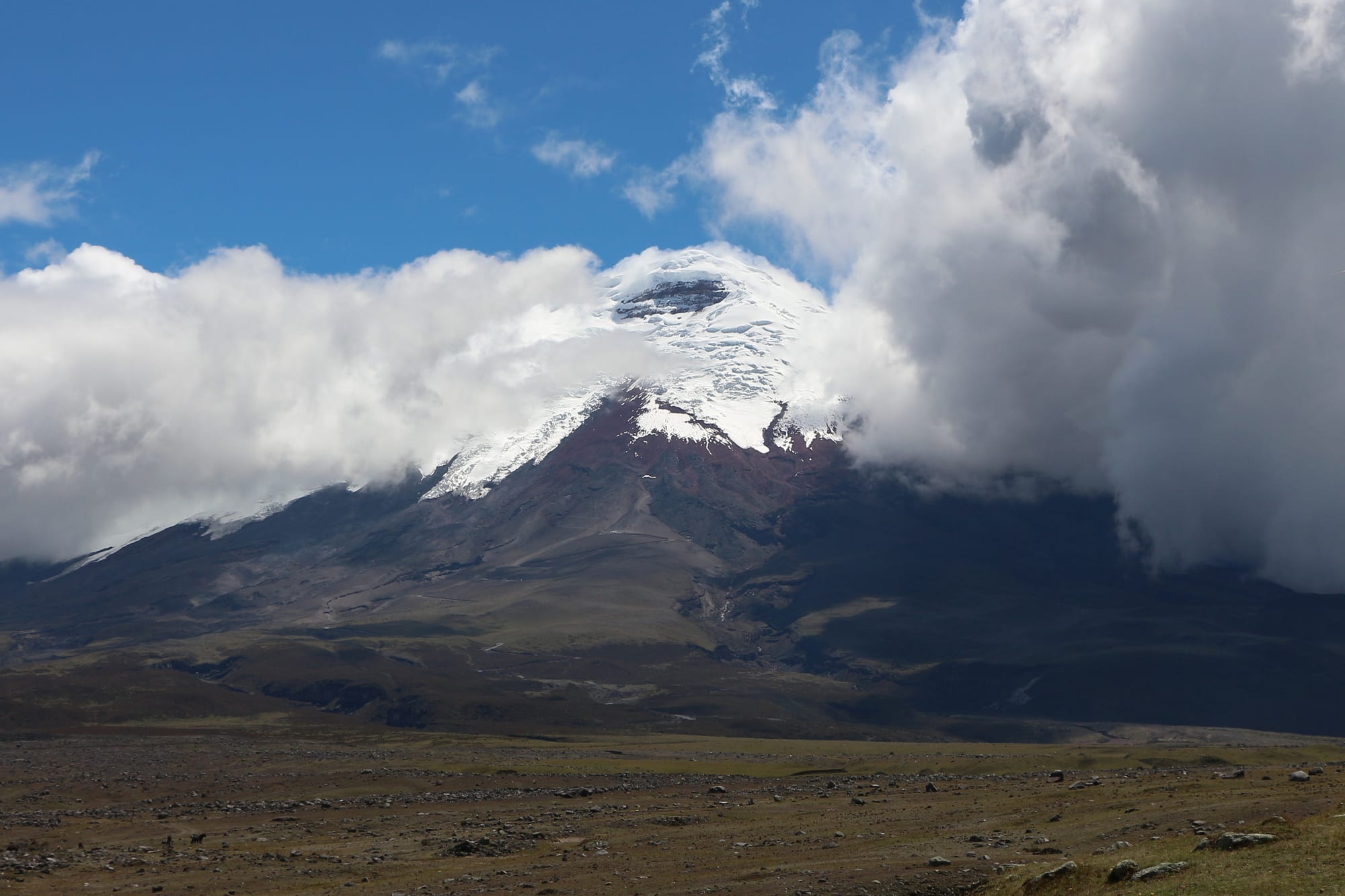
A symmetrical snow-capped volcano rising above golden high-altitude grassland under a clear blue sky

Ecuador

Cotopaxi, one of the world's highest active volcanoes, in the Ecuadorian Andes south of Quito. (Bernard Gagnon / Wikimedia Commons · CC BY-SA 3.0)

A compact Andean country straddling the Equator, with four sharply different worlds — the Pacific coast, the volcano-lined highlands, the Amazon, and the Galápagos Islands 1,000 kilometres offshore.

Explore Ecuador

History

The northern Andes were home to the Quitu, Cañari, and other peoples before the Inca conquered the region in the late fifteenth century and made Quito a second capital of their empire. Spanish forces arrived in 1534, founding Quito on Inca foundations, and the territory became the Audiencia of Quito under the Viceroyalty of Peru and later New Granada.

Independence came with the wider Spanish American revolutions: a victory on the slopes of Pichincha above Quito in 1822 freed the territory, which joined Simón Bolívar's Gran Colombia and then, when that broke up in 1830, became the separate Republic of Ecuador.

The next 170 years were unstable — many constitutions, frequent coups, a long border war with Peru that flared as recently as 1995, and repeated economic crises. The worst, in 1999–2000, wiped out the banking system and led Ecuador to abandon its currency for the US dollar. The 2007–2017 presidency of Rafael Correa brought a decade of oil-funded spending and a new constitution; since then politics has fragmented and, from 2021, a severe wave of organised-crime violence has become the country's dominant issue.

  • Ecuador: The Equator Republic An Inca frontier and a Spanish audiencia, the smallest Andean nation, chronic instability, an oil boom, and the Galápagos

Culture & Customs

Ecuador has one of the largest Indigenous populations, as a share, in South America, concentrated in the highlands and the Amazon. Kichwa communities keep their language, dress, markets, and communal work traditions (minga), and the Otavalo people are famous weavers and traders. The coast has a strong Afro-Ecuadorian culture, especially in Esmeraldas, with marimba music on UNESCO's list.

Catholicism, layered over Andean belief, shapes the calendar — Holy Week, Corpus Christi, and the Inti Raymi solstice festivals in the highlands, the Diablada de Píllaro, and Quito's founding celebrations in December. The devil-masked "Diablo Huma" and the burning of monigote effigies at New Year are widely practised.

Regional identity is pronounced: highland serranos and coastal costeños (or monos) tease each other over accent, temperament, and food, and Guayaquil and Quito have a long civic rivalry.

Daily Life

Guayaquil, the hot Pacific port, is the largest city and commercial centre; Quito, high in a narrow Andean valley at about 2,850 metres, is the capital and has one of the best-preserved colonial cores in the Americas. Cuenca, a smaller highland city, has drawn a large community of North American retirees.

The economy runs on oil, exported from the Amazon, plus bananas (Ecuador is the world's top exporter), shrimp, flowers, cacao, and remittances from Ecuadorians in Spain, Italy, and the US. The dollar has kept inflation low but left the country without monetary tools of its own.

Daily life follows the almuerzo set lunch, the neighbourhood market, and the bus; in the highlands it is tied to the farming year and the fiestas, on the coast to fishing and the heat.

Food

Ecuadorian cooking varies by altitude. On the coast, ceviche (often shrimp, "cooked" in citrus and served with popcorn and plantain chips), encebollado (a tuna-and-cassava soup eaten as a hangover cure), and encocado (seafood in coconut) dominate. The highlands lean on potatoes, corn, and pork: hornado (whole roast pig), fritada, llapingachos (cheesy potato cakes), locro de papa soup, and mote hominy.

Cuy — roast guinea pig — is a special-occasion highland dish, and fanesca, a rich soup of a dozen grains and salt cod, is eaten at Easter. Street snacks include empanadas de viento, humitas, and bolón (fried green-plantain balls).

Ecuador grows some of the world's finest cacao, and drinking chocolate is a local pleasure. Canelazo, a hot cinnamon-and-sugarcane-spirit drink, warms highland nights, and fresh fruit juices are everywhere.

  • Ecuador: Food and the National Dish A tomato-based shrimp ceviche served with popcorn, a fish soup with its own annual world championship, and three regions — coast, mountains and Amazon — that barely eat alike

Attractions & Natural Wonders

Quito's old town, a UNESCO World Heritage Site, is the highland starting point, with its gilded churches, plazas, and the TelefériQo cable car up Pichincha; nearby, the Mitad del Mundo monuments mark the Equator. The "Avenue of the Volcanoes" runs south past Cotopaxi's near-perfect cone, the emerald Quilotoa crater lake, the market town of Otavalo, and the adventure-sports hub of Baños.

Cuenca and the southern highlands add colonial architecture, the Inca ruins of Ingapirca, and Cajas National Park's lake-studded páramo. From the eastern slopes, lodges on the Napo and other rivers open into the Amazon, with canopy towers, clay licks, and Indigenous-run reserves such as Kapawi and Sani.

The Galápagos Islands, 1,000 kilometres out in the Pacific, are the country's world-famous draw — a living laboratory of evolution where giant tortoises, marine iguanas, blue-footed boobies, sea lions, and penguins show little fear of people, visited by cruise boat or by island-hopping under strict national-park rules. The Pacific coast itself offers surf at Montañita, humpback whales off Puerto López, and the dry forest and Machalilla National Park.

Planning basics

Budget

Mainland Ecuador is one of the cheaper countries in South America, helped by the use of the US dollar, which removes exchange hassle. Set-menu "almuerzos," local buses, and hostels are inexpensive; the Galápagos is a different world, where park fees, flights, and cruises make it costly.

Galapagos Fees
A national-park entry fee plus a transit control card, payable on arrival
Daily Budget Midrange
USD 70–140 on the mainland; the Galápagos adds USD 200–500+ per day
Daily Budget Shoestring
USD 30–50 on the mainland (hostel, almuerzos, buses)

Visa Requirements

Most nationalities — the EU, UK, US, Canada, Australia, and most of Latin America — enter visa-free for up to 90 days per year as tourists. Overstaying or repeated visits can trigger scrutiny.

Typical Stay
90 days per year, visa-free, for most Western passports

Keep proof of onward travel and funds; yellow fever vaccination is recommended for the Amazon regions.

Safety

Ecuador's security has deteriorated sharply since about 2021, with a surge in organised crime, gang violence, and prison unrest, especially in Guayaquil, Esmeraldas, Manta, and the northern border with Colombia. The highland tourist route (Quito, Otavalo, Baños, Cuenca) and the Galápagos remain much calmer, but street crime, express kidnapping, and armed robbery are real risks in the cities.

Source
US Department of State and UK FCDO travel advisories — check for the latest wording.

Avoid the northern border zone and the worst-affected coastal cities, use registered or app taxis, don't walk with valuables after dark, and check current advice before travelling.

Source: US Department of State and UK FCDO travel advisories — check for the latest wording.

Climate

Governed by altitude and region, not by summer and winter. The highlands have spring-like days and cool nights year-round with a wetter and a drier period; the coast is hot, with a rainy season from about December to May; the Amazon is hot, humid, and rains most of the year; the Galápagos has a warm-wet season and a cooler, drier "garúa" season.

Coast
hot and humid, sunniest June–November
Galapagos
warm and clear Dec–May; cooler, mistier, rougher seas Jun–Nov
Highlands
Quito 10–21°C, dry June–September, wetter October–May

Transportation

Quito and Guayaquil have the main airports; Galápagos flights go via one of the two. The country is small enough that comfortable long-distance buses reach almost everywhere cheaply, though mountain roads are slow. Domestic flights save time to the coast and the Amazon. In the Galápagos, travel is by inter-island ferry, small plane, or cruise boat.

For the Galápagos, decide early between a live-aboard cruise and island-hopping from town bases — they offer very different trips.

Best Time to Visit

June to September is the driest window in the highlands and good for trekking and volcano views. The Galápagos is rewarding year-round; December to May has calmer, warmer seas and better snorkelling, June to November brings more wildlife activity and rougher water.

Currency

Ecuador uses the US dollar, adopted in 2000 after a banking collapse. It mints its own coins alongside US ones. Bring small denominations — breaking a USD 20 outside cities can be hard — and clean notes, as damaged bills are refused.

Cards
Accepted in cities and tourist areas; cash needed in rural areas and for buses
Symbol
$
Currency Code
USD — US dollar

Language

Spanish is the main official language. Kichwa (Quichua) and Shuar are also official for Indigenous peoples, and Kichwa is widely spoken in the highlands, often as a first language. English is limited outside tourism and business.

English
Common in tourism hubs and the Galápagos; limited elsewhere
Official Language
Spanish
Indigenous Languages
Kichwa, Shuar, and others