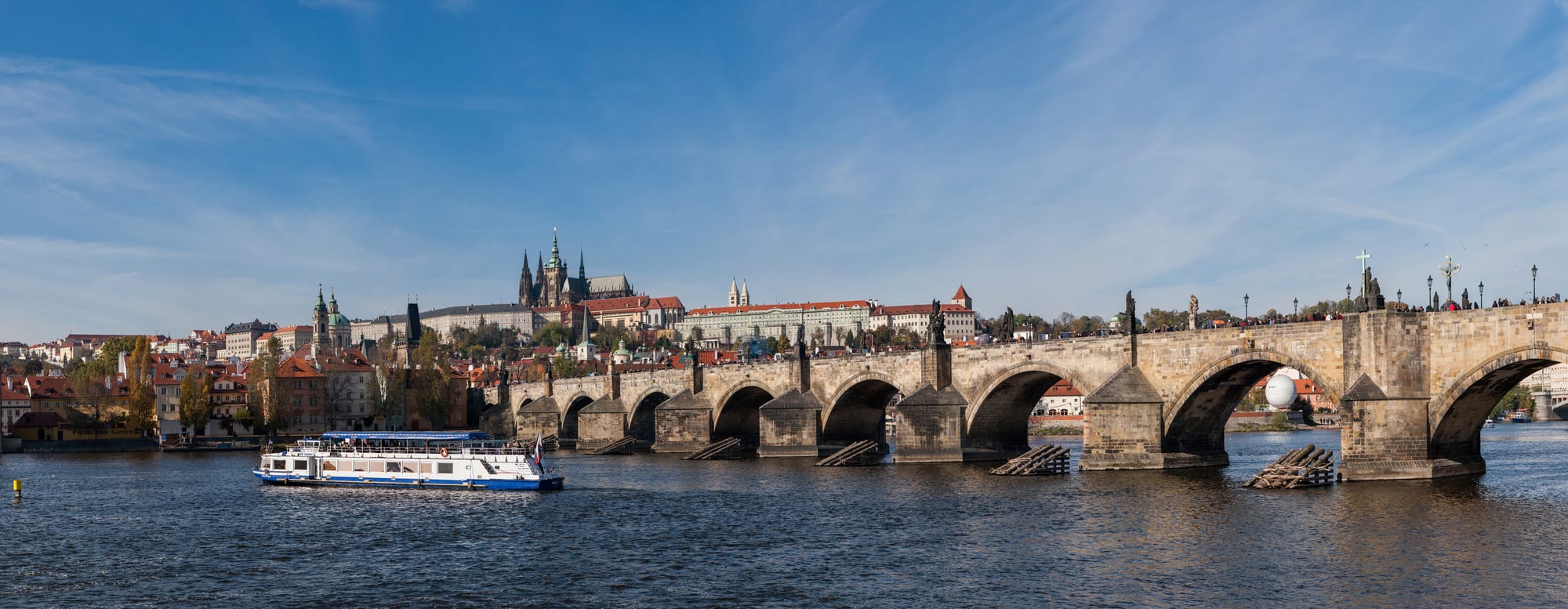
A medieval stone bridge lined with statues crossing a river toward a hill crowned by a Gothic castle and cathedral

Czechia

Charles Bridge and Prague Castle over the Vltava — the castle complex is often called the largest ancient castle in the world. (Diliff / Wikimedia Commons · CC BY-SA 3.0)

A landlocked country at the centre of Europe — the historic lands of Bohemia and Moravia — with a thousand-year record of castles, spa towns, and beer, and a capital, Prague, that came through the twentieth century almost unscathed.

Explore Czechia

History

The Czech lands were united under the Přemyslid dukes and kings from the ninth century as the Kingdom of Bohemia, which reached its height in the fourteenth century under Charles IV, who made Prague an imperial capital and founded its university, the oldest in Central Europe. In the fifteenth century the reformer Jan Hus was burned at the stake, triggering the Hussite Wars and a long tradition of religious dissent.

From 1526 Bohemia and Moravia came under the Catholic Habsburgs, and the defeat of a Protestant Bohemian revolt in 1620 began three centuries of rule from Vienna and a strong Germanising pressure, resisted by a nineteenth-century Czech national revival. In 1918, out of the collapse of Austria-Hungary, Czechs and Slovaks formed Czechoslovakia, the most stable democracy in interwar Central Europe.

The 1938 Munich Agreement handed the German-speaking borderlands to Hitler, and Nazi occupation followed, along with the destruction of the Jewish community. After the war the German population was expelled, and a 1948 coup brought Communist rule. The 1968 "Prague Spring" reform movement was crushed by a Warsaw Pact invasion. The 1989 "Velvet Revolution" ended Communism peacefully, and in 1993 Czechoslovakia split amicably into the Czech Republic and Slovakia. Czechia joined NATO in 1999 and the EU in 2004.

  • Czechia: The Heart of Europe The Bohemian kingdom and its heretics, three centuries under the Habsburgs, a democracy crushed twice, and the Velvet Revolution

Culture & Customs

Czech identity is bound up with language, music, and a wry, sceptical humour — Švejk, Kafka, Hašek, Havel, and the absurdist streak in Czech film and animation. The country is among the least religious in Europe; the great churches are visited as monuments more than as places of worship.

Beer is close to a national institution. Czechs drink more of it per head than any other nation, the pilsner style was invented in Plzeň in 1842, and the pivnice (pub) is the core of social life. Puppet theatre, Bohemian glass and garnets, brass and folk music in Moravia, and a strong classical tradition — Smetana, Dvořák, Janáček — are other threads.

Weekends are often spent at a chata or chalupa, a modest country cottage, and mushroom foraging in autumn is a widely shared pastime. Moravia, in the east, is more rural, more Catholic, and wine- rather than beer-oriented, with its own folk costume and festivals.

Daily Life

About 1.3 million people live in Prague, a compact city of Gothic, Baroque, and Art Nouveau architecture that escaped wartime bombing. Brno, the Moravian capital, is a lively university and tech city; Ostrava in the northeast is a former coal-and-steel centre reinventing itself; and much of the country is small towns, farmland, and forested hills.

The economy is industrial and export-driven — cars above all, plus machinery, electronics, and engineering — tightly integrated with Germany, and unemployment is consistently among the lowest in the EU. Housing costs in Prague and Brno are the main pressure point.

Daily life is orderly and home-centred, with an early start to the working day, a hot lunch as the main meal for many, and the pub or the cottage for downtime.

Food

Czech cooking is hearty, meat-and-dumpling food built for cold weather. The archetypal meal is vepřo-knedlo-zelo — roast pork with bread dumplings and sauerkraut — or svíčková, beef sirloin in a creamy root-vegetable sauce with cranberry and a dumpling. Guláš, řízek (schnitzel), and roast duck with red cabbage are pub and Sunday staples.

Starters and snacks include utopenec (a pickled sausage), nakládaný hermelín (marinated soft cheese), bramboráky (potato pancakes), and open sandwiches (chlebíčky). Sweet dishes such as fruit dumplings and palačinky can be a main course.

Beer is the national drink, ordered by the half-litre and often "on tap" from the famous breweries; Becherovka, a herbal liqueur from Karlovy Vary, and Moravian wines round out the drinks, along with slivovice plum brandy.

  • Czechia: Food and the National Dish Roast pork with dumplings and cabbage, a creamy sirloin dish with an equally strong claim to the title, and the small Bohemian town that gave the world the pale lager

Attractions & Natural Wonders

Prague is the centrepiece: the hilltop Castle and St. Vitus Cathedral, the statue-lined Charles Bridge, the Old Town Square with its astronomical clock, the Jewish Quarter's synagogues and cemetery, and the Art Nouveau of the Municipal House — a compact historic core that is itself a World Heritage Site.

Beyond the capital, Český Krumlov is a tiny, near-perfectly preserved medieval town wrapped in a bend of the Vltava beneath a large castle; Kutná Hora has a soaring Gothic cathedral built on silver-mining wealth and the bone-decorated Sedlec ossuary. The western "spa triangle" of Karlovy Vary, Mariánské Lázně, and Františkovy Lázně, a UNESCO listing, keeps its colonnades and grand hotels.

Moravia offers the wine country and folk villages of the south, the caves and gorges of the Moravian Karst, and the châteaux of Lednice and Valtice. The border mountains — the Krkonoše, Šumava, and the sandstone "rock towns" of Bohemian Switzerland and Český ráj — provide the hiking and skiing.

Planning basics

Budget

Czechia is mid-range for Central Europe — cheaper than Germany or Austria, no longer the bargain it was in the 1990s. Prague's centre is the priciest part of the country by far; smaller cities, Moravia, and the countryside cost noticeably less. Card payment is near-universal.

Half Litre Of Beer
EUR 1.50–2.50 in a pub outside the Prague tourist core
Daily Budget Midrange
EUR 100–180 (mid-range hotel, restaurants, museums, day trips)
Daily Budget Shoestring
EUR 45–75 (hostel or pension, pub meals, trains and trams)

Visa Requirements

Czechia is in the EU and the Schengen Area. Citizens of the EU, the UK, the US, Canada, Australia, and many other countries need no visa for stays of up to 90 days in any 180-day period.

Typical Stay
90 days in any 180-day period, visa-free, for most Western passports

Safety

Czechia is a safe country with low levels of violent crime. The main nuisance is pickpocketing and overcharging aimed at tourists in central Prague — around the Charles Bridge, Old Town Square, the astronomical clock, and on trams 22 and 9 — plus dishonest taxis and rigged currency-exchange booths.

Use official "AAA" or app-based taxis, change money only at reputable offices (never the ones advertising "0% commission"), and watch your bag in the tourist crush.

Climate

Temperate continental, with four distinct seasons. Summers are warm and can be hot, with thunderstorms; winters are cold, grey, and often snowy, more so in the border mountains. Spring and autumn are mild and changeable.

Summer
warm, 22–30°C, occasional heat waves
Winter
cold, around -3 to 3°C, snow likely, more in the mountains

Transportation

Prague's Václav Havel Airport is the main gateway, with Brno and Ostrava handling some flights. The rail network (České dráhy, plus private operators) is dense, cheap, and reaches most towns; intercity buses cover the gaps well. Prague, Brno, and Ostrava have excellent tram and metro systems.

Prague to Český Krumlov, Kutná Hora, or Karlovy Vary is an easy train or bus day trip; a car is optional.

Best Time to Visit

May, June, and September for warm, bright weather and manageable crowds. July and August are the busiest in Prague and Český Krumlov. December brings Christmas markets and lights to the city squares; the Krkonoše and Šumava mountains have a winter ski season.

Events
Prague Spring music festival (May); the Christmas markets on Old Town Square (Advent)

Currency

The currency is the Czech koruna (CZK), often written "Kč." Despite EU membership Czechia has kept its own currency. Cards are accepted almost everywhere; carry a little cash for small pubs, markets, and rural buses.

Symbol
Currency Code
CZK — Czech koruna

Language

Czech is the official language, a West Slavic language written in the Latin alphabet with many diacritics, closely related to Slovak. English is widely spoken by younger people and in Prague's tourism trade; German is also useful, and Russian is understood by many older people but not always welcome.

English
Common among the young and in tourist areas; patchier in the regions
Official Language
Czech