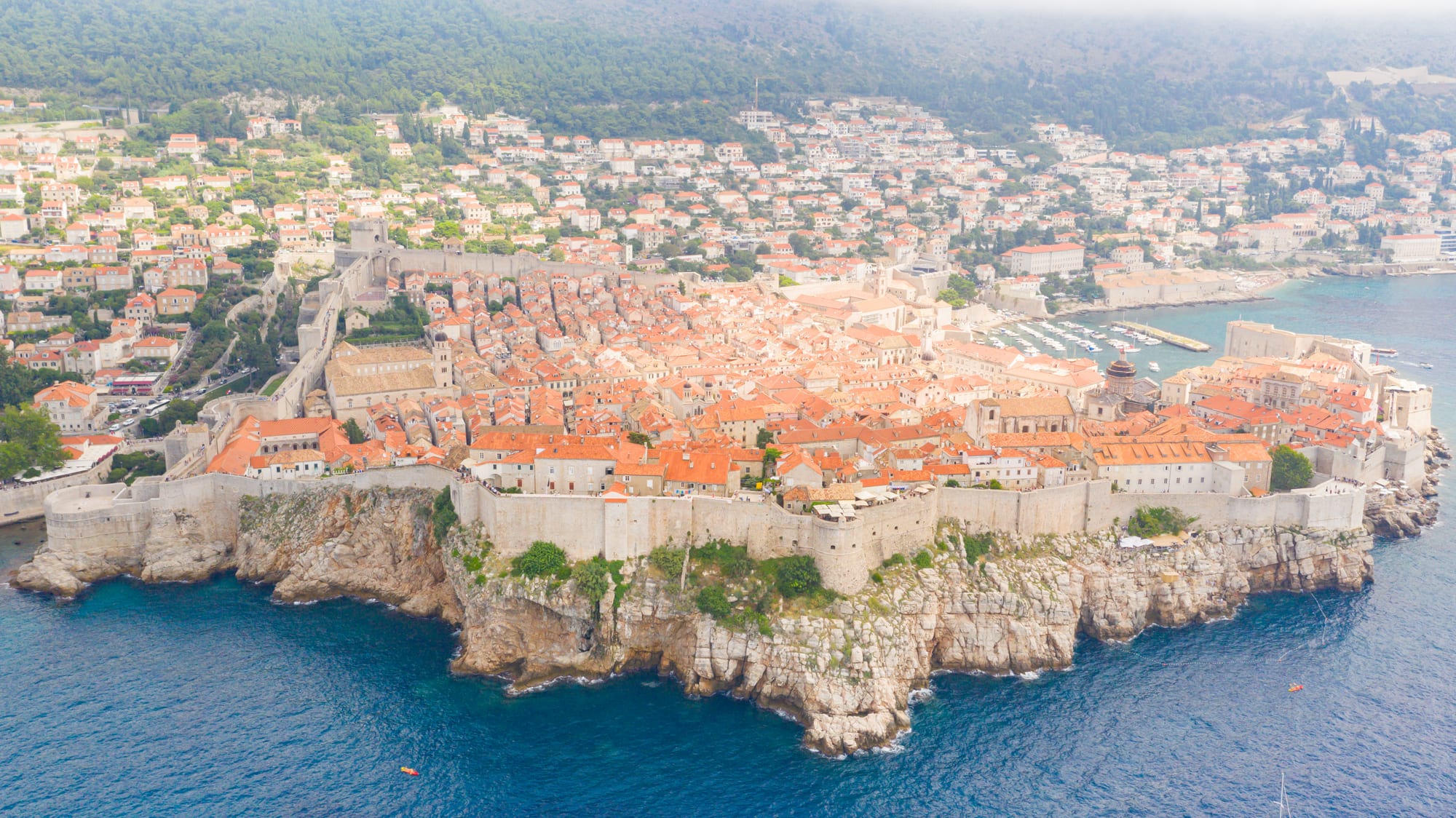
Massive medieval stone city walls dropping to a clear blue-green sea, red-roofed old town packed behind them

Croatia

The walls of Dubrovnik's Old Town, a UNESCO World Heritage Site, above the Adriatic. (dronepicr / Wikimedia Commons · CC BY 2.0)

A crescent-shaped country on the Adriatic, with a long, island-strewn coast of walled stone towns, a mountainous interior, and lakes and waterfalls — now one of Europe's most popular summer destinations.

Explore Croatia

History

Croats settled the region in the seventh century and formed a kingdom that was recognised in the year 925. From 1102 the Croatian crown was joined to Hungary's, and for centuries the country was a frontier: much of the coast and islands came under the Republic of Venice, the interior under the Habsburgs, and a swathe of territory under the Ottomans, whose advance was held along a militarised border.

After the First World War, Croatia joined the new Kingdom of Serbs, Croats, and Slovenes, later Yugoslavia. The Second World War brought a brutal Nazi-aligned puppet state and a partisan resistance; afterwards, Croatia became a republic of socialist Yugoslavia under Tito, himself a Croat.

Croatia declared independence in 1991 as Yugoslavia broke apart. The war that followed, until 1995, included the siege and shelling of Dubrovnik, the destruction of Vukovar, and the displacement of hundreds of thousands before Croatian forces retook rebel-held areas. Croatia joined NATO in 2009, the European Union in 2013, and the Schengen Area and the eurozone in 2023.

  • Croatia: The Crescent on the Adriatic A medieval kingdom absorbed by Hungary and the Habsburgs, a coast fought over by Venice and the Ottomans, a wartime fascist state, and independence won in a 1990s war

Culture & Customs

Croatia is overwhelmingly Roman Catholic, and the church, saints' days, and pilgrimage sites such as Marija Bistrica are woven into national identity, which also carries a strong Central European and Mediterranean self-image rather than a Balkan one. Regional identities are pronounced — Dalmatia on the coast, Istria in the northwest, hilly Zagorje, and flat, Pannonian Slavonia.

Coastal life runs on a slow rhythm the locals call pomalo — "take it easy" — with the evening promenade, long lunches, and a strong café culture. Klapa, the a cappella close-harmony singing of Dalmatia, is on UNESCO's heritage list, along with lacemaking, the Sinjska Alka tournament, and other traditions.

Sport is a national obsession far out of proportion to the country's size — football above all, with the 2018 and 2022 World Cup runs, plus water polo, handball, basketball, and tennis.

Daily Life

About a quarter of Croatia's 3.8 million people live in and around Zagreb, the capital, an Austro-Hungarian city in the northern interior. Split is the largest coastal city and the hub of Dalmatia; Rijeka is the main port; and much of the coast and islands live off a summer tourism season that swells the population enormously for three months and empties it the rest of the year.

The economy leans heavily on that tourism, along with shipbuilding, agriculture in Slavonia, and services. Emigration of young people to Germany, Ireland, and beyond since EU accession, and one of the world's lowest birth rates, have left many inland towns and islands ageing and shrinking.

Daily life is comfortable and unhurried, organised around family, the local konoba, coffee that lasts an hour, and — on the coast — the sea.

Food

Croatian food splits along the coast–interior line. Dalmatia and Istria eat Mediterranean: grilled fish and squid, black risotto coloured with cuttlefish ink, pašticada (beef braised in sweet wine and prunes), olive oil, and, under a metal bell called a peka, slow-roasted meat and potatoes. Istria adds truffles, wild asparagus, and fuži pasta.

The continental north eats heartier, Central European food: štrukli (baked dough with cottage cheese), roast meats, sausages, sarma, and freshwater fish stew (fiš paprikaš) in Slavonia. Cured pršut ham and sheep's cheese from Pag appear everywhere.

Croatia is a serious wine country, from Istrian Malvazija and Teran to the big Dalmatian reds Plavac Mali and Dingač; rakija fruit brandy is the aperitif and digestif, and strong coffee is constant.

  • Croatia: Food and the National Dish A country split neatly between a Central European interior and a Mediterranean coast, a cheese pastry with heritage protection, and a grape that turned out to be a lost cousin of Zinfandel

Attractions & Natural Wonders

Dubrovnik, its walled Old Town rising straight from the sea, is the headline — walk the ramparts, then escape by boat to Lokrum or the Elaphiti Islands. Split is built inside and around the Roman emperor Diocletian's retirement palace, still lived in and full of bars and shops, and is the gateway to the islands of Hvar, Brač, Vis, and Korčula.

Inland, Plitvice Lakes National Park is a staircase of sixteen turquoise lakes linked by waterfalls and wooden walkways, and Krka has falls you could once swim beneath. Zadar has Roman ruins, a sound-making Sea Organ, and famous sunsets; Šibenik has a UNESCO cathedral built entirely of stone.

The Istrian peninsula in the northwest feels almost Italian, with hilltop towns like Motovun and Grožnjan, Roman Pula and its arena, and truffle country around Buzet. Zagreb anchors an interior visit, with its Upper Town, museums, and Advent market, and the Kornati archipelago and Mljet's saltwater lakes reward those who get further off the main routes.

Planning basics

Budget

Croatia is no longer a bargain. The coast in July and August — Dubrovnik, Hvar, Split — reaches Western European prices for accommodation, boat trips, and restaurants; the interior, the shoulder seasons, and self-catering apartments (a Croatian speciality) are far cheaper. Card payment is widespread.

Daily Budget Midrange
EUR 120–240 (apartment or mid-range hotel, restaurants, ferries, a rental car)
Daily Budget Shoestring
EUR 55–90 (hostel or private room, market food, buses)

Coastal prices roughly double between May and August; visiting in June or September saves a lot.

Visa Requirements

Croatia is in the EU and, since 2023, the Schengen Area and the eurozone. Citizens of the EU, the UK, the US, Canada, Australia, and many others need no visa for stays of up to 90 days in any 180-day period.

Typical Stay
90 days in any 180-day period, visa-free, for most Western passports

Safety

Croatia is a very safe country for visitors, with low levels of violent crime. The usual precautions apply against pickpocketing in crowded coastal old towns and against overcharging by unofficial taxis. Some remote inland and former front-line areas still have uncleared landmines from the 1990s war.

Landmines
Suspect areas are fenced and signed; stay on marked roads and paths in parts of Slavonia, the Krajina, and around former front lines.

Watch belongings in the summer crush in Dubrovnik and Split, and use marked taxis or apps.

Climate

The coast and islands have a Mediterranean climate — hot, dry summers and mild, wetter winters — while the inland lowlands around Zagreb and Slavonia are continental, with cold winters and warm summers, and the mountains get snow. The dry, cold bura wind sweeps down to the coast in winter.

Interior
cold winters, hot summers, four clear seasons
Coast Summer
hot and sunny, 28–33°C, warm sea
Coast Winter
mild, 6–12°C, more rain

Transportation

Zagreb, Split, Dubrovnik, Zadar, and Pula have airports. An extensive intercity bus network is the backbone of travel; trains are limited and slow, and there is no rail link down the coast to Split or Dubrovnik. A dense ferry and catamaran network (Jadrolinija and others) links the islands. A rental car suits the interior and Istria.

Book island ferries and catamarans ahead in July and August, and note Dubrovnik is a long coastal drive or a short flight from Split.

Best Time to Visit

Late May to June and September for warm weather, swimmable sea, and far fewer people than the July–August peak, when the coast and the ferries are packed and prices peak. Plitvice and the interior are good from spring to autumn; Zagreb has a well-known Advent (Christmas market) season.

Currency

Croatia adopted the euro on 1 January 2023, replacing the kuna. Cards are accepted almost everywhere; carry some cash for markets, small konobas, and island shops.

Symbol
Currency Code
EUR — euro

Language

Croatian is the official language, a South Slavic language written in the Latin alphabet. English is very widely spoken along the coast and among younger people; German and Italian are also useful, especially in Istria, which has an Italian-speaking minority.

English
Widely spoken on the coast and by younger people
Official Language
Croatian