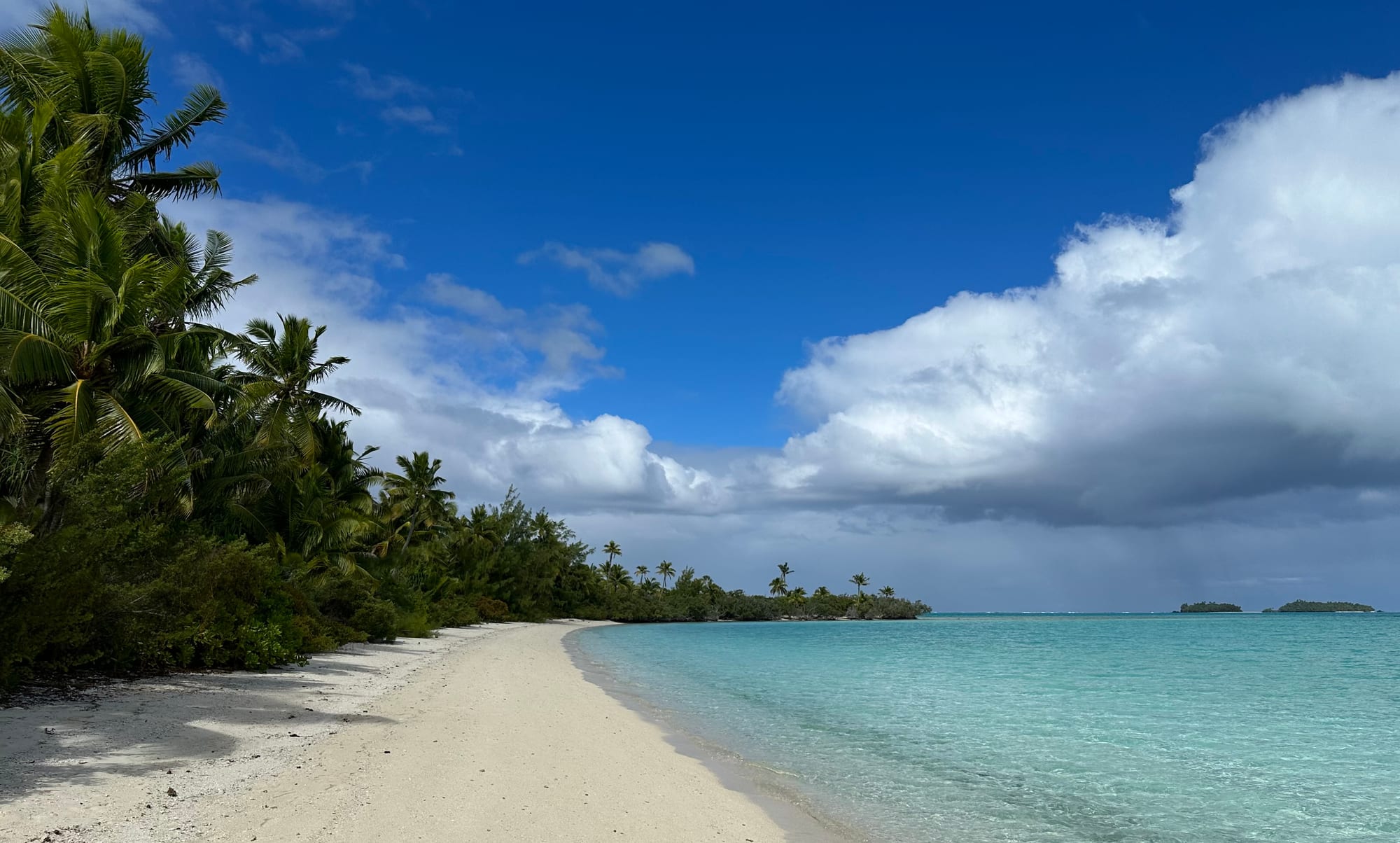
A curving white-sand beach backed by dense coconut palms beside a clear pale-turquoise lagoon, under a deep blue sky with towering white clouds and two tiny islets on the horizon

Cook Islands

A beach on Motu Akaiami, one of the small islets of the Aitutaki lagoon. (Tom Ackroyd / Wikimedia Commons · CC BY-SA 4.0)

Fifteen small islands scattered across a vast stretch of the South Pacific, self-governing in free association with New Zealand — a Polynesian country of about 15,000 people, sustained by tourism, fishing licences, and a diaspora many times larger than the resident population.

Explore Cook Islands

History

Polynesians settled these islands from around the sixth century AD, and Rarotonga features in New Zealand Māori tradition as a staging point for the canoes that reached Aotearoa. Spanish ships sighted some of the islands in 1595, and Cook charted several in the 1770s. The London Missionary Society arrived in 1821 and, working with the ariki (high chiefs), made the islands strongly Christian and imposed a code of strict "blue laws".

Britain declared a protectorate in 1888, and in 1901 the islands were annexed to New Zealand. In 1965 the Cook Islands became self-governing in free association with New Zealand: Cook Islanders are New Zealand citizens, New Zealand handles defence and assists with foreign affairs by agreement, and the Cook Islands otherwise runs its own affairs and makes its own treaties. It has taken an increasingly independent international role, declared its nationhood in 2001, and in 2025 signed a strategic-partnership agreement with China that strained relations with Wellington.

The defining social fact is depopulation. For decades Cook Islanders have moved to New Zealand and Australia, where perhaps 80,000 to 100,000 now live — many times the number who remain — leaving the outer islands especially small and ageing.

Culture & Customs

Cook Islands Māori culture is close kin to New Zealand Māori and Tahitian, with its own island dialects, the authority of the ariki and the land-holding kōpū tangata, and a deep Christian overlay. The Cook Islands Christian Church, the mission church, anchors village life; Sunday is quiet and church-centred; and the islands are famous across the Pacific for their hymn singing, imene tuki.

Dance is a point of pride — the Cooks claim the fastest and finest drumming and hip-shaking 'ura in Polynesia, on show at the "Island Nights" and at the Te Maeva Nui competitions. Other living traditions include tīvaevae appliqué quilting, carving (the Rarotongan fisherman's gods, Mangaian ceremonial adzes), and the tumunu bush-beer circle on 'Atiu. Land cannot be sold, only leased, which keeps ownership in Cook Islands families and shapes what gets built.

Daily Life

About 15,000 people live in the Cook Islands, roughly three-quarters on Rarotonga, with Aitutaki the next largest and the other islands small. The economy is built on tourism — over 100,000 visitors a year, most from New Zealand — along with fees for foreign tuna-fishing licences, black pearls from Manihiki and Penrhyn, and aid.

Rarotonga has a hospital, secondary schools, government offices, and a single loop road; the outer islands have infrequent flights, irregular shipping, and thinning populations. Everyday life runs on gardening and reef fishing alongside wage work, church on Sunday, and family ties that stretch to Auckland and Sydney.

Food

Ika mata — raw fish marinated in lime and coconut cream — is the signature dish. The umukai earth-oven feast brings pork, chicken, taro, kūmara, and rukau (young taro leaves in coconut cream), and poke is a pudding of banana or pawpaw thickened with arrowroot and coconut. Fresh tuna, wahoo, and parrotfish come straight off the reef and the boats.

The Punanga Nui market in Avarua on Saturday mornings is the food event of the week, with produce, fish, rukau, and cooked-food stalls. Otherwise the shops are stocked with New Zealand goods, and imported staples fill the gaps. Local beer is brewed on Rarotonga, and on 'Atiu the tumunu gatherings serve home-brewed orange "bush beer" in a ritualised round.

  • Cook Islands: Food and the National Dish Raw fish marinated in lime and coconut cream, an earth-oven feast shared with the wider Pacific, and a dessert that shares its name with a very different Hawaiian dish

Attractions & Natural Wonders

Rarotonga is ringed by lagoon and reef, best at Muri, where the water is shallow and clear and small motu sit offshore; glass-bottom-boat and snorkel trips run over the coral, and marine "ra'ui" reserves protect the fish. The Cross-Island Track climbs over the interior past the pinnacle of Te Rua Manga ("the Needle"), and the quiet inland "back road" passes old marae and whitewashed churches.

Aitutaki, a 45-minute flight north, has one of the most photographed lagoons in the world — a broad triangle of turquoise water with sandbars and motu, including the church and sandspit of One Foot Island (Tapuaetai), reached by cruise boat. 'Atiu has coffee plantations, limestone caves with ancestral burials and nesting swiftlets, and the tumunu; Mangaia and Ma'uke are ancient raised-coral islands ringed by fossil-reef cliffs and caves; and Mitiaro has freshwater cave pools. The remote northern atolls — Manihiki, Penrhyn, Pukapuka — are pearl country and very hard to reach. Whales pass close to Rarotonga and Aitutaki from July to October.

Planning basics

Budget

Mid-range by Pacific standards, and much cheaper than French Polynesia. Rarotonga has hostels, self-catering units, and mid-range resorts; Aitutaki is more expensive. Eating from the market, the roadside vans, and the supermarket keeps costs down against the resort restaurants.

Daily Budget Midrange
NZD 260–520 (mid-range resort or apartment, restaurants, a lagoon cruise, an Aitutaki flight)
Daily Budget Shoestring
NZD 110–170 (hostel or self-catering unit, market and van food, the island bus and a hired scooter)

Base on Rarotonga, shop at the Punanga Nui market and the supermarkets, hire a scooter for the ring road, and treat Aitutaki as a splurge day trip or overnight.

Visa Requirements

No visa is required by any nationality for stays of up to 31 days, which can be extended month by month to a maximum of six months. Visitors need an onward or return ticket and confirmed accommodation for at least the first night.

Typical Stay
31 days on arrival, extendable to 6 months

Book and be able to show your first night's accommodation; extensions are handled by the immigration office in Avarua.

Safety

One of the safest destinations in the Pacific, with very little crime; secure valuables against opportunistic theft. The real hazards are the sea — sharp coral, and strong currents through the reef passages — plus scooter accidents (helmets are now compulsory), sunburn, and stonefish in the shallows. Cyclones are a wet-season risk, and serious medical cases are flown to New Zealand.

Health
Tap water on Rarotonga is treated but many visitors drink bottled or filtered; medical facilities are basic

Wear the scooter helmet, swim inside the reef and heed passage warnings, shuffle your feet in shallow water for stonefish, and take out good insurance.

Climate

Tropical and warm year-round. The drier, cooler, less humid season runs May to October and is the main visitor season. November to April is hotter and wetter, with higher humidity and the cyclone risk.

Dry Season
May–October, cooler and less humid
Wet Season
November–April, hot, humid, cyclone risk

Transportation

Rarotonga International Airport has flights from Auckland (about four hours), plus Sydney and, seasonally, Los Angeles and Tahiti. Air Rarotonga flies to Aitutaki and the other inhabited islands. Rarotonga has one 32 km ring road served by clockwise and anticlockwise buses; scooters and small cars are widely hired, with a local licence issued on the spot. Inter-island cargo ships are slow and irregular.

Hire a scooter or use the island bus on Rarotonga; fly to Aitutaki rather than relying on boats.

Best Time to Visit

May to October for the driest and most settled weather. Humpback whales pass Rarotonga and Aitutaki from July to October, and the Te Maeva Nui festival marks self-government in late July and early August. December to March carries the cyclone risk.

Events
Te Maeva Nui (late July–August), the self-government anniversary with island dance competitions; Gospel Day (October); Dancer of the Year (April)

Currency

The New Zealand dollar is the currency. The Cook Islands also issues its own coins and notes — including the triangular $2 coin and the $3 note — which circulate locally and are popular keepsakes. Cards work on Rarotonga and Aitutaki; elsewhere it is cash only.

Symbol
$
Currency Code
NZD — New Zealand dollar (local Cook Islands coins and notes also circulate)

Language

English is an official language and universally spoken. Cook Islands Māori (Te Reo Māori Kūki 'Āirani), close to New Zealand Māori and Tahitian, is the other official language and the first language of most residents, with distinct dialects on each island; Pukapukan, in the northern group, is a separate language.

Official Languages
English and Cook Islands Māori