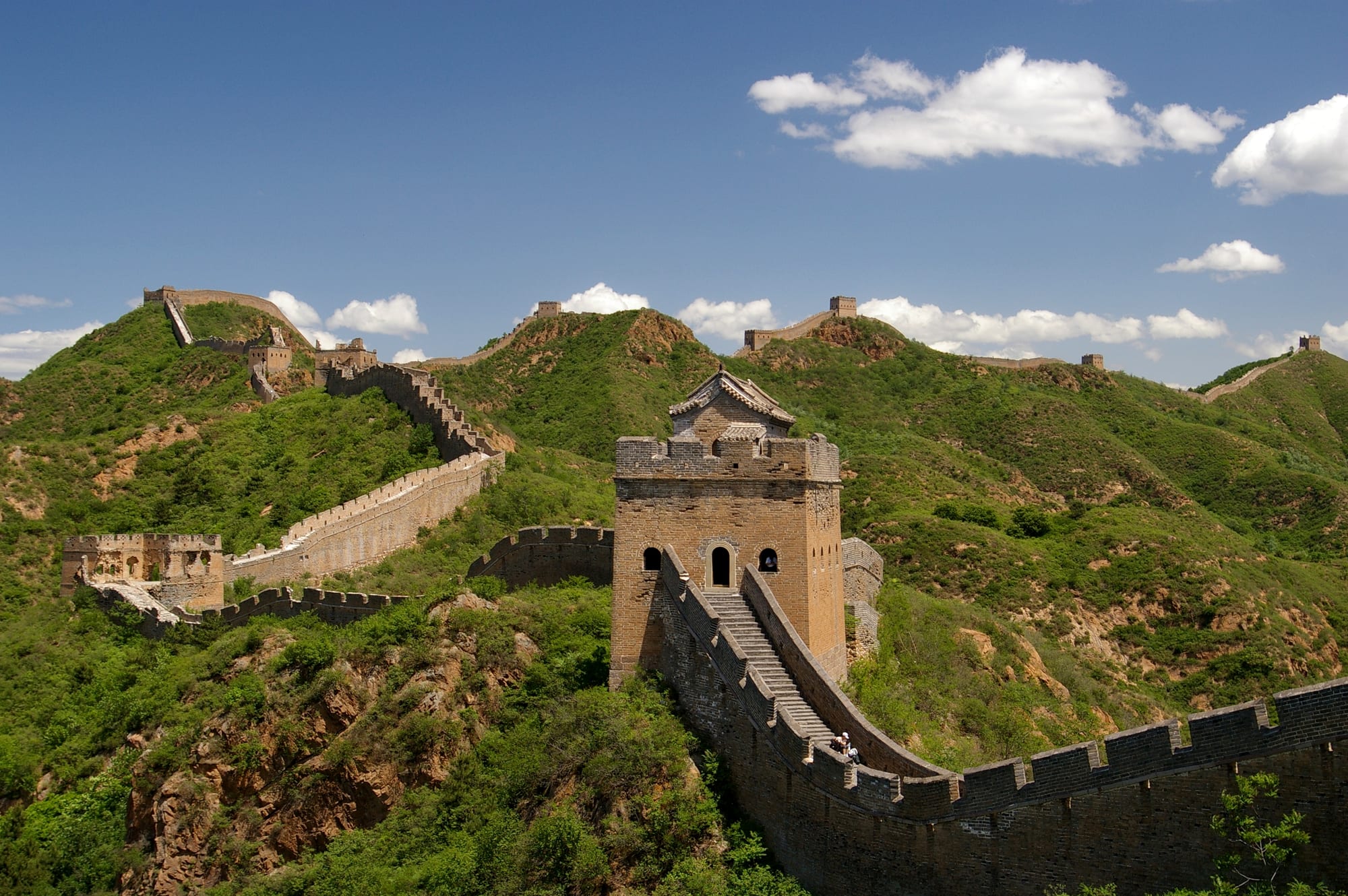
A stone wall with watchtowers snaking along the crest of steep, forested green mountain ridges into the distance

China

The Great Wall along the ridgelines north of Beijing — sections of the wall date from the Ming dynasty, 14th–17th centuries. (Jakub Hałun / Wikimedia Commons · CC BY-SA 4.0)

The world's most populous country for most of modern history and its second-largest economy — a continent-sized state with a 3,000-year cultural record, ruled since 1949 by the Communist Party.

Explore China

History

Chinese civilisation is among the oldest continuous in the world, with written records going back more than three thousand years. A sequence of dynasties — Qin, which first unified the empire in 221 BC and standardised its script and measures; Han; Tang; Song; Yuan under the Mongols; Ming; and Qing under the Manchus — governed through a centralised bureaucracy staffed, from the Song onward, by scholars chosen in written examinations.

The Qing collapsed in 1911 after a century of defeats, unequal treaties, and internal rebellion, and China became a fractured republic. Decades of warlordism, civil war between the Nationalists and the Communists, and the brutal Japanese invasion of 1937–45 followed. The Communists won the civil war, and Mao Zedong proclaimed the People's Republic in 1949; the defeated Nationalists withdrew to Taiwan.

Mao's rule brought land reform but also the famine of the Great Leap Forward, which killed tens of millions, and the upheaval of the Cultural Revolution. After his death in 1976, Deng Xiaoping's reforms opened the economy, beginning four decades of growth that lifted hundreds of millions out of poverty and made China a global power. The Party has retained a monopoly on political power throughout, and under Xi Jinping since 2012 has tightened control at home.

Culture & Customs

Traditional Chinese culture blends Confucian ideas about family, hierarchy, and education, Daoist attitudes to nature and balance, and Buddhism, which arrived from India two thousand years ago. Ancestor respect, the importance of the family name, and the concept of guanxi — networks of reciprocal obligation — still shape social life.

The written character script, shared across mutually unintelligible spoken languages, is a unifying thread, along with calligraphy, ink painting, classical poetry, and a cuisine treated as a serious art. Festivals follow the lunar calendar, above all Spring Festival, when hundreds of millions travel home in the world's largest annual human migration.

Regional identity is strong — a Sichuanese, a Cantonese, and a northeasterner will describe themselves as quite different in temperament, food, and language. Officially atheist, China nonetheless has large populations of Buddhists, Daoists, Christians, and Muslims, and folk religion is widespread.

Daily Life

More than half of China's roughly 1.4 billion people live in cities, many of them built or rebuilt in the last thirty years into dense high-rise landscapes linked by metro and high-speed rail. Hundreds of millions of rural migrants power the factories and services of the coastal cities while their household registration, the hukou, often remains in the countryside.

Daily life is highly digital: a single super-app handles payments, messaging, transport, deliveries, and government services, and cash has all but vanished from the cities. Long working hours are common, competition for school places and jobs is intense, and property is the main household asset and anxiety.

The gap between the wealthy eastern cities and the poorer inland and western regions remains large, though it has narrowed, and an ageing population and a sharp fall in births are the central long-term concerns.

Food

There is no single "Chinese food" but a set of great regional cuisines. Sichuan cooking is known for the tingling heat of its peppercorns and chillies, in dishes like mapo tofu and hotpot; Cantonese cooking prizes freshness and light seasoning, and gave the world dim sum; northern food centres on wheat — noodles, dumplings, and steamed breads — rather than rice.

Other traditions include the sweet-and-savoury "red-braising" of the lower Yangtze, the sour and smoky food of Hunan, the lamb and hand-pulled noodles of the Muslim northwest, and the seafood of the southeast coast. Meals are shared, with several dishes and a starch placed at the centre of the table.

Tea is the everyday drink, from green and oolong to pressed pu'er, and baijiu, a strong grain spirit, is the toast at formal dinners. Street food — from Xi'an's lamb "burgers" to Shanghai's soup dumplings — is a cuisine in itself.

  • China: Food and the National Dish A whole country too large for one cuisine, a lacquered duck served as its most famous single dish, and a grain liquor consumed in quantities most of the world has never heard of

Attractions & Natural Wonders

Beijing holds the classic first-visit sights: the Forbidden City, Tiananmen Square, the Temple of Heaven, the Summer Palace, and day trips to the Great Wall at Mutianyu, Jinshanling, or the wilder unrestored sections. Xi'an, an ancient capital, has the Terracotta Army and an intact Ming city wall.

For landscape, the karst pinnacles along the Li River between Guilin and Yangshuo, the mist-wreathed sandstone columns of Zhangjiajie, the rice terraces of Longsheng and Yuanyang, and the sacred peaks of Huangshan and Emei are the best known. Chengdu is the base for giant panda centres and Sichuan food; Zhangye has its striped "rainbow" hills.

Shanghai offers the colonial Bund and a hyper-modern skyline across the river; Hong Kong and Macau, run under separate systems, add their own draws. Farther afield lie the Tibetan plateau's monasteries and mountains, the Silk Road oasis towns and Buddhist caves of the northwest, and the water towns of the Yangtze delta.

Planning basics

Budget

China spans a wide range: cheap for street food, local trains, and simple hotels, expensive for international-standard hotels and flights within the country. The bigger practical hurdle is payment — daily life runs on the mobile apps Alipay and WeChat Pay, which now let foreign visitors link an overseas card, and cash and foreign cards are often awkward.

Daily Budget Midrange
USD 90–180 (mid-range hotel, restaurants, some flights, entry tickets, guides)
Daily Budget Shoestring
USD 35–60 (hostel or budget hotel, street and canteen food, high-speed rail second class)

Set up Alipay or WeChat Pay with your card before arriving; also carry some cash, as a few places still refuse cards.

Visa Requirements

Rules change frequently. Many nationalities need a visa arranged in advance at a Chinese visa centre, though China has expanded visa-free entry — a unilateral visa-free scheme for a growing list of countries (often up to 30 days), and a separate transit-without-visa scheme of up to 240 hours for many others when flying onward to a third country.

Typical Stay
30 days on a tourist (L) visa; varies under the visa-free schemes

Check the current visa-free list and transit rules for your passport and route close to your travel date — they have changed several times.

Safety

China has low levels of violent crime, and visitors are generally very safe from it. The realistic issues are scams (the "tea ceremony" and "art student" cons in Beijing and Shanghai), taxi overcharging, and heavy internet restriction — many foreign services (Google, WhatsApp, Instagram, most Western news) are blocked, so arrange a means of access before arrival.

Sensitive Topics
Politics, Taiwan, Tibet, Xinjiang, and the Party are sensitive; avoid photographing security forces, protests, or military sites.

Carry your passport at all times, register your address with the local police within 24 hours if not in a hotel, and keep a VPN set up in advance if you need blocked services.

Climate

Huge range. The north (Beijing, Xi'an) has cold, dry winters and hot summers; the Yangtze cities (Shanghai, Wuhan, Chongqing) are humid and hot in summer, chilly and damp in winter; the south (Guangzhou, Guilin) is subtropical; the west and north-west are arid; the Tibetan plateau is high and cold.

North
cold winters, hot summers, spring dust
South
warm and humid, wet summers, mild winters
Monsoon
most rain falls May to September, with typhoons possible on the southeast coast

Transportation

China has the world's largest high-speed rail network, and fast trains are the best way to move between cities — book through an app or agent, and bring your passport, which is your ticket ID. Domestic flights cover longer distances. Cities have extensive, cheap metro systems; ride-hailing (Didi) is ubiquitous.

Buy popular train tickets days ahead, especially around holidays, and allow time for airport-style security at stations.

Best Time to Visit

Spring (April–May) and autumn (September–October) are the most comfortable nationwide. Avoid the major domestic travel rushes: the Lunar New Year period (late January or February), the first week of May, and the first week of October, when transport and sites are overwhelmed.

Events
Lunar New Year (Spring Festival); the autumn Mid-Autumn Festival

Currency

The currency is the renminbi (RMB), the unit called the yuan (CNY) and colloquially "kuai." Physical cash is now uncommon in cities; almost everything is paid by QR code through Alipay or WeChat Pay.

Cards
Foreign cards accepted at some hotels and large stores; mobile apps are the norm
Symbol
¥ / 元
Currency Code
CNY — yuan renminbi

Language

Standard Mandarin (Putonghua) is the official language and is taught nationwide, written in simplified Chinese characters. Many regional languages and dialects are spoken — Cantonese in the south, Shanghainese, Hokkien, and others — along with Tibetan, Uyghur, Mongolian, and more. English is limited outside big-city tourism, hotels, and among the young.

English
Limited; a translation app is very useful
Official Language
Standard Mandarin (simplified characters)