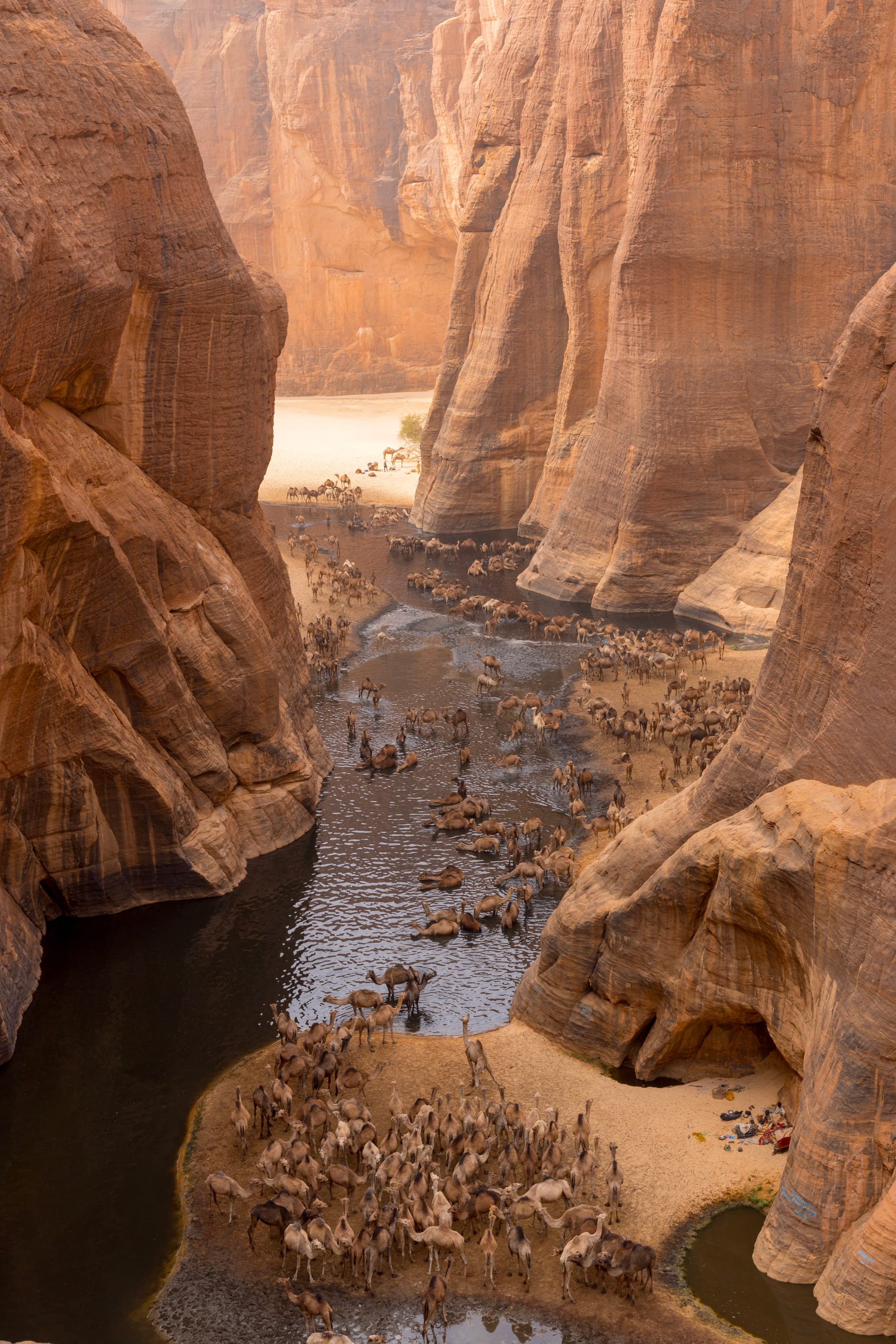
A narrow canyon of towering sandstone walls sheltering a dark green pool of water, with camels drinking at its edge

Chad

The Guelta d'Archei in the Ennedi Plateau, a permanent desert waterhole where camel herders, crocodiles, and sandstone cliffs meet. (Valerian Guillot / Wikimedia Commons · CC BY 2.0)

A vast, landlocked country reaching from the Central African rainforest edge to the deep Sahara — oil-exporting but very poor, chronically unstable, and host to some of the continent's largest refugee populations.

Explore Chad

History

The Lake Chad basin was the base of a series of Sahelian states that grew rich on trans-Saharan trade, above all the Kanem-Bornu empire, which lasted in some form for a thousand years, and later the sultanates of Baguirmi and Ouaddaï. These were Muslim, slave-raiding states whose raids reached deep into the non-Muslim south.

France conquered the region around 1900 and governed it as the least-developed part of French Equatorial Africa, investing little outside the cotton-growing south. Independence came in 1960. Almost immediately, resentment in the Muslim north at rule by southern elites fed a rebellion, and Chad spent much of the next thirty years in civil war, with repeated Libyan intervention in the north and a disputed border strip.

Hissène Habré's brutal 1980s rule — later punished in a landmark international trial — gave way in 1990 to Idriss Déby, who held power for three decades until he was killed fighting rebels in 2021. The army installed his son, Mahamat Déby, who consolidated control and won a contested election in 2024. Oil, pumped since 2003 through a pipeline to the Cameroonian coast, funds the state without lifting most Chadians out of poverty.

  • Chad: The Sahel Fault Line Ancient states around a shrinking lake, a French colony split between desert and savanna, and forty years of civil war along the line between north and south

Culture & Customs

Chad's central divide is between a Muslim, Arabic-speaking, herding north and centre and a Christian and traditional-religion, farming south, with the Sara the largest single group. Overlaid on this are dozens of peoples — Toubou of the Tibesti, Zaghawa, Kanembu, Ouaddaïans, Fulani, Hadjarai, and others — each with distinct languages and customs.

Cattle and camels are wealth and status among the pastoralists, and the year is organised around the search for pasture and water. In the south, farming villages keep older masking and initiation traditions. Hospitality to travellers is a strong obligation, and tea — poured in rounds — is the ritual of welcome across the north.

The Sahara peoples have left a remarkable record on the rocks of the Ennedi and Tibesti: thousands of paintings and engravings of cattle, hunters, and a once-green Sahara, spanning several thousand years.

Daily Life

Most Chadians live by farming millet, sorghum, and groundnuts in the south and centre, or by herding across the Sahel, both increasingly squeezed by drought, desertification, and the shrinking of Lake Chad. Cotton is the traditional cash crop of the south; livestock is the north's.

N'Djamena, on the Chari River facing Cameroon, is the one large city and the centre of government and commerce. Elsewhere, towns are small and services thin — Chad has some of the world's worst indicators for maternal health, schooling, and electricity access.

The country also carries an enormous humanitarian burden, hosting well over a million refugees from Sudan, the Central African Republic, and Nigeria, many in camps in the east and around Lake Chad, straining already scarce water and land.

Food

Chadian food is Sahelian and grain-based. The staple is a stiff millet or sorghum porridge — boule — eaten by hand with a sauce of okra, dried fish, meat, or daraba, a mix of vegetables and peanut. In the south, cassava and maize feature more; in the north, dates, milk, and grilled meat.

Rice dishes, maafé-style groundnut stews, and grilled river fish appear in N'Djamena. Bil-bil, a millet beer, is drunk in the non-Muslim south; strong sweet tea is universal in the Muslim areas.

Dates from the Saharan oases, and camel and goat milk among the herders, are staples of the desert diet.

  • Chad: Food and the National Dish A millet paste eaten with a deliberately sticky okra sauce, a country split between desert north and farmed south, and a cuisine still thinly documented outside its own borders

Attractions & Natural Wonders

Chad's great sight is the Ennedi Plateau in the northeast, a UNESCO World Heritage Site of sandstone arches, towers, and slot canyons rising from the desert. At its heart the Guelta d'Archei is a permanent pool in a deep gorge where Toubou herders water their camels alongside a relict population of desert crocodiles, beneath walls stained by centuries of guano and ancient rock art.

The Lakes of Ounianga, further north, are a second World Heritage Site: a cluster of lakes of different colours in the middle of the Sahara, some fresh, some salt, fed entirely by underground water. Beyond them rise the volcanic Tibesti Mountains, home to the Sahara's highest peak — spectacular but effectively closed to visitors.

In the southeast, Zakouma National Park is a conservation success story: brought back from near-collapse by intensive anti-poaching work, it again holds large elephant herds, big buffalo and antelope populations, lions, and, in the dry season, huge gatherings of birds around the last waterholes.

  • Chad: Seven Attractions and Natural Wonders A sandstone labyrinth of arches and towers in the deep Sahara, a canyon pool where desert crocodiles survive, blue lakes that should not exist, and a recovered wildlife park

Planning basics

Budget

Chad is one of the hardest and most expensive countries in Africa to travel, with almost no tourist infrastructure. Reaching the Ennedi or Zakouma means an organised expedition with 4x4s, fuel caches, permits, and often armed escort. N'Djamena has a few costly hotels. Cash only, in CFA francs and euros.

Source
Very limited data — verify against current advice.
Daily Budget Midrange
USD 300–600+ per day on an organised Ennedi or Zakouma expedition, before international flights
Daily Budget Shoestring
Not realistically applicable

Independent travel is impractical; use a specialist Sahara operator.

Source: Very limited data — verify against current advice.

Visa Requirements

A visa is required for all visitors, arranged in advance at a Chadian embassy, usually with a letter of invitation or a tour booking. A yellow fever vaccination certificate is mandatory, and travel permits are needed for the Ennedi, Tibesti, and border regions.

Typical Validity
30 to 90 days, single entry

Your operator arranges the internal permits; the Tibesti is generally off-limits.

Safety

Chad is unstable and much of it is dangerous. The Lake Chad region in the west faces attacks by Boko Haram and Islamic State factions; the borders with Libya, Sudan, and the Central African Republic see armed groups, banditry, and — since 2023 — a massive influx of refugees from Sudan's war; and N'Djamena has seen deadly political unrest. Most governments advise against all or all-but-essential travel to nearly the whole country.

Source
US Department of State, UK FCDO, and French diplomatic advisories — check for the latest wording.

Worldlore covers Chad so it can be understood. The Ennedi and Zakouma are visited by a small number of organised expeditions each dry season; anyone considering this must rely on an operator with current, on-the-ground security knowledge.

Source: US Department of State, UK FCDO, and French diplomatic advisories — check for the latest wording.

Climate

Three bands. The far south is tropical, with a rainy season from May to October. The Sahel across the middle is semi-arid with a shorter summer rains. The northern half is true Sahara — scorching by day, cold at night, almost rainless, and swept by dust storms.

Sahara
winter days pleasant, nights cold; summer daytime heat is extreme
Ndjamena
very hot; the rains, such as they are, fall June to September

Transportation

N'Djamena's international airport has limited connections. There is no railway and few paved roads outside the capital. Travel to the east and north is by 4x4 convoy across trackless desert, arranged by a tour operator. Domestic flights are minimal.

Distances are enormous and journeys are measured in days; everything hinges on vehicles, fuel, and permits.

Best Time to Visit

November to February is the only sensible window: the Sahara and Ennedi are cool enough to travel, and Zakouma's wildlife concentrates around shrinking water. The park closes for the rains, roughly June to October, when much of the country is hard to move around.

Currency

The currency is the Central African CFA franc (XAF), shared by six countries and pegged to the euro at a fixed rate.

Symbol
FCFA
Cash To Bring
Euros in cash
Currency Code
XAF — Central African CFA franc

Language

French and Arabic are both official. Chadian Arabic is the main lingua franca across the north and centre and in trade; French is used in government and schooling, more so in the south. More than 120 local languages are spoken, Sara languages prominent among them in the south.

English
Very rarely spoken
Lingua Franca
Chadian Arabic
Official Languages
French, Arabic